
Entering the world of cryptocurrency can feel like stepping into a foreign country where the language and customs are entirely different. For new investors, the primary barrier is often not the complexity of blockchain technology itself but the interface used to access it.
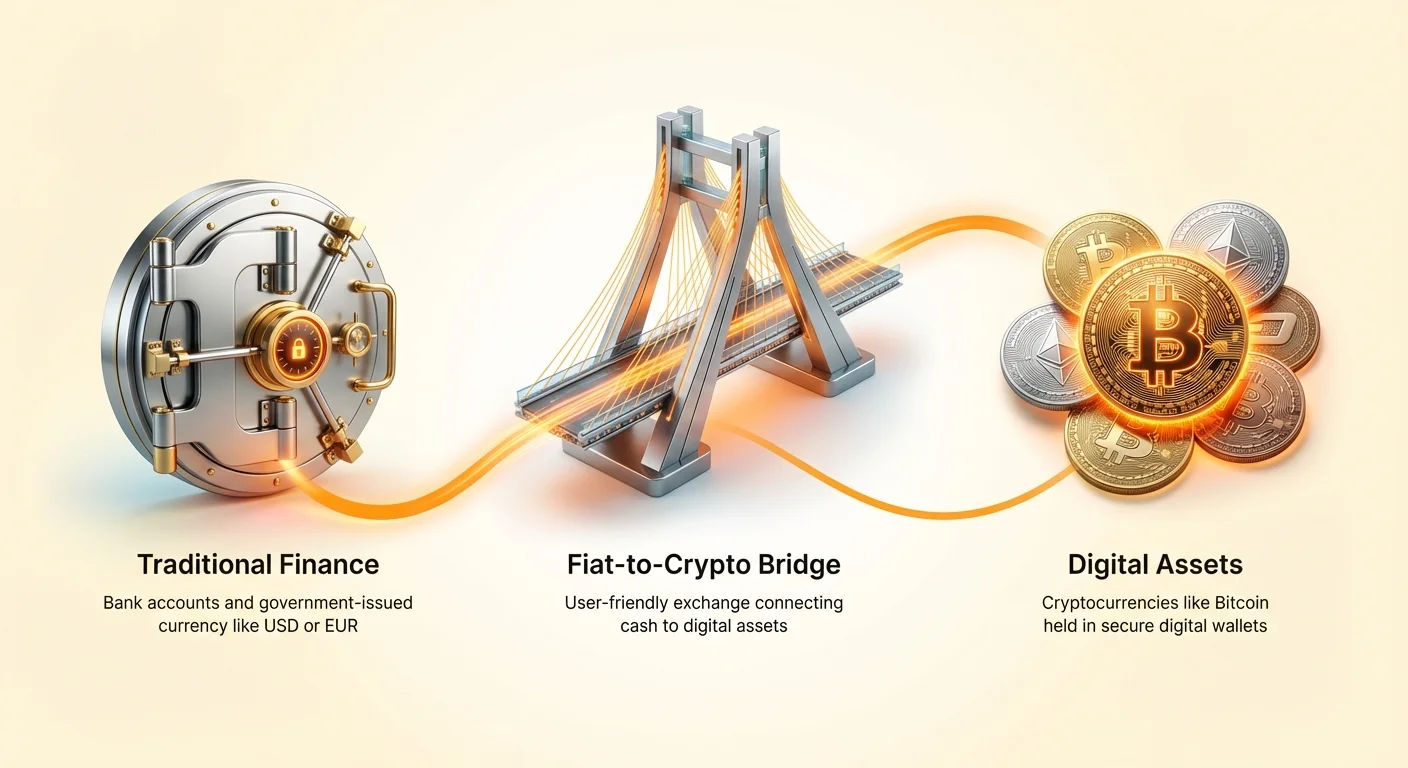
The bridge between traditional finance and digital assets is the cryptocurrency exchange. For a beginner, the ideal platform combines rigorous security with an intuitive user interface. It must also provide seamless methods to convert government-issued currency into digital coins.
This conversion process is known as a fiat onramp. It serves as the entry point where US dollars, Euros, or Pounds are exchanged for Bitcoin, Ethereum, or other assets. Without a simple fiat onramp, the crypto ecosystem remains largely inaccessible to the average person.
Choosing the right platform requires understanding how these exchanges operate. It involves looking at fee structures, security protocols, and usability. The goal is to find a service that removes technical friction. This allows investors to focus on their financial goals rather than troubleshooting software.
Understanding Centralized Exchanges
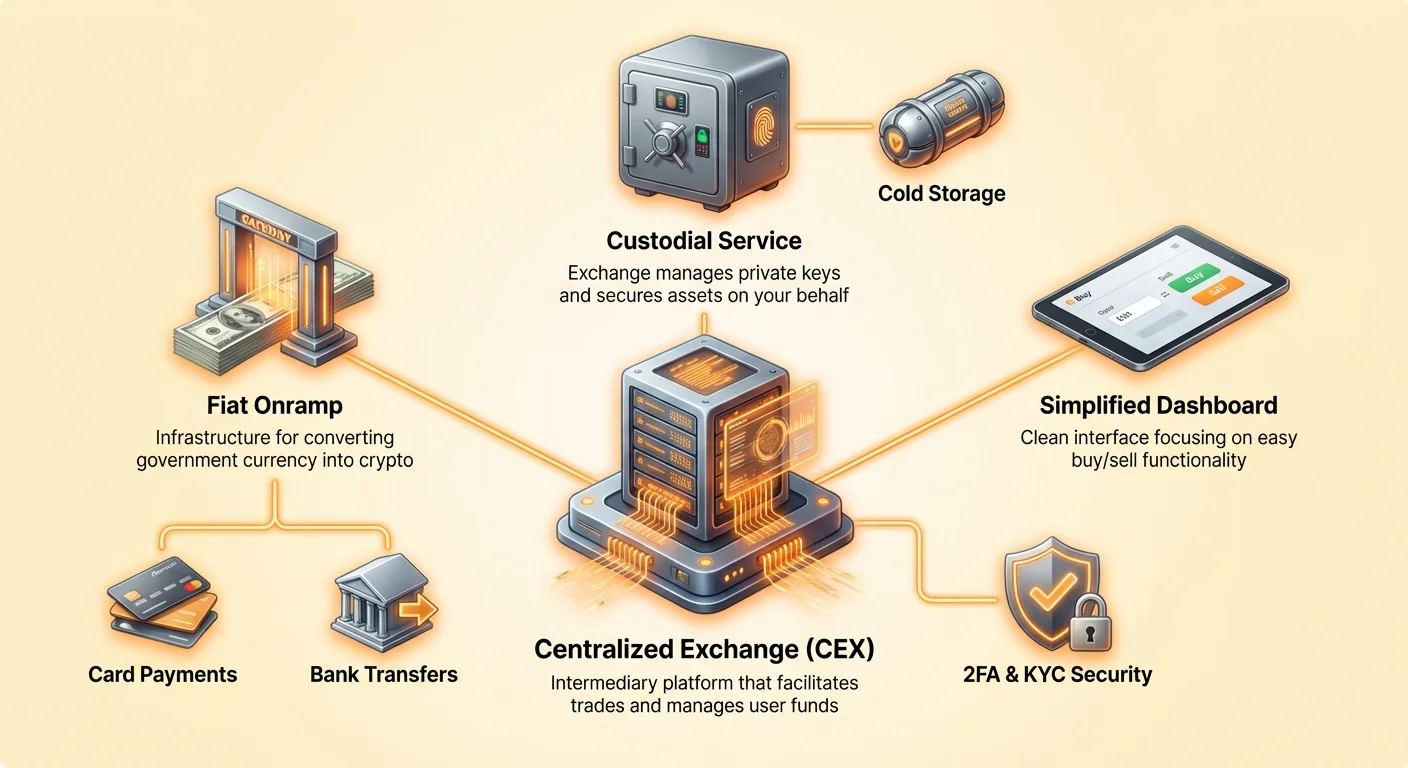
Centralized exchanges, often abbreviated as CEXs, act as intermediaries in the financial world. They function similarly to traditional stock brokerages. A third-party company operates the platform to facilitate trades between buyers and sellers.
These platforms are generally the most user-friendly option for newcomers. They offer high liquidity, meaning it is easy to buy or sell assets quickly without significant price changes. They also typically provide customer support teams to assist with account issues.
The Role of Custodianship
One defining feature of a centralized exchange is custodianship. When you deposit funds or purchase crypto on a CEX, the exchange holds those assets on your behalf. You do not essentially hold the private keys to the wallet.
This arrangement simplifies the process for beginners. You do not need to worry about managing complex cryptographic keys or recovery phrases immediately. If you forget your password, the exchange can help you recover your account.
However, this convenience requires trust. Users must trust that the exchange manages funds responsibly and employs strong security measures. This is why selecting a reputable platform is critical for new investors.
Brokerage Services vs. Trading Platforms
Within the centralized category, there is a distinction between pure brokerages and trading platforms. A brokerage acts as a direct counterparty. When you buy Bitcoin from a brokerage, you are buying it directly from the company at a set price.
Trading platforms match you with other users. If you want to sell, the platform finds a user who wants to buy. Brokerages are often easier for absolute beginners because the interface is simpler. There are no complex charts or order books to navigate.
Trading platforms offer more control and often lower fees. They allow you to set specific prices at which you want to buy or sell. Many modern exchanges offer both a simple brokerage interface and an advanced trading view to cater to all skill levels.
The Importance of Fiat Onramps
A fiat onramp is the infrastructure that allows you to move money from a bank account into the crypto market. For a new investor, the quality and variety of these onramps are deciding factors in choosing an exchange.
If an exchange has limited funding options, it creates friction. A user might have to sign up for third-party payment services or wire money internationally. The easiest exchanges integrate these payment methods directly into their dashboard.
Direct Bank Transfers and Wires
Connecting a bank account is the most common way to fund a crypto account. This method usually offers the lowest fees. In the United States, this is often done via ACH transfer. In Europe, SEPA transfers are the standard.
Bank transfers are reliable but can sometimes be slow. An ACH transfer might take several days to clear, meaning you cannot withdraw your crypto immediately. Wire transfers are faster but often incur higher fees from your bank.
Top-tier exchanges facilitate instant bank linking. They use secure APIs to verify account ownership instantly. This allows users to start trading within minutes of signing up, rather than waiting days for micro-deposits to verify.
Credit and Debit Card Integration
For speed and convenience, many beginners prefer using debit or credit cards. This mirrors the experience of online shopping. You simply enter your card details and purchase the amount of crypto you want.
The transaction is usually instant. The assets appear in your exchange wallet immediately. However, this convenience often comes at a cost. Credit card processing fees are generally higher than bank transfer fees.
Exchanges pass these costs on to the user. You might pay an additional percentage on top of the trading fee. Additionally, some credit card issuers treat crypto purchases as cash advances. This can trigger high interest rates and additional bank fees.
Payment Processors like PayPal
Integration with familiar payment processors can significantly lower the barrier to entry. Platforms like PayPal offer a layer of familiarity and security that comforts new investors.
Using a digital wallet allows for quick transfers without directly exposing bank details to the exchange. This is particularly appealing for those cautious about digital security. The speed is comparable to card purchases.
However, not all exchanges support these third-party processors. Those that do may have specific limits on how much you can deposit or withdraw. It is important to check if the exchange supports two-way transactions, allowing you to withdraw back to the same processor.
Navigating User Interfaces
The user interface, or UI, dictates how you interact with the exchange. For a professional trader, a screen filled with candlestick charts, depth charts, and scrolling order books provides necessary data. For a beginner, this is often overwhelming.
The easiest exchanges prioritize a clean, minimalist dashboard. The primary focus is usually on your portfolio balance and a simple "Buy/Sell" button. Complex data is hidden behind advanced tabs or separate "Pro" modes.
Clear navigation is essential. Users should be able to find their deposit address, transaction history, and security settings without digging through menus. The language used should be plain. Avoiding jargon like "limit orders" or "stop-loss" in the primary view helps prevent confusion.
Mobile accessibility is equally important. Many new investors rely entirely on their smartphones. A well-designed mobile app should offer the full functionality of the desktop site. It should allow for secure trading, funding, and account management on the go.
Security Essentials for Beginners
Security is the foundation of any reputable crypto platform. Because cryptocurrency transactions are generally irreversible, protecting assets is paramount. Beginners should prioritize exchanges that enforce strict security protocols by default.
Two-Factor Authentication (2FA)
Two-factor authentication adds a second layer of defense beyond a password. Even if a hacker steals your login credentials, they cannot access the account without the second factor.
The most common forms are SMS codes and authenticator apps. SMS codes are convenient but susceptible to SIM-swapping attacks. Authenticator apps, which generate time-sensitive codes on your device, offer superior security.
The best exchanges require 2FA for all critical actions. This includes logging in, generating API keys, and initiating withdrawals. Some platforms also support hardware security keys, which provide the highest level of protection.
Cold Storage Protocols
How an exchange stores its assets determines its resilience against hacking. Hot wallets are connected to the internet and are used for daily processing of withdrawals. Cold wallets are offline storage devices, completely disconnected from the internet.
Top exchanges keep the vast majority of user funds in cold storage. This ensures that even if the exchange's online systems are breached, the bulk of the assets remain untouched.
Users should look for exchanges that are transparent about their storage methods. Some platforms carry insurance policies to cover digital assets held in online hot wallets. This provides a safety net for users in the event of a security breach.
Regulatory Compliance and KYC
Legitimate exchanges comply with local regulations. This includes Know Your Customer (KYC) and Anti-Money Laundering (AML) laws. While some privacy advocates dislike these measures, they are a sign of a safe platform for beginners.
Compliance ensures the exchange is operating legally within your jurisdiction. It often means the platform has relationships with traditional banks, ensuring smoother fiat onramps.
KYC processes involve verifying your identity. You will typically need to upload a government-issued ID and sometimes a selfie. This prevents identity theft and fraud on the platform.
Fee Structures Explained
Fees can significantly impact investment returns over time. Understanding the different types of costs associated with trading is essential for choosing a cost-effective exchange.
Maker and Taker Fees
Trading fees are often split into "maker" and "taker" categories. A "taker" is someone who accepts a price currently listed on the order book. They take liquidity from the market. A "maker" places an order at a specific price that is not yet available. They provide liquidity.
Exchanges usually charge takers slightly higher fees. For beginners using simple "Buy Now" options, you are almost always acting as a taker. You pay the market price for immediate execution.
Deposit and Withdrawal Costs
Moving money in and out of an exchange can incur separate fees. As mentioned, credit card deposits often carry a surcharge. Bank transfers are usually cheaper but may have flat fees depending on the banking network.
Withdrawal fees are critical to check. Some exchanges charge high fees to move crypto off the platform to a private wallet. These fees often cover the network costs of the blockchain, but some platforms add a markup.
The Hidden Cost of Spreads
Brokerage services often advertise "zero fee" trading. In reality, they make money through the spread. The spread is the difference between the buying price and the selling price quoted by the platform.
If the market price of Bitcoin is $50,000, a broker might charge you $50,250 to buy it. If you wanted to sell it immediately, they might only offer $49,750. That difference is the spread.
For beginners, this pricing model is simple because the price you see is the price you pay. However, it can be more expensive than paying a transparent percentage fee on a trading platform.
Verification Processes (KYC)
To use a centralized exchange with fiat onramps, you must complete identity verification. This process is mandated by financial regulators to prevent money laundering and illicit activities.
The process typically begins after email verification. You will be asked to provide personal details such as your full name, address, and date of birth. The next step involves document upload.
Most platforms use automated systems to verify documents. You will take a photo of your driver's license, passport, or national ID card. Many apps also require a "liveness check" where you scan your face using your phone's camera.
This might seem invasive to new users, but it protects your account. It ensures that no one else can open an account in your name. It also facilitates account recovery if you lose your credentials, as you can prove your identity with documents.
Coinbase: The Industry Standard for Simplicity
Coinbase is frequently cited as the benchmark for beginner-friendly exchanges. Since its launch in 2012, it has focused on making crypto as easy to use as a standard banking app.
Interface and Usability
The dashboard is clean and intuitive. It avoids cluttering the screen with trading charts. Instead, it focuses on asset performance and portfolio value. Buying an asset is as simple as clicking "Buy," selecting the asset, and entering the dollar amount.
This design philosophy extends to the mobile app. It is highly rated for its stability and ease of navigation. Users can track prices, read news, and execute trades with minimal taps.
Educational Incentives
A unique feature is the "Learn and Earn" program. This offers a practical way for beginners to understand different cryptocurrencies. Users watch short educational videos or read simple explainers about a specific token.
Upon completing a short quiz, the user is rewarded with a small amount of that cryptocurrency. This incentivizes education and allows new investors to diversify their portfolio without risking their own capital.
Security Measures
Coinbase employs extensive security protocols. They claim to hold 98% of customer funds in offline cold storage. The remaining 2% held online is insured against cybersecurity breaches.
The platform also encourages strong user security. It supports hardware keys and authenticator apps for 2FA. For US customers, USD cash balances are FDIC insured up to $250,000, similar to a traditional bank account.
Kraken: Security and Fiat Support
Kraken is one of the longest-running exchanges in the industry. It has built a reputation for uncompromised security and robust banking relationships. While it offers advanced tools, its "Instant Buy" feature makes it accessible to beginners.
Banking Relations and Funding
Kraken supports a wide array of fiat currencies including USD, EUR, CAD, GBP, and JPY. This global reach makes it an excellent option for international investors. Their relationships with banking partners often result in faster processing times for wire transfers.
The platform offers distinct interfaces for different needs. The standard interface is simple and direct. For users who want to advance, Kraken Pro offers detailed market data and lower fees.
Security Track Record
Security is Kraken's defining characteristic. They maintain a comprehensive security team that tests their own systems for vulnerabilities. Their servers are kept in secure cages under 24/7 surveillance.
Kraken provides users with granular control over their account security. You can set up different 2FA methods for login, trading, and funding. A "Global Settings Lock" allows users to block any changes to account settings for a set period, preventing hackers from adding new withdrawal addresses.
Tiered Verification
Kraken uses a tiered verification system. The "Starter" level requires minimal information but has low limits. The "Intermediate" and "Pro" levels require more documentation but unlock higher limits and fiat funding options. This allows users to provide only the information necessary for their specific trading needs.
Uphold: Multi-Asset Trading
Uphold takes a unique approach by blurring the lines between different asset classes. It allows users to trade between cryptocurrencies, precious metals, and fiat currencies within a single interface.
Anything-to-Anything Trading
The platform's standout feature is its "Anything-to-Anything" trading capability. On most exchanges, if you want to swap Bitcoin for Gold, you would have to sell Bitcoin to USD, then use USD to buy Gold.
Uphold removes the intermediate step. You can trade Bitcoin directly for Gold, or Ethereum directly for Euro. This simplifies the trading process and reduces the number of taxable events and transaction fees.
Transparency and Reserves
Uphold emphasizes transparency regarding its reserves. They publish a real-time public dashboard showing their total assets and liabilities. This allows users to verify that the platform is fully reserved and not lending out customer funds.
This "Proof of Reserves" is updated every 30 seconds. For beginners worried about exchange solvency, this provides a high level of reassurance.
Ease of Access
The user interface is designed around "cards." specific assets are represented as cards on your dashboard. You can easily swipe between them to view balances or initiate trades. This visual approach is intuitive for mobile users.
Uphold also offers curated "baskets" of cryptocurrencies. These allow investors to buy a collection of assets in a specific sector, such as gaming or finance, with a single click. This simplifies diversification for new investors.
Bitget: Social Trading for Beginners
Bitget has gained popularity by integrating social elements into the trading experience. For beginners who are unsure about market moves, social trading provides a way to lean on the expertise of others.
Copy Trading Mechanics
Copy trading allows users to automatically replicate the trades of experienced investors. You can browse a list of "elite traders," viewing their historical performance, win rate, and risk level.
Once you follow a trader, their buy and sell orders are automatically executed in your account. This is a passive way to participate in the market. It allows beginners to observe strategies in real-time without constantly monitoring charts.
User Experience
The platform is designed to handle high volumes of data while remaining responsive. The interface separates the copy trading section from the standard exchange, preventing confusion.
Bitget also supports a wide range of cryptocurrencies. This ensures that users can access both major coins and smaller altcoins. The platform provides clear metrics on the performance of copy traders, helping users make informed decisions about whom to follow.
Fiat Integration
Bitget supports various fiat onramps. Users can purchase crypto using credit cards, debit cards, and third-party payment providers. They also have a Peer-to-Peer (P2P) marketplace where users can buy crypto directly from other users using local payment methods.
Alternative Payment Methods
While bank transfers are standard, the crypto ecosystem has evolved to support various payment methods that prioritize convenience. Understanding these options helps beginners choose the path of least resistance.
Using PayPal for Deposits
PayPal integration is a highly sought-after feature. It allows users to fund their accounts using their existing PayPal balance or linked cards. The transaction is processed instantly.
This method adds a layer of privacy. The exchange only sees the PayPal transaction, not the funding source behind it. However, fees for PayPal deposits can be higher than bank transfers due to the processing costs charged by PayPal.
Digital Wallets and Apple Pay
Many mobile-first exchanges support Apple Pay and Google Pay. This creates a frictionless experience on mobile devices. Users can authorize purchases using FaceID or TouchID.
These methods are processed as card transactions. Therefore, they are subject to the same potential fees and limits as standard credit or debit card purchases. They are best used for smaller, quick purchases rather than large investments.
Comparing CEX and DEX for Newcomers
While this guide focuses on centralized exchanges (CEX), it is important to understand the alternative: Decentralized Exchanges (DEX). A DEX operates without a central company. It runs on code (smart contracts) that executes trades automatically.
Ease of Use Comparison
For a beginner, a CEX is significantly easier. It provides a username/password login, account recovery, and customer support. A DEX requires you to manage your own digital wallet (like MetaMask).
If you lose access to your wallet on a DEX, your funds are gone forever. There is no support team to help. The interface of a DEX can also be technical, requiring knowledge of gas fees and slippage settings.
Custody Differences
On a CEX, the exchange holds your funds. On a DEX, you hold your funds in your private wallet until the moment the trade executes. This offers better security against exchange hacks but places full responsibility on the user.
Fiat Accessibility
DEXs generally do not accept fiat currency. You cannot connect a bank account to a DEX. You must first buy crypto on a CEX and transfer it to your wallet to use a DEX. This makes CEXs the necessary first step for almost all new investors.
The Role of Mobile Apps
The modern investor is rarely tethered to a desktop computer. The quality of a mobile app is a major factor in the "easiness" of an exchange.
Top apps condense the desktop experience without sacrificing functionality. They use biometric login (fingerprint or face scan) for quick access. They also employ push notifications to alert users of price movements or filled orders.
Some apps offer a "Lite" mode specifically for beginners. This interface strips away complex trading tools. It presents a simplified view with just the buy/sell buttons and a portfolio overview. Users can toggle to "Pro" mode as they gain experience.
Risk Management for New Investors
Even on the safest exchange, investing in cryptocurrency carries risk. Understanding how to manage this risk is as important as choosing the right platform.
Volatility Awareness
Crypto markets are highly volatile. Prices can swing double-digit percentages in a single day. Beginners should be prepared for this. Easy exchanges often provide price alerts to help users stay informed without obsessively checking the app.
Phishing Protection
Phishing is a common threat. Scammers create fake websites or emails that look like the official exchange to steal login credentials. Safe exchanges use anti-phishing codes. This is a code you set up that appears in every official email from the exchange, verifying its authenticity.
Withdrawal Best Practices
While exchanges are convenient for trading, they are not always the best place for long-term storage. Security experts recommend moving significant holdings to a personal hardware wallet.
A hardware wallet is a physical device that stores your private keys offline. This protects your funds even if the exchange itself is compromised. Easy exchanges make the withdrawal process straightforward, usually requiring just a destination address and 2FA confirmation.
Understanding Liquidity
Liquidity refers to how easily an asset can be bought or sold without affecting its price. High liquidity is crucial for a smooth trading experience.
If an exchange has low liquidity, you might try to sell Bitcoin but find no buyers at the current price. You might have to sell for a lower price to get out of the position. This is known as slippage.
The major exchanges discussed here handle billions of dollars in volume daily. This ensures that for the average retail investor, trades execute instantly at the expected price. Beginners should avoid obscure, low-volume exchanges where liquidity risks are higher.
Customer Support Importance
When money is on the line, the ability to get help is vital. Support quality varies significantly across the industry. The best platforms offer 24/7 live chat with human agents.
Live Chat vs. Email
Live chat is preferred for immediate issues like login problems or stuck deposits. Email support is better for complex issues requiring document submission.
Some exchanges rely heavily on automated bots. While these can answer basic FAQs, they can be frustrating for specific account issues. Testing the support responsiveness before depositing large funds is a good strategy for new users.
Self-Help Resources
A comprehensive help center is a sign of a user-focused exchange. It should contain step-by-step guides for common tasks like verification and withdrawals. Video tutorials and searchable knowledge bases empower users to solve problems independently.
Conclusion
Entering the cryptocurrency market does not have to be a technical ordeal. The evolution of exchanges has prioritized user experience, making digital assets accessible to everyone. Platforms like Coinbase, Kraken, and Uphold have streamlined the process, turning complex blockchain interactions into simple button clicks.
When selecting your first exchange, prioritize simplicity and security over low fees or advanced features. Look for robust fiat onramps that allow you to use your preferred payment method. Ensure the platform has a strong track record of security and regulatory compliance.
Remember that the goal of your first exchange is to provide a safe learning environment. As your skills develop, you can explore more complex platforms. For now, choosing an exchange that offers a seamless, secure, and supportive experience is the best investment you can make in your crypto journey.
The best exchange is the one that balances ease of use with uncompromising security standards.