
When you enter the world of cryptocurrency, you immediately become your own bank. This profound freedom comes with an equally profound responsibility: securing your digital assets. Unlike traditional bank accounts, there is no central institution to call if you forget a password or if your funds are stolen. Your security rests entirely on how you manage your private keys.
This management process is known as storage, but it is far more complex than simply saving a file on a computer. Crypto storage involves a crucial trade-off: convenience versus control. The easier it is to access your funds quickly (for trading or spending), the higher the risk of online theft. Conversely, the harder it is to access your funds, the safer they are from digital attacks.
To help manage this trade-off, the crypto community has developed a taxonomy for asset security: hot, cold, and the emerging hybrid solution, warm storage. Understanding the operational security (OpSec) requirements for each category is the most essential skill a crypto user can master, determining whether your assets are ready for daily use or secured for long-term wealth preservation.
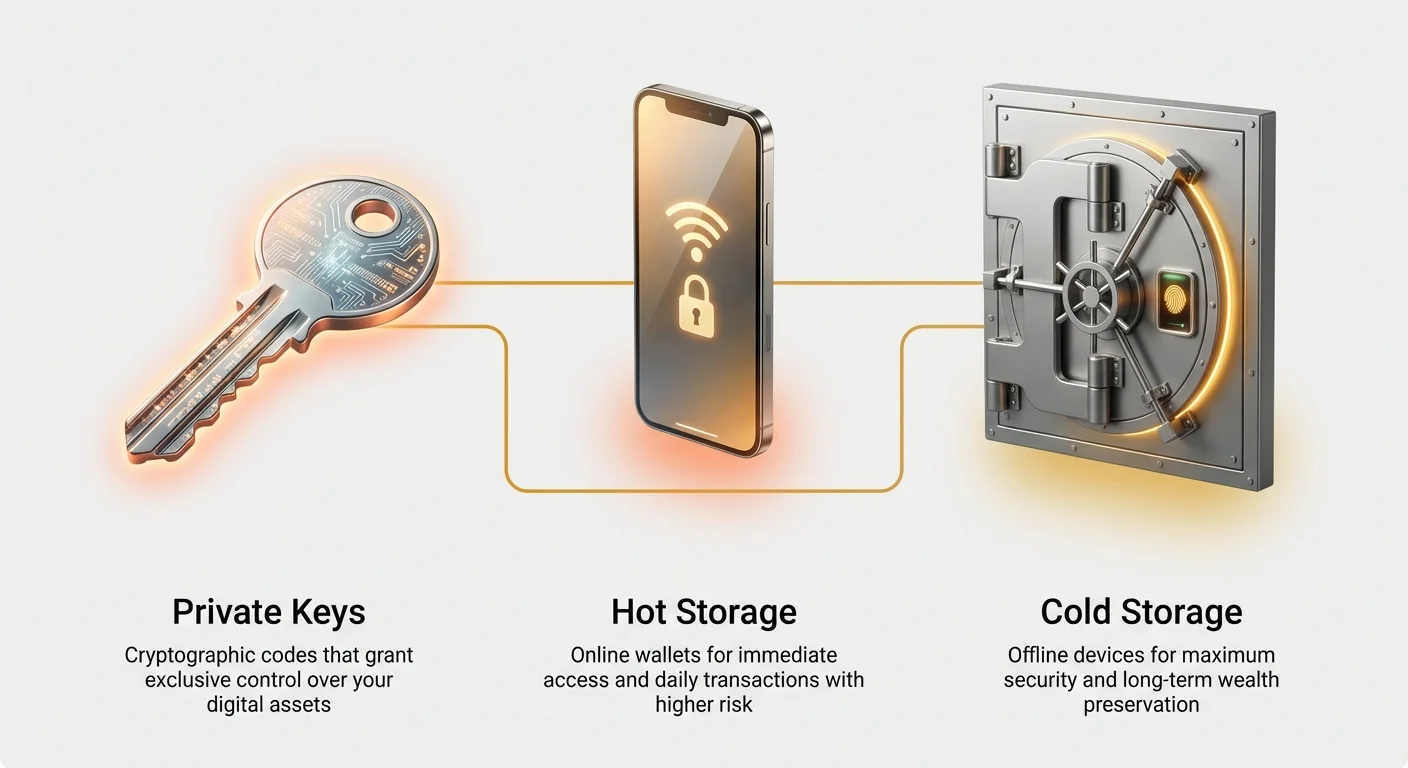
The Foundation: Private Keys and the Custody Challenge
Before diving into storage types, we must clarify what we are protecting. You do not store Bitcoin or Ethereum itself; you store the private keys that prove ownership of those assets on the respective public ledger. Losing the key means losing access to your funds forever.
In most modern wallets, these private keys are represented by a 12-to-24-word recovery phrase, often called the seed phrase (based on the BIP39 standard). The physical or digital location of this seed phrase dictates whether your storage method is categorized as hot, cold, or warm.
Understanding Operational Security (OpSec)
Operational security is the process of protecting sensitive information not just through technology, but through behaviors and procedures. For crypto, OpSec means recognizing that the weakest link in any security chain is typically the human element or the interaction point.
For example, having a state-of-the-art security device is useless if you take a photo of your seed phrase and store it in your phone’s photo library (a common OpSec failure). Every storage method detailed below requires different levels of OpSec maturity to be effective.
The Custody Continuum
Storage models exist on a continuum defined by the degree of control the user retains:
| Category | Control Level | Access Speed | Primary Risk | Typical Use Case |
|---|---|---|---|---|
| Hot | Moderate/Shared | Instant | Online Hacking (Malware, Phishing) | Spending, Trading, DeFi |
| Warm | High/Delegated | Slow (requires multiple steps) | Operational Failure, Insider Theft (if relying on a custodian) | Family Trusts, Institutional Use, Large Retail Holdings |
| Cold | Absolute (Self-Sovereign) | Very Slow (requires physical retrieval) | Physical Loss/Damage, User Error (Seed loss) | Long-term HODLing, Retirement Funds |
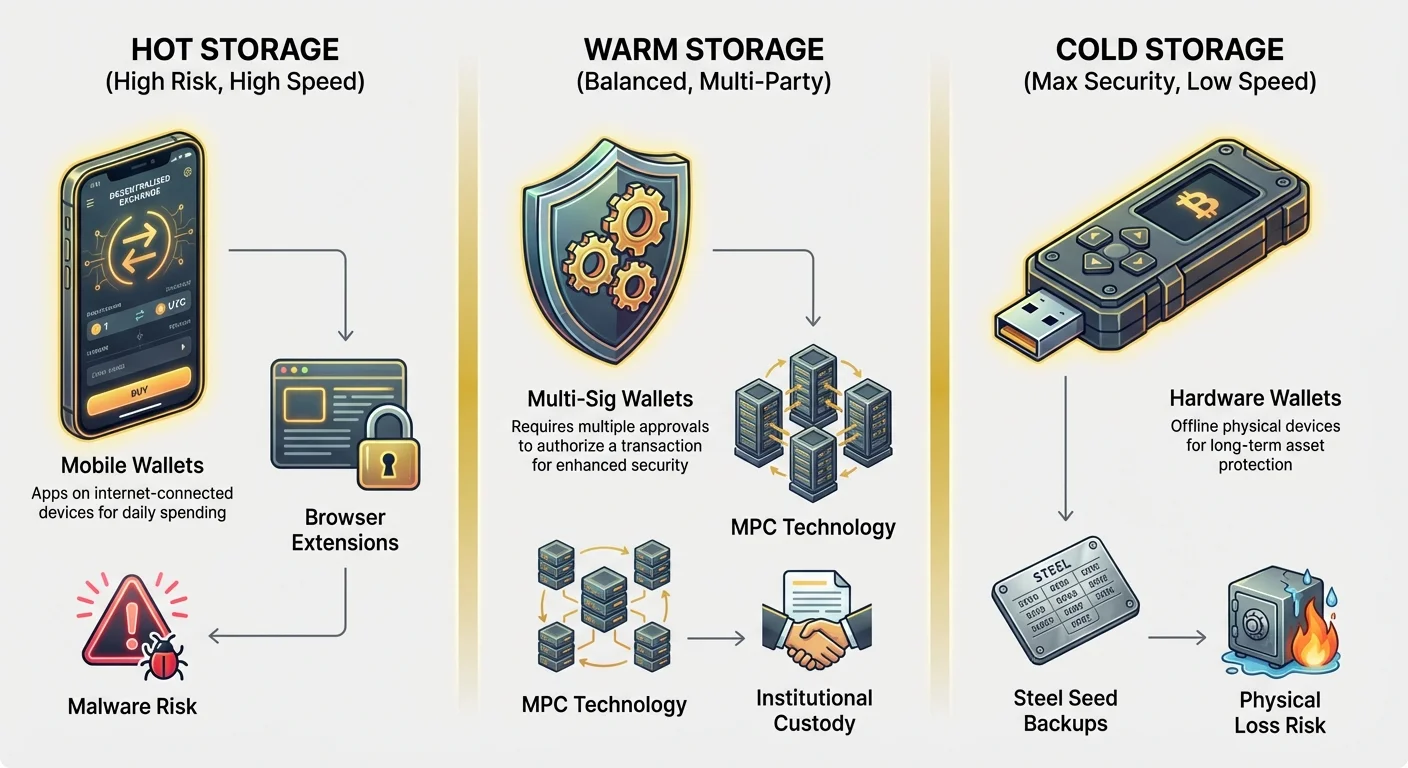
Hot Storage: Speed, Access, and Online Risk
Hot storage refers to any wallet where the private keys are created, encrypted, and stored on a device that is constantly connected to the internet. Because these keys are regularly online, transactions can be signed instantly, offering unparalleled speed and convenience.
Characteristics and Use Cases
Hot wallets are ideal for day-to-day spending, small transactions, and interacting with decentralized applications (DApps), where continuous connectivity is required.
Types of Hot Wallets:
- Exchange/Custodial Wallets: The exchange (like Coinbase or Binance) holds your private keys on your behalf. This is the simplest option but grants you the least control. While convenient, if the exchange is hacked or freezes your account, you lose access.
- Mobile Wallets (e.g., MetaMask, Trust Wallet): These are software applications on your smartphone. They are non-custodial (you hold the keys) but are always "hot" because your phone is always online. They are excellent for small balances and interacting with DApps.
- Browser Extensions/Desktop Wallets: Software installed on a desktop computer or browser. These are convenient for immediate transactions but carry the highest risk of being targeted by desktop malware.
Primary Online Attack Vectors
The convenience of hot storage comes with high exposure to malicious attacks that exploit internet connectivity.
1. Malware and Keyloggers
If your computer or phone is infected with malware, malicious software can silently monitor your activity. A keylogger can record your typing when you enter your password or even intercept the unencrypted seed phrase during wallet setup or migration.
2. Phishing and Spoofing
Phishing involves tricking users into revealing their seed phrase or private key, often through fake websites, deceptive emails, or malicious social media DMs impersonating a legitimate service. For example, a fake DApp might prompt a user to "Verify" their wallet by entering their seed phrase, leading to instant theft.
3. Exchange or Centralized Service Hacks
If you leave a significant balance on a centralized exchange (a custodial hot wallet), you are trusting that entity’s security team. Major exchange hacks have resulted in the theft of billions of dollars. While highly regulated exchanges have insurance, relying on their security architecture introduces a massive, centralized point of failure.
Actionable Tip: Limit the funds in your hot wallets to only what you need for immediate spending or trading, analogous to keeping cash in your physical wallet rather than your life savings.
Cold Storage: Maximum Security (The Offline Solution)
Cold storage is the method of securing private keys in an environment that is permanently disconnected, or "air-gapped," from the internet. The entire transaction signing process occurs offline, ensuring digital thieves cannot access the keys remotely.
Cold storage is the gold standard for securing large balances or assets intended for long-term holding (HODLing).
The Concept of Air-Gapped Security
The term "air-gapped" literally means there is a physical gap (air) between the storage device and the internet network.
In a cold storage environment, a transaction is initiated on an online, "watching" device (like a computer), which creates an unsigned transaction file. This file is then moved manually (usually via USB or QR code) to the offline cold storage device. The cold device uses the stored private key to cryptographically sign the transaction and then sends the signed file back to the online device for broadcast to the network.
Crucially, the private key never touches a device that has ever connected to the internet, eliminating virtually all online attack vectors.
Modern Cold Storage: Hardware Wallets (Digital Security)
The most effective and recommended form of cold storage is the Hardware Wallet (e.g., Ledger, Trezor, Coldcard).
A hardware wallet is a dedicated, specialized computer chip designed to perform only one function: securely generate and store private keys, and sign transactions.
Key Features of Hardware Wallets:
- Secure Element: The private keys are stored within a tamper-proof chip that physically isolates them from the general operating system, making it nearly impossible for malware to extract the key, even if the device itself is plugged into an infected computer.
- Physical Confirmation: Every outgoing transaction requires physical confirmation (e.g., pressing buttons) on the device itself. This prevents remote attackers from initiating unauthorized transfers, even if they somehow compromise the online communication link.
- Firmware Integrity: Modern hardware wallets employ sophisticated mechanisms to ensure that the user is running genuine, verified firmware, protecting against supply chain attacks.
Retiring Legacy Cold Storage: Why Paper Wallets Are Dangerous
Historically, "paper wallets" were the first form of cold storage. This involved printing or writing down a private key or seed phrase on paper and storing it physically. While technically air-gapped, this method is highly discouraged today due to massive operational risks.
Operational Risks of Paper Wallets:
- High Retrieval Risk: To spend funds from a paper wallet, the private key must be imported or "swept" into an online software wallet. This single act turns the cold key hot, exposing it entirely to the online environment and malware during the import process.
- Physical Degradation: Paper is vulnerable to ink fading, fire, water, and simple physical wear and tear.
- Scanning and Photographic Risk: If a user scans or photographs the paper wallet for backup, they immediately compromise the air gap and create a digital copy on an insecure device.
- Mislabeling and Loss: Unlike hardware wallets that verify the key upon setup, a paper wallet offers no verification that the key was written down correctly until the user attempts to retrieve the funds, potentially years later.
Conclusion on Paper: Hardware wallets have rendered paper wallets obsolete and unsafe. The minimal cost savings of a paper wallet are vastly outweighed by the near-certainty of OpSec failure during the retrieval process. Modern cold storage should always be a dedicated, specialized hardware device.
Operational Risks of Cold Storage
While cold storage eliminates online threats, it introduces significant physical and setup risks. The greatest security device in the world is useless if the associated OpSec is poor.
Physical and Environmental Risks
The primary failure mode for cold storage is the physical loss or destruction of the stored asset (the hardware wallet or the backup seed phrase).
Disaster and Loss: Hardware wallets, metal plates, and recovery phrases stored in a single location (e.g., a home safe) are vulnerable to fire, flood, or theft. If both the primary device and the backup seed phrase are destroyed, the funds are permanently lost.
- Mitigation: Use geographically separated storage locations for the hardware wallet and the seed phrase backup.
The Single Point of Failure (The Seed Phrase): The seed phrase is the master key. If it is stored insecurely (e.g., digitally, in the cloud, or unprotected in a physical location), the cold nature of the hardware wallet becomes irrelevant.
- Mitigation: Utilize metal stamping or etching solutions for seed phrase storage to protect against physical elements, and never digitize the phrase. Consider advanced methods like Shamir Secret Sharing for extremely large holdings.
Software and Supply Chain Risks
Even an air-gapped device is vulnerable if it was compromised before it reached the user or if the user makes a mistake during setup.
Supply Chain Attacks: A compromised supply chain involves an attacker intercepting a hardware wallet during shipping and tampering with it (e.g., installing malicious firmware or pre-loading a seed phrase).
- Mitigation: Always purchase hardware wallets directly from the official manufacturer. Thoroughly inspect the packaging for signs of tampering, and crucially, never use a pre-generated seed phrase provided by the device (the user must generate the phrase themselves upon initial setup).
Initializing on a Compromised Device: If a hardware wallet is connected to a computer riddled with malware when it is first initialized, the computer malware may be able to capture the newly generated key, even if the hardware wallet is designed to resist key extraction later.
- Mitigation: Initialize the hardware wallet on a clean, ideally brand-new or freshly wiped computer. Some dedicated devices (like Coldcard) allow initialization entirely offline, without a computer connection, for maximum air-gapped security.
Warm Storage: The Hybrid Approach
Warm storage represents a middle ground on the custody continuum, offering a blend of security similar to cold storage but with operational flexibility that exceeds typical hot wallets. Warm solutions are often characterized by methods that require multiple keys or multiple parties to authorize a transaction.
These solutions are perfect for organizations, high-net-worth individuals, or anyone managing large funds who still need occasional access without the extreme inconvenience of retrieving a deeply cold hardware wallet.
Multi-Signature (MultiSig) Wallets
A MultiSig wallet requires "M" out of "N" designated private keys (signatures) to authorize a transaction. For example, a 2-of-3 MultiSig wallet requires two of the three keyholders to approve the movement of funds.
Operational Benefits of MultiSig:
- Enhanced Security: A thief cannot steal the funds by compromising a single device or party. They would need to compromise two or more geographically disparate devices.
- Redundancy and Key Loss Protection: If one key is lost or destroyed, the remaining keys can still access and recover the funds (assuming M keys remain).
- Organizational Control: MultiSig is essential for businesses, trusts, or joint family holdings, ensuring no single employee or family member can unilaterally move assets.
A common retail MultiSig setup involves distributing the three keys among a hot wallet (for viewing/initiating), a hardware wallet (for one signature), and a third dedicated hardware device stored in a secure location (for the second signature).
Institutional and Advanced Warm Solutions
Beyond standard MultiSig, advanced custody solutions utilize mathematical techniques to enhance security and operational workflow, creating specialized forms of "warm" custody:
1. Multi-Party Computation (MPC)
MPC is a cryptographic method that distributes the computation of the private key across several parties or shards (pieces). Unlike MultiSig, where each party holds a full, distinct key, in MPC, the private key is never fully created or known by any single party, even during the transaction signing process.
MPC is rapidly becoming standard in enterprise custody because it allows for high security while integrating seamlessly into fast operational environments (e.g., automated institutional trading desks), eliminating the need for physical hardware interaction.
2. Delegated Warm Custodianship
Some users opt for professional custodians (often licensed trust companies) who manage the cold storage infrastructure on their behalf. This is a form of delegated warm storage. The custodian handles the OpSec, MultiSig, and physical security, but the assets remain highly secure and generally offline, only becoming "warm" when the client requests an authorized withdrawal (which requires internal processes and sign-offs). This sacrifices complete self-sovereignty for professional-grade security and insurance coverage.
Choosing Your Storage Strategy: The Custody Continuum
Effective crypto security is not about using the most expensive hardware; it's about matching the storage solution to the asset's function and the user's risk tolerance.
The 80/20 Rule: Asset Allocation Strategy
A robust security strategy employs all three storage types based on an allocation principle, often referred to as the 80/20 rule:
- 80% Cold (Long-Term Wealth): The vast majority of your holdings (retirement savings, large investments) should be secured using dedicated, air-gapped hardware wallets, stored safely and separately from their backup seeds. This is the Vault.
- 15% Warm (Contingency and High-Value Needs): Assets that might be sold or moved within 6–12 months, or assets managed jointly, should be secured in a MultiSig setup. This provides greater operational flexibility than pure cold storage while maintaining high security. This is the Savings Account.
- 5% Hot (Daily Operations): Only the funds required for immediate trading, small purchases, or interacting with new DApps should reside in mobile or browser wallets. This is the Petty Cash.
Enhancing Security: Practical Operational Tips
Regardless of the storage type, the following OpSec practices are universally recommended:
- Never Digitize the Seed Phrase: The 12 or 24 words should never be typed into a cloud service (Evernote, Google Docs), sent via email, stored on a networked computer, or photographed. If the phrase touches the internet, it is no longer cold.
- Test Your Recovery Process: Before committing large funds to a cold wallet, practice the recovery process. Wipe the hardware wallet and recover the key using your physical backup phrase. If you can recover the wallet, your backup is sound. If you cannot, you need to correct your backup method immediately.
- Use Passphrases (BIP39 Optionality): Many advanced wallets allow users to add an extra, user-defined word (a passphrase) to the standard 12 or 24-word seed. This creates a "hidden wallet" and offers extreme security, as the standard seed phrase, if discovered, would access a wallet with zero funds. This is highly recommended for cold storage, provided the user has a bulletproof system for remembering and securing the passphrase itself.
Conclusion
The journey into digital asset ownership requires a shift in mindset from delegated banking security to active self-sovereign operational security.
Hot, cold, and warm storage are not competing methods, but rather tools to be deployed strategically. Hot wallets offer unmatched convenience for daily interactions but require vigilance against online threats. Cold storage provides maximum protection against digital theft but requires meticulous physical OpSec. Warm solutions, like MultiSig, offer a balanced blend suitable for large, accessible holdings.
By understanding the inherent trade-offs—convenience for control—and adopting rigorous operational practices, crypto users can effectively mitigate risks and confidently secure their digital wealth across the entire custody continuum.