
Ethereum is not a static piece of software that was released once and left untouched. It is a living protocol that manages billions of dollars in value and supports a vast ecosystem of decentralized applications. To fix critical bugs, scale the network, and respond to evolving market conditions, the protocol must constantly change. However, unlike a traditional company with a CEO and a board of directors, Ethereum has no central authority to unilaterally dictate these changes.
This lack of a central figurehead leads to a unique challenge. The network requires a system to propose, debate, and implement upgrades without compromising its decentralized nature. This process is generally referred to as governance. In centralized systems, decision-making is efficient but opaque. In decentralized systems like Ethereum, the process is necessarily one of deliberation, persuasion, and volition among disparate stakeholders.
The evolution of the network relies on a concept known as "rough consensus." This means that while total unanimity is rarely achieved, the community must broadly agree on a path forward before changes are made. This structure turns software development into a quasi-political process. Different groups often have competing interests, and balancing these needs determines the future of the blockchain.
The Formal Modification Process
The primary vehicle for governance in Ethereum is the Ethereum Improvement Proposal, or EIP. This is a formal document that outlines proposed changes to the protocol. The process begins when an individual or a team of developers drafts a proposal. This can be anyone in the community, though it is often core developers or researchers who have the technical expertise to specify complex upgrades.
Once an EIP is submitted, it undergoes a rigorous period of debate. The wider community, including developers and researchers, scrutinizes the technical merits and potential security risks of the proposal. Suggestions are made, and the proposal is often amended and resubmitted multiple times. This phase is crucial for filtering out bad ideas and refining good ones before any code is finalized.
After the code is written, it does not immediately go live on the main network. It is first audited and tested on a "testnet." This allows developers to see how the upgrade behaves in a simulated environment without putting real funds at risk. Only after extensive testing and broad community agreement is the upgrade scheduled for the main network.
The Role of Voluntary Adoption
A critical aspect of Ethereum governance is that it relies on voluntary adoption. Even after an EIP is finalized and the code is released, the network does not upgrade automatically. The "Ethereum network" is essentially thousands of independent computers, known as nodes, running the Ethereum client software. For an upgrade to take effect, the operators of these nodes must choose to download and install the new version of the software.
This mechanism acts as the ultimate check on power. If the core developers were to release an update that the community fundamentally disagreed with, node operators could simply refuse to update. This would result in a failed upgrade or a network split. Therefore, the power does not reside solely with those who write the code, but also with those who run the infrastructure that executes it.

Credible Neutrality as a North Star
The Ethereum community is guided by specific values that influence decision-making. While Bitcoin culture focuses heavily on self-sovereignty and extreme conservatism regarding changes, Ethereum aims to be a platform for global decentralized applications. To serve this broad purpose, the network strives for a principle that co-founder Vitalik Buterin calls "credible neutrality."
Credible neutrality essentially means that the mechanism design of the protocol should not discriminate for or against any specific people. It should treat everyone fairly to the extent possible. When looking at the design of the system, it should be obvious that it is not rigged to favor specific stakeholders or special interests.
The Challenge of Implementation
Achieving this neutrality in practice is difficult. The world is inherently unequal, and participants come with different capabilities and needs. A mechanism that treats everyone exactly the same might still favor those with more resources. For example, if running a node requires expensive hardware, the system effectively discriminates against those with less capital, even if the software is open to everyone.
The governance process itself must also remain neutral. It cannot be captured by a single group of influencers or large corporations. If the decision-making process becomes dominated by a few powerful entities, the network loses its claim to decentralization. Ensuring that the protocol evolves in a way that maintains this neutrality is a constant struggle for the community.
Progressivism Versus Conservatism
The commitment to neutrality is often tested when things go wrong. The most famous example of this was the DAO hack in 2016. A significant amount of Ether was stolen due to a bug in a smart contract. The community faced a difficult choice: intervene to reverse the theft or stick to the principle that "code is law" and let the hacker keep the funds.
The majority of the community chose to intervene, creating a "hard fork" that reversed the transaction. This decision effectively split the network into two. The new chain kept the name Ethereum (ETH), while the original chain, supported by those who favored a conservative, non-interventionist approach, became Ethereum Classic (ETC). This event highlighted that Ethereum governance tends toward progressivism, favoring pragmatic solutions and active development over rigid adherence to established rules.
The Shift to Proof of Stake
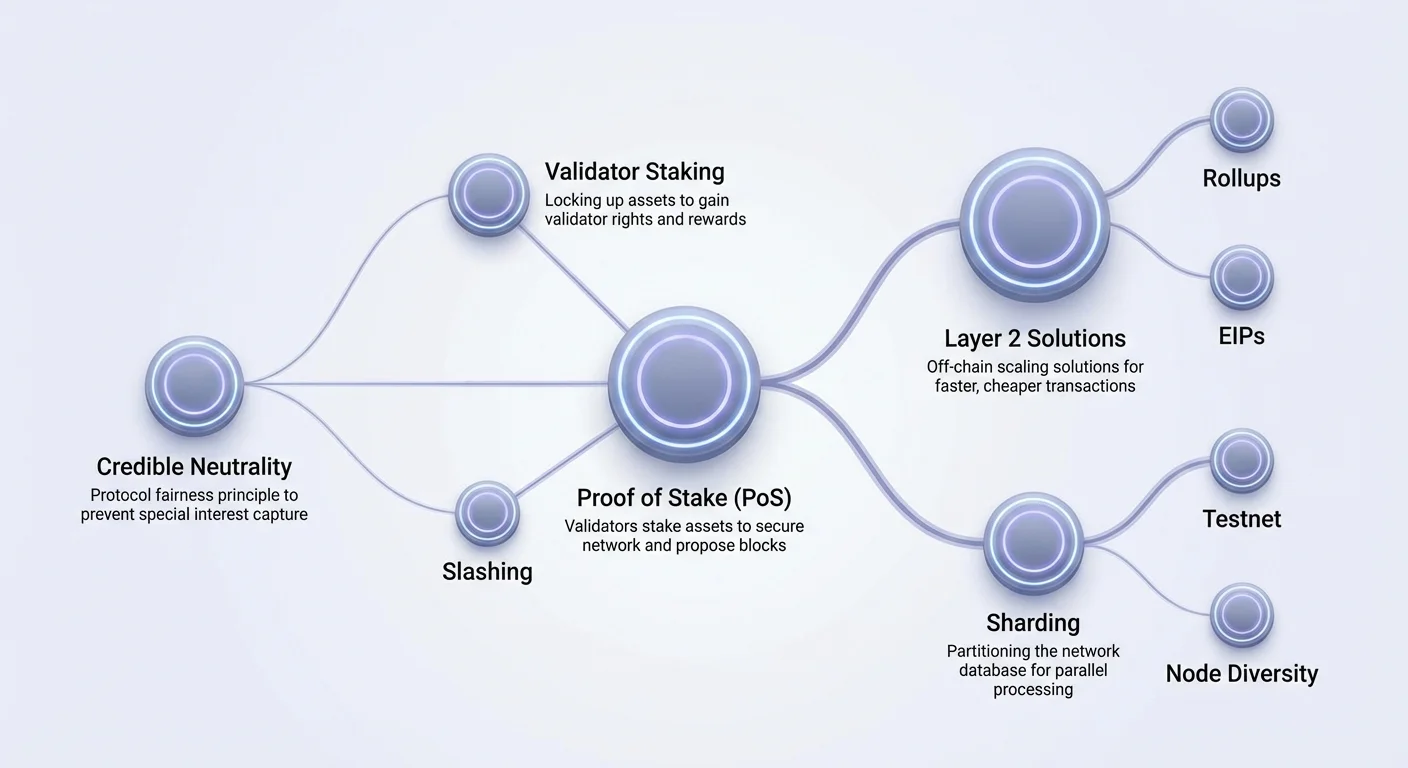
One of the most significant governance decisions in Ethereum's history was the transition from Proof of Work (PoW) to Proof of Stake (PoS). This upgrade, known as "The Merge," fundamentally changed how the network is secured and who gets to participate in consensus. It was a move designed to solve the "blockchain trilemma" by improving security and scalability while drastically reducing energy consumption.
In the old PoW system, miners used energy-intensive hardware to solve puzzles and validate blocks. In the new PoS system, validators replace miners. Validators lock up, or "stake," crypto assets in a smart contract to gain the right to propose new blocks. This shift eliminated the need for massive mining farms, reducing energy consumption by over 99%.
New Incentives and Risks
The move to PoS introduced a "carrot and stick" approach to security. Validators earn rewards for processing transactions correctly (the carrot). However, if they violate protocol rules or attempt to attack the network, they face "slashing," where a portion or all of their staked assets are forfeited (the stick). This economic model is designed to align the incentives of validators with the health of the network.
However, this transition also brought new governance concerns. Critics argue that PoS can lead to a "rich get richer" scenario. In PoW, mining is competitive and has thin profit margins, forcing miners to sell coins to cover costs. In PoS, operating costs are low, allowing large stakeholders to compound their wealth simply by staking. This could potentially concentrate influence among wealthy validators over time.
Validator Centralization Concerns
To become a validator on your own, you generally need 32 ETH. This is a high financial barrier for many individuals. As a result, many users stake their ETH through intermediaries or pooled services. If a handful of these services control the majority of the staked ETH, they could theoretically exert outsized influence on the network.
Governance discussions now frequently revolve around how to mitigate these centralization risks. The community actively monitors the distribution of stake and encourages the use of decentralized staking solutions. The goal is to ensure that the validator set remains large and diverse, preventing any single group from dominating the consensus process.
Scalability and the Blockchain Trilemma
The governance of Ethereum is heavily influenced by the technical constraints known as the blockchain trilemma. This concept posits that a blockchain can only optimize for two of three features at once: decentralization, security, and scalability. Ethereum's roadmap has consistently prioritized decentralization and security, often at the expense of raw speed and low fees on the main layer.
This prioritization has consequences. When demand for the network exceeds its capacity, transaction fees (gas) skyrocket. This prices out smaller users and limits the network's utility. To address this, the governance roadmap has shifted focus toward "Layer 2" solutions and a technique called sharding to handle scaling without compromising the base layer's security.
The Role of Layer 2 Solutions
Layer 2 refers to a set of technologies that operate on top of the Ethereum mainnet. These solutions, such as rollups, process transactions off-chain and then bundle the data to send back to the main Ethereum blockchain. This allows for much faster and cheaper transactions while still benefiting from Ethereum's security.
There are two main types of rollups: Optimistic rollups and Zero-Knowledge (ZK) rollups. Optimistic rollups assume transactions are valid by default and only compute validity if challenged. ZK rollups use complex cryptography to prove validity upfront. Both methods aim to increase throughput, but they introduce their own governance layers. Layer 2 networks often have their own operators and upgrade processes, creating a fragmented governance landscape where users must trust both Ethereum and the Layer 2 protocol.
| Feature | Optimistic Rollups | ZK Rollups |
|---|---|---|
| Validation Method | Assumes validity; fraud proofs used if challenged | Cryptographic validity proofs submitted on-chain |
| Withdrawal Time | Long delay (e.g., 7 days) for dispute resolution | Instant or very fast once proof is verified |
| Complexity | Lower technical complexity to implement | High computational and cryptographic complexity |
Sharding and Future Data Availability
Sharding is another major upgrade on the Ethereum timeline aimed at scalability. It involves partitioning the network's database into smaller, manageable pieces called shards. Each shard operates somewhat like a separate blockchain but communicates with the others. This allows the network to process many transactions in parallel rather than sequentially.
The implementation of sharding is complex and requires careful governance coordination. Validators are randomly assigned to different shards to ensure security, preventing any single shard from being corrupted by a specific group. This random assignment is a key defense against coordinated attacks. As sharding is rolled out, it will further test the community's ability to execute complex technical upgrades without disrupting the live network.
The Integrity of the Node Ecosystem
The decentralization of Ethereum relies heavily on the diversity of its nodes. Nodes are the computers that store the blockchain's history and verify rules. If running a node becomes too expensive or technically difficult, fewer people will do it. This leads to a situation where only large institutions run nodes, making the network more vulnerable to censorship or capture.
Critics often point out that the Ethereum blockchain is very large, measured in terabytes. This makes running a "full archival node" difficult for an average user compared to Bitcoin's smaller blockchain. If users cannot verify the chain themselves, they must rely on third-party service providers to interact with the network.
The Risk of Infrastructure Reliance
The reliance on third-party infrastructure providers poses a governance risk. In November 2020, a major infrastructure provider called Infura suffered a technical malfunction. Because many wallets and exchanges relied on Infura rather than running their own nodes, they were forced to pause transactions. This incident highlighted the dangers of centralization in the infrastructure layer.
If a critical mass of the ecosystem relies on a single provider, that provider becomes a central point of failure. Governance discussions often focus on how to reduce the barrier to entry for node operators. The goal is to keep the hardware and bandwidth requirements low enough that a robust, diverse group of participants can continue to secure the network independently.
Conclusion
Ethereum governance is a complex, evolving experiment in human coordination. It lacks the clean efficiency of a corporate structure, relying instead on messy debates, rough consensus, and voluntary adoption. The transition to Proof of Stake and the integration of Layer 2 scaling solutions demonstrate the community's ability to execute massive changes in pursuit of a better protocol. However, these changes bring new challenges regarding wealth concentration, technical complexity, and infrastructure centralization.
The principle of credible neutrality remains the guiding light for the network's future. For Ethereum to succeed as a global platform, it must resist capture by special interests and remain fair in its design. The stakeholders—developers, validators, and users—must remain vigilant. They bear the responsibility of ensuring that the pursuit of scalability does not erode the decentralized foundation that gives the network its value.
The future of the network is decided not by a single leader, but by the collective choice of those who run the software.