
The cryptocurrency ecosystem has evolved significantly since the inception of decentralized digital currency in 2009. What began as a singular experiment in peer-to-peer electronic cash has expanded into a complex financial landscape comprising thousands of distinct assets. Investors and participants no longer view the market as a monolith but rather as a collection of diverse sectors with unique behaviors.
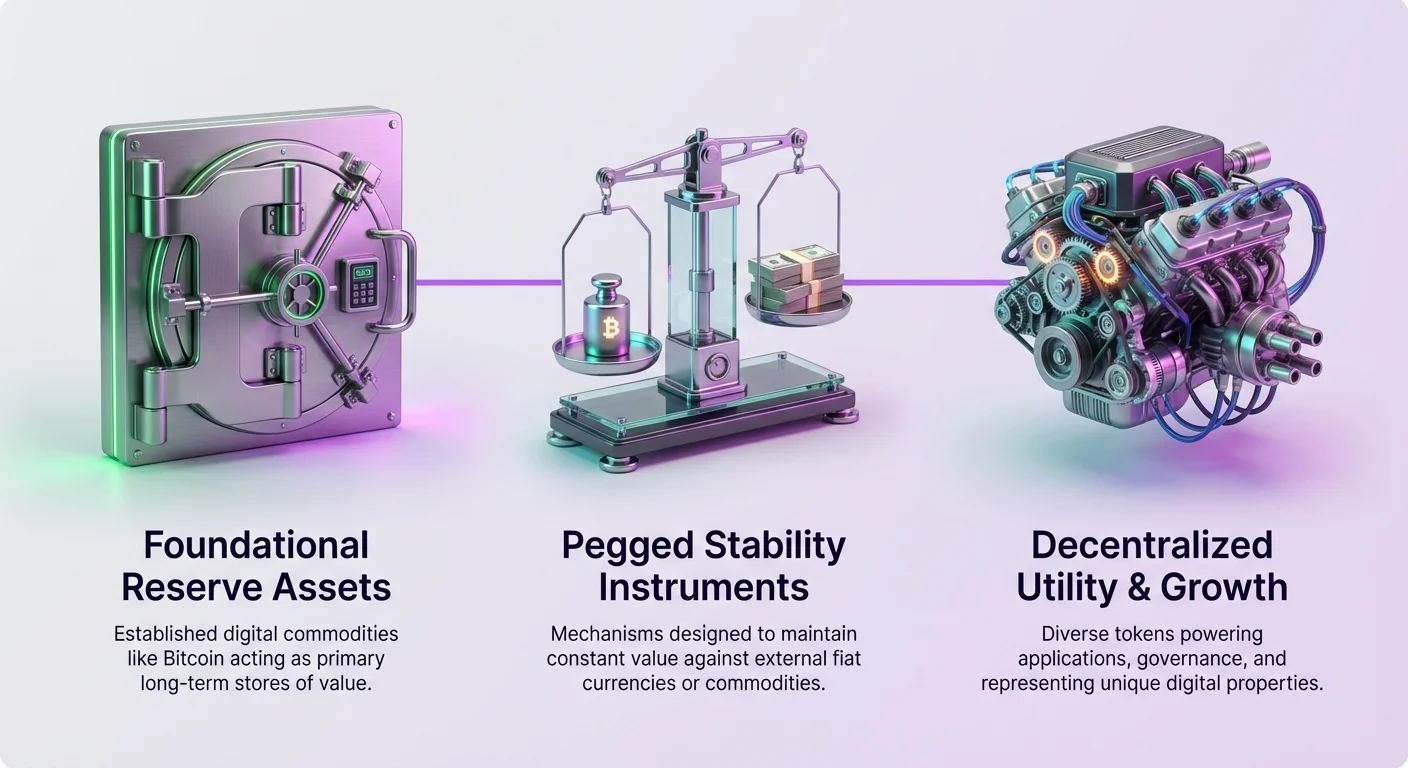
Understanding the nuances of these asset classes is essential for anyone navigating the digital economy. Each category of crypto asset offers a different value proposition, technological foundation, and risk profile. Some assets are designed to act as stable stores of value, while others serve as fuel for decentralized networks or represent voting rights in autonomous organizations.
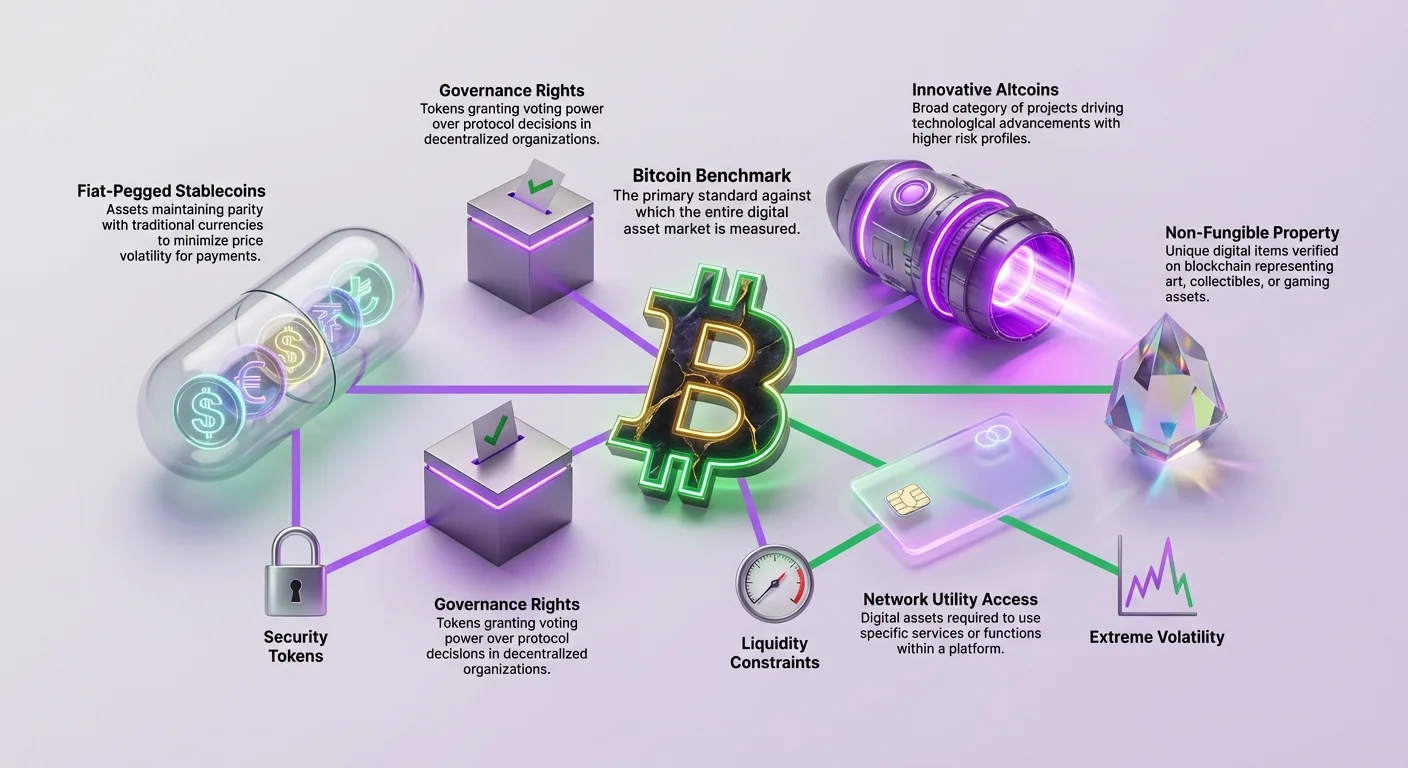
The distinction between these classes goes beyond mere terminology. It affects fundamental investment metrics such as volatility, liquidity, and correlation to broader economic trends. A stablecoin pegged to a fiat currency behaves fundamentally differently than a governance token for a decentralized exchange or a non-fungible token representing digital art.
Recognizing these differences allows market participants to construct more balanced portfolios. It helps in identifying which assets are suitable for long-term holding versus short-term trading. As the industry matures, the lines between these categories continue to sharpen, creating a structured hierarchy of digital instruments.
Bitcoin: The Benchmark for Digital Value
The Role of Digital Gold
Bitcoin occupies a unique position within the cryptocurrency market. As the pioneer of blockchain technology, it has established itself as the primary benchmark against which all other assets are measured. Its defining characteristic is its fixed supply cap of 21 million coins, a feature that enforces scarcity and positions it as a store of value. This scarcity has led many to compare Bitcoin to precious metals, earning it the moniker "digital gold."
Unlike fiat currencies which can be printed by central banks, Bitcoin’s monetary policy is hard-coded and immutable. This predictability appeals to investors looking for a hedge against inflation and currency devaluation. The decentralized nature of the network ensures that no single entity controls the issuance or validation of transactions, providing a level of censorship resistance not found in traditional finance.
Market Dominance and Stability
Bitcoin typically exhibits lower volatility compared to the broader altcoin market, although it remains volatile relative to traditional assets like bonds. Its massive market capitalization provides a level of liquidity that is unmatched in the crypto space. This high liquidity means that large buy or sell orders can be executed with minimal impact on the price, making it the preferred entry point for institutional capital.
The asset often dictates the directional trend of the entire crypto market. When Bitcoin experiences significant price movements, the rest of the market tends to follow, usually with amplified magnitude. However, as the market matures, Bitcoin is slowly decoupling from other speculative assets, solidifying its role as a foundational reserve asset rather than a high-growth technology play.
The Structural Divide: Coins Versus Tokens
Native Blockchain Assets
A fundamental technical distinction exists between "coins" and "tokens," though the terms are often used interchangeably in casual conversation. A coin is a cryptocurrency that operates on its own independent blockchain. These assets are native to their specific network and are essential for its operation. They are used to pay transaction fees, secure the network through mining or staking, and incentivize validators.
Bitcoin (BTC) and Ethereum (ETH) are prime examples of coins. They exist on their own infrastructure and do not rely on another platform to function. Creating a coin requires building a blockchain from scratch, which involves significant resources, security planning, and network development. Because they exist at the protocol level, coins are deeply tied to the health and security of their respective networks.
Assets Built on Existing Chains
In contrast, tokens are digital assets created on top of existing blockchains. They leverage the security and technology of the host network, allowing developers to deploy new assets without building independent infrastructure. Tokens are typically created using smart contracts, which are self-executing code deployed on platforms like Ethereum or Solana.
This structure allows for rapid innovation and customization. Tokens can represent anything from a currency within a specific application to a share in a project. Because they rely on the host blockchain for consensus and security, tokens can face risks if the underlying layer experiences congestion or technical issues. However, this dependency also provides the benefit of interoperability within the host ecosystem.
| Feature | Coins (e.g., BTC, SOL) | Tokens (e.g., UNI, USDC) |
|---|---|---|
| Infrastructure | Runs on own blockchain | Built on existing blockchain |
| Creation | Protocol-level integration | Smart contract deployment |
| Security | Independent consensus | Inherits host chain security |
Altcoins: Innovation and High Variance
The term "altcoin" refers to any cryptocurrency that is not Bitcoin. This broad category encompasses a massive range of projects, from direct competitors aiming to improve transaction speeds to niche tokens serving specific communities. Altcoins are generally considered higher-risk investments compared to Bitcoin, offering the potential for greater returns but also bringing increased exposure to volatility.
Many altcoins aim to address perceived limitations of Bitcoin. Some focus on scalability, attempting to process thousands of transactions per second. Others prioritize privacy, using advanced cryptography to obscure transaction details. There are also projects dedicated to specific sectors like supply chain management, data storage, or artificial intelligence services.
Investing in altcoins requires a higher tolerance for risk. While Bitcoin has a decade-long track record, many altcoins are experimental startups in digital form. They often suffer from lower liquidity, making them susceptible to sharp price swings caused by relatively small trades. The altcoin market is also where the majority of scams and failed projects occur, necessitating rigorous due diligence.
Despite the risks, altcoins drive much of the technological innovation in the sector. Ethereum, the largest altcoin, introduced smart contracts, which paved the way for decentralized finance (DeFi) and non-fungible tokens (NFTs). These innovations have expanded the utility of blockchain technology far beyond simple peer-to-peer payments.
Stablecoins: Anchoring the Digital Economy
Mechanisms of Stability
Stablecoins represent a crucial asset class designed to minimize price volatility. Unlike Bitcoin or altcoins, whose value is determined entirely by supply and demand dynamics, stablecoins are pegged to an external asset. Most commonly, this peg is linked to a fiat currency like the US dollar, though some track commodities like gold or baskets of other currencies.
The primary goal of a stablecoin is to maintain a constant value, typically one dollar. This stability is achieved through various mechanisms. Fiat-backed stablecoins hold reserves of cash and equivalents in regulated financial institutions. Algorithmic stablecoins use complex on-chain code to adjust supply and demand to maintain the peg. This reliability makes them essential for everyday transactions where price fluctuations are undesirable.
The Role in DeFi and Payments
Stablecoins serve as the bridge between traditional finance and the crypto economy. They allow traders to exit volatile positions without converting back to fiat currency, which can be slow and costly. In the world of decentralized finance, stablecoins are the primary medium of exchange for lending, borrowing, and earning interest.
For global payments and remittances, stablecoins offer a significant advantage over traditional banking rails. They enable near-instant cross-border transfers with minimal fees, operating 24/7. This utility has driven their adoption in regions with unstable local currencies, where they function as a digital dollar for preserving purchasing power.
Utility and Governance Assets
Access and Functionality
Utility tokens are a specific type of asset designed to provide access to a product or service within a blockchain ecosystem. They function similarly to digital coupons or vouchers. For example, a decentralized cloud storage network might require users to pay in a specific token to store their data. The demand for the token is theoretically driven by the demand for the underlying service.
These tokens are integral to the operation of decentralized applications (dApps). They often facilitate the internal economy of a project, ensuring that participants are compensated for their contributions. However, holding a utility token does not necessarily grant ownership rights in the company or project developing the platform.
Decentralized Decision Making
Governance tokens represent a shift toward community-led management. These assets grant holders the right to vote on decisions impacting a protocol or project. This concept is central to Decentralized Autonomous Organizations (DAOs), where no single central authority dictates the roadmap.
Holders of governance tokens can propose and vote on various issues. These might include changes to fee structures, treasury allocations, or software upgrades. The value of a governance token is often linked to the influence it provides over a protocol's future and, in some cases, a claim on the revenue generated by the platform.
Security Tokens and Real-World Assets
Security tokens are digital representations of ownership in tangible, real-world assets. Unlike utility tokens, which provide access to a service, security tokens function more like traditional financial securities. They can represent shares in a company, fractional ownership of real estate, or rights to revenue streams.
This asset class is subject to strict regulatory oversight. Issuers must comply with securities laws, including Know Your Customer (KYC) and Anti-Money Laundering (AML) requirements. The primary benefit of security tokens is the ability to tokenize illiquid assets. By dividing a high-value asset like a commercial building into digital tokens, issuers can allow for fractional ownership and easier transferability.
The integration of real-world assets (RWAs) into the blockchain is a growing trend. It promises to bring the efficiency and transparency of distributed ledger technology to traditional markets. However, the heavy regulatory burden means that this sector moves slower than the unregulated corners of the crypto market.
Non-Fungible Tokens and Digital Property
Non-Fungible Tokens (NFTs) differ fundamentally from cryptocurrencies like Bitcoin or Ethereum. While one bitcoin is identical to and interchangeable with another, each NFT is unique. This uniqueness is verified on the blockchain, providing immutable proof of ownership and provenance for digital items.
NFTs have found their most prominent use cases in digital art, collectibles, and gaming. They allow creators to monetize digital works directly, without intermediaries. In the gaming sector, NFTs enable players to truly own in-game assets, such as skins or items, which can then be traded or sold on secondary markets.
Beyond art and gaming, NFTs have potential applications in identity verification and certification. They can represent unique credentials, diplomas, or tickets to events. The value of an NFT is subjective and relies heavily on scarcity, cultural significance, and demand, making them one of the most volatile asset classes in the ecosystem.
Volatility Profiles Across the Spectrum
Volatility measures how rapidly and significantly the price of an asset changes. In the crypto market, volatility varies drastically between asset classes. Bitcoin, while volatile by traditional standards, is generally more stable than most altcoins. Its deep liquidity and broad distribution dampen the impact of individual trades.
Altcoins, particularly those with smaller market capitalizations (micro-caps), exhibit extreme volatility. It is not uncommon for these assets to double in value or lose half their value in a single day. This high variance attracts speculative traders but poses severe risks for long-term investors. Factors such as low liquidity and concentrated ownership contribute to these wild price swings.
Stablecoins sit at the opposite end of the spectrum. By design, they have near-zero volatility relative to their peg. They are the "safe haven" assets within the crypto ecosystem, used to preserve capital during market downturns. Understanding these profiles is crucial for risk management; a portfolio heavy in micro-cap altcoins will behave very differently from one balanced between Bitcoin and stablecoins.
| Asset Class | Volatility | Primary Driver |
|---|---|---|
| Bitcoin | Medium-High | Macro adoption, Store of Value |
| Large Cap Altcoins | High | Innovation, Platform adoption |
| Micro Cap/Meme | Extreme | Speculation, Community sentiment |
| Stablecoins | Very Low | Fiat currency peg |
Liquidity Dynamics in Crypto Markets
Liquidity refers to the ease with which an asset can be bought or sold without affecting its price. Bitcoin and Ethereum enjoy the highest liquidity in the market. They are listed on virtually every exchange and have massive daily trading volumes. This depth allows institutional investors to enter and exit positions efficiently.
Moving down the risk curve, liquidity dries up significantly. Many altcoins are traded only on a few exchanges or have low trading volume. In these illiquid markets, a relatively small sell order can crash the price, a phenomenon known as slippage. This risk is compounded during market crashes when liquidity often evaporates completely, leaving investors unable to sell their positions.
Liquidity also differs between Centralized Exchanges (CEXs) and Decentralized Exchanges (DEXs). CEXs typically offer higher liquidity for major assets due to professional market makers. DEXs rely on liquidity pools funded by users. While DEXs offer access to a wider range of tokens, the liquidity for niche assets can be thin, resulting in higher transaction costs and price impact.
Correlations and Macroeconomic Factors
In the early years of crypto, digital assets were largely uncorrelated with traditional finance. They moved independently of the stock market or commodities. However, as institutional adoption has grown, this dynamic has shifted. Bitcoin and major altcoins now often show a positive correlation with risk-on assets like technology stocks.
Macroeconomic factors such as interest rates, inflation data, and central bank policies now heavily influence crypto prices. When central banks raise interest rates to combat inflation, liquidity often drains from speculative markets, causing both stocks and crypto to decline. Conversely, periods of monetary easing tend to boost crypto asset prices.
Within the crypto market itself, correlation remains high. When Bitcoin falls, altcoins typically fall further. It is rare to see the altcoin market rally significantly while Bitcoin is in a steep decline. However, "altcoin seasons" do occur when capital rotates from Bitcoin into higher-risk assets after a period of Bitcoin dominance, leading to temporary decoupling.
Risk Management Strategies
Given the diverse nature of crypto asset classes, effective risk management is paramount. Diversification helps spread risk across different categories. A balanced portfolio might include a core holding of Bitcoin for long-term stability, a selection of utility tokens for growth potential, and a portion in stablecoins to have dry powder for buying opportunities.
Due diligence is critical before investing in any asset. For altcoins and tokens, this means researching the project's team, technology, and tokenomics. Understanding the vesting schedule of a token—how many new tokens will be released over time—can prevent investors from buying into an asset destined for inflation.
Investors must also consider custody risks. Storing assets on exchanges introduces counterparty risk, while self-custody requires careful management of private keys. Security practices should be tailored to the value and type of assets held. Hardware wallets generally offer the best protection for significant long-term holdings.
Conclusion
The cryptocurrency market is a multifaceted ecosystem comprising distinct asset classes, each with its own rules and behaviors. From the foundational stability of Bitcoin and stablecoins to the experimental frontier of DeFi tokens and NFTs, the market offers tools for various financial goals. Understanding the technical and economic differences between coins and tokens is the first step toward navigation.
Investors who recognize the varying volatility and liquidity profiles across these assets are better equipped to manage risk. As the market matures and integrates further with traditional finance, these classifications will likely become even more defined. Success in this space requires continuous education and a disciplined approach to portfolio construction.
A well-structured crypto portfolio balances high-growth potential with the stability of established assets to navigate market volatility.