
The blockchain industry is witnessing a significant shift from monolithic architectures to modular frameworks. Early iterations of distributed ledger technology required every application to share the same limited bandwidth and storage capacity. This resulted in network congestion and volatile transaction fees during periods of high demand. As decentralized finance and global enterprise adoption expand, this one-size-fits-all model has become a bottleneck for scalability and specific use cases.
Avalanche has emerged as a leading solution to this scalability challenge through its unique architectural design. While it functions as a high-performance Layer 1 blockchain capable of general-purpose smart contract execution, its defining feature is the ability to deploy Subnets. These are specialized, sovereign blockchains that remain connected to the broader ecosystem. This approach allows developers to launch networks that are tailored to exact specifications regarding compliance, speed, and fee structures.
By enabling the creation of application-specific blockchains, Avalanche moves beyond the limitations of legacy networks. It offers a platform where enterprises can build private, regulatory-compliant chains while Web3 developers can create high-performance environments for gaming or complex financial protocols. This modular strategy addresses the competing needs of customization and interoperability, positioning Subnets as a critical infrastructure layer for the next generation of digital applications.
The Avalanche Consensus Mechanism
Random Sampling and Speed
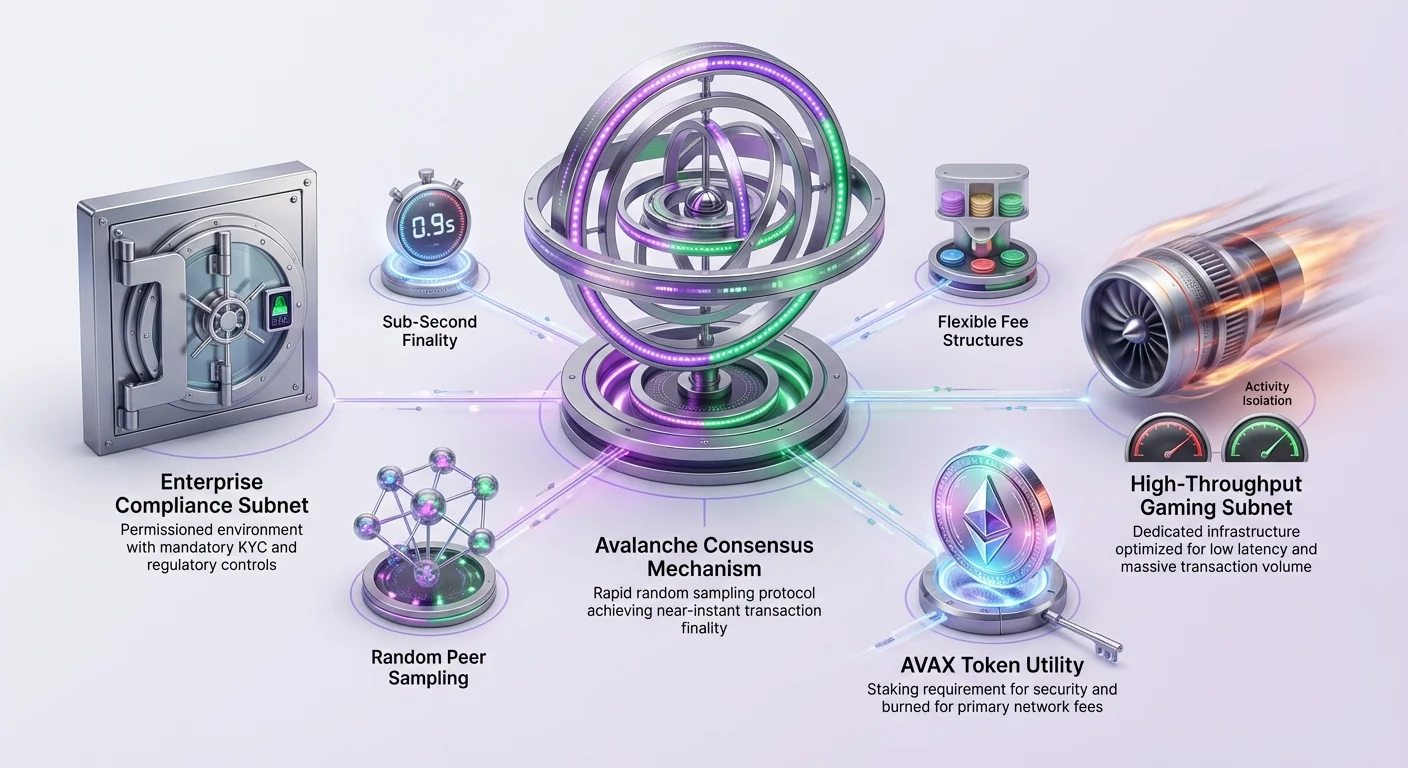
The foundation of the Avalanche network and its Subnets is a breakthrough consensus protocol that differs significantly from traditional Proof-of-Work or Proof-of-Stake models. In this system, validators are not required to process every transaction linearly or compete to mine blocks through energy-intensive computations. Instead, the network utilizes a method based on random sampling to achieve agreement across the distributed ledger.
When a transaction is broadcast to the network, a validator independently verifies it. To confirm the validity, this validator then randomly polls a small subset of other validators in the network to check their verdict. This process is repeated repeatedly and rapidly. If the majority of the sampled peers agree, the validator updates its decision to match the group. This gossiping mechanism spreads across the network almost instantly, creating a cascade of agreement that secures the ledger.
Achieving Instant Finality
This unique approach allows Avalanche to achieve transaction finality in less than two seconds. In many legacy blockchains, a user must wait for multiple block confirmations to ensure a transaction is irreversible, which can take minutes or even nearly an hour. On Avalanche, once the consensus is reached through this rapid sampling process, the transaction is final. This speed is vital for real-world applications like point-of-sale payments or high-frequency trading.
The efficiency of this mechanism also enables high throughput. The network can process roughly 4,500 transactions per second, depending on the specific Subnet configuration. Because validators only need to communicate with a small sample rather than the entire network for every decision, the system remains lightweight and scalable. As the network grows, it theoretically becomes faster and more secure rather than slower and more cumbersome.
Defining Avalanche Subnets
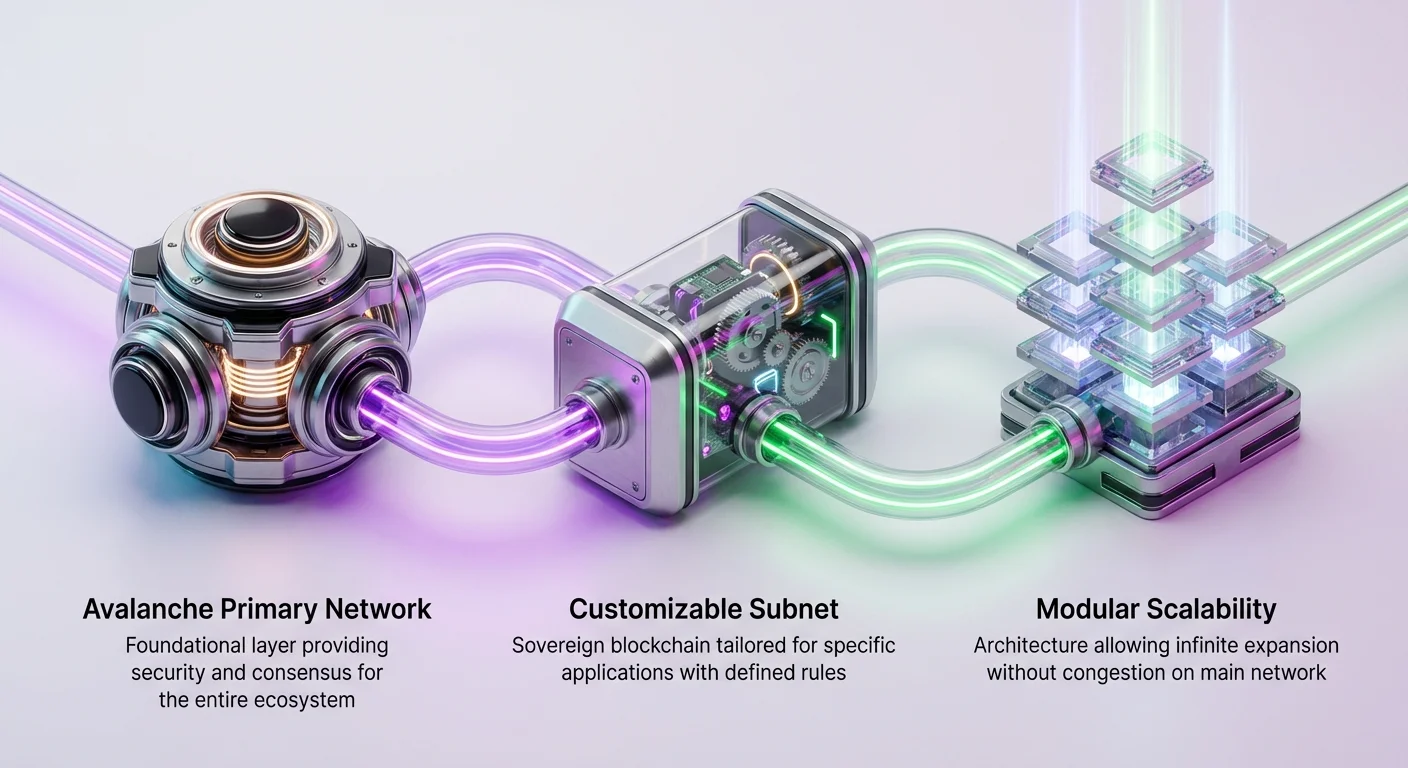
A Subnet, short for distinct sub-network, is a dynamic set of validators working together to achieve consensus on the state of a set of blockchains. In simpler terms, a Subnet is a sovereign network that defines its own rules regarding membership and token economics. It is not just a sidechain or a Layer 2 solution in the traditional sense but a fully independent environment that leverages the security and tools of the primary Avalanche protocol.
Avalanche itself is often described as a "network of networks." The Primary Network consists of three built-in chains: the Exchange Chain (X-Chain), Platform Chain (P-Chain), and Contract Chain (C-Chain). Subnets expand this architecture infinitely. Developers can launch a Subnet to run a single decentralized application or a suite of related projects. Because the Subnet operates independently, activity on one chain does not negatively impact the performance of another.
This isolation is the key to the "modular" description. If a popular game on one Subnet experiences a surge in traffic, it does not clog the main network or spike gas fees for users on a different financial Subnet. This separation of concerns solves the "noisy neighbor" problem found on monolithic blockchains like Ethereum, where a single popular NFT mint can render the network unusable for everyone else.
Enterprise Applications and Compliance
Regulatory Control and KYC
For enterprises and institutional players, the public and permissionless nature of most blockchains is a significant barrier to entry. Regulated financial institutions often cannot interact with anonymous counterparties due to strict Anti-Money Laundering (AML) and Know Your Customer (KYC) laws. Subnets provide a solution by allowing the creator to define exactly who can be a validator and who can transact on the network.
An enterprise can launch a "permissioned" Subnet where every validator must undergo KYC verification before joining the network. Furthermore, the Subnet can require that all wallet addresses interacting with the chain are whitelisted. This capability creates a "Walled Garden" environment that enjoys the benefits of blockchain technology—transparency, immutability, and security—without violating regulatory compliance standards required in traditional finance.
Custom Fee Structures
Enterprises also require predictability in operational costs. On a shared public blockchain, transaction fees fluctuate wildly based on global network demand. A logistics company tracking supply chain data cannot afford for their database costs to spike 1,000% overnight because of a meme coin frenzy. Subnets allow the network creator to define the fee token and the fee schedule.
A corporation could choose to pay gas fees in its own corporate token, a stablecoin, or even eliminate gas fees entirely for end-users by subsidizing the validators directly. This flexibility allows for "gasless" user experiences, which is crucial for consumer-facing applications where the user should not need to understand cryptocurrency market dynamics just to use a service.
Performance for Specific DApps
High-Throughput Gaming
Web3 gaming requires a completely different performance profile compared to simple asset transfers. A blockchain game might generate thousands of micro-transactions per minute as players move items, earn rewards, or interact with the environment. If this game runs on a shared Layer 1, the costs would become prohibitive, and the latency would destroy the user experience.
Subnets allow game developers to dedicate an entire blockchain to their specific game economy. By isolating the game activity, developers can ensure consistently low latency and high throughput. They can also customize the virtual machine (VM) to optimize for gaming logic rather than general finance. This ensures that gameplay remains smooth and responsive, regardless of what is happening on the wider Avalanche network.
DeFi and Institutional Finance
Decentralized Finance (DeFi) protocols benefit similarly from the Subnet architecture. High-frequency trading platforms and order book exchanges require speed and liquidity. A dedicated DeFi Subnet can be tuned for speed, prioritizing transaction ordering and execution times that rival centralized exchanges.
Furthermore, Subnets allow for the creation of compliant DeFi environments. Institutions can participate in decentralized lending and borrowing pools within a permissioned Subnet, ensuring that all participants are vetted entities. This opens the door for trillions of dollars in traditional capital to enter the DeFi space, utilizing the efficiency of smart contracts while mitigating counterparty regulatory risk.
Comparative Analysis: Modular vs. Monolithic
Understanding where Avalanche Subnets fit in the broader ecosystem requires comparing them to other scaling solutions. Monolithic chains handle execution, settlement, consensus, and data availability on a single layer. Modular chains separate these functions.
| Feature | Monolithic Layer 1 | Ethereum Layer 2 | Avalanche Subnet |
|---|---|---|---|
| Throughput | Shared capacity | High, but dependent on L1 | Dedicated capacity |
| Compliance | Permissionless only | Generally permissionless | Fully customizable |
| Gas Token | Native L1 token | Native or L1 token | Any custom token |
While Ethereum Layer 2 solutions (Rollups) offer scalability, they typically rely on the main Ethereum chain for final settlement and data availability. This means they are ultimately constrained by the limitations and costs of the underlying Layer 1. Subnets, however, are sovereign. They manage their own security and execution independently while still being able to interoperate with the wider network.
This distinction is vital for specific use cases. A Layer 2 might still be subject to latency issues if the main chain is under attack or heavily congested. A Subnet maintains its own performance metrics regardless of the state of the Primary Network. For an enterprise relying on 24/7 uptime and consistent confirmation times, this sovereignty provides a necessary guarantee of service quality.
The Role of the AVAX Token
Staking and Security
Despite the independence of Subnets, the AVAX token remains central to the ecosystem's security and economics. To become a validator on the Avalanche Primary Network, a participant must stake a minimum amount of AVAX. This requirement aligns the financial incentives of the validators with the health of the broader platform.
Validators who wish to participate in Subnets must first validate the Primary Network. This ensures that as the number of Subnets grows, the security and decentralization of the core network also increase. It creates a symbiotic relationship where the success of specific DApps contributes to the robustness of the foundational layer. The AVAX token acts as the economic bond that secures this expanding universe of blockchains.
Transaction Fees and Utility
On the Primary Network, AVAX is used to pay for transaction fees. A unique aspect of Avalanche's tokenomics is that all transaction fees paid in AVAX are burned, permanently removing them from circulation. This creates a deflationary pressure on the token supply as network usage increases. While Subnets can use their own tokens for fees, the requirement for validators to hold AVAX maintains demand for the native asset.
This model differs from networks where fees go directly to miners or validators as income. In Avalanche, validators are compensated through staking rewards, while the burning mechanism benefits all token holders by reducing supply. For enterprise Subnets using their own tokens, this dual model allows them to build their own internal economies without being forced to expose their users to AVAX price volatility directly.
Interoperability and Bridging
A major challenge for modular ecosystems is fragmentation. If every DApp runs on its own blockchain, assets and data can become trapped in silos. Avalanche addresses this through its native interoperability protocols and bridging solutions. The architecture is designed to facilitate cross-chain communication, allowing users to move assets between Subnets and the Primary Network efficiently.
The official Avalanche Bridge and third-party solutions like Celer cBridge enable the transfer of assets from Ethereum and other EVM-compatible chains to the Avalanche C-Chain. From there, assets can move to specific Subnets. This connectivity is crucial for liquidity. A DeFi Subnet needs access to stablecoins and major crypto assets to function.
Bridges on Avalanche are designed to be fast and low-cost, mirroring the performance of the network itself. Transferring assets typically takes minutes, providing a smooth user experience. This interconnectedness ensures that while Subnets are isolated in terms of performance and rules, they remain part of a cohesive financial ecosystem. Users can interact with a game on one Subnet and a lending protocol on another without navigating complex technical barriers.
Developer Experience and EVM Compatibility
Building with Familiar Tools
One of the strongest drivers of Avalanche's adoption is its compatibility with the Ethereum Virtual Machine (EVM). The C-Chain is an implementation of the EVM, meaning that developers who have written smart contracts for Ethereum can deploy the exact same code on Avalanche. This lowers the barrier to entry significantly.
Developers do not need to learn a new programming language like Rust or Haskell to build on Avalanche. They can use standard industry tools like Solidity, Remix, and MetaMask. This compatibility extends to Subnets as well. A developer can launch a Subnet that runs a customized version of the EVM, allowing them to fork existing Ethereum applications and optimize them for a dedicated environment.
Custom Virtual Machines
Beyond EVM compatibility, Avalanche offers the flexibility to deploy custom Virtual Machines. If a developer requires a blockchain optimized for a specific type of computation that the EVM handles poorly, they can design a VM from scratch. This is particularly relevant for advanced use cases in cryptography, privacy, or complex data processing.
This capability positions Avalanche as a future-proof platform. As blockchain technology evolves, new and more efficient virtual machines will be developed. Subnets can adopt these new technologies without requiring the entire Avalanche network to upgrade. This modular upgrade path ensures that the platform remains at the cutting edge of technical innovation while maintaining stability for existing applications.
The Modular Future of Blockchain
The trajectory of the blockchain industry suggests a move away from general-purpose chains toward application-specific networks. The early era of crypto was dominated by the idea of a "World Computer" where all activity happened in one place. However, the physical limits of computation and bandwidth make this model difficult to scale for a global population.
Avalanche Subnets represent the realization of the "AppChain" thesis. This thesis posits that the most successful DApps will eventually outgrow shared blockspace and require their own dedicated chains. By making it easy to launch and secure these chains, Avalanche provides the infrastructure for this transition.
This evolution mirrors the development of the internet itself. We moved from shared mainframes to dedicated servers and cloud instances. Subnets offer a similar progression for Web3, providing the dedicated resources necessary for mass adoption. Whether for global enterprise supply chains or massive multiplayer online games, the future requires dedicated throughput and customizable environments.
Conclusion
Avalanche has established itself as a formidable contender in the blockchain space by addressing the "trilemma" of decentralization, security, and scalability through a novel architectural approach. By combining a high-speed consensus mechanism with a modular Subnet structure, it offers a solution that caters to both general users and specialized enterprise needs. The platform's ability to provide instant finality and low transaction costs makes it a practical alternative to legacy networks.
The Subnet model specifically unlocks potential for industries that were previously unable to utilize public blockchains due to regulatory or performance constraints. By offering isolation, customization, and compliance controls, Avalanche bridges the gap between traditional institutional requirements and decentralized innovation. As the ecosystem matures, this flexibility will likely be a key driver in bringing the next wave of users and capital on-chain.
Modular architecture is the bridge connecting rigid enterprise requirements with the open innovation of Web3.