
The evolution of the internet has moved through distinct phases, shifting from static information to dynamic social interaction, and now toward user ownership. The current iteration, often described as Web3, is defined by decentralized applications. These software programs, known commonly as dApps, represent a fundamental shift in how users interact with digital services. Unlike traditional applications that rely on centralized servers controlled by a single corporation, dApps operate on peer-to-peer network nodes and consensus.
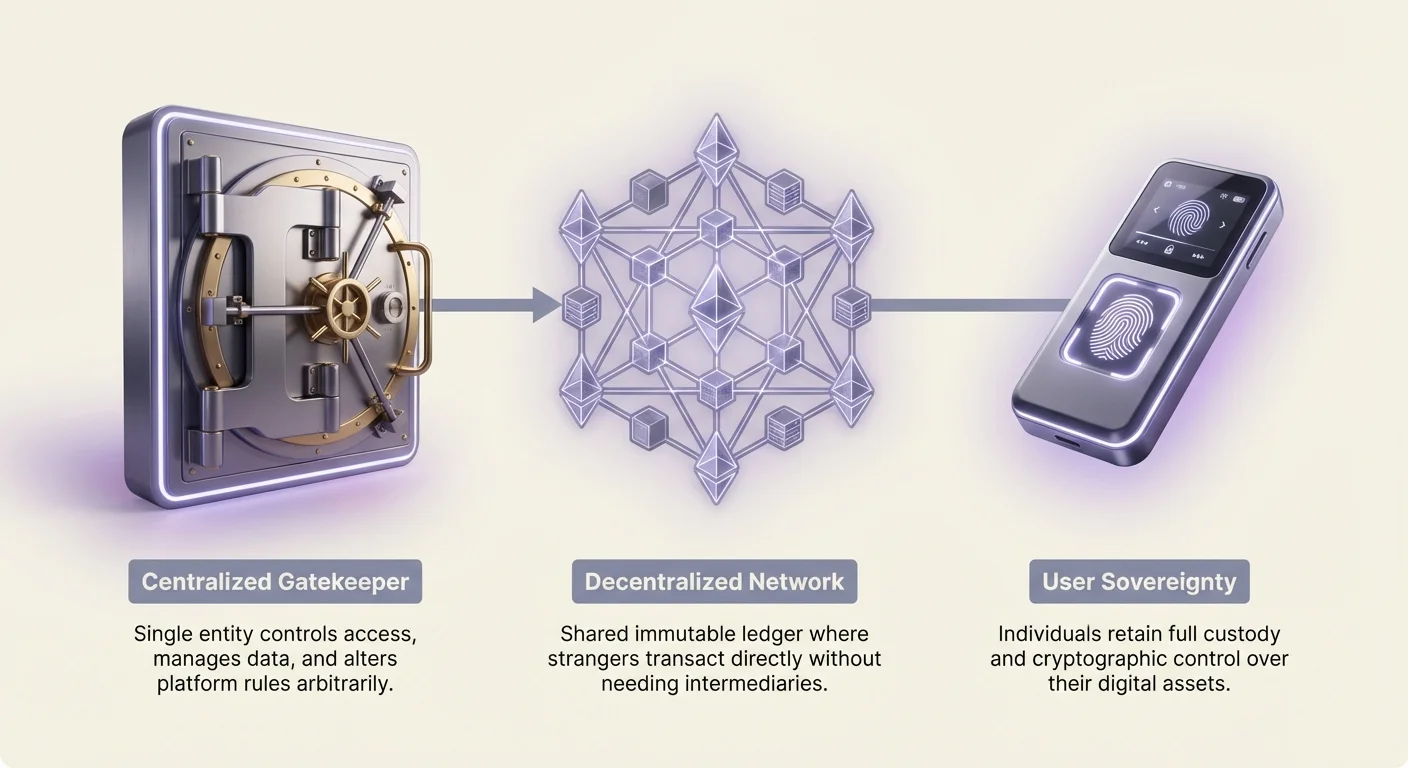
This structural difference changes the relationship between the user and the application. In the traditional model, a company acts as a gatekeeper. They control access, manage data, and can alter the rules of the platform at any time. Users must trust these intermediaries to handle their information responsibly and to keep the service running.
Decentralized applications remove the need for this trust. They are built on blockchain technology, predominantly Ethereum, which serves as a shared, immutable ledger. By leveraging the security and transparency of a distributed network, dApps allow strangers to transact and interact without a middleman. The code itself enforces the rules, ensuring that outcomes are predictable and that no single entity can manipulate the system.
The Core Components of a dApp
To the end user, a decentralized application often looks and feels like any other website or mobile app. It has buttons, forms, and distinct visual elements. However, the underlying architecture is radically different. A dApp is generally composed of a standard frontend user interface and a decentralized backend.
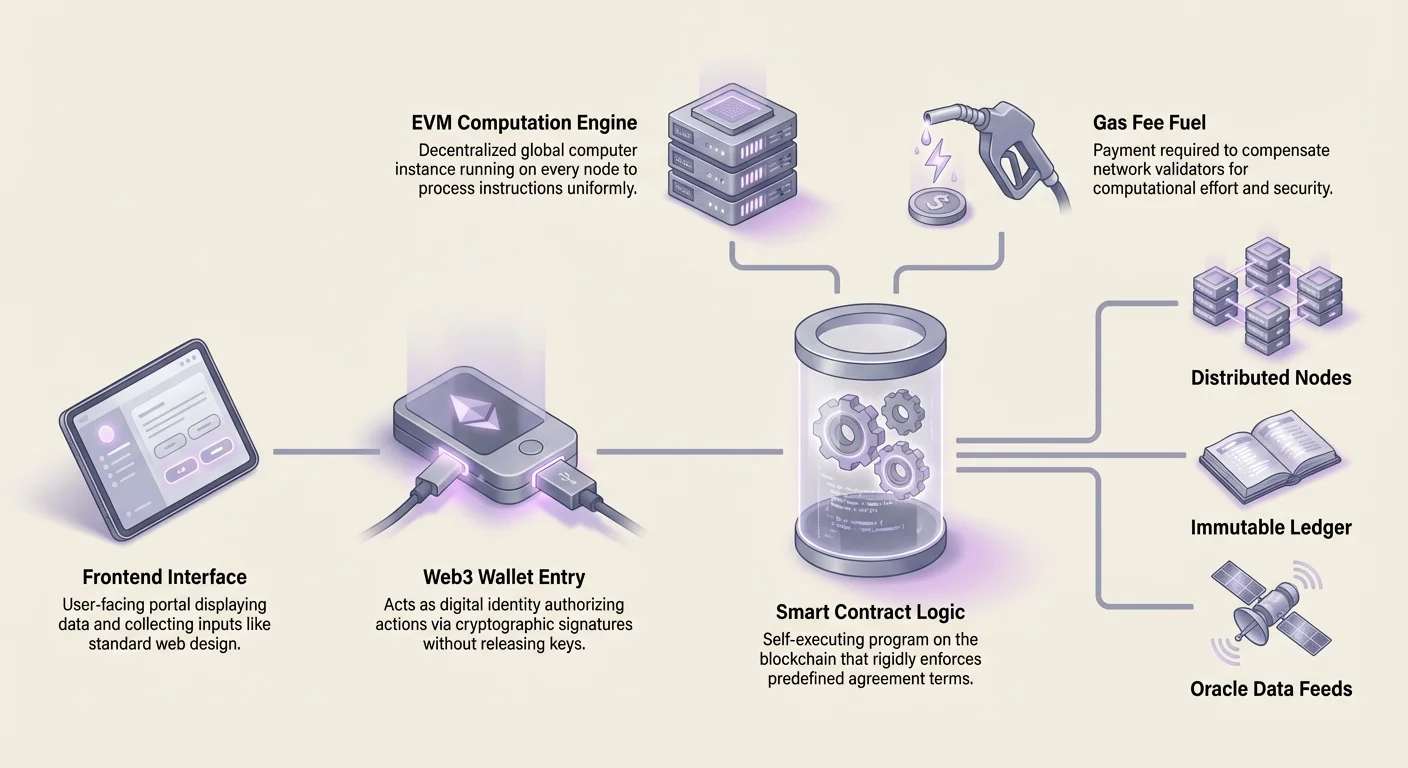
The frontend is the part of the application that the user sees. It is typically written in standard web languages like HTML, JavaScript, and CSS. This interface serves as a portal. It displays data to the user and collects inputs, such as a request to trade a token or cast a vote. While the visuals are standard, the way this frontend communicates with the database is unique to Web3.
The backend is where the true innovation lies. Instead of connecting to a private server and a proprietary database, the frontend connects to a blockchain network. The "logic" of the application lives in smart contracts deployed on the network. When a user interacts with the frontend, they are essentially triggering functions within these on-chain smart contracts.
The Role of the Web3 Wallet
Connecting the frontend interface to the blockchain backend requires a specific tool: a Web3 wallet. In the traditional web, users log in with a username and password, effectively asking the server for permission to access an account. In the decentralized web, the wallet serves as both identity and authorization key. When looking to use a dApp, learn about setting up your wallet.
The wallet manages the user's private keys, which are cryptographic tools used to sign transactions. When a user clicks a button on a dApp interface to perform an action, the application sends a request to the wallet. The user must then approve this request, cryptographically signing the data.
This signature proves to the network that the user authorized the action without revealing their private key. The wallet then broadcasts this signed transaction to the blockchain nodes. This process ensures that the user retains full custody and control over their assets and data at all times. The dApp never actually "holds" the user's funds; it merely requests permission to interact with them based on pre-defined rules.
Smart Contracts: The Logic Layer
At the heart of every decentralized application is the smart contract architecture. A smart contract is a self-executing program where the terms of the agreement are written directly into lines of code. Once deployed to a blockchain like Ethereum, these contracts become immutable. This means the code cannot be changed, preventing developers or bad actors from tampering with the rules after the fact.
Smart contracts function as the backend logic for dApps. They handle the heavy lifting of computation and state storage. For example, in a decentralized exchange, the smart contract manages the liquidity pools, calculates exchange rates, and executes the swap of tokens between users.
Because these contracts live on a public ledger, they are entirely transparent. Anyone with the technical know-how can inspect the code to verify exactly how the application works. This creates a "trustless" environment. Users do not need to trust the developer's promises; they only need to trust the code's execution.
Automating Trust Without Intermediaries
The primary value proposition of smart contracts is their ability to automate processes that previously required human intermediaries. In traditional finance, a loan requires a bank officer to review an application, check credit history, and approve the transfer of funds. This process is slow, opaque, and prone to human error or bias.
In a DeFi (Decentralized Finance) dApp, this entire process is handled by code. A lending protocol's smart contract is programmed to release funds only when specific collateral requirements are met. If a user deposits the required amount of cryptocurrency as collateral, the contract automatically issues the loan.
If the value of the collateral drops below a certain threshold, the contract automatically liquidates the position to protect the protocol. There is no negotiation and no need for a bank manager. The rules are enforced rigidly and impartially by the network. This automation reduces costs and allows these services to operate 24/7 without downtime.
The Limitations of On-Chain Logic
While smart contracts are powerful, they have limitations regarding what they can do. A blockchain is an isolated system. It knows everything that happens within its own network, such as token transfers and wallet balances. However, it has no inherent knowledge of the outside world.
While smart contracts are powerful, they have limitations regarding what they can do. A blockchain is an isolated system. It knows everything that happens within its own network, such as token transfers and wallet balances. However, it has no inherent knowledge of the outside world. A smart contract does not know the price of gold, the winner of a football match, or the current weather in New York. This data is "off-chain." To build useful dApps, smart contracts often need access to this external information. This is where "oracles" come into play. Oracles are services that fetch real-world data and feed it onto the blockchain in a way that smart contracts can use, demonstrating how trustless data feeds operate.
By combining on-chain logic with oracle data, developers can build complex applications like prediction markets, insurance protocols, and synthetic asset platforms. This expands the scope of dApps beyond simple token transfers into sophisticated financial instruments and utility tools.
The Ethereum Virtual Machine (EVM)
To understand how dApps function, one must understand the environment in which they run. For Ethereum and many compatible networks, this environment is the Ethereum Virtual Machine (EVM). The EVM is a computation engine that acts like a decentralized global computer.
Every node (computer) participating in the Ethereum network runs an instance of the EVM. When a smart contract is executed, every node processes the same instructions to ensure they all agree on the outcome. This redundancy is what makes the network secure and decentralized.
The EVM is "Turing complete," meaning it can theoretically execute any logical step or calculation, provided there are enough resources to do so. This flexibility is what separates Ethereum from the original Bitcoin network. While Bitcoin uses a limited scripting language designed primarily for transaction processing, the EVM allows for complex, multi-step programs.
Developers write smart contracts in higher-level languages, such as Solidity. Before these contracts can be deployed, they are compiled into "bytecode." Bytecode is a low-level machine language that the EVM can interpret and execute. This compilation process ensures that the logic can be read and run efficiently by the network's nodes.
The EVM operates in a "sandboxed" environment. This is a crucial security feature. It means that the code running inside the EVM is isolated from the rest of the network and the host computer's file system. If a smart contract contains a bug or malicious code, it cannot crash the entire blockchain or access private files on the computers running the nodes. It can only affect the specific state variables it has access to within the blockchain's ledger.
Transaction Costs and Gas
Running code on a decentralized network is not free. Because every node in the network must execute the smart contract operations to verify them, there is a significant cost in terms of computational power. To manage this resources, Ethereum and similar networks use a system called "gas," which is the unit of computation.
Gas is the unit used to measure the amount of computational effort required to execute specific operations. Simple actions, like sending ETH from one person to another, require a small amount of gas. Complex interactions, such as minting a batch of NFTs or executing a multi-step trade across several liquidity pools, require much more gas.
Users pay for this gas using the network's native cryptocurrency (like ETH). The fee acts as an incentive for the miners or validators who maintain the network. It compensates them for the hardware and electricity costs associated with processing transactions and securing the blockchain.
Preventing Network Abuse
The gas system serves a second, equally important purpose: security. In a centralized system, a malicious actor might try to crash a server by flooding it with infinite loops or complex calculations. This is known as a Denial of Service (DoS) attack.
On the EVM, every operation costs money. If an attacker attempts to run an infinite loop, they must pay for every cycle of that loop. Eventually, their transaction runs out of the gas they provided, and the EVM halts the execution. This makes spamming or attacking the network prohibitively expensive.
This economic model ensures that resources are allocated efficiently. Users must value their transaction enough to pay the market rate for block space. During periods of high demand, gas prices rise, prioritizing users who have the most urgent need for transaction processing.
Decentralization and Permissionless Access
A defining characteristic of dApps is their permissionless nature. In the traditional financial system, access to services is often restricted based on geography, wealth, or social status. Opening a bank account or investing in certain assets requires passing strict identity checks and meeting arbitrary criteria set by the institution.
Decentralized applications do not discriminate. The smart contracts do not care who interacts with them; they only care that the transaction is valid and the fees are paid. Anyone with an internet connection and a compatible wallet can access DeFi protocols, play blockchain games, or participate in DAOs.
This openness creates a global, inclusive economy. A user in a developing nation can access the same financial tools and yield-generating opportunities as a user in a major financial hub. There are no forms to fill out and no approval processes to wait for.
Censorship Resistance
Because dApps run on distributed networks, they are extremely difficult to shut down. A centralized application lives on a specific set of servers. If a government or corporation decides to censor that application, they can simply unplug the servers or block the domain name.
A dApp, however, lives on thousands of nodes spread across the globe. Even if the original website frontend is taken down, the smart contracts remain active on the blockchain. Community members can host their own versions of the frontend, or interact with the contracts directly through block explorers.
This resilience ensures that the platform remains neutral. It cannot be coerced into blocking specific users or reversing transactions. This property is vital for building a financial system that is credibly neutral and reliable over the long term.
Categories of Decentralized Applications
The flexibility of smart contracts has led to the emergence of several distinct categories of dApps. While the technology is still young, these sectors have already begun to disrupt traditional industries by offering decentralized alternatives.
Decentralized Finance (DeFi): This is currently the largest and most active sector. DeFi dApps recreate traditional financial services without banks. This includes decentralized exchanges (DEXs) that allow peer-to-peer trading, lending protocols for borrowing assets, and yield aggregators that automate investment strategies.
Non-Fungible Tokens (NFTs): NFT dApps deal with unique digital assets. Unlike cryptocurrencies where every token is identical, NFTs represent distinct items. Marketplaces allow users to trade digital art, music, and collectibles. Gaming dApps use NFTs to give players true ownership of in-game items, like swords or avatars, which can be sold for real value.
Decentralized Autonomous Organizations (DAOs): DAOs are dApps designed for governance. They allow groups of people to coordinate and make decisions without a central leader. Members hold tokens that grant them voting rights. Smart contracts tally votes and automatically implement the results, such as moving funds from a treasury or changing a protocol parameter.
| Category | Primary Function | Example Use Case |
|---|---|---|
| DeFi | Financial Services | Lending and Borrowing |
| NFT | Digital Ownership | Art and Gaming Assets |
| DAO | Governance | Voting on Proposals |
Challenges and Trade-offs
Despite their potential, dApps face significant challenges compared to centralized competitors. The most prominent issue is scalability. Blockchains like Ethereum can only process a limited number of transactions per second. When the network is busy, it becomes slow and expensive to use. Efforts are underway to implement Layer-2 modular scaling.
Centralized databases can handle thousands of transactions per second with ease. This performance gap is a major hurdle for the mass adoption of dApps. While solutions like Layer-2 scaling are being developed to speed up transactions and lower costs, the user experience on Web3 often lags behind the seamless speed of Web2.
Another trade-off is user responsibility. In a centralized app, if a user forgets their password, they can ask the company to reset it. In a dApp, the user is solely responsible for their private keys. If a wallet is lost or a seed phrase is forgotten, the assets are gone forever. There is no customer support hotline for the blockchain.
Security Risks
While the blockchain layer is secure, smart contracts are written by humans and can contain bugs. If a hacker finds a vulnerability in a dApp's code, they can exploit it to drain funds. Because transactions are immutable, these hacks are often irreversible.
Users must exercise caution and perform due diligence before interacting with a new dApp. The transparency of open-source code is a double-edged sword; it allows auditors to verify security, but it also allows attackers to study the code for weaknesses.
Conclusion
Decentralized applications represent a fundamental restructuring of how digital services are built and consumed. By replacing centralized servers with shared blockchains and replacing trusted intermediaries with immutable smart contracts, dApps offer a vision of the internet that is more open, transparent, and resilient. They empower users with ownership over their assets and data, removing the reliance on gatekeepers.
However, this technology is still in its early stages. The ecosystem is navigating complex challenges regarding scalability, user experience, and security. As the infrastructure matures through innovations like Layer-2 solutions and improved wallet interfaces, the gap between the performance of centralized and decentralized apps will likely narrow. The transition to Web3 is not just a technological upgrade but a shift toward a more democratic and user-centric digital economy.
dApps put the power of the internet back into the hands of the users who build and use it.