Decentralized finance offers a revolutionary approach to asset management, removing the need for traditional intermediaries like banks or brokers. By using code and smart contracts, individuals gain full autonomy over their financial lives. However, this freedom comes with significant responsibility. Unlike centralized systems where a customer support agent might reverse a fraudulent transaction, the blockchain is immutable. Once a transaction is executed, it is final. This reality makes security the single most critical skill for anyone interacting with Web3 protocols.
Navigating this environment requires a shift in mindset from passive user to active verifier. Security in this space is not a single software you install but a series of behaviors and checks performed before every interaction. Whether swapping tokens on a decentralized exchange (DEX) or purchasing digital collectibles, the safety of your assets depends entirely on your understanding of the underlying mechanics. By mastering the fundamentals of self-custody, liquidity analysis, and transaction parameters, you can significantly reduce the risk of falling victim to scams or costly errors.
The Foundation of Self-Custody
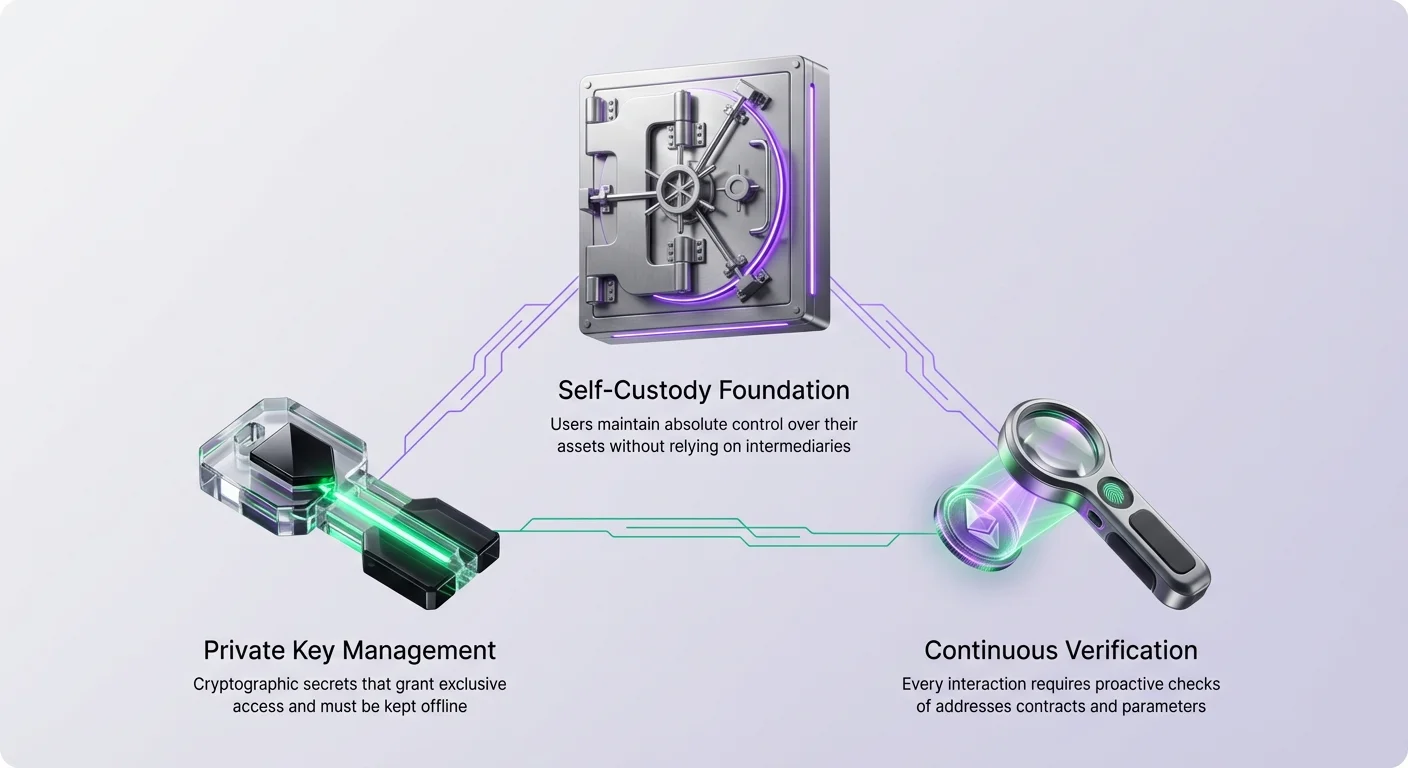
The core principle of decentralized finance is self-custody. This concept distinguishes Web3 wallets from traditional bank accounts or centralized exchange accounts. In a custodial arrangement, a third party holds the ultimate control over the funds. Reviewing custody risks in detail is crucial. They manage the security, and you must trust them to protect your assets from insolvency or theft. If a centralized exchange pauses withdrawals, you lose access to your capital.
Private Keys and Control
Self-custody means you possess the private keys that control the specific address on the blockchain. These keys are often represented by a seed phrase, a sequence of words generated when you create a wallet. This phrase is the only way to access your funds. If you lose it, the funds are unrecoverable. Conversely, if someone else gains access to it, they have total control over your assets.
The most secure wallets are self-custodial, allowing you to interact directly with blockchains like Ethereum or Bitcoin. Because no central entity controls your access, you are immune to platform bankruptcies or account freezes. However, this places the burden of security entirely on your shoulders. You must store your seed phrase offline, away from digital eyes and potential hackers. Never type your seed phrase into a website or share it with support staff.
Hardware vs. Software Wallets
Self-custodial wallets generally fall into two categories: software (hot) wallets and hardware (cold) wallets. Software wallets exist as applications on your phone or extensions in your browser. They are convenient for frequent trading and connecting to decentralized applications. Hardware wallets are physical devices that store your private keys offline. They require you to physically confirm transactions on the device, adding an immense layer of security against remote attacks.
For significant holdings, a hardware wallet is recommended for maximum protection. However, many users start with mobile or browser wallets due to their ease of use. Regardless of the type, the security checklist remains the same: verify every interaction and never expose your private keys. When using a software wallet, ensure your device is free of malware and that you are using the official version of the application.
Analyzing DEX Liquidity and Volume
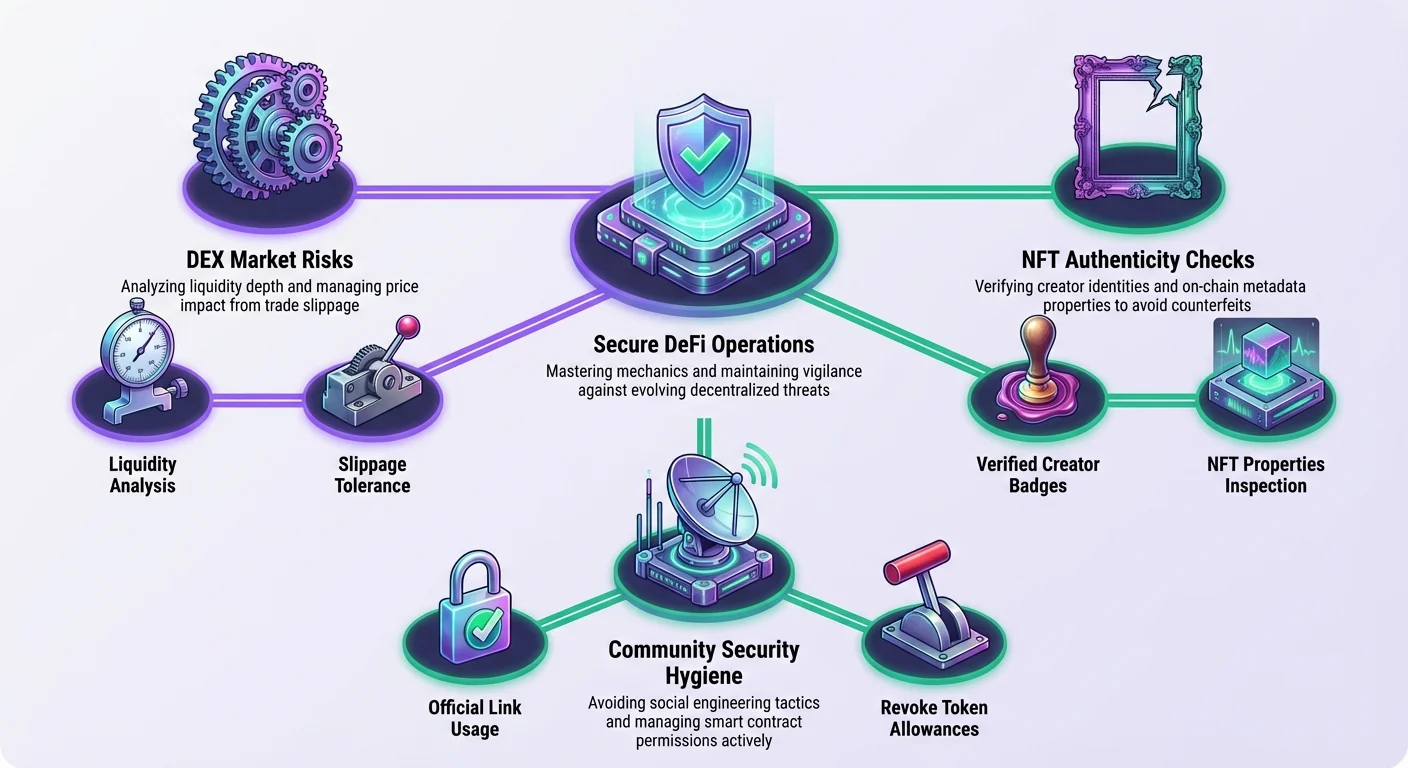
When trading on a decentralized exchange, understanding market analytics is a vital security measure. Scammers often create fake tokens with names identical to popular assets to trick users into swapping for worthless coins. One of the most effective ways to identify a legitimate market is by analyzing liquidity and volume.
Understanding Liquidity Pools
DEXs operate using liquidity pools, which are reserves of two assets that facilitate trading. For example, a pool might contain VERSE and WETH. People add liquidity to these pools to earn a share of the trading fees. A healthy, legitimate market will typically have substantial liquidity. This ensures that trades can occur without causing drastic price changes.
If you encounter a token with extremely low liquidity, it is a major red flag. Low liquidity often indicates a lack of community support or a potential "rug pull," where the developer removes all liquidity, leaving holders with unsellable tokens. Before swapping, access the DEX’s analytics dashboard. Look for the "Total Liquidity" metric and compare it to similar tokens. If a project claims to be popular but has only a few hundred dollars in liquidity, exercise extreme caution.
verifying Volume and Activity
Volume refers to the total amount of value traded within a specific timeframe, usually 24 hours. High volume suggests active participation and interest from the market. In the analytics section of a DEX, you can usually view the number of transactions and the average trade size.
A token with zero or near-zero volume is illiquid and risky. Furthermore, analyzing the transaction history can help you spot artificial activity. If you see only buy orders and no sell orders, it may indicate a malicious contract that prevents users from selling. Always check the pair data by tapping on the specific trading pair in the analytics menu to review fees generated and recent transaction counts.
Mastering Slippage and Price Impact
One of the most common ways users lose money in DeFi is not through direct theft, but through poor trade execution settings. Slippage is a key concept that refers to the difference between the expected price of a trade and the price at which the trade is actually executed. This occurs because asset prices can fluctuate between the moment you submit a transaction and the moment it is confirmed on the blockchain.
The Dangers of High Slippage Tolerance
Most DEX interfaces allow you to set a "slippage tolerance." This is a percentage that dictates how much price movement you are willing to accept. If the price moves unfavorably by more than your set tolerance, the transaction will fail. While it might be tempting to increase this percentage to ensure a trade goes through during volatile periods, doing so is dangerous.
Setting a high slippage tolerance, such as 10% or higher, leaves you vulnerable to front-running bots. These bots spot your pending transaction, buy the asset before you to drive up the price, and then sell it to you at the inflated price. You essentially pay the maximum amount your slippage tolerance allows.
Calculating Potential Loss
To understand the risk, consider a mathematical example. If you intend to swap 1 ETH and are quoted 1500 USDC, a 10% slippage tolerance means you are willing to accept as little as 1350 USDC or pay as much as 1650 USDC value equivalent. In a liquidity pool with low depth, a single large transaction can shift the price dramatically.
DEXs will usually display the "Minimum Received" amount based on your settings. This figure is key to optimizing your DEX swaps. Always review this number. If the difference between the market price and the minimum received is uncomfortably large, lower your trade size or wait for liquidity to improve. Using a DEX that automatically finds the most liquid exchange path can also help minimize slippage costs.
Verifying NFT Authenticity
The world of Non-Fungible Tokens (NFTs) is rife with copycat projects and intellectual property theft. Because anyone can upload an image and mint it as an NFT, seeing a familiar image on a marketplace does not guarantee it is the genuine article. Security in NFT collecting involves strict verification of properties, creators, and smart contracts.
Checking Creator Badges
Reputable decentralized marketplaces implement verification systems to help users identify authentic collections. This often takes the form of a verification badge or checkmark next to the creator's name or the collection title. This signals that the marketplace has vetted the project and confirmed its origin.
When browsing for an NFT, your first step should be to look for this badge. Be careful, as scammers may try to embed a checkmark image directly into the collection banner or logo to mimic the official badge. Hover over the badge or click the creator's profile to ensure it is a system-level verification and not just part of the artwork. If a popular project lacks a badge, it is almost certainly a fake.
Analyzing Properties and Rarity
Legitimate NFT collections, particularly those generated algorithmically, possess specific "properties" or traits. These traits are metadata coded into the token that describe visual elements like background color, accessories, or character type. Marketplaces display these properties along with their rarity percentages within the collection.
Fake collections often upload the images without the corresponding metadata properties. If you are looking at an NFT that appears to be part of a complex collection but has no properties listed, or the properties do not match the visual traits, it is likely a counterfeit. Reviewing the "Details" section of an NFT listing will also reveal the contract address. You can cross-reference this address with the official project website to confirm authenticity.
Safe Interaction with Marketplaces
Decentralized marketplaces allow for peer-to-peer trading without a middleman holding your assets. However, you must still connect your wallet to these platforms to interact. This connection process grants the application permission to view your balance and request transaction approvals.
Wallet Connection Protocols
When you click "Connect Wallet" on a site, you are establishing a link between your Web3 interface and the DApp. Trusted protocols like WalletConnect facilitate this securely. However, the danger lies in connecting to a phishing site that looks identical to a legitimate marketplace.
Always verify the URL of the marketplace before connecting. Phishers often buy domains that are slight misspellings of popular sites. Once connected, a malicious site may prompt you to sign a message or transaction that looks like a standard login but actually grants them permission to drain your funds. Never sign a transaction you do not understand, especially if it claims to be a mere "verification" or "login" step.
Understanding Trading and Royalty Fees
Security also involves financial prudence regarding fees. Marketplaces charge trading fees, often around 2.5%, to facilitate transactions. additionally, creators can set royalty fees for secondary sales. These fees ensure original artists are compensated as their work gains value.
While not a scam, failing to account for these fees can lead to unexpected losses. When buying or selling, review the fee breakdown. If a marketplace listing shows an unusually high royalty fee that doesn't match the official collection's standards, it could be a modified fake designed to funnel money to a scammer. Legitimate marketplaces clearly display the fee structure before you confirm the purchase.
Navigating Exchange Paths and Routes
In decentralized finance, there is not always a direct trading pair for the assets you wish to swap. For instance, you may want to trade a niche token for a specific stablecoin, but no direct liquidity pool exists for that pair. DEXs solve this using exchange paths, or routes.
How Routing Works
Routing involves finding the most liquid and cost-effective way to swap assets by using intermediate tokens. If you want to swap ETH for a token called SHIB, but the direct pair has poor liquidity, the DEX might route the trade from ETH to VERSE, and then from VERSE to SHIB. This multi-step process often results in a better final price than forcing a trade through an illiquid direct pair.
Security Implications of Routing
While routing is a feature designed for efficiency, it is important to review the proposed path. A compromised or low-quality interface might route you through pools with high fees or high price impact. Legitimate DEXs will display the exact path the trade will take.
By tapping on "Show swap details" or a similar option in the interface, you can see the exchange path. Ensure that the intermediate tokens are reputable. While the protocol handles this automatically, being aware of the route helps you understand where your fees are going. It also acts as a sanity check; if a simple trade is being routed through five or six obscure tokens, the gas fees will be astronomical, and you should reconsider the trade.
Social Engineering and Community Risks
A significant portion of crypto scams occur off-chain, primarily on social media platforms like Twitter, Discord, and Telegram. Scammers exploit the community-driven nature of Web3 to deceive users into handing over their assets or private keys.
verifying Social Channels
Projects often link to their official social media channels directly from their websites or marketplace profiles. Always use these official links rather than searching for the community on the social platform itself. Scammers create duplicate Discord servers and Telegram groups that look identical to the real ones, populated with fake users and bots to create a sense of legitimacy.
Inside these fake communities, "announcements" will direct you to phishing sites promising airdrops, exclusive mints, or urgent security updates. These sites are designed to steal your wallet credentials. If you are unsure if a channel is legitimate, cross-reference it with the links provided on the official project website or a verified marketplace page.
The "Support" Impersonation
One of the most pervasive scams involves impersonators posing as customer support. If you ask a question in a public Discord or tweet about a problem, you will likely receive Direct Messages (DMs) from users claiming to be "Help Desk" or "Admin." They may have the project's logo and a convincing name.
These imposters will offer to help you "validate" your wallet or "sync" your transaction. They will eventually ask for your seed phrase or send a link to a website asking for it. Remember: no legitimate admin, developer, or support agent will ever ask for your private key or seed phrase. They will never DM you first to offer support. Treat all unsolicited DMs as malicious attempts to compromise your security.
Transaction Fees and Network Native Assets
To perform any action on a blockchain, whether swapping tokens or buying an NFT, you must pay a transaction fee. These fees incentivize the network validators or miners to process your request. Understanding how these fees work is crucial for avoiding stuck transactions and failed interactions.
Native Currency Requirements
Transaction fees are always paid in the native currency of the blockchain you are using. On the Ethereum network, fees are paid in ETH. On the Polygon network, they are paid in MATIC. Even if you are swapping a different token, like USDC, you must hold a balance of the native currency in your wallet to pay for the gas.
A common mistake is transferring all funds into a token without leaving enough native currency for future gas fees. This results in the assets being "stuck" in the wallet until you deposit more of the native coin. Always maintain a buffer of the blockchain's native asset to cover potential spikes in network fees.
Gas Wars and Failed Transactions
During high-traffic periods, such as a popular NFT mint, network congestion can cause fees to skyrocket. This is often referred to as a "gas war." Users compete to have their transactions processed first by paying higher fees.
If you set your gas fee too low during these times, your transaction may fail, or it may remain pending for hours. This often requires troubleshooting stuck transactions. Importantly, even if a transaction fails, the network still consumes the gas you paid to attempt the process. You do not get a refund for failed gas fees. Most modern wallets and DEXs estimate fees automatically, but during extreme volatility, it is safer to wait for the network to cool down rather than risking expensive failed transactions.
| Security Feature | Best Practice | Risk Indicator |
|---|---|---|
| Private Keys | Store offline on paper or metal. | Stored in cloud, email, or typed online. |
| DEX Slippage | Set between 0.1% and 1%. | Set above 5% (risk of front-running). |
| URL verification | Bookmark official sites. | Clicking links in DMs or ads. |
Smart Contract Approvals and Revocation
When you want to trade a token on a DEX or list an NFT on a marketplace, you must first "approve" the smart contract to spend that specific token from your wallet. This is a necessary step, but it carries long-term security risks if not managed correctly.
The Risk of Unlimited Allowance
For convenience, many DApps ask for an "unlimited" allowance. This means the smart contract can access all of that specific token in your wallet at any time in the future, without asking for permission again. While this saves on gas fees for frequent traders, it creates a vulnerability.
If the smart contract of the DApp is later exploited or hacked, the attackers can use that unlimited approval to drain the tokens from your wallet, even if you haven't used the site in months. You should be wary of granting unlimited allowances to new or untested protocols. Learn more about mitigating smart contract risks.
Auditing and Revoking Permissions
Good security hygiene involves regularly auditing your wallet's active approvals. Several tools allow you to view which contracts have permission to spend your tokens. If you no longer use a specific DApp, or if you notice suspicious activity associated with a project, you should revoke the permission.
Revoking a permission requires a small gas fee, but it closes the door on potential exploits. It is a best practice to revoke allowances for high-value assets or after interacting with temporary or experimental projects. By keeping your active approvals list clean, you minimize the surface area for potential attacks.
The Role of Exchange Analytics in Safety
Using the analytics tools provided by DEXs is not just for finding profitable trades; it is a defense mechanism. These dashboards provide a transparent view of the market's health and can expose inconsistencies that are invisible on the simple swap interface.
Detecting Wash Trading
Wash trading occurs when a single entity buys and sells the same asset to create the illusion of high volume. This is done to attract unsuspecting investors to a fake or dying project. By looking at the detailed analytics, specifically the list of recent transactions, you can sometimes spot this behavior.
If you see the same wallet addresses trading back and forth repeatedly, or transactions of the exact same size occurring at regular intervals, it is likely wash trading. A legitimate market will have a chaotic, organic mix of different trade sizes and many different wallet addresses.
Tracking Fee Generation
Legitimate projects generate fees for liquidity providers. The analytics dashboard will show the fees accrued by the pool over the last 24 hours. If a project claims to have millions in volume but shows very little fee generation, something is wrong with the reporting or the contract mechanics.
Verifying that the fee generation aligns with the reported volume is a quick way to sanity-check the data. Scammers can easily manipulate a token's price chart, but it is much harder to fake the decentralized liquidity and fee data across the entire history of the pool.
Protecting Against Phishing and spoofing
Phishing remains the most effective attack vector in crypto because it targets human error rather than code vulnerabilities. We explore active crypto defense strategies against these threats. Attackers create websites that look pixel-perfect identical to popular DEXs or NFT marketplaces.
Domain Verification Strategies
The only difference between a real site and a phishing site is the URL. Attackers use "punycode" or similar character sets to make a URL look correct at a glance. For example, they might use a Cyrillic "a" instead of a Latin "a."
To defend against this, never rely on search engine results to navigate to a DeFi protocol. Scammers frequently buy ads that appear at the top of search results. Always type the URL manually or use a verified bookmark. If you are visiting a site for the first time, verify the link through the project's official documentation or a trusted data aggregator like CoinGecko or CoinMarketCap.
The Danger of Airdrop Phishing
A common tactic involves sending free tokens or NFTs to your wallet unprompted. These tokens often have names like "Visit-Website-To-Claim." When you go to the website and connect your wallet to "claim" your reward, the malicious contract drains your assets.
If you find random tokens in your wallet that you did not buy, do not interact with them. Do not try to sell them or swap them. Simply ignore them. Interacting with the smart contract associated with these tokens is the trigger that compromises your security. Hiding them from your wallet view is the safest course of action.
Conclusion
Security in decentralized finance is an active, ongoing process that demands vigilance. The specific risks of this ecosystem—permanent transactions, self-custody requirements, and sophisticated phishing attempts—require users to be their own bank and security guard. By understanding the mechanics of DEXs, such as liquidity pools and slippage, and rigorously verifying NFT metadata and marketplace credentials, you can navigate this space with confidence.
The tools for security are readily available. Analytics dashboards, blockchain explorers, and community verification channels provide the data needed to distinguish between legitimate opportunities and scams. However, these tools are useless if not consistently applied. Establishing a routine of checking URLs, verifying contract addresses, and auditing wallet permissions is essential for long-term survival in the crypto market.
Ultimately, the power of DeFi lies in its removal of intermediaries, but this power implies that no one is coming to save you if you make a mistake. Your safety relies on your habits. Treat every transaction as a high-stakes operation, verify every source, and never prioritize convenience over security.
True security in crypto is not about the strength of the code, but the discipline of the user.