
The landscape of cryptocurrency trading has evolved significantly over the last decade. In the early days, enthusiasts monitored price charts manually, executing trades based on gut feeling or basic analysis. As the market matured, the volatility and 24/7 nature of digital assets exposed the limitations of human endurance. Sleep, emotions, and reaction times became liabilities in a market that never closes. This realization paved the way for the adoption of automated trading strategies.
Automation in cryptocurrency involves using software to execute trades based on pre-defined criteria. It moves beyond simple buy and hold strategies. It introduces a systematic approach to capitalizing on market movements. For traders in 2025, understanding these tools is no longer a luxury. It is often a necessity for maintaining a competitive edge.
The core appeal of automation lies in its ability to process data faster than any human. Algorithms can analyze price action across multiple exchanges simultaneously. They can execute orders in milliseconds. This speed is crucial in an environment where prices can fluctuate by double-digit percentages in minutes. Furthermore, automation removes the emotional component of trading. Fear and greed are the primary drivers of poor investment decisions. Software follows the plan without hesitation, regardless of market panic or euphoria.
The Mechanics of Automated Trading
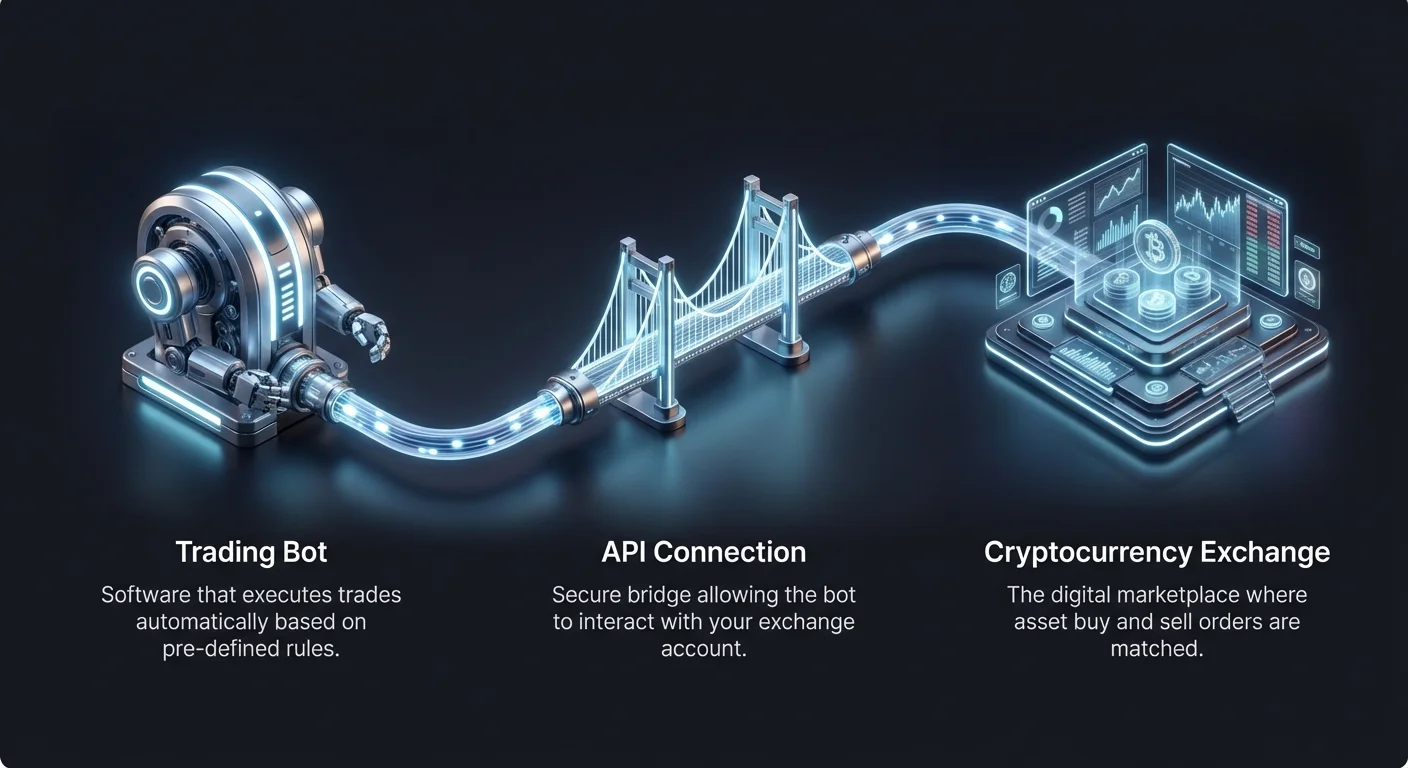
At the heart of crypto automation sits the trading bot. A bot is a software program designed to interact directly with financial exchanges. It does this through an Application Programming Interface, or API. The API acts as a bridge. It allows the bot to send buy and sell instructions to the exchange without the user needing to be logged into the website.
These bots operate based on specific algorithms. An algorithm is simply a set of rules. For example, a rule might be to buy Bitcoin when its price drops by five percent and sell it when it rises by ten percent. While this is a simplistic example, modern bots use complex mathematical models. They utilize technical indicators like Moving Averages, the Relative Strength Index (RSI), and MACD to identify trends.
The effectiveness of a bot depends entirely on the strategy it is programmed to follow. The software itself is merely a tool for execution. If the underlying strategy is flawed, the bot will execute losing trades just as efficiently as winning ones. Therefore, successful automation requires a deep understanding of market mechanics. Traders must configure their bots to align with current market conditions.
Distinguishing Between Investment and Trading
Before diving into specific automated strategies, it is vital to understand the difference between investing and trading. Automation applies differently to each approach. Investing typically involves a long-term outlook. Investors buy assets with the intention of holding them for months or years. They believe in the fundamental value of the project.
Trading, conversely, focuses on short-term price movements. Traders aim to profit from volatility. They may not care about the long-term viability of a project, only its price action over the next hour or day. Automated systems are primarily designed for trading. They thrive on the rapid price swings that characterize the crypto market.
However, automation can also assist investors. Strategies like Dollar-Cost Averaging (DCA) are automated investment techniques. They help accumulate assets over time without trying to time the market. Understanding your primary goal is the first step in selecting the right automation tool. A strategy designed for high-frequency scalping will be disastrous for a long-term investor looking for stability.
The Role of Cryptocurrency Exchanges
Automated trading cannot exist without the infrastructure provided by cryptocurrency exchanges. These platforms serve as the marketplace where digital assets are bought and sold. In 2025, the variety of exchange types offers different benefits for automated strategies. The choice of exchange directly impacts the performance of a trading bot.
Centralized Exchanges (CEX) remain the most popular venue for automated trading. These platforms are operated by a central authority or company. They function similarly to traditional stock exchanges. They offer high liquidity, which is the ability to buy or sell an asset quickly without causing a drastic change in its price.
For a trading bot, liquidity is paramount. If a bot attempts to sell a large amount of Bitcoin on an exchange with low liquidity, it may suffer from slippage. Slippage occurs when the final execution price is worse than the expected price. Centralized exchanges typically provide the deep order books necessary to minimize this risk. They also offer robust API support, making them easy to integrate with third-party bot software.
Decentralized and Hybrid Alternatives
Decentralized Exchanges (DEX) operate without a central authority. They facilitate peer-to-peer trading directly on the blockchain. While they offer enhanced privacy and security by allowing users to retain custody of their funds, they often present challenges for automation. Transaction speeds on a DEX are limited by the block time of the underlying network.
This latency can be a disadvantage for high-frequency bots that rely on split-second execution. Additionally, liquidity on DEXs can be fragmented. However, for arbitrage strategies that exploit price differences between platforms, DEXs are an essential part of the ecosystem.
Hybrid exchanges attempt to combine the best of both worlds. They aim to offer the liquidity and speed of a centralized platform with the security of a decentralized one. As the industry evolves, these platforms are becoming more viable for automated strategies. They reduce the counterparty risk associated with leaving funds on a centralized server while maintaining the performance needed for algorithmic trading.
Security Considerations on Exchanges
Security is the foundation of any trading activity. When using automated tools, you often have to keep funds on an exchange to be ready for trading. This introduces risk. Centralized exchanges mitigate this through various protocols. The most standard measure is Two-Factor Authentication (2FA). This adds a layer of protection beyond just a password.
Cold storage is another critical security feature. This involves storing the majority of user funds in offline wallets that are not connected to the internet. This makes them inaccessible to hackers. Top-tier exchanges employ cold storage for the vast majority of their assets. They only keep a small percentage in "hot wallets" to facilitate immediate withdrawals and trading.
When connecting a bot to an exchange via API, users must handle permissions carefully. API keys should be generated with trade-only access. They should never have withdrawal permissions enabled. This ensures that even if a malicious actor gains access to the bot or the API key, they cannot remove funds from the account.
Grid Trading Strategies
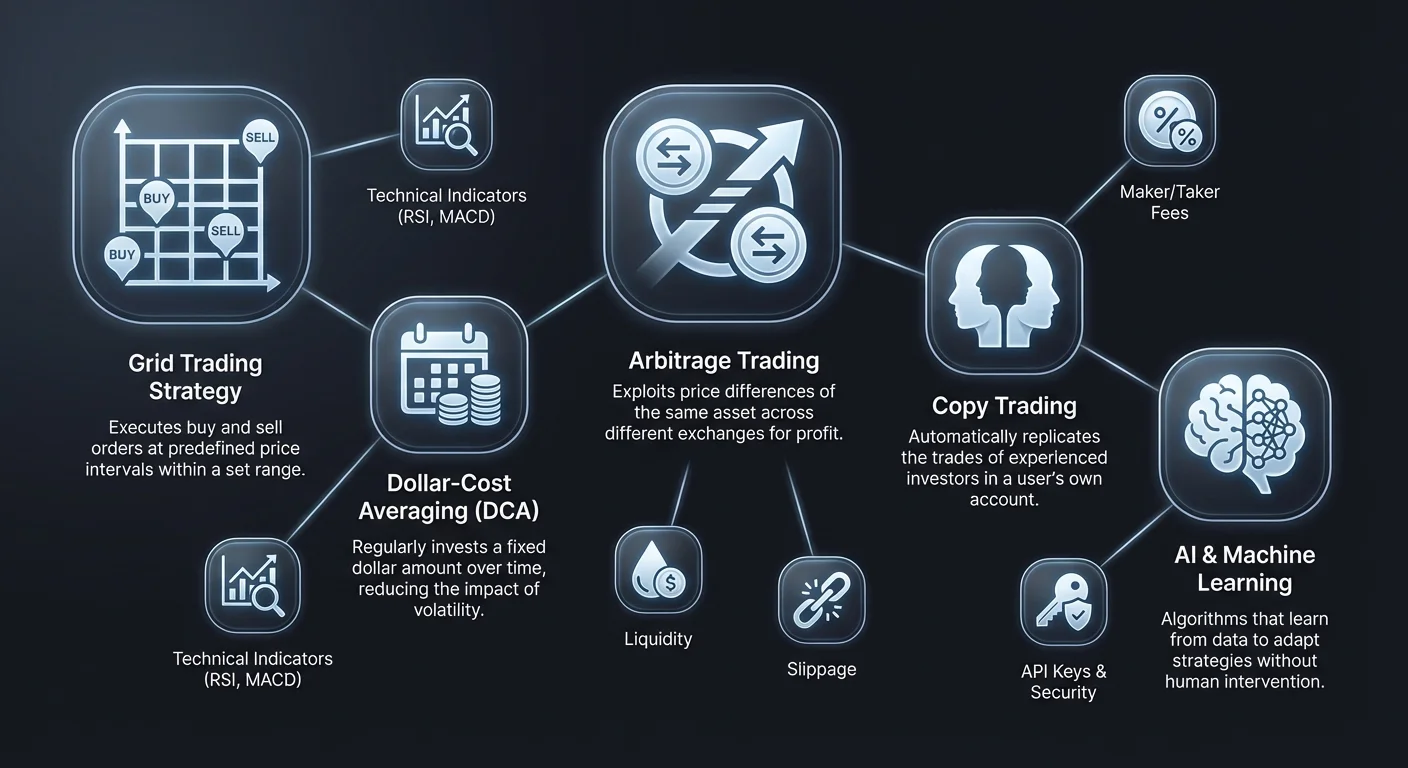
Grid trading is one of the most popular automated strategies for the cryptocurrency market. It is particularly effective in sideways or ranging markets. A ranging market occurs when the price of an asset fluctuates between a consistent high and low price without establishing a clear upward or downward trend.
The concept of grid trading is straightforward. The trader sets a price range for a specific asset. Within this range, the bot creates a series of buy and sell orders at specific intervals. These intervals create a "grid" of orders. When the price drops to a certain level, the bot executes a buy order. When the price rises to the next level, it sells the asset for a profit.
This strategy thrives on volatility. Every time the price wiggles up and down, the bot captures a small profit. In a market that moves flat for weeks, a manual trader might make zero profit. A grid bot, however, could execute hundreds of trades, accumulating small gains that add up to a significant return.
Setting Up a Grid
To deploy a grid strategy, a trader must first identify the trading range. This involves technical analysis to find support and resistance levels. Support is the price level where an asset historically has difficulty falling below. Resistance is the ceiling it struggles to break through.
Once the range is set, the user determines the number of grids. This dictates the spacing between orders. More grids mean smaller gaps between orders. This results in more frequent trades but smaller profits per trade. Fewer grids result in larger profits per trade but fewer executions. Finding the right balance is key to optimizing the strategy.
There is a risk to grid trading. If the price breaks out of the defined range, the strategy becomes less effective. If the price drops below the lower limit, the bot will have bought the asset all the way down and will be left holding a bag of depreciating coins. It will stop trading until the price returns to the grid. Conversely, if the price skyrockets above the upper limit, the bot will sell all holdings early. The trader misses out on the continued upside.
Market Conditions for Grid Bots
Grid bots are not "set and forget" money printers. They require monitoring. They perform best when the market is indecisive. In a strong bull run, a simple buy-and-hold strategy often outperforms a grid bot. The bot sells too early as the price climbs. In a bear market, the bot keeps buying as the price falls, potentially leading to unrealized losses.
Advanced grid bots offer features to mitigate these risks. "Trailing up" features allow the grid to move upward with the price. This helps capture profits during a trend while still trading the volatility. Stop-loss mechanisms can also be integrated. These automatically shut down the bot and sell positions if the price falls below a critical level, preventing catastrophic losses.
Arbitrage Trading
Arbitrage is a trading strategy that exploits price discrepancies for the same asset across different markets. In an efficient market, the price of Bitcoin should be identical on every exchange. However, the crypto market is fragmented. Liquidity varies from platform to platform. Regional demand can cause price spikes in one area while prices remain flat elsewhere.
An arbitrage bot constantly monitors the prices of assets on multiple exchanges. When it detects a difference, it acts. For example, if Bitcoin is trading at $50,000 on Exchange A and $50,200 on Exchange B, the bot buys on Exchange A and instantly sells on Exchange B. The $200 difference, minus fees, is profit.
This strategy is considered low risk compared to directional trading. The trader is not betting on the price going up or down. They are simply capturing a market inefficiency. However, speed is critical. These price gaps often exist for only seconds. Human traders cannot react fast enough to capture them. Automated bots are essential for this strategy.
Types of Arbitrage
There are several forms of arbitrage. Cross-Exchange Arbitrage is the standard method described above. It requires the trader to hold funds on both exchanges involved. Transferring funds between exchanges takes too long. The trader must already have fiat or stablecoins on the buying exchange and the crypto asset on the selling exchange to execute the trade instantly.
Triangular Arbitrage occurs within a single exchange. It involves trading three different assets. For instance, a trader might exchange Bitcoin for Ethereum, then Ethereum for XRP, and finally XRP back to Bitcoin. If there are price misalignments between these pairs, the trader ends up with more Bitcoin than they started with.
This method avoids the need to transfer funds between platforms. It also eliminates the risk of withdrawal delays. However, it requires high liquidity on all three trading pairs. If one leg of the triangle takes too long to fill, the profit margin can vanish.
Risks in Arbitrage
While theoretically low risk, arbitrage has practical challenges. The primary enemy is execution fees. Every trade incurs a fee. In cross-exchange arbitrage, there are withdrawal fees to consider when rebalancing funds. If the price spread is smaller than the combined fees, the trade results in a loss.
Slippage is another danger. If the bot spots a price difference but the available liquidity at that price is small, the order may not fill completely. The remaining portion might fill at a worse price, erasing the profit. Additionally, during times of high network congestion, transfers between exchanges can be delayed. This can leave a trader exposed if they need to move funds to cover a position.
Finally, competition is fierce. Large institutional traders use sophisticated arbitrage bots with direct connections to exchange servers. Retail traders using standard API connections may find themselves beaten to the trade by milliseconds.
Copy Trading
Copy trading creates a bridge between social networking and financial markets. It allows users to automatically replicate the trades of experienced investors. This is an attractive option for beginners who lack the time or expertise to analyze charts themselves. Instead of programming a bot with a specific strategy, the user selects a "Master Trader" to follow.
When the Master Trader opens a position, the follower's account automatically opens the same position. The size of the trade is adjusted proportionally to the follower's account balance. If the Master Trader allocates 5% of their portfolio to a Bitcoin buy, the follower's account will also allocate 5%.
This creates a passive investment vehicle. The follower relies entirely on the skill of another person. It is distinct from "social trading," where users merely discuss ideas. Copy trading is executable action. It binds the financial results of the follower to the leader.
Selecting a Trader to Copy
The success of copy trading depends on choosing the right leader. Platforms provide detailed statistics to help with this decision. Key metrics include Return on Investment (ROI), win rate, and maximum drawdown. ROI indicates profitability over a specific period. However, a high ROI can be misleading if it was achieved through excessive risk.
Maximum drawdown is a crucial metric. It measures the largest decline in the trader's portfolio from peak to trough. A trader with 500% ROI but a 90% drawdown is extremely risky. It suggests they gamble with high leverage. A consistent trader with lower ROI but minimal drawdown is often a safer bet for long-term growth.
Diversification applies here as well. Copying a single trader puts all capital at risk of one person's judgment. Spreading capital across multiple traders with different strategies can smooth out volatility. One trader might focus on Bitcoin, while another specializes in altcoins or scalping strategies.
The Cost of Copying
Copy trading is rarely free. The Master Traders need an incentive to share their strategies. Platforms typically use a profit-sharing model. A percentage of the follower's profits is deducted and given to the Master Trader. This aligns the interests of both parties. The leader only gets paid if the followers make money.
However, users must also account for standard exchange fees. Every trade executed by the copy software incurs trading fees. In a high-frequency strategy, these fees accumulate quickly. It is possible for a Master Trader to show a small profit while the follower shows a loss after fees are deducted. Users should verify if the reported performance statistics are net of fees or gross.
Understanding Exchange Fees
Fees are the friction in any automated trading system. Understanding the fee structure of an exchange is vital for profitability. Most centralized exchanges use a Maker-Taker model. This model differentiates between orders that provide liquidity and orders that take it away.
A "Maker" order is a limit order that is placed on the order book. It does not fill immediately. It sits there, adding depth to the market, waiting for someone to accept the price. Makers are often rewarded with lower fees because they help stabilize the market.
A "Taker" order is a market order that fills immediately against an existing order on the book. It removes liquidity. Takers generally pay higher fees. Trading bots can be configured to act as makers or takers. A grid bot, for example, places limit orders, often qualifying for maker fees. An arbitrage bot usually requires immediate execution, incurring taker fees.
Withdrawal and Network Fees
Beyond trading fees, users must consider the cost of moving funds. Withdrawal fees vary significantly by exchange and by asset. Some platforms charge a flat fee to withdraw Bitcoin, regardless of the amount. Others may offer free withdrawals up to a certain limit.
These costs are particularly relevant for arbitrage strategies that involve moving assets between platforms. If a bot makes a $10 profit on a trade but it costs $15 to move the funds back to the starting position, the strategy is viable only on paper.
High-volume traders often qualify for fee discounts. Exchanges have VIP tiers based on 30-day trading volume. Automated trading naturally generates high volume. Traders should check if they can reduce their costs by holding the exchange's native token or reaching a higher volume tier. Even a 0.01% reduction in fees can substantially impact the bottom line over thousands of trades.
Risk Management in Automation
Automation does not eliminate risk. It changes the nature of the risk. One of the biggest dangers is technical failure. Internet outages, API disconnects, or exchange downtime can leave a bot stranded. If a bot opens a position and then loses connection, it cannot close the position if the market turns against it.
Software bugs are another concern. A flaw in the bot's logic could cause it to execute unintended trades. It might buy repeatedly without selling, draining the account balance. It is essential to use reputable software that has been tested thoroughly.
"Black Swan" events are unpredictable market crashes. During extreme volatility, liquidity can dry up. A bot programmed to sell at a specific stop-loss price might find no buyers at that level. The price could gap down, resulting in a much larger loss than anticipated. Algorithms function best in normal market conditions. They struggle during chaotic events.
Monitoring and Intervention
The term "passive income" is often associated with bots, but it is misleading. Automated systems require supervision. Traders should check their bots daily. They need to ensure the strategy remains valid for the current market phase.
If a grid bot is running a neutral strategy and the market suddenly enters a parabolic bull run, the trader should intervene. They might need to pause the bot, adjust the grid range, or switch to a trend-following strategy. Leaving a bot unattended for weeks is a recipe for unexpected losses.
Setting hard limits is a best practice. Most bot platforms allow users to define a maximum loss. If the equity in the bot drops by a certain percentage, it shuts down automatically. This acts as a circuit breaker, preserving the remaining capital.
Dollar-Cost Averaging (DCA)
Dollar-Cost Averaging is perhaps the simplest form of automation. It removes the pressure of timing the market entry. Instead of investing a lump sum all at once, the investor divides the capital into smaller amounts. The system then buys the asset at regular intervals, regardless of the price.
For example, instead of buying $12,000 of Bitcoin today, a DCA bot buys $1,000 every month for a year. When the price is high, the bot buys fewer coins. When the price is low, the bot buys more coins. Over time, this lowers the average cost per coin compared to trying to catch a bottom and missing.
DCA is a powerful psychological tool. It transforms price dips from stressful events into opportunities to accumulate more assets. It is particularly effective in the crypto market, where bear markets can last for a year or more. An automated DCA bot ensures the investor stays disciplined and continues to build their position during the boring or fearful phases of the market cycle.
DCA Risks and Variations
While safer than lump-sum investing during a downtrend, DCA is not risk-free. In a continuously rising market, DCA results in a higher average entry price than buying immediately. The investor ends up paying more for the asset as it climbs.
Advanced DCA bots offer "Smart DCA" features. These adjust the purchase amount based on technical indicators. For instance, the bot might double the purchase amount if the RSI indicates the asset is oversold. It might pause purchases if the market is overbought. This attempts to optimize the entry price while maintaining the disciplined schedule of standard DCA.
Technical Analysis Indicators in Automation
Most trading bots rely on technical analysis to make decisions. They do not read news headlines or analyze fundamental project data. They read numbers. Understanding the indicators used by bots helps traders configure them correctly.
Moving Averages (MA) are foundational. A Simple Moving Average (SMA) calculates the average price over a set number of days. Bots often use the "Golden Cross" strategy. This triggers a buy signal when a short-term moving average crosses above a long-term moving average. It signals upward momentum.
The Relative Strength Index (RSI) measures the speed and change of price movements. It oscillates between 0 and 100. An RSI above 70 is typically considered overbought, suggesting a price drop may occur. An RSI below 30 is oversold, suggesting a bounce. Mean-reversion bots use RSI to buy the dip and sell the rip.
MACD and Bollinger Bands
The Moving Average Convergence Divergence (MACD) is a trend-following momentum indicator. Bots use the convergence and divergence of two moving averages to identify buy and sell signals. It is useful for confirming the strength of a trend.
Bollinger Bands consist of a middle band (usually an SMA) and two outer bands. The outer bands expand and contract based on volatility. When the price touches the lower band, it is often considered a buy signal. When it touches the upper band, it is a sell signal. Grid bots can utilize Bollinger Bands to dynamically adjust their grid range based on current market volatility.
Selecting the Right Crypto Exchange
Choosing the right exchange is as critical as choosing the right bot. Not all exchanges support every type of automation. Some have restrictive API limits that prevent high-frequency trading. Others lack the specific trading pairs a user wants to target.
Security should be the primary filter. Exchanges with a history of hacks or poor security practices should be avoided. Users should look for platforms that offer cold storage, insurance funds, and regulatory compliance. A secure platform ensures that the profits made by the bot are not lost to theft.
User Interface (UI) matters for configuration. Even though the bot handles the trading, the human must set it up. A clear, intuitive dashboard makes it easier to monitor performance and adjust settings. Complex, cluttered interfaces increase the chance of user error during setup.
Comparing Exchange Features
When evaluating exchanges for automation, liquidity is a key metric. High trading volume ensures that orders fill quickly and at the expected price. Low liquidity leads to slippage, which eats into the thin margins of algorithmic trading.
The variety of available assets is also important. Traders looking to run bots on obscure altcoins need an exchange that lists them. However, major exchanges often have stricter listing requirements, meaning they offer fewer but more reputable assets. Smaller exchanges might list hundreds of coins but lack the liquidity to trade them effectively with a bot.
| Feature | Importance for Automation | Description |
|---|---|---|
| Liquidity | High | Ensures orders fill instantly without price slippage. |
| API Quality | High | Stable connections prevent bot downtime and errors. |
| Fee Structure | High | Low maker/taker fees are essential for profit margins. |
The Future of Crypto Automation
As we move through 2025, artificial intelligence (AI) is beginning to reshape crypto automation. Traditional bots follow static rules. AI bots use machine learning. They can adapt to changing market conditions without human intervention.
Machine learning algorithms analyze vast amounts of historical data to find patterns invisible to the human eye. They can adjust their own parameters. If market volatility increases, an AI bot might automatically widen its grid spacing. If a trend reverses, it might switch from a long strategy to a short strategy.
This evolution brings new challenges. AI models are complex opacity boxes. It is difficult to understand exactly why the bot made a specific decision. This lack of transparency can be unsettling for traders. Furthermore, AI models can be "overfitted" to past data, performing perfectly in backtests but failing in live markets.
Regulatory Landscape
Regulation is catching up with automation. In some jurisdictions, the use of trading bots is scrutinized. Regulators are concerned about market manipulation. Strategies like "spoofing," where a bot places fake orders to trick other traders, are illegal in traditional finance and increasingly policed in crypto.
Users must be aware of the legal implications of their strategies. Exchanges are implementing stricter Know Your Customer (KYC) protocols. They are also monitoring for suspicious trading patterns. Using a bot to manipulate low-liquidity markets can result in account bans or legal action.
Compliance is becoming a feature of reputable bot platforms. They are building safeguards to prevent illegal trading activities. This legitimizes the industry and paves the way for institutional adoption of automated strategies.
Security Best Practices for Bot Users
Running a bot involves giving a third-party application access to your funds. This requires strict security hygiene. The first rule is API management. When creating an API key, users should whitelist IP addresses. This restricts access to the API key to only the specific server hosting the bot. If the key is stolen, it is useless from any other computer.
Two-Factor Authentication (2FA) should be enabled on both the exchange account and the bot platform account. Authenticator apps are more secure than SMS codes, which are vulnerable to SIM swapping attacks.
Regularly auditing API keys is recommended. If a bot is no longer in use, the API key should be deleted immediately. Leaving old, unused keys active increases the attack surface. Users should also be wary of downloading bot software from unverified sources. Malware disguised as a trading bot is a common method for stealing credentials.
Hardware Wallets and Profits
A common mistake is leaving all profits on the exchange. While the trading capital needs to be online, the profits do not. Traders should regularly skim profits and move them to a hardware wallet.
A hardware wallet is a physical device that stores private keys offline. It is immune to online hacks. By regularly moving profits to cold storage, the trader limits their exposure. In the worst-case scenario of an exchange hack, they only lose the active trading capital, not their accumulated wealth.
Conclusion
Crypto automation offers a powerful toolkit for navigating the complexities of the 2025 market. It provides the speed, discipline, and efficiency necessary to compete in a 24/7 environment. From the steady accumulation of Dollar-Cost Averaging to the rapid-fire execution of arbitrage and the systematic approach of grid trading, there is a strategy for every risk profile. However, these tools are not magic wands. They require understanding, monitoring, and respect for the underlying risks.
Success in automated trading comes from a blend of technology and strategy. It requires selecting the right exchange with deep liquidity and robust security. It demands a clear understanding of fees and how they impact profitability. Most importantly, it requires the trader to remain educated and vigilant. The market is dynamic, and the strategies that work today may need adjustment tomorrow. By combining the precision of machines with human oversight, traders can unlock the full potential of their digital asset portfolios.
Automation amplifies your strategy, so ensure your underlying plan is sound before letting the code take over.