
Cryptocurrency markets are defined by their dynamic nature and intense price fluctuations. Since the inception of Bitcoin in 2009, the asset has experienced dramatic rises and falls. While this volatility attracts speculative traders and long-term investors looking for growth, it presents a significant hurdle for day-to-day transactions. Businesses and institutions require predictability for operational expenses and short-term liquidity. This is where stablecoins bridge the gap between the innovative potential of blockchain technology and the stability required for stable assets.
Stablecoins are a specific category of cryptocurrency designed to maintain a stable value relative to a pegged asset. Most commonly, these digital assets are pegged to fiat currencies like the US dollar, though some track the value of commodities such as gold. By maintaining a consistent price, stablecoins allow market participants to keep assets on the blockchain without being exposed to the wild price swings associated with Bitcoin or altcoins. This stability is the cornerstone of modern crypto liquidity.
For institutional investors and corporate treasuries, stablecoins serve as a vital tool for entering and exiting positions. When market volatility increases, traders can convert volatile assets into stablecoins rather than moving back into fiat currency. This keeps capital within the crypto ecosystem, allowing for faster redeployment when opportunities arise. This mechanism preserves liquidity within the market and reduces the friction and fees associated with traditional banking rails.
The Mechanics of Price Stability
Understanding how stablecoins function is essential for grasping their role in liquidity. Unlike Bitcoin, which has a fixed supply cap of 21 million coins and relies on market demand for its value, stablecoins generally have a variable supply. The supply expands or contracts based on the mechanisms used to maintain the peg. This elasticity allows the token to handle varying levels of demand without experiencing the price appreciation or depreciation seen in scarce assets.
There are different methods for achieving this stability. The most common approach involves a centralized issuer holding reserve assets. For every unit of the stablecoin issued on the blockchain, the issuer holds an equivalent amount of fiat currency, cash equivalents, or commercial paper in a traditional bank or vault. This 1:1 backing provides confidence that the digital token can be redeemed for the underlying asset. It mirrors the gold standard of the past but operates with the speed of the internet.
| Feature | Bitcoin | Stablecoins |
|---|---|---|
| Primary Purpose | Store of value, digital gold | Price stability, medium of exchange |
| Volatility Profile | High volatility | Low volatility (pegged) |
| Supply Mechanism | Fixed supply (21 million) | Variable supply based on reserves |
Other types of stablecoins use decentralized methods to maintain their value. These may rely on over-collateralization with other cryptocurrencies or algorithmic adjustments to supply. Regardless of the mechanism, the goal remains the same. The objective is to provide a blockchain-native asset that mimics the purchasing power of a stable fiat currency. This allows users to transact globally and instantly without the risk of their funds losing value during the transfer process.
Facilitating High-Volume OTC Trading
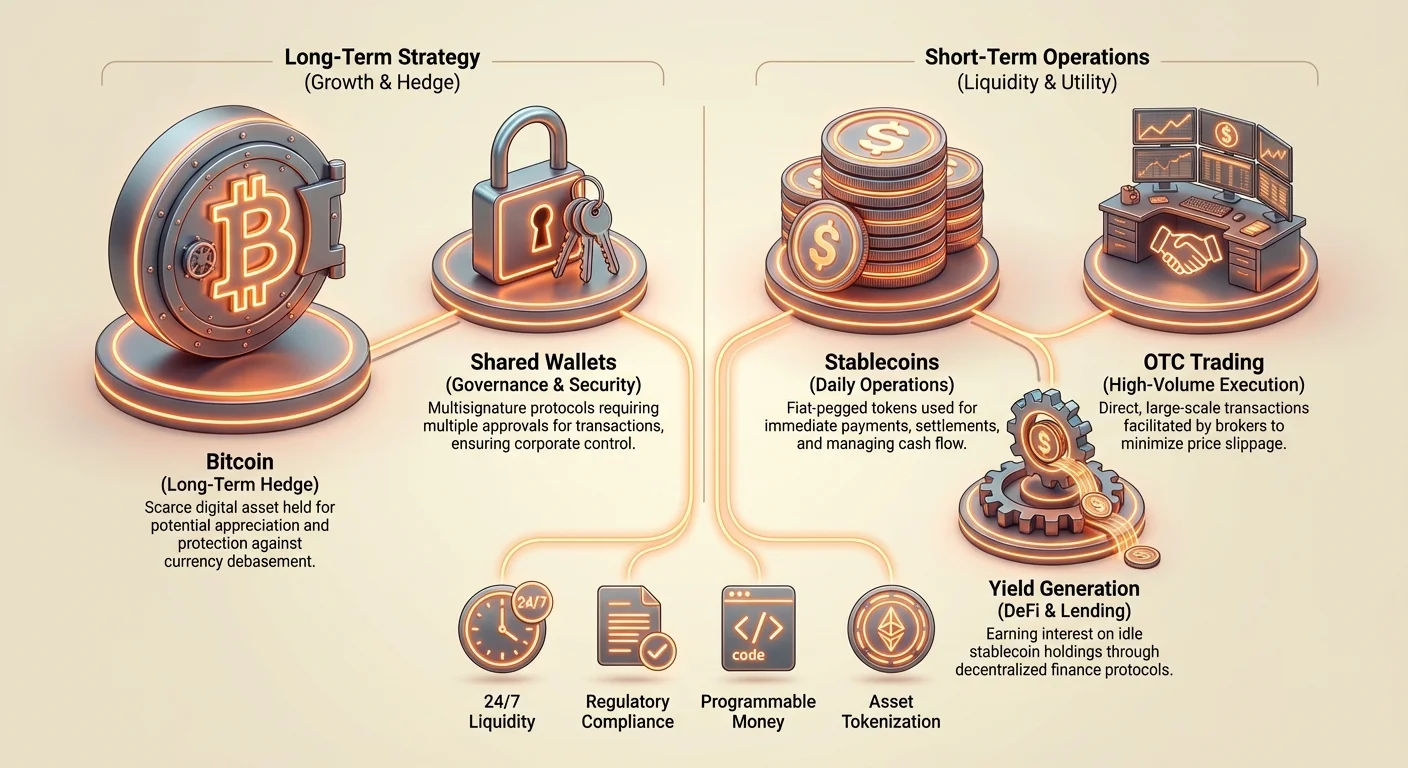
Institutional involvement in cryptocurrency often occurs through Over-The-Counter (OTC) trading desks rather than public exchanges. OTC trading involves direct transactions between two parties, often facilitated by a broker. This method is preferred by "whales" and institutions moving large sums of capital. Executing a multi-million dollar trade on a public order book could cause significant price slippage. This means the act of buying or selling negatively impacts the price the trader receives.
Stablecoins are the preferred settlement currency for many of these OTC transactions. In a bilateral trade, a buyer can settle a purchase of Bitcoin using a US-dollar pegged stablecoin. This settlement happens on the blockchain, often within minutes. If the parties relied on traditional wire transfers, settlement could take days. This delay introduces counterparty risk, where one party might fail to deliver the agreed assets. Stablecoins minimize this risk by speeding up the exchange of value.
Brokerage desks rely on deep pools of stablecoin liquidity to service their clients. When a large holder wants to exit a Bitcoin position without triggering a market crash, the OTC desk matches them with a buyer. The liquidity provided by stablecoins ensures that the seller receives a stable value immediately. This ecosystem allows billions of dollars to flow through the crypto market daily without necessarily touching the traditional banking system for every individual trade.
Corporate Treasury Strategies
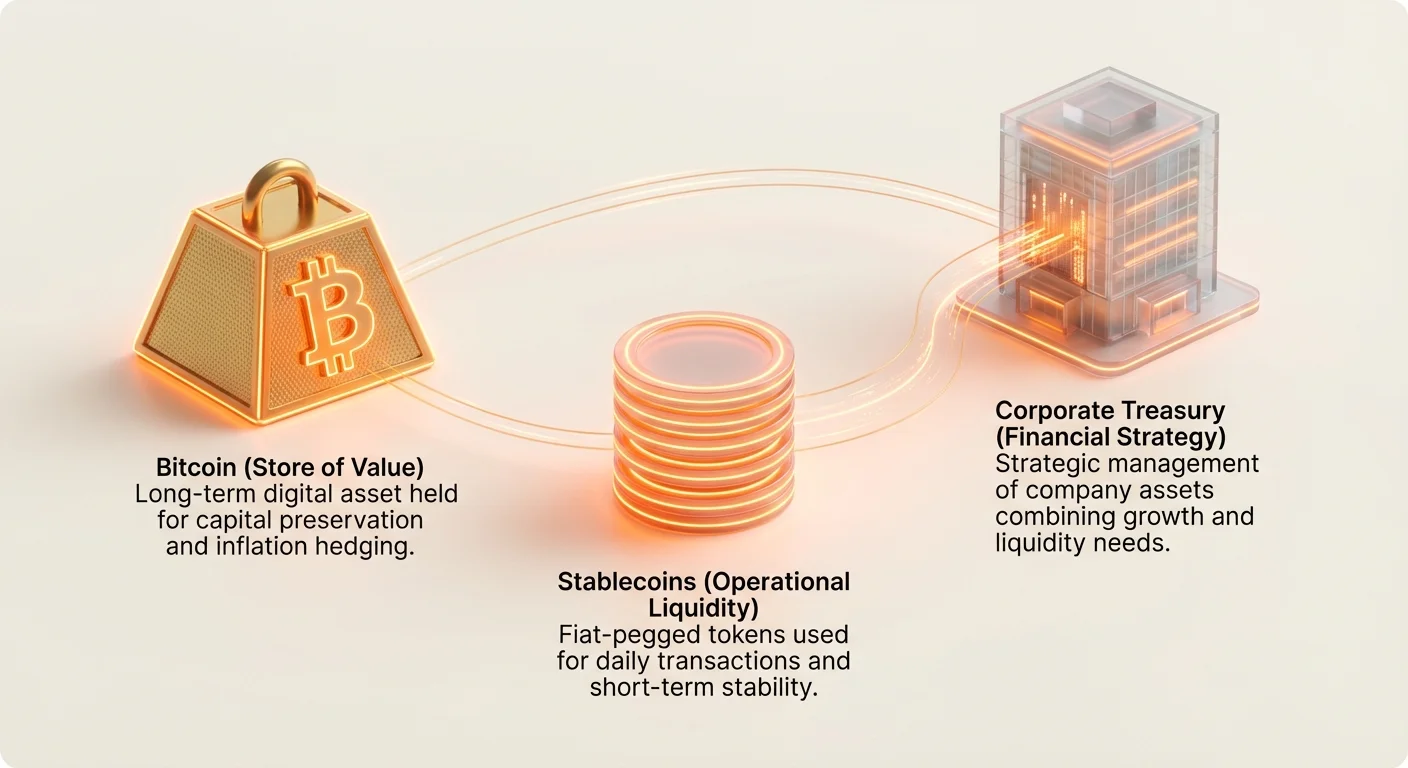
A corporate treasury refers to the financial assets a company holds on its balance sheet. Traditionally, companies hold cash, cash equivalents, and short-term bonds to meet operational needs. However, the landscape is shifting. Some forward-thinking corporations have begun adding Bitcoin to their treasuries as a long-term reserve asset. This strategy is often driven by a desire to hedge against inflation and diversify holdings away from fiat currency, which can lose purchasing power over time.
While Bitcoin serves as the long-term store of value in this strategy, stablecoins act as the operational liquidity layer. A company might hold Bitcoin for years, treating it like digital gold. However, they cannot easily use Bitcoin to pay suppliers or employees due to its volatility. Stablecoins solve this by acting as a cash equivalent that lives on the same network as the company's long-term investments.
Holding digital assets on a corporate balance sheet does impact financial reporting. Bitcoin is often classified as an "intangible asset." This means companies must record it at its purchase price. If the price drops, they may have to record an impairment loss. If the price rises, they typically cannot record the gain until the asset is sold. This accounting treatment is complex, but recent rule changes in some jurisdictions are moving toward fair value accounting. This would allow companies to reflect the current market price more accurately.
Operational Security with Shared Wallets
Managing a corporate crypto treasury requires rigorous security protocols. A single individual should never have sole control over a company's digital assets. This introduces "key person risk," where the loss or unavailability of that person could result in the permanent loss of funds. To mitigate this, institutions utilize shared wallets, also known as multisignature (multisig) wallets. These wallets require multiple approvals before a transaction can be broadcast to the network.
A shared wallet functions like a digital vault with multiple keys. For a corporate board, a "4-of-6" setup might be appropriate. In this configuration, six board members hold access keys, but at least four of them must approve any transaction. This ensures that no single member can drain the treasury. It also provides redundancy. If one or two members lose their keys or are unavailable during an emergency, the remaining members can still access the funds.
These wallets are not only for security against theft. They also serve as a governance tool. Every transaction request is visible to all participants. This transparency ensures that funds are being used according to the company's approved financial strategy. If a CFO initiates a transfer to pay a vendor using stablecoins, the CEO and another director must review and digitally sign the transaction. This process creates an immutable on-chain record of corporate financial decisions.
The Role of Shared Wallets in Governance
Beyond simple security, shared wallets enforce corporate hierarchy and spending limits. A company can set up different wallets for different purposes. A "treasury" wallet holding the bulk of the company's Bitcoin might require a majority of the board to unlock. Meanwhile, an "operations" wallet holding stablecoins for monthly expenses might only require a "2-of-3" signature from the finance department. This tiered approach balances high security for reserves with operational efficiency for daily needs.
The setup process for these wallets is critical. Participants generate their own private keys, which are never shared with others. When the wallet is created, it generates a single public address that can receive funds. However, sending funds out requires the coordination of the participants. This structure eliminates the single point of failure associated with basic wallets. It also protects the company from internal collusion, as a significant number of bad actors would be needed to compromise the funds.
Liquidity Pools and Yield Generation
One of the distinct advantages of holding stablecoins in a corporate treasury is the potential for yield generation through Decentralized Finance (DeFi). Unlike cash sitting in a corporate bank account, which often earns near-zero interest, stablecoins can be deployed into lending protocols. These platforms allow users to lend their stablecoins to other traders who are willing to pay interest for liquidity.
This utilization of assets connects directly to the concept of market efficiency. Traders need stablecoins to leverage their positions or engage in arbitrage. By supplying this liquidity, treasury managers can earn a return on their idle cash equivalents. However, this introduces new risks. While the stablecoin itself might be stable, the smart contracts governing the lending protocols can have vulnerabilities. Institutional managers must weigh the potential yield against the technical risks of the platform.
It is important to distinguish between holding assets for liquidity and holding them for growth. Bitcoin is held for potential appreciation and inflation protection. Stablecoins are held to facilitate action. They are the oil in the engine of the crypto economy. Without them, moving between different volatile assets would be slow, expensive, and tax-inefficient. The ability to move millions of dollars into a stable asset within seconds gives institutions the agility required in 24/7 markets.
Asset Classification and Market Dominance
Bitcoin dominance is a metric used to measure Bitcoin's share of the total cryptocurrency market capitalization. Stablecoins play an interesting role in this metric. During periods of market uncertainty, investors often sell altcoins and Bitcoin into stablecoins. This can technically reduce the total market cap of volatile assets while the stablecoin market cap grows or remains steady.
Monitoring these flows gives treasury managers insight into market sentiment. A swelling supply of stablecoins on exchanges often indicates "dry powder." This is capital that is sitting on the sidelines, ready to be deployed into Bitcoin or other assets when confidence returns. Conversely, if stablecoin reserves on exchanges are dropping, it may indicate that capital is leaving the ecosystem entirely, moving back into traditional fiat banking.
When comparing asset classes, Bitcoin has performed exceptionally well over the last decade, often outperforming stocks, bonds, and gold. However, it is still a relatively small asset class compared to global equities or real estate. As more corporations adopt Bitcoin treasuries, the liquidity provided by stablecoins will become even more critical to support the increased volume. The integration of traditional finance with crypto finance relies on these stable bridges.
Managing Volatility and Risk
Risk management is the primary duty of any treasury department. Bitcoin's volatility is its most cited drawback. While long-term trends have been upward, short-term drawdowns of 50% or more have occurred historically. Stablecoins neutralize this risk for the portion of the portfolio needed for near-term obligations. By maintaining a balanced allocation between Bitcoin (for growth) and stablecoins (for stability), companies can navigate market cycles effectively.
Dollar-cost averaging (DCA) is a common strategy employed to manage entry risk. Instead of buying a large position at once, a company might use their stablecoin reserves to purchase small amounts of Bitcoin at regular intervals. This smooths out the average purchase price and reduces the impact of buying at a local market peak. This strategy requires a consistent pool of stable liquidity to execute automatically over time.
Regulatory risk remains a significant factor for stablecoins. Since many are pegged to the US dollar and backed by fiat reserves, they are subject to scrutiny regarding their reserves and compliance with anti-money laundering laws. Institutions generally prefer regulated stablecoins with transparent audits. The safety of the peg is paramount; if a stablecoin loses its 1:1 value, it fails in its primary purpose as a store of stability.
Inflation Hedging vs. Cash Equivalents
The economic environment plays a massive role in treasury decisions. In times of high inflation, holding large amounts of fiat currency results in a loss of purchasing power. Bitcoin is viewed by many proponents as a hedge against this debasement due to its fixed supply. In contrast, fiat-backed stablecoins are subject to the same inflationary pressures as the currency they are pegged to. A US dollar stablecoin will lose purchasing power at the same rate as the US dollar.
Therefore, the role of the stablecoin is not to preserve wealth over decades, but to preserve nominal value over days, weeks, or months. They are a temporary shelter. Corporate treasurers must actively manage the ratio between their inflation-hedge assets (Bitcoin) and their liquid operational assets (stablecoins). Leaving too much capital in stablecoins for too long during high inflation is inefficient.
Conversely, real estate and gold are traditional stores of value, but they lack portability and divisibility. Gold is heavy, requires physical storage, and is difficult to transport. Real estate is illiquid and takes months to sell. Bitcoin and stablecoins share the advantage of being highly portable and divisible. A company can send a fraction of a Bitcoin or a million stablecoins to a subsidiary across the world in minutes. This efficiency is a major driver for global adoption.
The Impact of ETFs on Liquidity
The approval and launch of Bitcoin Exchange-Traded Funds (ETFs) have introduced a new dynamic to institutional adoption. ETFs allow investors to gain exposure to Bitcoin price movements without holding the asset directly. This appeals to traditional investment funds that may be restricted from holding actual cryptocurrency. However, holding an ETF is different from holding Bitcoin in a corporate treasury.
When a company buys a Bitcoin ETF, they are buying shares in a fund. They do not control the private keys. This introduces counterparty risk, as they are relying on the fund manager and the custodian. In contrast, the "self-custody" model used by companies like MicroStrategy involves holding the actual Bitcoin in secure wallets. This eliminates reliance on third-party managers but increases the responsibility for security.
For liquidity purposes, ETFs trade during stock market hours. The crypto market operates 24/7. A corporate treasury holding actual stablecoins and Bitcoin can execute trades on the weekend or holidays if a market event occurs. An ETF holder is stuck until the market opens on Monday. This continuous liquidity is a unique feature of the crypto-native treasury model, powered by the constant availability of stablecoin trading pairs.
Risks of Centralization in Stablecoins
While decentralized cryptocurrencies like Bitcoin are resistant to censorship, many popular stablecoins are issued by centralized entities. These issuers have the power to freeze addresses or blacklist funds if required by law enforcement or regulators. For a corporation, this centralization provides a layer of compliance comfort, as they are dealing with a regulated instrument. However, it contrasts with the ethos of censorship resistance found in Bitcoin.
There is also the risk of the "run on the bank" scenario. If confidence in the stablecoin issuer wavers, holders may rush to redeem their tokens for the underlying fiat. If the issuer does not have 100% liquid reserves, the peg could break. This occurred with several algorithmic stablecoins in the past. Corporate treasurers generally stick to the largest, most liquid, and most transparently audited fiat-backed stablecoins to mitigate this systemic risk.
Diversification within the stablecoin allocation is another risk management tactic. Rather than holding all liquid reserves in a single brand of stablecoin, a treasury might split holdings across two or three major issuers. This protects the company from a specific failure of one issuer while maintaining the utility of digital cash equivalents.
Future Trends in Treasury Management
As the infrastructure for digital assets matures, the line between traditional finance and crypto finance will likely blur. We are already seeing the tokenization of other assets, such as treasury bonds and stocks. This could allow stablecoins to be backed by government debt directly on-chain, providing a yield-bearing stable instrument without the need for third-party lending protocols.
The concept of "programmable money" allows corporate treasuries to automate complex financial flows. Smart contracts can automatically release stablecoin payments when certain conditions are met, such as the delivery of goods verified by a supply chain tracking system. This reduces administrative overhead and speeds up the cash conversion cycle. Bitcoin provides the capital base, while stablecoins and smart contracts provide the execution logic.
Institutional adoption is not just about buying Bitcoin; it is about integrating blockchain technology into financial operations. The ability to audit a balance sheet in real-time using blockchain explorers provides a level of transparency that is impossible with traditional accounting. As regulatory clarity improves, more standardized tools for reporting and tax compliance will emerge, lowering the barrier to entry for smaller corporations.
Conclusion
The integration of stablecoins and Bitcoin into institutional treasury management represents a shift in how organizations handle value. Bitcoin offers a digital, scarce asset that acts as a potential hedge against monetary inflation and a vehicle for long-term capital preservation. However, its inherent volatility necessitates a complementary asset to ensure operational fluidity. Stablecoins fulfill this role by providing the stability of fiat currency with the technological advantages of cryptocurrency. They enable rapid settlement, reduce friction in high-volume trading, and offer a secure medium for short-term liquidity needs.
For corporations, the adoption of these assets requires robust security frameworks. The use of shared multisignature wallets allows businesses to implement strict governance controls, eliminating single points of failure and ensuring accountability among decision-makers. As the market continues to evolve with the introduction of ETFs and deeper regulatory frameworks, the synergy between the store-of-value properties of Bitcoin and the utility of stablecoins will likely become a standard component of sophisticated financial strategies.
A balanced crypto treasury uses Bitcoin for long-term wealth preservation and stablecoins for immediate, reliable operational liquidity.