
The terminology surrounding digital assets is often used interchangeably by casual observers, yet distinct technical differences define the landscape. While "cryptocurrency" serves as a broad umbrella term for all blockchain-based assets, the ecosystem is sharply divided into two primary categories: coins and tokens. Understanding this fundamental taxonomy is essential for navigating the technical nuances of wallets, transaction fees, and network security.
At the highest level, the distinction relies on where the asset lives and how it is created. This classification impacts everything from how an asset is stored in a self-custodial wallet to how a user pays for transaction processing. As the industry matures, these categories have expanded to include complex standards that facilitate decentralized finance and digital ownership.
The Foundation: Native Coins
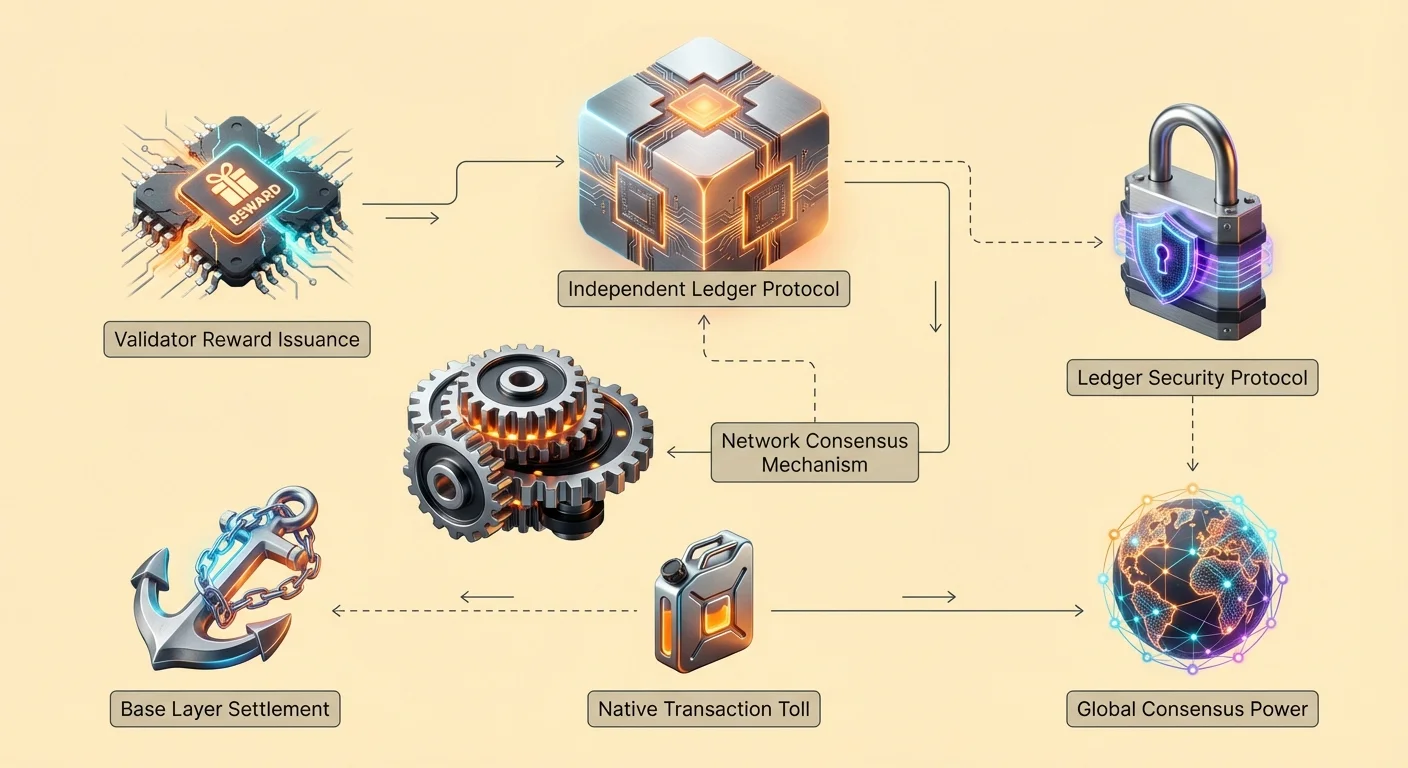
A "coin" is defined by its independence. It is the native asset of a specific blockchain network. These digital currencies are hard-coded into the protocol of their respective ledgers. They are not built on top of other platforms; they are the platform. Bitcoin (BTC) is the original and most prominent example of a coin. It exists on the Bitcoin blockchain and is essential for the network's operation.
The primary role of a native coin is to incentivize the maintenance of the ledger. Blockchains rely on decentralized networks of computers, known as nodes or validators, to process transactions and secure the history of the chain. These participants must be compensated for their hardware costs and electricity usage. The native coin serves as this reward mechanism.
The Role of Coins in Network Security
In a Proof of Work system like Bitcoin, miners solve complex mathematical puzzles to validate blocks. The network protocol rewards them with newly minted BTC. This issuance of new coins is the only way new Bitcoin enters circulation. The coin acts as the economic engine that keeps the infrastructure secure against attacks. Without the value of the native coin, there would be no financial reason for miners to protect the network.
Similarly, in Proof of Stake networks like Ethereum or Solana, the native coin is used to secure the protocol through a process called staking. Validators lock up a certain amount of the native coin (ETH or SOL) as collateral. This acts as a security deposit to ensure honest behavior. If a validator attempts to cheat the system, their staked coins can be slashed or confiscated.
Utility as a Medium of Exchange
Beyond security, native coins function as the default currency for paying transaction fees. Every time a user sends funds or interacts with a specialized application, the network charges a fee to prevent spam and prioritize traffic. This fee must almost always be paid in the blockchain's native coin.
For example, if a user wants to transfer an asset on the Ethereum network, they must hold ETH to pay for the "gas" required to process that transfer. Even if the asset being moved is not ETH, the toll for using the road must be paid in the native currency. This utility ensures a baseline demand for the coin as long as the network is being used.
The Expansion: Tokens and Smart Contracts
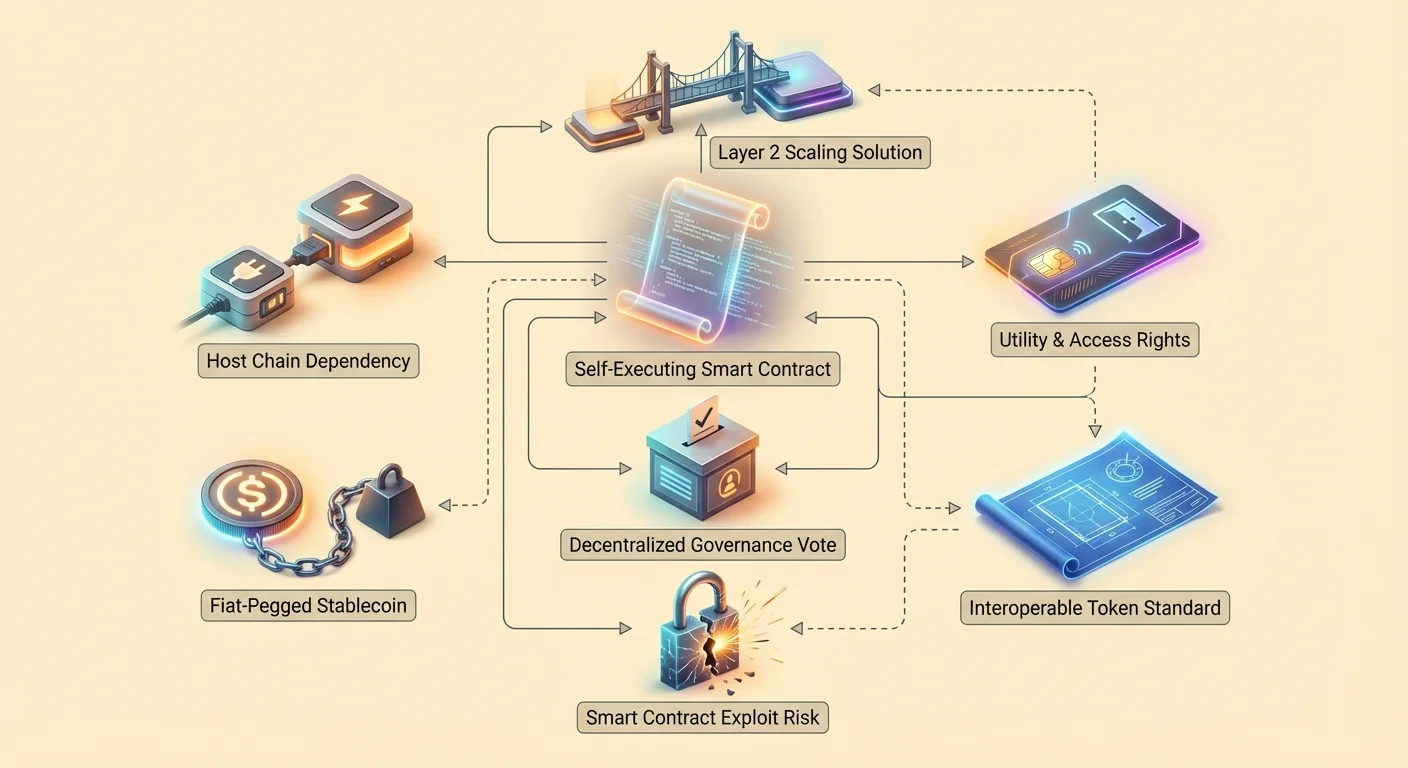
Unlike coins, tokens do not have their own independent blockchain. Instead, they are built on top of existing networks using smart contracts. A smart contract is self-executing code deployed to a blockchain that defines the rules for how a token behaves. These assets leverage the security and infrastructure of the host chain rather than building their own from scratch.
Tokens represent a massive expansion of what is possible in the crypto space. Because developers do not need to build a new blockchain to launch a token, the barrier to entry is significantly lower. This has led to the creation of thousands of unique assets that serve specific purposes within decentralized applications (dApps).
Dependence on Host Chains
A token is entirely dependent on its underlying blockchain for security and settlement. If the Ethereum network were to go offline, all tokens built on Ethereum would become inaccessible. The token relies on the host network's validators to confirm transactions and record balances.
This dependency creates a unique dynamic regarding fees. When sending a token, the user is technically asking the host network to update a ledger inside a smart contract. This operation requires computational power. Therefore, the user must pay the transaction fee in the host blockchain's native coin, not in the token itself.
Flexibility and Migration
Tokens offer immense flexibility in design. Developers can program specific features directly into the asset, such as automated inflation schedules, transaction taxes, or voting rights. This programmability allows for the creation of complex financial instruments that would be difficult to implement as a native coin.
Interestingly, the line between coin and token is not always permanent. Some projects launch as tokens to raise funds and build a community before migrating to their own proprietary blockchain. Binance Coin (BNB) is a historical example of this transition. It launched as an ERC-20 token on Ethereum before moving to its own dedicated network, at which point it became a coin.
Comparative Analysis: Coins vs. Tokens
The distinction between coins and tokens shapes the user experience and the technical architecture of digital assets. While they may appear similar in a wallet interface, their underlying mechanics differ significantly.
| Feature | Coin | Token |
|---|---|---|
| Infrastructure | Runs on its own independent blockchain | Built on top of an existing blockchain |
| Creation | Generated by protocol consensus (mining/staking) | Created by deploying a smart contract |
| Fee Payment | Used to pay network transaction fees | Requires native coin to pay transaction fees |
Value Proposition and Security
The value of a coin is typically tied to the adoption and security of its entire network. It functions as a store of value or a general-purpose currency. Its security model is derived from the collective power of all miners or stakers on that network. To attack a major coin, an adversary would need to overpower the entire global consensus mechanism.
Tokens, however, derive value from their specific utility or the project they represent. Their security risks are two-fold. First, they inherit the security of the host chain. Second, they are vulnerable to bugs within their specific smart contract code. A secure blockchain cannot protect a token if the token's own code contains a flaw that allows a hacker to mint infinite supply.
Token Standards and Interoperability
To ensure that tokens can be easily traded and stored, blockchain communities have developed technical standards. These standards function like a blueprint, dictating how a token must be coded to be compatible with exchanges and wallets. Without these standards, every token would require custom integration code.
The ERC-20 Standard
The most prominent standard is ERC-20, developed for the Ethereum network. This standard defines a common list of rules that an Ethereum token must follow. It ensures that the token has functions for transferring value, checking balances, and approving transactions.
Because of ERC-20, a single Ethereum wallet can store and manage thousands of different tokens without needing updates for each new asset. When a new project launches an ERC-20 token, it is immediately compatible with the existing infrastructure of decentralized exchanges and custody solutions.
Emerging Standards on Other Chains
Other blockchains have adopted similar models to foster their own ecosystems. Solana uses the SPL standard, while Binance Smart Chain utilizes BEP-20. These standards serve the same purpose as ERC-20, allowing for the efficient creation and management of fungible assets within their respective environments.
Non-fungible tokens (NFTs) utilize a different set of standards, most notably ERC-721. Unlike payment tokens where every unit is identical, ERC-721 tokens have unique identification codes. This standard allows for the representation of distinct digital items, such as artwork or gaming collectibles, which cannot be mutually interchanged on a one-to-one basis.
Taxonomy by Utility: Classifying Tokens
Beyond the technical architecture, tokens are often categorized by their intended function. This "utility taxonomy" helps investors and users understand what a specific asset is actually designed to do. The vast majority of tokens fall into a few primary categories based on their economic design.
Utility and Ecosystem Tokens
Utility tokens are designed to provide access to a specific service or product. They function somewhat like digital coupons or arcade tokens. The holder can redeem them for services within a specific application.
An example is the VERSE token, which serves as a rewards and utility token for the Bitcoin.com ecosystem. Users can earn the token by providing liquidity or interacting with the platform, and then use it to unlock features or receive cashback. These assets are intended to circulate within a specific economy, driving engagement and loyalty among users.
Governance Tokens
Governance tokens represent a shift toward decentralized management. Holding these tokens grants the user the right to vote on decisions affecting the protocol. This is common in Decentralized Autonomous Organizations (DAOs) and decentralized finance (DeFi) platforms.
For instance, the UNI token allows holders to vote on fee structures and software upgrades for the Uniswap exchange. The more tokens a user holds, the greater their voting power. This model attempts to distribute control of the software among its user base rather than concentrating it in the hands of a centralized corporate entity.
Stablecoins
Stablecoins are a unique class of token designed to minimize price volatility. They are typically pegged to a fiat currency like the US Dollar. Assets like USDC or USDT allow traders to exit volatile positions without converting back to traditional bank currency.
These tokens act as a bridge between the traditional financial world and the crypto economy. They are essential for day-to-day commerce and trading pairs on exchanges. While they are technically tokens running on chains like Ethereum or Solana, their economic behavior mimics that of a sovereign currency.
Emerging Asset Classes and Innovations
As blockchain technology evolves, new asset types are emerging that blur the traditional lines or add new layers of functionality. These innovations often involve complex interactions between different blockchains or layers of infrastructure.
Layer 2 Tokens and Scaling
Layer 2 solutions are networks built on top of a main blockchain (Layer 1) to improve speed and reduce costs. These networks, such as Arbitrum or Optimism, bundle transactions together and settle them on the main Ethereum chain.
Many Layer 2 networks issue their own tokens. These assets often serve a dual purpose: they act as governance tokens for the Layer 2 protocol and may eventually play a role in the network's decentralized sequencer network. However, the transaction fees on these networks are often still paid in the Layer 1 coin (ETH), maintaining the economic link to the base layer.
Wrapped Assets
Interoperability remains a challenge in the crypto space; a Bitcoin cannot natively exist on the Ethereum network. Wrapped assets solve this by creating a tokenized representation of a coin on a different blockchain.
Wrapped Bitcoin (WBTC) is an ERC-20 token on Ethereum that is backed 1:1 by real Bitcoin held in a reserve. This allows Bitcoin holders to use their value within Ethereum's decentralized finance ecosystem, such as lending platforms or decentralized exchanges. The wrapped token "pegs" the value of the original coin to a compatible standard on the guest chain.
Privacy and Specialized Coins
While most blockchains are transparent, a subset of coins focuses specifically on anonymity. Privacy coins use advanced cryptography to obscure transaction details, including the sender, receiver, and amount. These assets function as native coins but prioritize fungibility and confidentiality over public transparency.
Privacy features can also be implemented at the token level or through specialized smart contracts. This sector represents a growing niche for users concerned with data privacy and financial surveillance, though it often faces higher scrutiny from regulatory bodies.
Security Implications for Users
The distinction between coins and tokens carries significant security implications for the end user. Understanding these risks is vital for safe asset management.
Network Attacks vs. Contract Exploits
For native coins, the primary security threat is a "51% attack," where a hostile entity gains control of the majority of the network's mining power or stake. This is incredibly difficult and expensive to achieve on established networks like Bitcoin or Ethereum. Therefore, holding major native coins is generally considered lower risk in terms of protocol failure.
Tokens face a different threat vector. Because they live in smart contracts, they are susceptible to coding errors. If a developer leaves a loophole in the smart contract, a hacker could exploit it to drain the liquidity pool or mint unauthorized tokens. This can happen even if the underlying blockchain (like Ethereum) remains perfectly secure.
Wallet Compatibility and Custody
When using self-custodial wallets, users must be aware of which network they are using. Sending a token to a specialized coin address (for example, sending an Ethereum-based token to a Bitcoin address) can result in the permanent loss of funds.
Modern wallets often support multiple chains, but the user must verify that the specific token standard is supported. Furthermore, users must always maintain a balance of the native coin in their wallet to pay for transaction fees when moving their tokens. A wallet full of tokens with zero native coin is essentially frozen until the user deposits the necessary funds for gas.
Conclusion
The classification of cryptocurrency assets into coins and tokens provides a necessary framework for understanding the digital economy. Coins serve as the bedrock, providing the security, consensus, and settlement layers upon which the rest of the ecosystem is built. They are the digital commodities that power the global networks of Bitcoin, Ethereum, and others.
Tokens represent the application layer, bringing utility, governance, and asset representation to the blockchain. Through standards like ERC-20, tokens have enabled the explosion of decentralized finance and digital ownership. They allow for innovation without the massive overhead of launching and securing a new network.
As the industry progresses toward 2025 and beyond, the lines may continue to blur with the rise of Layer 2s and cross-chain interoperability. However, the fundamental relationship between the native settlement asset and the programmable utility token remains the cornerstone of blockchain architecture.
Coins are the digital infrastructure that secures the network, while tokens are the applications and assets that run on top of it.