The High-Performance Blockchain Landscape
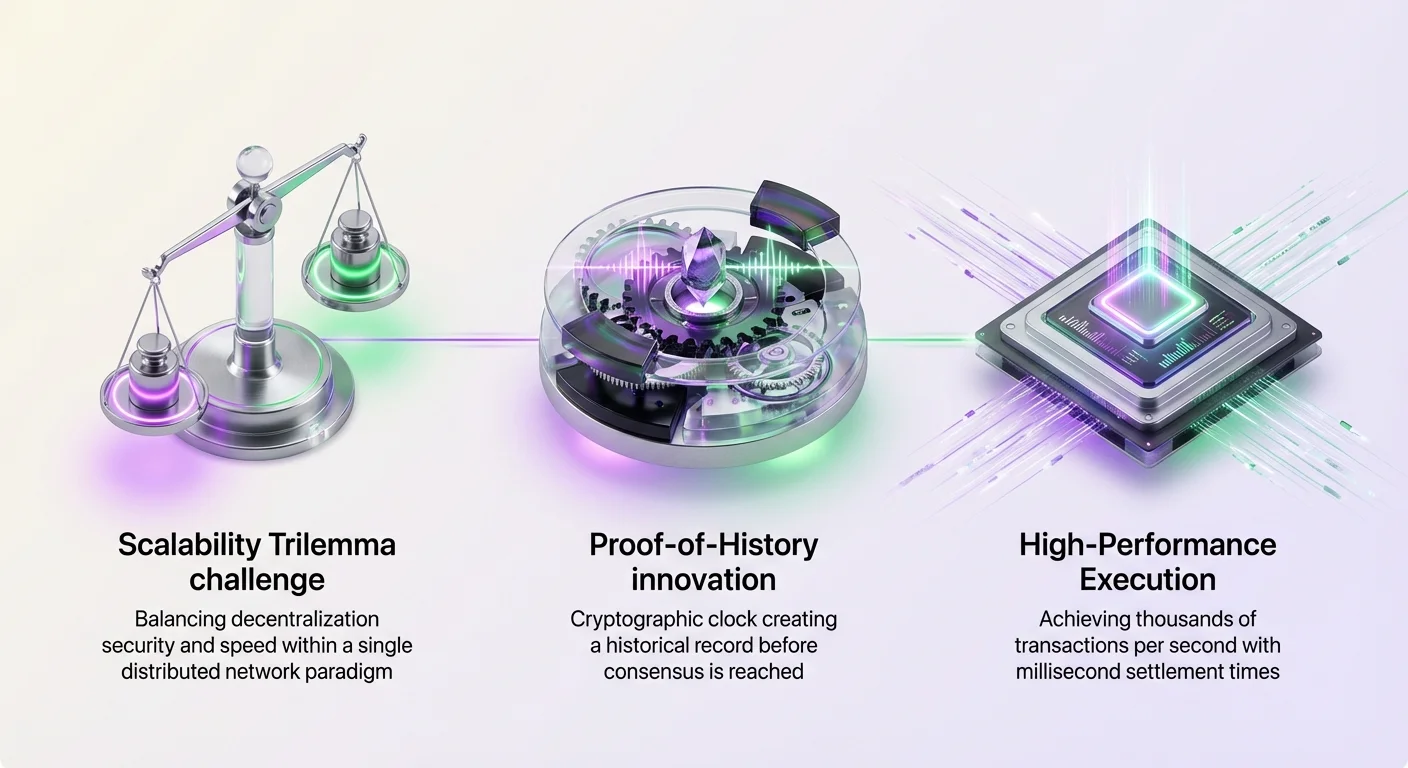
The blockchain industry has long struggled with a fundamental challenge known as the scalability trilemma. This concept suggests that a decentralized network can only achieve two out of three primary benefits at any given time: decentralization, security, and scalability. Early pioneers like Bitcoin established the standard for security and decentralization but sacrificed speed, processing limited transactions per second. Ethereum introduced smart contracts and programmable money, yet it too faced significant congestion and high fees during periods of peak demand.
Solana emerged in 2020 with a radical architectural approach designed to solve these throughput limitations directly on the base layer. Rather than relying on second-layer solutions or complex sharding techniques initially proposed by other networks, Solana focuses on maximizing the efficiency of a single, monolithic shard. The goal is to facilitate thousands of transactions per second (TPS) with settlement times measured in milliseconds, all while keeping costs at a fraction of a cent.
This focus on raw performance places Solana at the "edge" of decentralization. It pushes hardware and bandwidth limits to achieve speed that rivals centralized financial systems. By demanding more from its validators in terms of computing power, the network aims to serve as a global execution layer for everything from high-frequency trading to decentralized gaming. Understanding Solana requires looking under the hood at the eight core innovations that distinguish its architecture from earlier blockchain iterations.
The Role of Time in Distributed Systems
One of the most difficult problems in distributed networks is agreeing on time. In centralized systems, a trusted server stamps a time on every database entry. In decentralized networks like Bitcoin or Ethereum, nodes worldwide must communicate to agree on when an event occurred. This negotiation takes time and bandwidth, creating latency. Traditional blockchains solve this by grouping transactions into blocks and averaging out the time it takes to mine them, which acts as a network heartbeat.
Solana introduces a novel cryptographic mechanism called Proof-of-History (PoH) to address this bottleneck. PoH is not a consensus mechanism in itself but rather a clock before consensus. It allows the network to create a historical record that proves an event occurred at a specific moment in time. This is achieved through a high-frequency Verifiable Delay Function (VDF). The function requires a specific number of sequential steps to evaluate, but the result can be verified quickly and in parallel.
By embedding these timestamps into the blockchain's data structure, validators can trust the order of messages without having to pause and check with every other node. They effectively operate with a synchronized clock. This reduction in messaging overhead allows the network to process transactions continuously rather than in stop-and-go blocks. It fundamentally shifts the constraint from network communication speeds to processor speeds.
Consensus at Lightning Speed
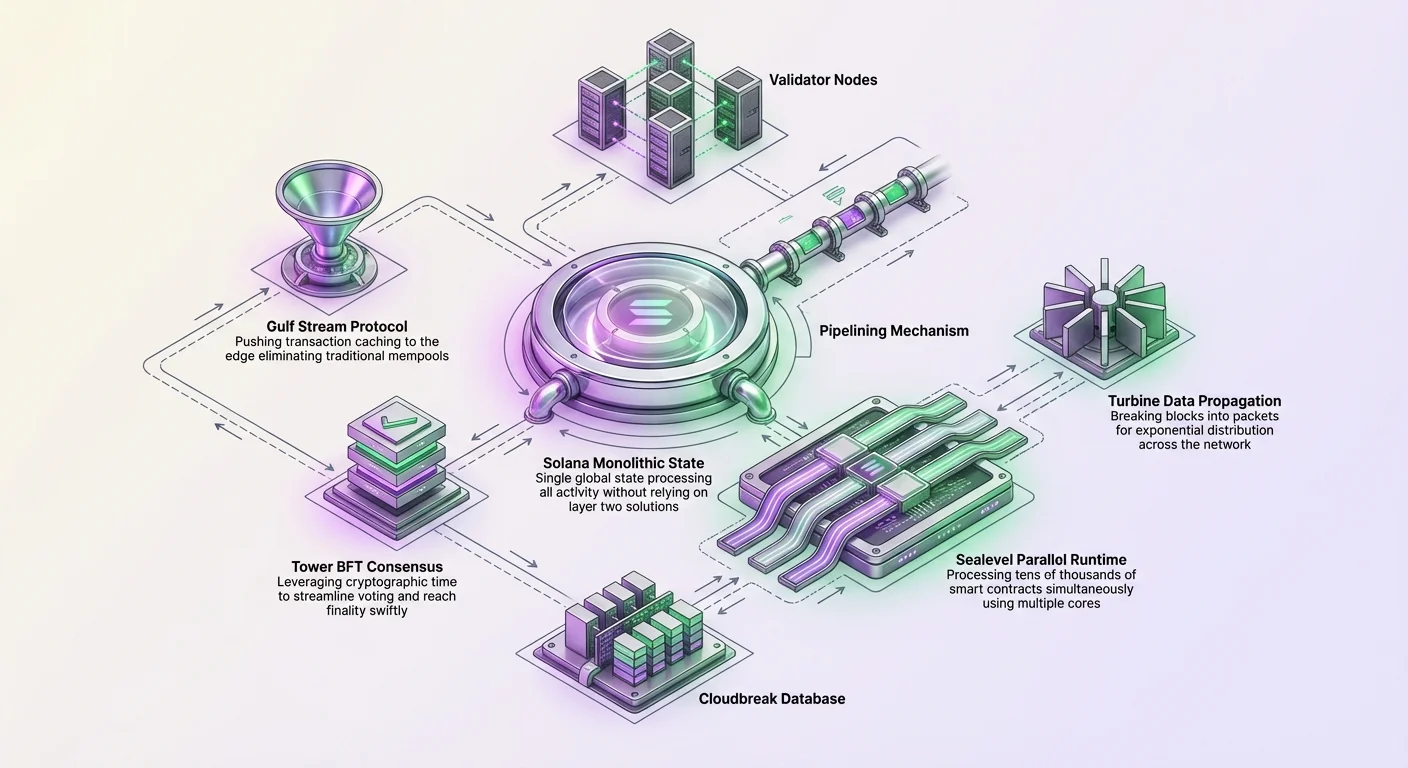
While Proof-of-History provides the clock, the actual agreement on the validity of transactions is handled by a consensus algorithm. Solana utilizes Tower BFT, a custom implementation of Practical Byzantine Fault Tolerance (PBFT). Traditional PBFT can be slow because it requires multiple rounds of voting among nodes to finalize a block. Tower BFT leverages the cryptographic clock provided by PoH to streamline this process.
Because the order of events is already cryptographically verified, validators can vote on the state of the ledger with greater efficiency. They "stake" their votes on a particular fork of the chain. If they vote for a fork that violates the protocol, their stake can be slashed. This economic incentive aligns security with speed. Tower BFT allows the network to reach finality—the point where a transaction is irreversible—much faster than legacy chains.
This system enables what is known as optimistic confirmation. The network can accept blocks and move forward before they are fully finalized by the entire network, assuming the leaders are honest. If a discrepancy is found, the network can roll back, but in practice, this allows for a user experience that feels nearly instant. This responsiveness is critical for applications requiring real-time interaction, such as order book exchanges or multiplayer games.
Data Propagation and Network Flow
Speed in a blockchain is not just about processing power; it is also about how quickly data moves between nodes. In many legacy blockchains, unconfirmed transactions sit in a waiting area called a mempool. The entire network gossips these transactions randomly, which is robust but inefficient. Solana eliminates the traditional mempool concept through a protocol called Gulf Stream.
Gulf Stream pushes transaction caching and forwarding to the edge of the network. Since the schedule of upcoming leaders (validators who will propose the next blocks) is known in advance, wallets and nodes can forward transactions directly to the expected leader before they are even required to propose a block. This allows validators to execute transactions ahead of time, reducing confirmation delays and memory pressure on validators.
Complementing Gulf Stream is Turbine, a block propagation protocol inspired by BitTorrent. When a leader produces a massive block of data, sending it to thousands of validators individually would choke the bandwidth. Turbine breaks data into smaller packets. The leader sends these packets to a small group of validators.
These recipients then pass the data to a larger group of peers. This hierarchical structure allows a large amount of data to proliferate through the network exponentially fast. It prevents the bandwidth of a single node from becoming a bottleneck, enabling the network to handle blocks that are much larger and more frequent than those on Ethereum or Bitcoin.
Parallel Processing Architecture
Perhaps the most significant departure from Ethereum's architecture is how Solana executes smart contracts. The Ethereum Virtual Machine (EVM) is single-threaded. This means it processes one contract at a time, sequentially. If a popular NFT mint or a volatile token launch clogs the network, every other transaction must wait in line, regardless of whether they are related. This creates global congestion from localized demand.
Solana introduces Sealevel, a parallel smart contract runtime. Sealevel allows the network to process tens of thousands of contracts simultaneously, using as many cores as are available on the validator's hardware. It achieves this by requiring transactions to specify exactly which data accounts they will read or write to during execution.
By knowing the state dependencies upfront, the runtime can schedule non-overlapping transactions to run at the same time. For example, a payment between Alice and Bob does not affect a payment between Charlie and Dave. On Solana, these execute in parallel. Only transactions that try to modify the same specific account state must be processed sequentially. This horizontal scaling means the network can expand its capacity simply by adding more powerful hardware (more cores) to the validator set.
Comparison of Execution Models
To understand the impact of Sealevel, it is helpful to compare execution models across major networks.
| Feature | Ethereum (Legacy) | Solana | Impact on User |
|---|---|---|---|
| Execution Type | Sequential (Serial) | Parallel (Sealevel) | Solana avoids network-wide jams. |
| State Access | Dynamic | Predictive | Higher efficiency on Solana. |
| Hardware Use | Single Core optimized | Multi-Core optimized | Solana scales with Moore's Law. |
This architectural difference explains why Solana is often preferred for high-traffic events. In a serial system, a single noisy application creates a traffic jam for everyone. In a parallel system, the traffic is separated into different lanes. While one lane might be congested, others remain free flowing.
Optimizing Validation and Storage
Processing thousands of transactions per second creates massive amounts of data. Writing this data to a database is a significant bottleneck for high-performance computing. Solana addresses this with Cloudbreak, a data structure designed for concurrent reads and writes. Traditional databases often struggle to scale when many threads try to access the same data simultaneously. Cloudbreak optimizes for the specific access patterns of transaction processing.
It maps accounts to memory in a way that prevents fragmentation and allows the system to utilize the full throughput of modern SSDs (Solid State Drives). This ensures that the speed of disk input/output does not slow down the transaction processing capabilities of the CPU. It effectively creates a database that is optimized specifically for the needs of a high-velocity blockchain ledger.
Furthermore, managing the sheer volume of historical data is a challenge. Storing petabytes of blockchain history on every single validator node would make running a node prohibitively expensive and centralize the network. To mitigate this, Solana utilizes Archivers (now often referred to as part of the broader storage and replication strategy).
This distributes the storage of ledger history across many nodes, rather than requiring every node to store everything. This concept of "Proof-of-Replication" allows the network to verify that data is being stored reliably without forcing every high-performance validator to act as a massive storage warehouse.
The Pipeline Transaction Processing Unit
To maximize hardware efficiency, Solana employs a processing mechanism called Pipelining. In computing, pipelining is a common technique used in CPU design where different stages of processing are handled by different hardware units simultaneously. Solana applies this concept to transaction validation.
The Transaction Processing Unit (TPU) on a validator node progresses data through distinct stages: data fetching, signature verification, banking, and writing to the ledger. Instead of one transaction finishing all steps before the next begins, the hardware processes different stages of multiple transactions at once.
For instance, while one batch of transactions is having its signatures verified, the previous batch is being credited to bank accounts, and the batch before that is being written to the disk. This constant stream of activity ensures that no part of the hardware sits idle waiting for another part to finish. It maximizes the utility of the validator's resources, squeezing every ounce of performance out of the available infrastructure.
Ecosystem and Application
The architectural choices made by Solana have shaped the type of ecosystem that resides on it. The high throughput and low latency enable use cases that are difficult or impossible to build on slower chains. Decentralized Exchanges (DEXs) on Solana can operate with on-chain order books. This contrasts with the Automated Market Maker (AMM) model common on Ethereum, which was largely adopted because order books were too slow and expensive for a 15-second block time.
On Solana, market makers can update prices and execute orders in milliseconds, mimicking the experience of centralized exchanges like Binance or Coinbase but in a non-custodial manner. This has attracted sophisticated trading firms and high-frequency traders to the DeFi ecosystem. Similarly, the gaming sector benefits immensely. Blockchain games require frequent state updates—recording items, moves, or interactions.
On high-fee networks, developers must rely on sidechains or centralized servers for gameplay, only using the main blockchain for high-value asset transfers. Solana's architecture allows more of the game logic to exist directly on-chain, creating a more immersive and truly decentralized experience. This capability extends to other high-bandwidth applications like decentralized physical infrastructure networks (DePIN) and large-scale NFT minting events.
Challenges in High-Performance Design
Despite its technological breakthroughs, Solana's approach involves distinct trade-offs. The primary criticism centers on centralization risks. Running a validator node requires enterprise-grade hardware, high-speed internet connections, and significant technical expertise. This creates a higher barrier to entry compared to Bitcoin or Ethereum, where nodes can often run on consumer-grade laptops.
Critics argue that if only a wealthy few can afford to run validators, the network becomes less resistant to censorship or external pressure. The cost of voting on transactions is also non-trivial, further consolidating power among larger validators who can afford the operational expenses.
Stability has also been a historical concern. The network has experienced several high-profile outages where block production halted for hours. These incidents were often caused by the network being overwhelmed by bot traffic or software bugs in the complex consensus client. While the developers have released patches and upgrades to improve resilience, reliability remains a critical metric for institutional adoption.
Comparative Network Dynamics
It is useful to situate Solana within the broader context of Layer 1 blockchains. Ethereum, the dominant smart contract platform, prioritized security and decentralization first. Its transition to Proof-of-Stake improved energy efficiency, but scaling primarily relies on Layer 2 rollups. These L2s bundle transactions off-chain and settle them on Ethereum. Solana takes a monolithic approach, attempting to handle all activity on the main layer.
Avalanche offers another alternative with its subnet architecture. It allows developers to spawn custom blockchains that interoperate with the main network. This segregates traffic but adds complexity in cross-chain communication. BNB Smart Chain (BSC) utilizes a Proof-of-Staked Authority (PoSA) model, which is highly efficient but relies on a very small, vetted set of validators, leaning heavily toward centralization for the sake of speed.
Solana sits uniquely in this mix. It is permissionless and public like Ethereum, but it engineers its base layer for speed like a centralized server. It does not rely on sharding (splitting the network into pieces) or Layer 2s to achieve its headline throughput figures. This "single global state" makes applications highly composable; a program can interact with any other program on the network instantly without bridging or complex messaging protocols.
Tokenomics and Network Security
The native currency, SOL, serves multiple vital functions within this high-speed architecture. First and foremost, it is the utility token used to pay for transaction fees. While these fees are designed to be low, the sheer volume of transactions generates revenue for the validator network. Additionally, SOL is used for staking. Token holders can delegate their SOL to validators to help secure the network.
In exchange for locking up their capital and voting on the truth of the ledger, stakers receive rewards. This Proof-of-Stake mechanism ensures that attacking the network is economically unfeasible. An attacker would need to acquire a massive percentage of the total staked supply to alter the ledger, a feat that would likely cost billions of dollars and destroy the value of the asset they are trying to steal.
Governance also plays a role. While Solana's development has been driven heavily by Solana Labs and the Solana Foundation, the ecosystem is gradually moving toward more community governance. SOL holders can vote on proposals and upgrades, influencing the direction of the protocol. This transition is critical for the network's long-term credibility as a decentralized infrastructure.
The Road Ahead
Solana's journey represents a test of the limits of blockchain technology. By betting on the continued improvement of hardware—Moore's Law—and bandwidth (Nielsen's Law), the protocol positions itself to grow faster than its competitors over time. As computers become more powerful, Solana becomes faster without needing fundamental code changes.
The introduction of fee markets and priority fees has helped address spam issues, allowing users to pay slightly more to ensure their transactions are processed during congestion. This brings Solana closer to the economic models of established networks like Ethereum but with a baseline capacity that is orders of magnitude higher.
Developers are also exploring compatibility layers. Tools that allow Ethereum-based contracts to run on Solana (via EVM compatibility solutions) are lowering the migration barrier. This interoperability, combined with the network's native speed, aims to attract liquidity and talent from the broader crypto ecosystem.
Conclusion
Solana represents a distinct philosophy in the blockchain space, prioritizing raw execution speed and engineering optimization to achieve global scale. Its innovations in timekeeping via Proof-of-History, parallel execution through Sealevel, and efficient data propagation with Turbine allow it to process transaction volumes that would cripple older networks. This architecture offers a glimpse into a future where blockchain applications can operate with the responsiveness of traditional web apps.
However, this performance comes with high hardware requirements and the ongoing challenge of maintaining stability under extreme load. As the network matures, its success will depend on balancing its blazing speed with the robust security and decentralization that users demand. By pushing the boundaries of what a single blockchain can handle, Solana continues to be a pivotal experiment in the quest for a decentralized financial infrastructure.
Solana proves that speed and decentralization can coexist if the underlying architecture reinvents how network time and data flow are handled.