
The world of digital finance is often grouped under the broad umbrella of "cryptocurrency." However, this single term masks a complex hierarchy of distinct asset classes. To the uninitiated, Bitcoin, Ethereum, and a governance token might appear identical. They all trade on exchanges, reside in digital wallets, and fluctuate in value. Yet, their technical foundations and economic roles differ vastly. Understanding the taxonomy of crypto assets is not merely an academic exercise. It is a fundamental requirement for assessing risk and utility.
At the core of this ecosystem lies a crucial technical distinction: the difference between a coin and a token. While these words are used interchangeably in casual conversation, they refer to completely different architectures. A clear grasp of these definitions helps users separate foundational infrastructure from the applications built on top of it. This guide breaks down the classifications of digital assets, moving from the protocol layer up to specific application utilities.
Defining the Core Architecture
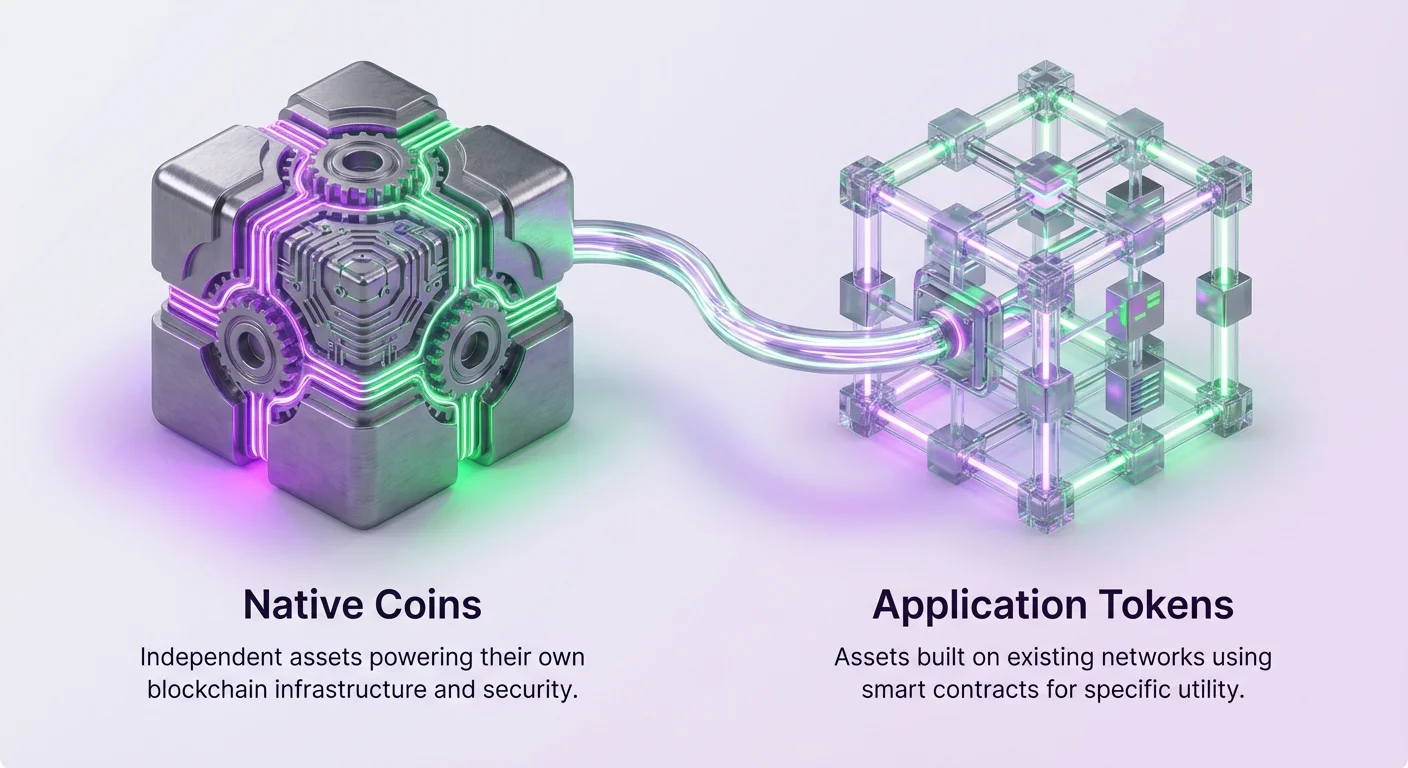
The primary dividing line in the crypto asset space is the relationship between the asset and the blockchain it resides on. This distinction determines the asset's independence, security model, and primary function.
Coins: The Native CurrencyA coin is the native asset of a specific blockchain. It is baked into the protocol's code and is essential for the network to function. For example, Bitcoin (BTC) is the native coin of the Bitcoin blockchain. Ether (ETH) is the native coin of the Ethereum blockchain. These assets have two primary roles. First, they act as a mechanism to pay for transaction fees and network services. You cannot send a transaction on the Ethereum network without paying gas fees in ETH.
Second, coins serve as the incentive for network security. In Proof-of-Work systems, miners earn newly minted coins for validating transactions. In Proof-of-Stake systems, validators stake these coins to secure the network. Coins operate independently. They rely on their own decentralized network of computers to maintain their ledger and history. If a coin's network fails, the coin ceases to function.
Tokens: The Application Layer
Tokens, conversely, do not have their own blockchain. Instead, they are built on top of existing networks using smart contracts. A token creator does not need to build a network of validators or miners. They write code that defines the token's rules and deploy it to a host chain like Ethereum, Solana, or Avalanche. The host blockchain handles the security and transaction processing, while the token serves a specific purpose within an application.
Because tokens piggyback on established networks, they are easier and faster to create. A developer can launch a token in minutes. However, tokens introduce different risks. While they inherit the security of the host chain, they are vulnerable to bugs in their specific smart contract code. If the smart contract has a flaw, the token can be exploited even if the underlying blockchain remains secure.
The Technical Hierarchy
The relationship between coins and tokens is hierarchical. The coin powers the infrastructure, while the token represents value or utility within that infrastructure. When you transfer a token, you must pay fees using the native coin of the host chain. This dynamic creates a constant demand for the underlying coin as long as the tokens and applications built on top of it remain active.
Bitcoin: The Premier Asset Class
Bitcoin occupies a unique category in the taxonomy of digital assets. Launched in 2009, it was the first decentralized digital currency and remains the benchmark for the entire industry. While technically a "coin" because it runs on its own blockchain, its function sets it apart from most other assets. Bitcoin was designed primarily as a peer-to-peer electronic cash system. Over time, its narrative has shifted toward being a store of value, often compared to digital gold.
The defining characteristics of Bitcoin are its fixed supply and decentralized architecture. There will never be more than 21 million coins. This scarcity is hard-coded into the protocol and enforced by thousands of independent nodes. Unlike modern "altcoins" that may have flexible monetary policies or centralized leadership teams, Bitcoin operates without a central authority. This resistance to censorship and inflation makes it a distinct asset class, often viewed as a pristine reserve asset rather than a platform for applications.
The Broad Scope of Altcoins
The term "altcoin" is an abbreviation for "alternative coin." Historically, this category included any cryptocurrency that was not Bitcoin. In the early years of the industry, most altcoins were simple clones of Bitcoin with minor tweaks to transaction speed or mining algorithms. Today, the term encompasses a massive and diverse range of assets with varying goals.
Evolution of Purpose
Modern altcoins are rarely just digital currency. They often power complex decentralized platforms. Ethereum, the largest altcoin, introduced the concept of a programmable blockchain. This allowed developers to build decentralized applications (dApps) directly on the network. Consequently, the native coin (Ether) transformed from simple money into a fuel for a global computing platform.
Diversity of Function
The altcoin market includes vast differences in technology and intent. Some projects focus on privacy, using advanced cryptography to obscure transaction details. Others focus on speed and scalability, attempting to process thousands of transactions per second to rival traditional payment processors. There are also specialized chains for supply chain management or file storage. While Bitcoin is often held as a long-term passive investment, altcoins are typically viewed as technology bets. Their value is tied to the adoption and success of the specific technical solutions they provide.
| Feature | Bitcoin | Altcoins |
|---|---|---|
| Primary Goal | Store of value, money | Diverse utility, apps, tech |
| Technology | Proof-of-Work (mostly) | PoW, Proof-of-Stake, others |
| Volatility | High (historically) | Typically higher than BTC |
Functional Taxonomy of Tokens
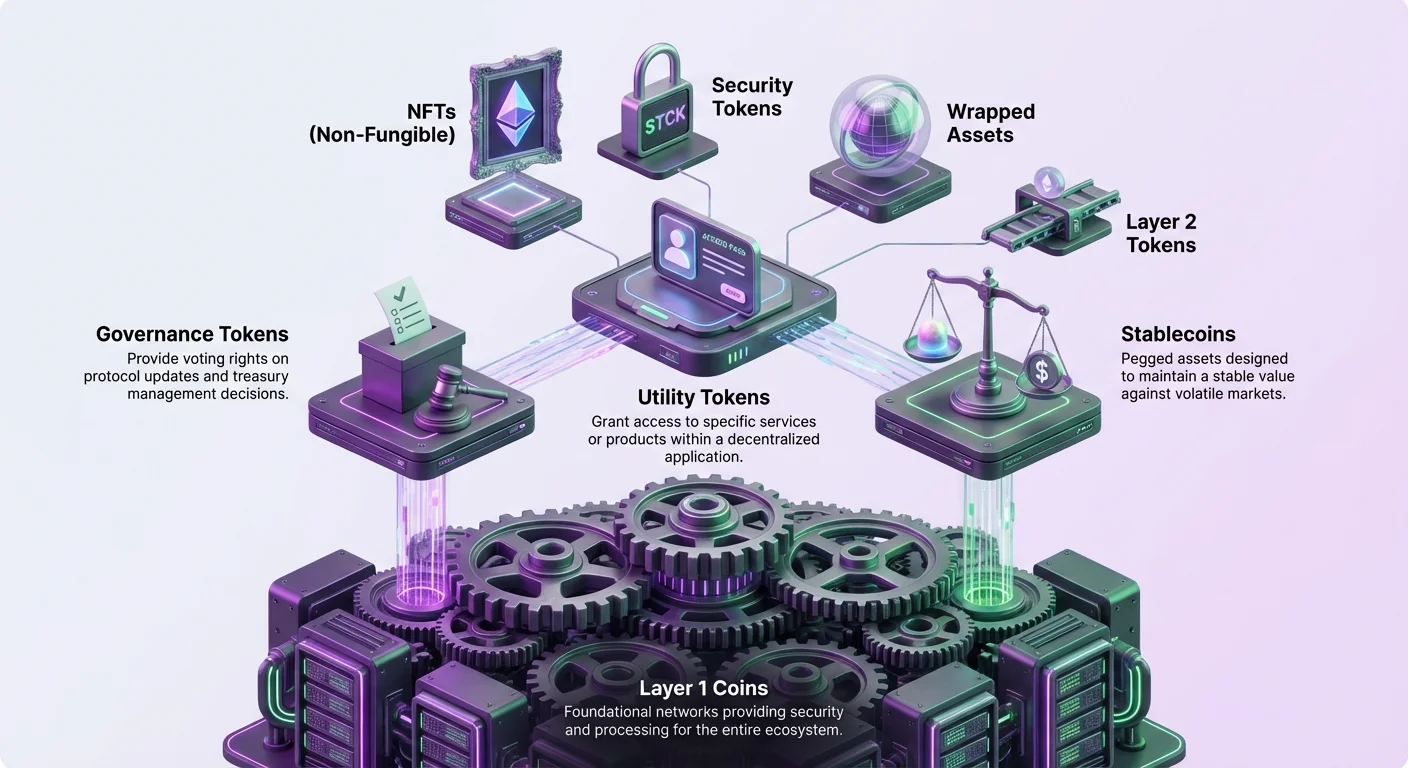
Once we move beyond native coins, we enter the vast world of tokens. Because tokens are programmable, they can represent almost anything. This flexibility has led to the emergence of several distinct sub-categories based on utility and economic design.
Utility Tokens
Utility tokens function like a digital coupon or an access key. They provide the holder with the right to use a specific product or service within a blockchain ecosystem. For example, a decentralized cloud storage network might require users to pay for storage space using its native utility token. The value of the token is theoretically driven by the demand for the service it unlocks. If no one wants to use the service, the utility token has little value. These tokens are not designed to be investments in the traditional sense, though they are often speculated upon.
Governance tokens represent a shift toward decentralized management. Holders of these tokens are granted voting rights within a Decentralized Autonomous Organization (DAO). They can vote on proposals regarding protocol upgrades, fee structures, or the allocation of treasury funds. This transforms users into active stakeholders. The influence a user has is usually proportional to the number of tokens they hold. Governance tokens align the interests of the community with the health of the protocol, as bad decisions could reduce the value of the project and the token itself.
Security Tokens
Security tokens are the digital equivalent of traditional financial securities. They represent ownership of an external asset, such as shares in a company, real estate, or debt instruments. unlike utility or governance tokens, security tokens are often subject to strict federal regulations. They are designed to bridge the gap between traditional finance and blockchain technology. These tokens often include features like automated dividend payouts or programmatic compliance checks to ensure only eligible investors can trade them.
Stablecoins: The Anchor Assets
Stablecoins are a specific type of crypto asset designed to minimize price volatility. While Bitcoin and altcoins can experience double-digit percentage price swings in a single day, stablecoins aim to maintain a constant value. This is typically achieved by pegging the token's value to a stable asset, most commonly the US dollar.
Mechanisms of Stability
The most common stablecoins are fiat-collateralized. A central issuer holds reserves of fiat currency (or equivalent assets) and issues tokens on a 1:1 basis. For every digital dollar in circulation, there is supposedly a real dollar in a bank account backing it. Users trust the issuer to maintain these reserves and honor redemptions.
Other types include crypto-collateralized stablecoins, which use volatile crypto assets as collateral. Smart contracts manage the peg by requiring users to over-collateralize their loans. If the value of the collateral drops, the system automatically liquidates assets to protect the peg. Algorithmic stablecoins attempt to maintain stability through supply manipulation without direct backing, though this model carries significant risk.
Utility in Ecosystems
Stablecoins have become the backbone of the crypto trading and DeFi economy. They allow traders to exit volatile positions without converting back to fiat currency, which can be slow and tax-inefficient. In decentralized finance, they serve as the primary unit of account for lending and borrowing. They enable users to earn interest on dollar-pegged assets without leaving the blockchain environment. Furthermore, they are increasingly used for cross-border remittances, offering a faster and cheaper alternative to traditional banking rails.
Non-Fungible Tokens (NFTs)
Most cryptocurrencies and tokens are "fungible," meaning one unit is identical to another. One Bitcoin is worth exactly the same as another Bitcoin. Non-Fungible Tokens (NFTs) disrupt this model. An NFT is a unique digital token that represents ownership of a specific, distinct item.
Digital Provenance
NFTs use blockchain technology to prove scarcity and authenticity for digital files. Before NFTs, digital art or items could be copied endlessly with no way to distinguish the original. An NFT creates a permanent, unalterable record of creation and ownership on the blockchain. While the image itself might be copied, the ownership record cannot be forged.
Beyond Digital Art
While famous for high-priced digital artwork and collectibles, the taxonomy of NFTs extends further. They are used in gaming to represent unique in-game items like swords or skins that players can trade. They can represent digital identity or domain names. In the future, NFTs may be used to represent ownership of physical assets like house deeds or luxury goods, providing a transparent history of ownership transfer.
Hybrid Assets and Layer 2 Evolution
The lines between coins and tokens are becoming blurred as blockchain technology matures. The emergence of Layer 2 scaling solutions and cross-chain interoperability has created hybrid assets that do not fit neatly into a single box.
Wrapped Assets
Wrapped assets allow a cryptocurrency from one blockchain to be used on another. For example, Bitcoin exists on its own isolated network. However, through "wrapping," a representation of Bitcoin can be created on the Ethereum network (often called wBTC). This wBTC is technically a token on Ethereum, but its value is pegged to the original Bitcoin. This allows Bitcoin holders to participate in Ethereum's decentralized finance applications. The asset changes its technical form (coin to token) while retaining its economic identity.
Layer 2 Ecosystems
Layer 2 networks are scaling solutions built on top of major blockchains like Ethereum. They process transactions off the main chain to save costs and then settle the data back to the main chain. These networks often have their own native tokens. In some cases, these tokens function similarly to coins, paying for transaction fees on the Layer 2 network. However, because the Layer 2 network ultimately relies on the Layer 1 blockchain for final security, these assets occupy a middle ground between a true native coin and a standard utility token.
Asset Migration
Assets can also evolve over time. A project might launch as a token on Ethereum to raise funds and build a community. Later, the developers might launch their own independent blockchain. At this point, the original tokens are swapped for new native coins on the new chain. This migration shifts the asset from the token category to the coin category, fundamentally changing its security model and technical dependence.
Assessing Risk Across the Taxonomy
Categorizing an asset is the first step in risk management. Different categories carry different inherent risks that have little to do with the project's marketing.
Volatility and Liquidity
Bitcoin generally has the highest liquidity and, while volatile, is often less volatile than smaller altcoins. Large-cap coins tend to have more established markets. Tokens, particularly those for new or niche projects, often suffer from low liquidity. This means a small sell order can crash the price. Governance and utility tokens are highly reflexive; their value depends on the success of the underlying application. If the app fails or is hacked, the token value can go to zero.
Technical Risk Profiles
Coins face consensus risk. If the network of miners or validators becomes too centralized, the chain can be attacked. Tokens face smart contract risk. Since tokens are essentially software code running on a blockchain, a bug in that code can allow hackers to drain the funds or mint infinite tokens. This risk exists even if the host blockchain is perfectly secure. Stablecoins carry peg risk. If the issuer creates more tokens than they have reserves for, or if the algorithmic mechanism fails, the token can lose its parity with the dollar.
Conclusion
The taxonomy of crypto assets provides a necessary framework for understanding the digital economy. At the foundation are coins, the native currencies that power and secure blockchain networks. Above them sit tokens, flexible assets that enable applications, governance, and digital ownership. Flanking these are stablecoins, which provide the stability required for commerce, and NFTs, which introduce uniqueness to the digital realm.
Navigating this space requires recognizing that not all digital assets are competitors. Bitcoin competes with gold and fiat currency. Ethereum competes with other development platforms. Governance tokens allow for control over specific protocols. By correctly categorizing an asset, investors and users can better evaluate its purpose, its technical dependencies, and its specific risk profile. As the industry matures, these definitions will likely expand, but the core distinction between the infrastructure (coins) and the applications (tokens) remains the bedrock of crypto classification.
A coin is the road; a token is the car that drives on it.