
The landscape of digital asset management has shifted dramatically over the last decade. As the cryptocurrency ecosystem expands into 2025, the necessity for robust security protocols has moved beyond simple recommendations to absolute requirements. Investors and users are no longer just passive holders. They are active participants in a decentralized economy that operates twenty-four hours a day. This shift places the burden of security entirely on the individual.
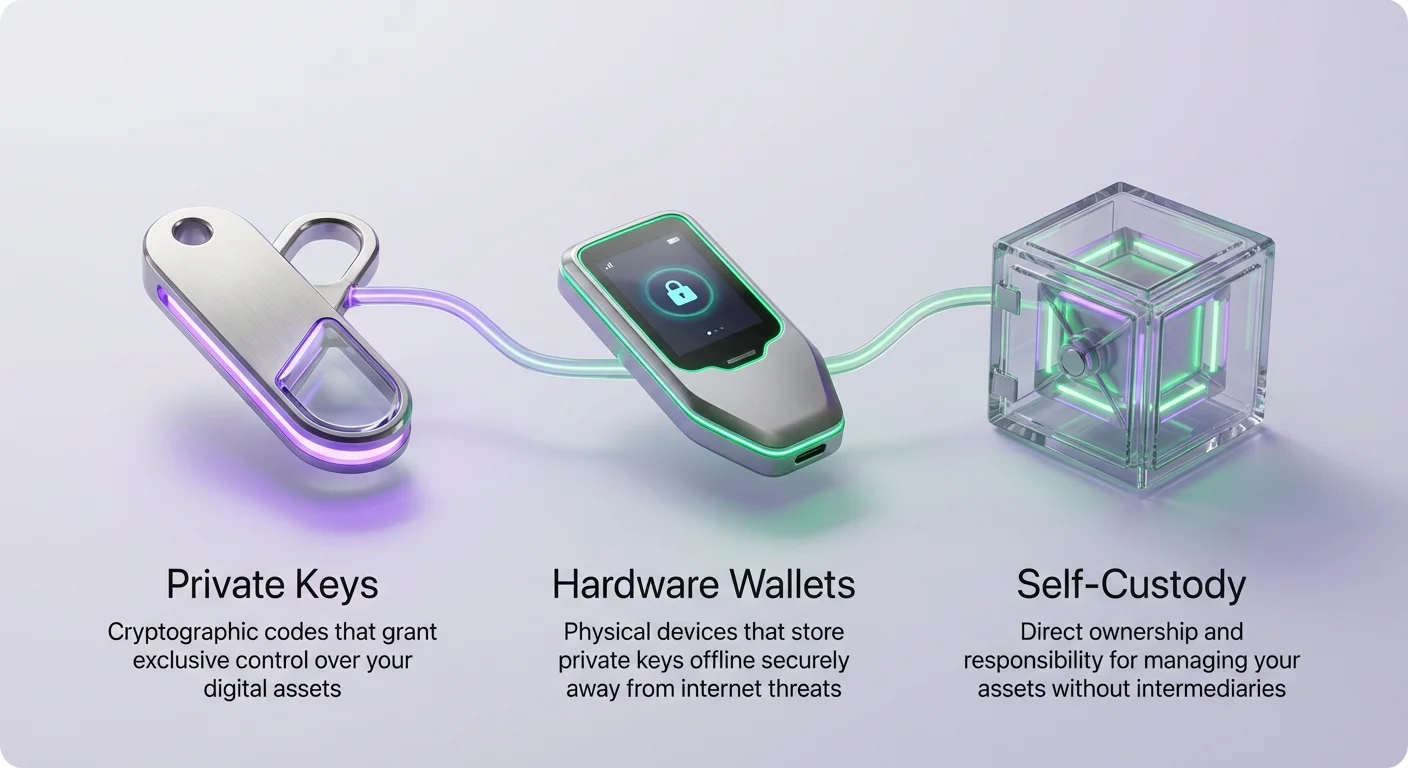
Cryptocurrency wallets serve as the fundamental gateway to this digital economy. They are not merely storage containers like physical wallets. Instead, they are sophisticated tools that manage the private and public key pairs necessary to authorize transactions on the blockchain. For a foundational analysis, review the anatomy of digital ownership. Understanding this distinction is the first step toward mastering cold storage. When you control the keys, you control the assets. If a third party holds the keys, you simply have a claim to those assets.
The concept of self-custody allows users to interact directly with blockchain networks without intermediaries. This independence brings immense power but also significant responsibility. A single mistake in key management can lead to irreversible loss. Therefore, establishing an advanced cold storage setup is not just about buying a device. It involves creating a comprehensive system of checks, balances, and operational security protocols.
This guide explores the intricacies of integrating hardware wallets into a maximum security framework. We will examine the technical nuances of modern devices, advanced backup strategies like Shamir’s Secret Sharing, and the critical importance of asset segregation. By understanding the mechanics of these systems, users can navigate the complex world of DeFi and multi-chain environments with confidence.
The Hierarchy of Wallet Architectures
Defining Wallet Categories
Understanding the different types of wallets is essential for building a tiered security strategy. Wallets generally fall into two primary categories: hot and cold. Hot wallets are connected to the internet, making them convenient for frequent trading but vulnerable to online attacks. These include mobile apps, desktop software, and web browser extensions. They are excellent for managing "active" assets that move frequently between decentralized applications. To choose the optimal method for your assets, examine security trade-offs across storage layers.
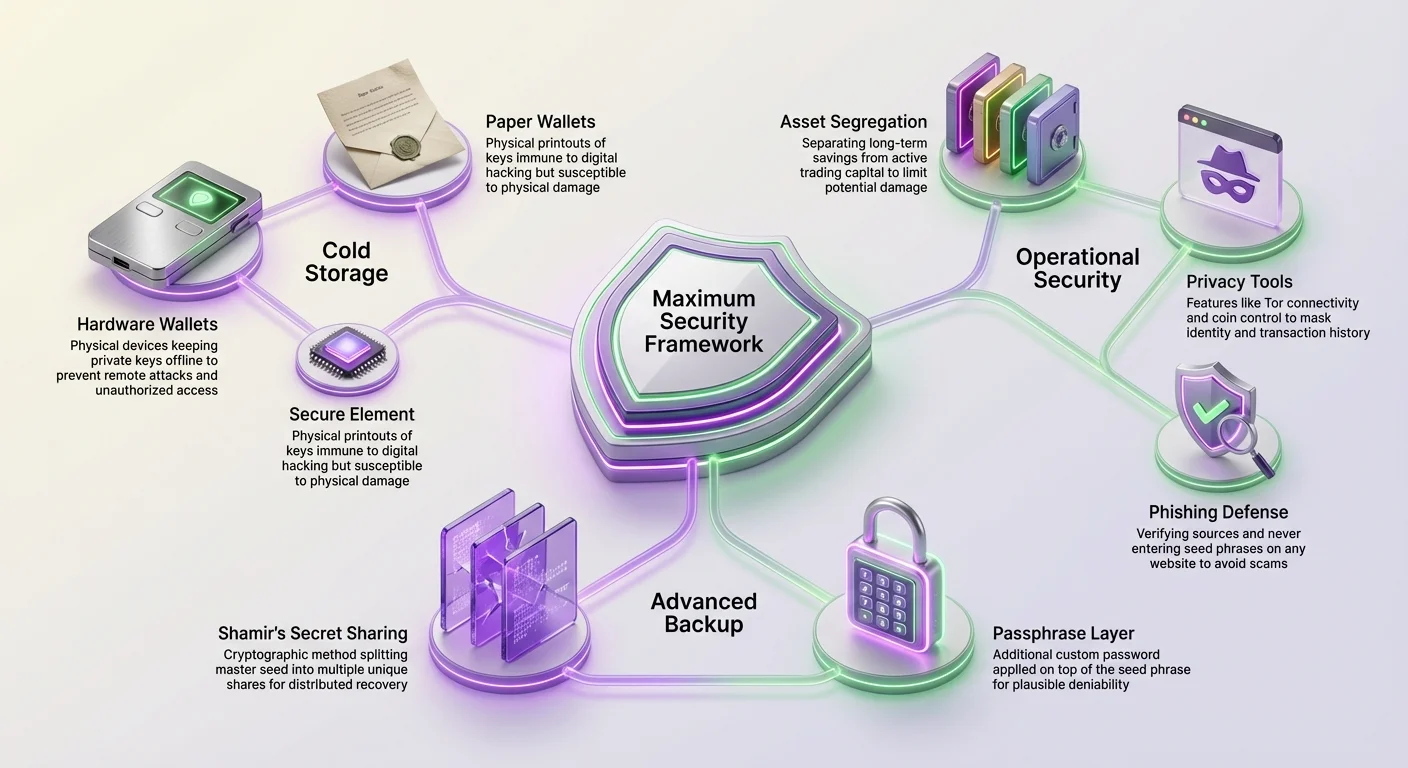
Cold wallets, primarily hardware devices, keep private keys offline at all times. They act as a physical barrier between your digital wealth and the internet. Even when connected to a compromised computer, a properly designed hardware wallet ensures that the private key never leaves the device. Paper wallets represent an analog form of cold storage. These are physical printouts of keys. While immune to digital hacking, paper wallets are fragile and susceptible to physical damage or loss.
The Evolution of Hardware Devices
Modern hardware wallets have evolved significantly from early iterations. Devices like the Trezor Safe family now integrate advanced secure elements. These are specialized chips designed to withstand sophisticated physical attacks. The integration of features like haptic feedback and color touchscreens in newer models improves the user experience, reducing the likelihood of input errors during critical transactions.
Open-source design remains a gold standard in this sector. Transparency in the code allows the broader community to audit the security architecture. When code is public, security researchers can identify and patch vulnerabilities faster than in closed systems. This peer-reviewed approach builds trust, ensuring that the device operates exactly as claimed without hidden backdoors or malicious code.
Assisted Self-Custody Solutions
A hybrid approach known as assisted self-custody has emerged for users who fear total loss of access. Platforms like Uphold have introduced vault services that combine the benefits of user-controlled keys with a recovery mechanism. In these setups, the user holds the primary keys, maintaining control over funds. However, a designated third party holds a backup key that can assist in recovery if the primary key is lost.
This model typically involves a subscription service and is distinct from pure cold storage. It serves as a middle ground for those who want self-custody but are uncomfortable with the "no safety net" reality of traditional hardware wallets. While it adds a layer of centralization, it mitigates the catastrophic risk of losing a seed phrase.
Advanced Backup Protocols
The seed phrase is the master key to your digital kingdom, and securing it starts with mastering seed phrase security. Traditionally, this is a list of 12 or 24 words that can regenerate your private keys on any compatible device. However, reliance on a single physical list creates a single point of failure. If that list is destroyed by fire, water, or theft, the assets are gone. Advanced setups now utilize more resilient methods to secure this backup.
Shamir’s Secret Sharing is a cryptographic method that splits the master seed into multiple unique shares. To recover the wallet, a user must combine a specific number of these shares. For example, you might create a "2 of 3" setup. You generate three separate lists of words. You only need any two of them to access your funds. This allows you to store one share at home, one in a bank deposit box, and one with a trusted relative.
If a thief steals one share, they cannot access your funds because they lack the second required share. If a fire destroys your home, you still have the shares stored at the bank and with your relative. This distribution of risk significantly enhances the resilience of your cold storage setup. It transforms the backup from a physical liability into a distributed security network.
The Passphrase Layer
Plausible Deniability
Beyond the standard seed phrase, advanced users often implement a passphrase. This is sometimes referred to as the "25th word." It acts as a custom password applied on top of the existing seed phrase. Unlike a PIN code, which only unlocks the device, the passphrase actually mathematically alters the seed to generate a completely new set of accounts.
If you enter the seed phrase alone, you access a "standard" wallet. If you enter the seed phrase plus a passphrase, you access a "hidden" wallet. This feature provides plausible deniability. If a highly sophisticated attacker forces you to unlock your device, you can provide the standard PIN or even the seed phrase. They would see only the funds in the standard wallet, which you might keep as a decoy with a small balance.
Securing the Passphrase
The strength of this security layer depends entirely on the complexity and storage of the passphrase. Since the passphrase is not stored on the device itself, losing it results in permanent loss of the hidden funds. There is no "forgot password" option. The device does not know the passphrase exists; it simply calculates a wallet based on whatever input you provide.
Because of this, the passphrase must be stored separately from the seed phrase. Keeping them together negates the security benefit. Ideally, the seed phrase is stored in durable physical media, like steel plates, while the passphrase is memorized or stored in a secure password manager. For instructions on preparing non-digital backups, consult our guide on creating deep cold storage strategies. This separation ensures that physical theft of the seed phrase alone does not compromise the main holdings.
Integrating Privacy and Anonymity
Privacy is a distinct concept from security, yet they often overlap. A secure wallet that leaks your identity and transaction history to the world offers an incomplete form of protection. Advanced wallet setups prioritize anonymity to protect users from targeted attacks. If bad actors know how much crypto you hold, you become a target.
Network Level Privacy
Wallets like Cake Wallet integrate privacy tools directly into the interface. Features like Tor connectivity route your internet traffic through multiple encrypted nodes. This masks your IP address from the blockchain nodes you communicate with. Without this protection, your internet service provider or a sophisticated observer could link your physical location to your blockchain transactions.
VPN integration offers another layer of defense. By encrypting the data tunnel between your device and the internet, you prevent eavesdropping on local networks. This is particularly vital if you ever need to broadcast a transaction from a public Wi-Fi network, though such actions should be avoided for cold storage operations whenever possible.
Coin Control and Address Management
Advanced wallet interfaces allow for "coin control." This feature lets users select exactly which unspent transaction outputs (UTXOs) to use for a transaction. By manually selecting inputs, you prevent the wallet from automatically combining dust (small amounts of crypto) from different sources. Combining inputs can inadvertently link separate identities or transaction histories together on the public ledger.
Generating new addresses for every transaction is a standard best practice. Most modern HD (Hierarchical Deterministic) wallets do this automatically. However, maintaining strict discipline in not reusing addresses prevents anyone from easily viewing your entire balance by looking at a single address. Subaddresses, commonly used in privacy-focused chains like Monero, further obfuscate the destination of funds.
Asset Segregation Strategies
Active vs. Inactive Funds
A fundamental rule of asset safety is segregation. You should not walk around with your entire life savings in your pocket, and you should not keep all your crypto in a single wallet. Segregation begins by categorizing assets based on their usage frequency. "Inactive" assets are long-term holdings that you do not intend to trade or move for months or years. These belong in deep cold storage.
"Active" assets are funds used for trading, staking, or interacting with decentralized applications. These can reside in a hardware wallet that is connected more frequently, or in a secure software wallet for small amounts. By separating these pools, you limit the potential damage of a compromise. If a malicious dApp drains your active wallet, your long-term savings remain untouched in their separate, offline environment.
Operational Wallets
When engaging with new and untested protocols, create a dedicated "burner" wallet. This is a temporary wallet generated for a specific purpose or interaction. You transfer only the specific amount of crypto needed for that interaction from your active wallet. Once the transaction or session is complete, you can discard the wallet or sweep any remaining funds back to a secure location.
This practice is essential when entering new ecosystems where the risk of smart contract bugs or scams is higher. Modern wallet apps allow you to generate multiple portfolios or accounts easily. Utilizing this feature creates firewalls between your various on-chain activities. It ensures that a mistake in one area does not cascade into a total financial loss.
Entering New Blockchain Ecosystems
The decentralized world is composed of dozens of active blockchains. Each chain makes specific trade-offs regarding speed, security, and cost. Ethereum, for instance, offers a highly developed ecosystem with deep liquidity but often suffers from high transaction fees. Newer chains might offer significantly faster processing times—sometimes 150x faster—but may have different security assumptions.
Moving assets to a new chain requires careful planning. You are effectively leaving the security of a known environment for a new territory. The first step is always research. You must identify the native token used for gas fees on the new chain. Without this native token, you cannot transact. For example, moving USDC to the Avalanche network is useless if you do not also have AVAX to pay for the gas to move or swap that USDC.
Understanding Bridges
Bridges are the infrastructure that connects these isolated islands. When you bridge an asset, you are typically locking the original token in a smart contract on the source chain and minting an equivalent "wrapped" token on the destination chain. This process introduces counterparty risk. The bridge itself becomes a honeypot for hackers because it holds massive reserves of locked assets.
When using a bridge, verify the URL carefully. Phishing sites often mimic popular bridge interfaces to steal funds. Always navigate from a trusted aggregator or the official documentation of the blockchain project. Once the assets are bridged, the transaction times can vary wildly, taking anywhere from a few minutes to several hours depending on network congestion.
| Feature | Single dApp Chain | General Purpose Chain |
|---|---|---|
| Focus | Specific application | Diverse ecosystem |
| Onboarding | Integrated/Curated | requires user initiative |
| Complexity | Lower barrier to entry | Steeper learning curve |
The Role of Native Tokens
Upon arriving at a new chain, your priority is acquiring the native currency. Most bridges will not provide this automatically, though some advanced bridges offer a "faucet" feature or swap a small portion of your bridged funds into the native token for gas. If you arrive without gas, your funds are effectively frozen until you can onboard the native asset from a centralized exchange or another source.
DeFi users often look for "faucets" or campaigns that reward users for entering a new ecosystem. Blockchains compete for liquidity, much like shopping malls compete for shoppers. They may run incentives where yields are boosted or gas fees are subsidized. While attractive, these campaigns often attract scammers. Always verify that the incentive program is official before connecting your wallet.
Operational Security and Phishing Defense
The Human Factor
Even the most secure hardware wallet cannot protect against social engineering, which requires defending against wallet exploits. Phishing remains the most effective attack vector against crypto users. Attackers impersonate support staff, trusted influencers, or official websites to trick users into revealing their seed phrases or signing malicious transactions.
A golden rule of cold storage is that your seed phrase never touches a keyboard. It is entered only on the physical device itself. If a website, email, or support chat asks for your seed phrase to "verify" or "restore" your wallet, it is a scam. There are no exceptions to this rule. Hardware wallets are designed to keep keys offline; typing them into a computer defeats their entire purpose.
Verifying Sources
When exploring new projects, start from trusted market aggregators like CoinGecko or CoinMarketCap. These platforms perform basic due diligence before listing a project's website link. Using these links is safer than relying on search engine results. Search engines often display sponsored ads at the top of results that lead to imposter sites designed to drain wallets.
Bookmark the official sites of the exchanges and dApps you use frequently. This prevents typo-squatting attacks, where scammers register domains that are one letter different from the legitimate site (e.g., "Goggle.com" instead of "Google.com"). By relying on verified bookmarks, you eliminate the risk of landing on a malicious interface by accident.
Secure Interaction with DeFi Protocols
Decentralized Finance (DeFi) allows for trading, lending, and borrowing without intermediaries. However, interacting with smart contracts carries inherent risks. When you connect a wallet to a dApp, you often have to grant permission for that contract to spend your tokens. If the contract is malicious or has a bug, it can drain all the tokens it has access to.
Hardware Integration with Web Wallets
The safest way to interact with DeFi is by connecting your hardware wallet to a web interface like MetaMask or a dedicated dashboard like Trezor Suite, a process covered in our hardware wallet deep dive. In this setup, the web interface acts only as a viewer and transaction builder. It proposes a transaction, but the transaction cannot be broadcast until you physically confirm it on your hardware device.
This workflow ensures that you have a "human in the loop" for every action. The screen on your hardware wallet will display the true details of the transaction. You can verify the destination address and the amount before pressing the physical button. If your computer is compromised and the screen shows one thing while the malware tries to send another, the hardware wallet's screen will reveal the discrepancy.
Managing Allowances
Periodically review the permissions you have granted to smart contracts. Over time, active users may accumulate dozens of open approvals. Tools exist that allow you to view and revoke these allowances. Revoking access for old or unused dApps reduces your attack surface. If an old protocol gets hacked years later, your funds are safe because the contract no longer has permission to spend them.
Conclusion
Achieving maximum security for your digital assets is an ongoing process that requires vigilance and adaptation. The integration of hardware wallets provides the foundational layer of protection by keeping private keys strictly offline. However, the hardware is only as effective as the user's operational habits. Combining these devices with advanced backup methods like Shamir’s Secret Sharing and robust passphrase protocols creates a defense-in-depth strategy that eliminates single points of failure.
As users venture into new blockchain ecosystems and decentralized applications, the need for segregation becomes paramount. separating long-term savings from active trading capital ensures that experimental ventures do not jeopardize financial stability. Privacy tools and strict adherence to anti-phishing practices further harden this perimeter against external threats. Ultimately, true self-custody demands that users become their own bank, security team, and risk manager.
True security is not a product you buy, but a disciplined process you practice every single day.