
Welcome to the ultimate guide for self-custody. In the world of digital finance, where financial sovereignty means holding your own keys, there is no asset more critical than your seed phrase (often called a recovery phrase, mnemonic phrase, or master key). This simple string of 12 or 24 common words is the singular, non-negotiable key to all your crypto holdings, regardless of how many coins or tokens you own.
Understanding and correctly securing this phrase is the difference between true financial freedom and irrevocable loss. Unlike traditional banking, where you can call a bank to reset a password, if your seed phrase is lost, destroyed, or stolen, there is no customer support line, no IT department, and no physical vault that can help you retrieve your funds. The funds are gone forever.
This article moves beyond basic definitions. We will provide an actionable, step-by-step security framework, detailing how to physically store your recovery phrase, implement redundancy, and utilize advanced cryptographic tools like the BIP39 passphrase to achieve a professional standard of security. Stop guessing about storage and start building an impenetrable foundation for your digital wealth.
1. Understanding the Seed Phrase: The Foundation of Crypto Security
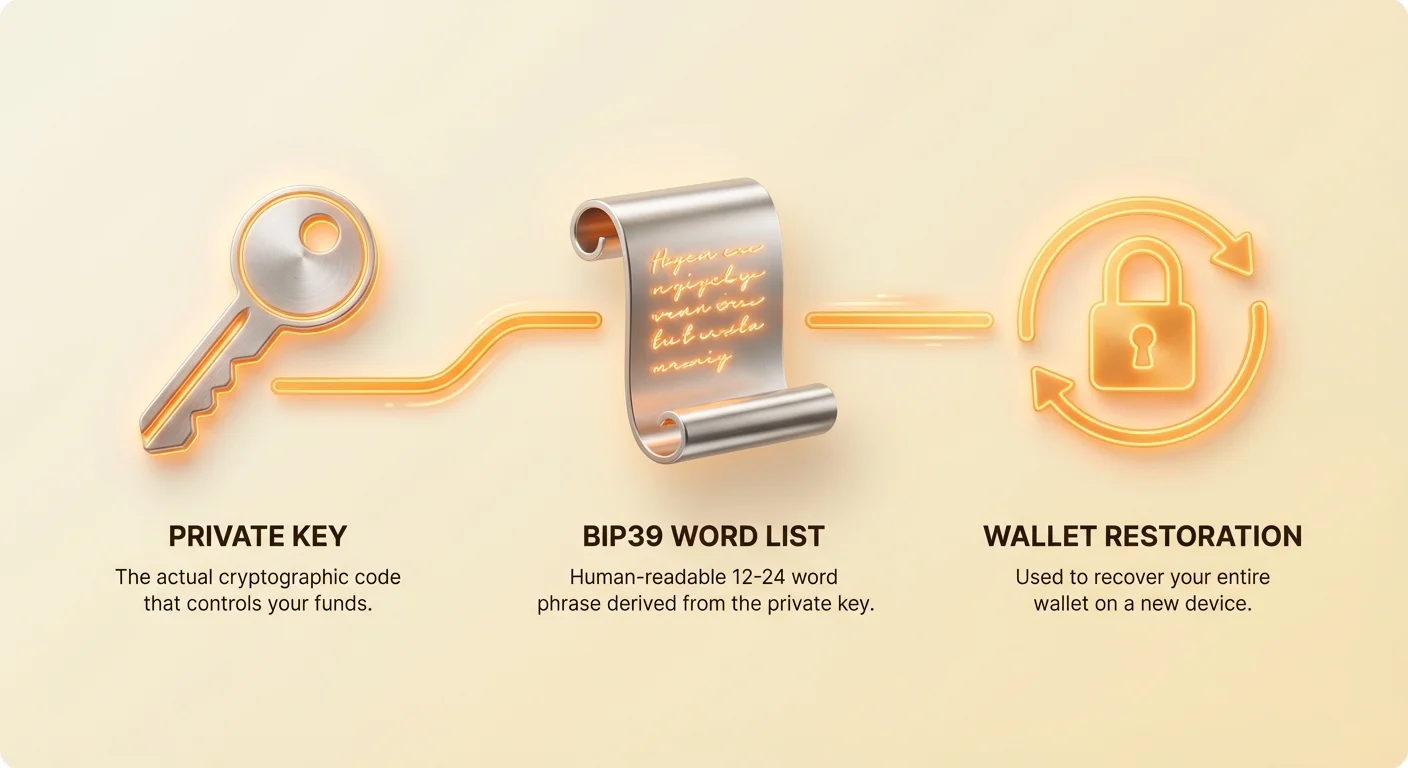
Before implementing any security measure, it is crucial to understand the cryptographic role of the seed phrase. It is not merely a password; it is the ultimate backup mechanism that regenerates your entire wallet structure.
1.1 The Role of Entropy and BIP39
When you initiate a new wallet (whether software or hardware), the device generates a random number. The quality of this randomness is called entropy. This massive, random number is mathematically translated into an ordered list of 12 or 24 simple words, using a standardized dictionary called BIP39 (Bitcoin Improvement Proposal 39).
This word list serves as a human-readable representation of your private keys. Crucially, the order of the words matters, and a single incorrect word or misplaced order renders the entire phrase useless. When you restore a wallet, you are not recovering the coins themselves; you are instructing the wallet software to mathematically re-derive all the individual private keys and public addresses associated with your funds.
1.2 The Single Point of Failure
Because the seed phrase is the cryptographic root from which all subsequent keys are derived, it represents the single most critical point of failure in your security model.
- If stolen: The thief gains instant access to all assets associated with the phrase, across all supported blockchains (Bitcoin, Ethereum, Solana, etc.). This access is immediate and non-traceable.
- If lost: Your assets are permanently locked away. No amount of money or hacking skill can recover funds without this phrase.
Therefore, the primary goal of self-custody is achieving near-perfect, permanent, and redundant physical security for this single string of words.
2. Physical Storage Solutions: Evaluating Risk and Permanence
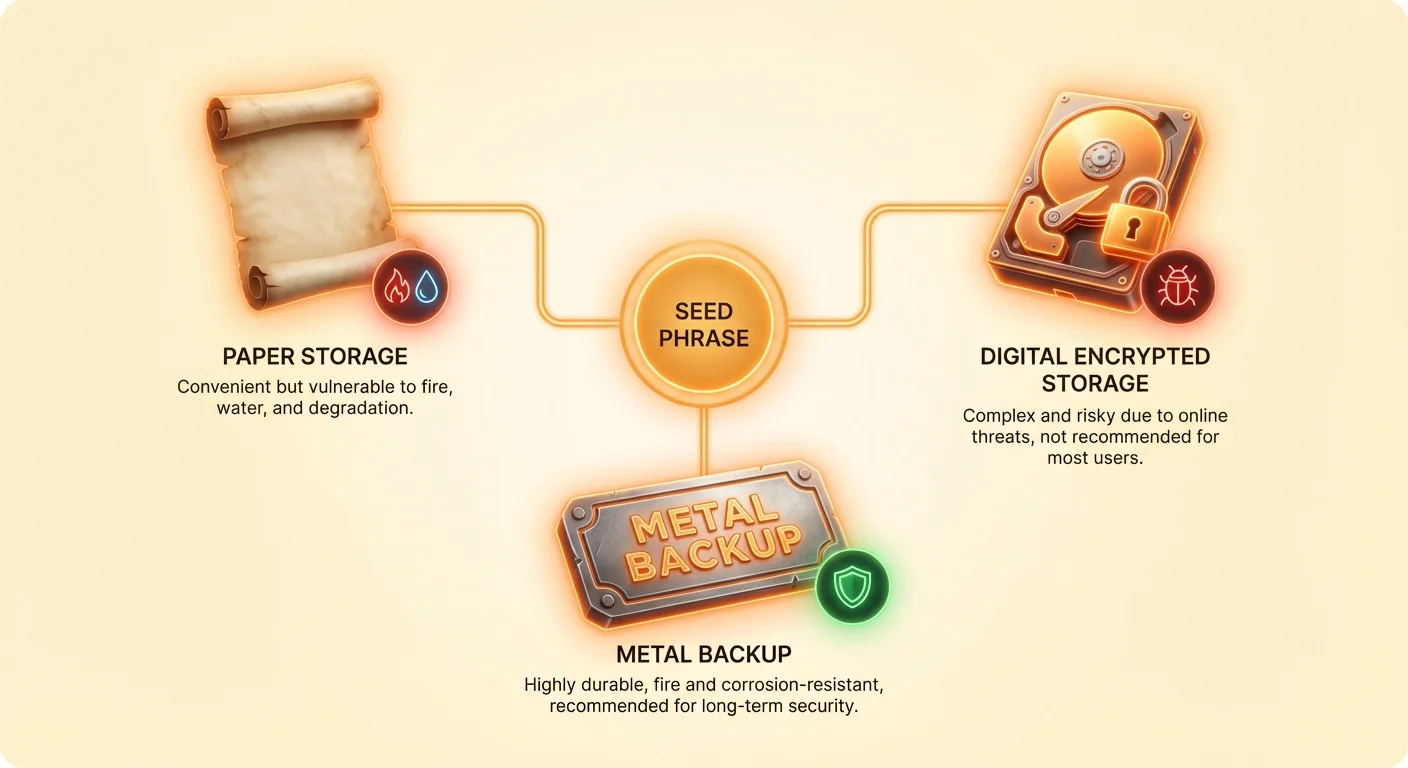
When determining how to store your seed phrase, you must weigh convenience against permanence and resilience. The optimal solution minimizes exposure to digital threats while maximizing protection against physical disasters (fire, water, time).
2.1 Paper Storage: Convenience Meets Vulnerability
Paper is the default method provided by most wallets and is simple to use. However, paper offers minimal protection against environmental risks.
| Pros | Cons |
|---|---|
| Low cost, readily available | Extremely vulnerable to fire, water, and fading. |
| Easy to hide (if done well) | Paper degrades over time (acid corrosion). |
| Complete protection against malware | Requires frequent verification and maintenance. |
Actionable Tip for Paper Storage: If using paper temporarily, choose archival-grade, acid-free paper and use a permanent, waterproof ink pen (like a Pigma Micron). Store the paper in a sealed, waterproof, fire-retardant pouch, never near high humidity or extreme heat sources.
2.2 Digital Encrypted Storage: High Risk, High Complexity
Storing your seed phrase digitally—even heavily encrypted—is highly discouraged for newcomers, as it introduces exposure to the internet, malware, and keyloggers.
Threat Model: While encrypting a file (e.g., using VeraCrypt or similar software) protects it in transit, the moment you decrypt the file and open it on a computer connected to the internet, you become vulnerable to screen-scraping malware, keyloggers, and data syncing services (like Dropbox or Google Drive) which might quietly upload the decrypted file.
Recommendation: For the vast majority of users, the risk of digital storage far outweighs the minor convenience. True self-custody security demands separation from the internet.
2.3 Establishing Redundancy and Geographic Separation
The cardinal rule of seed phrase security is redundancy, meaning having multiple copies of your key. If one copy is destroyed or compromised, others remain safe.
A highly recommended professional standard is the 3-2-1 Backup Rule adapted for crypto:
- Three total copies of the seed phrase.
- Stored using two different media types (e.g., one metal stamp, one laminated paper).
- At least one copy stored geographically separate (e.g., one copy at home, one in a safety deposit box).
Never store all copies in the same place (e.g., three copies hidden inside the same house). A localized disaster (fire, flood, theft) would wipe out your entire inheritance.
3. The Ultimate Shield: Implementing Metal Backup Solutions
For assets intended to be held for years or decades, paper is inadequate. The security standard for long-term crypto storage is inscription onto a durable material, typically stainless steel or titanium. This directly addresses the threat of fire and water damage.
3.1 Why Metal is the Best Way to Store Recovery Phrase
Metal storage devices are designed to survive common house fires (which typically burn between 800°F and 1200°F) and resist corrosion from water and chemicals.
- Material Choice: Stainless steel (304 or 316 grade) is the baseline standard due to its high melting point and rust resistance. Titanium offers superior strength and higher fire resistance but is typically more expensive.
- Format: These devices often come as metal plates, washers, or tubes where the words or their first four letters (which is sufficient for BIP39 standards) are physically etched or stamped.
3.2 Stamping vs. Engraving
There are two primary methods for inscribing your phrase onto metal, and the choice affects long-term resilience:
A. Direct Stamping (The Preferred Method)
Stamping involves using a metal punch kit (number/letter stamps and a hammer) to physically indent the words deep into the surface of the metal plate.
- Security Benefit: Stamping provides superior durability. Even if the surface of the plate is severely charred or exposed to high heat that melts surrounding materials, the physical indentations remain readable. This is considered the most secure non-digital method.
- Workflow Tip: Always practice on a scrap piece of metal first. Use solid, controlled strikes, and double-check the accuracy of each word immediately after stamping.
B. Laser Engraving
Some services offer professional laser engraving. While cleaner and faster than stamping, laser-engraved phrases are typically superficial.
- Security Risk: If the metal is exposed to extreme temperatures, the fine laser markings may oxidize, char, or wear off, making the phrase illegible. It does not provide the same depth resilience as physical stamping.
3.3 Security Through Obfuscation and Encoding
To protect against physical theft, where a common thief might discover and recognize a set of 12 or 24 words, advanced users often implement simple obfuscation techniques on their metal backups:
- Use a Random Order Key: Stamp the words onto the plate in a random order, not the sequential 1-12 or 1-24. Separately, write down a physical "key" that maps the random order back to the correct sequence (e.g., "Word 1 is in spot C4, Word 2 is in spot A1"). Hide this key separately from the plate itself.
- Use First Four Letters Only: Since BIP39 is designed so that the first four letters of any word are unique, you only need to stamp the first four letters of each word onto the metal (e.g., "abso" for "absorb"). This saves space and slightly increases the effort required by an attacker.
4. Implementing Advanced Security: The BIP39 Passphrase (The 25th Word)
For high-net-worth individuals and those seeking maximum security and plausible deniability, the BIP39 passphrase is an essential tool. This feature, sometimes called the "25th word," adds a custom layer of encryption to your master key.
4.1 How the BIP39 Passphrase Works
When you create a standard wallet, the 12 or 24 words derive a specific set of keys. If you add a custom passphrase (which can be any length, including spaces or special characters), the wallet combines the original 12/24 words plus the passphrase to derive an entirely different set of keys.
Crucial Functionality:
- New Wallet Space: The passphrase does not simply "lock" the original wallet; it calculates a completely new, unique wallet space (a new "derivation path").
- Multiple Wallets, One Seed: You can use the same 12/24 word phrase with dozens of different passphrases, creating dozens of entirely separate, secure wallets.
4.2 The Benefit of Plausible Deniability
The primary security benefit of the BIP39 passphrase is plausible deniability, a critical concept in advanced security known as "duress" or "hostage" security.
The Decoy Wallet Scenario:
- The Main Wallet (Secured): The 12/24 words + Secret Passphrase (where the majority of funds are held).
- The Decoy Wallet (Standard): The 12/24 words + No Passphrase (or a common, simple decoy phrase). This wallet holds a small amount of "dust" or negligible funds.
If an attacker physically forces you to reveal your seed phrase, you can reveal the 12/24 words. If they input this phrase without the secret passphrase, they will only gain access to the empty or low-value decoy wallet. They will conclude the main funds are not present or were moved, protecting your primary assets.
4.3 Warning: The Non-Recoverable Risk
While the passphrase provides unparalleled security, it introduces an extreme risk that must be understood perfectly:
The BIP39 Passphrase is NOT stored on your hardware wallet, nor is it recoverable by the 12/24 words.
If you forget the exact spelling, capitalization, or spacing of your passphrase, the funds derived from that passphrase are permanently lost. Even if you have the 12/24 words perfectly stored in metal, the passphrase acts like a separate, non-backup-able key.
Best Practices for BIP39 Passphrase Usage:
- Treat it like a 25th Seed Word: Store the passphrase with the same extreme security and redundancy as the 12/24 words, but separately. Never store the passphrase directly next to the seed phrase.
- Memorize or Encrypt: Ideally, memorize the passphrase, but if that is impossible, encode it in a way only you understand, using specialized encryption or splitting it into parts stored in geographically distinct locations.
- Practice Restoration: Immediately after implementing a passphrase, test the entire restoration process (inputting the 12/24 words and the passphrase) on a new device to ensure it works before transferring significant funds.
5. Secure Restoration and Recovery Workflows
The moment you need to use your seed phrase is the moment you are most vulnerable. This usually happens during device failure or when upgrading to a new hardware wallet. Typing your master key into a device connected to the internet carries the risk of keyloggers and malware stealing the phrase before you even hit enter.
The goal of secure restoration is to minimize this digital exposure using an air-gapped environment.
5.1 The Air-Gapped Restoration Strategy
An air-gapped environment refers to a device or system that has never been and will never be connected to the internet. This ensures that no hidden malware, keylogger, or remote attacker can observe the input of your seed phrase.
Step-by-Step Secure Restoration:
- Acquire a Fresh Device: Use a brand new hardware wallet, or an older computer that has been factory reset and never connected to Wi-Fi/Ethernet since the reset. The safest approach is always a dedicated, verified hardware wallet.
- Go Offline: Ensure all internet connections (Wi-Fi, Bluetooth, cellular data) are disabled on the device you are using to perform the recovery.
- Perform the Recovery: Input your 12 or 24 words (and the BIP39 passphrase, if used) directly into the device interface. Since the device is offline, any malware present cannot transmit the data.
- Verification: Once the recovery is complete, verify that the wallet displays the correct balances.
- Online Connection (Wallet Only): If using a hardware wallet, you can now safely connect it to an online computer to transact. The private keys remain isolated within the secure chip of the hardware wallet; the online computer only facilitates the transaction signing request.
5.2 The Importance of "Test Restores"
How certain are you that your metal-stamped phrase is correct? A misplaced letter, a typo in the word order, or an error in transcription can result in permanent loss.
Actionable Workflow: Immediately after backing up your seed phrase (especially after stamping it into metal or securing a complex passphrase), perform a "Test Restore" using the following procedure:
- Create the wallet and transfer a minimal amount of crypto (e.g., $5).
- Wipe the hardware wallet back to factory settings.
- Use your physical backup (the metal plate, paper, etc.) to restore the wallet onto the wiped device.
- Confirm that the $5 is accessible.
- If successful, the backup is verified as accurate, and you can now safely transfer significant funds.
5.3 Beware of Software Wallet Restoration
Restoring a seed phrase into a software wallet (like a mobile app or desktop application) exposes the phrase to the internet and the operating system of the device. This is acceptable only if the funds in that wallet are trivial.
For high-value storage, always restrict seed phrase input to the secure environment of a dedicated hardware wallet. The private keys should never touch a general-purpose operating system (Windows, iOS, Android).
6. The Comprehensive Disaster Recovery Checklist
Security is not a one-time setup; it is an ongoing process of maintenance and verification. Use this checklist to structure your annual security audit and ensure all necessary protections are in place.
6.1 Annual Security Audit
- Physical Inspection: Check all metal backups for signs of corrosion, oxidation, or physical damage. Ensure all letters are clearly legible.
- Test Restoration: Perform a dry-run restoration (as described above) using a minor wallet or a recently-acquired device to ensure you remember the exact process and that your physical backups work.
- Passphrase Verification: If you use a BIP39 passphrase, verify its exact encoding/storage location. Never write it down next to the 12/24 words.
- Update Inventory: Maintain a secure, non-digital inventory of where each physical copy (A, B, C) is stored, and which assets are associated with which passphrase.
6.2 Key Management and Distribution
- Avoid Photos: Never, under any circumstances, take a photo of your seed phrase with any device (phone, tablet, computer). Camera roll data is frequently backed up to cloud services, rendering all other security efforts moot.
- Geographic Separation Implementation: Confirm that your copies are stored in at least two highly separate locations—ideally, different cities or even countries.
- Inheritance Plan Review: Ensure your digital inheritance and disaster planning procedures are up to date. Review the instructions provided to your trusted beneficiaries on how to safely access the scattered components of your seed phrase and passphrase, should the worst occur. (For detailed steps on this, refer to our guide: Inheritance & Disaster Planning: Ensuring Crypto Continuity).
6.3 Maintenance and Upgrading
- Upgrade Hardware Security: As technology evolves, consider upgrading your hardware wallet to devices that offer progressive security features like multi-signature (Multi-Sig) or Multi-Party Computation (MPC). (For more information, see: Advanced Hardware: Multi-Sig, MPC, and Progressive Wallet Security).
- Review BIP Standards: Keep a basic understanding of BIP standards and derivation paths. While your seed phrase is static, understanding the mechanics helps you utilize advanced security features correctly. (For technical details, see: Private Key Mechanics: Seeds, Entropy, and Derivation Paths (BIP Standards)).
Conclusion
The seed phrase is the key to achieving true self-sovereignty in the digital economy. It is a powerful tool, but with that power comes absolute responsibility. By moving beyond temporary paper solutions and implementing professional standards—like durable metal storage, rigorous redundancy protocols, and advanced features such as the BIP39 passphrase—you transition from being a simple crypto holder to a secured, self-sufficient custodian of your wealth. Master the security of your master key, and you master your financial future.