
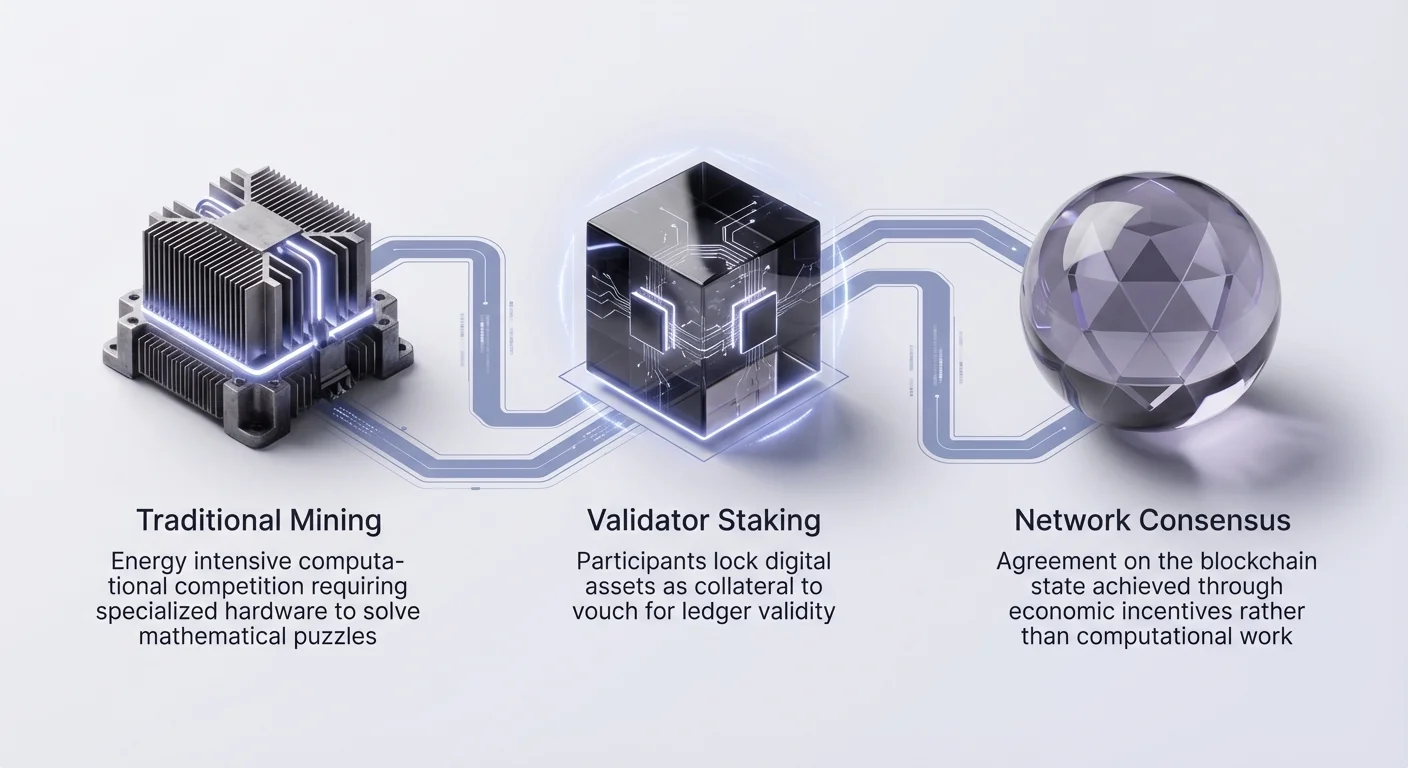
Blockchain technology has evolved significantly since the inception of Bitcoin, moving from energy-intensive mining operations to more capital-efficient security models. At the heart of this evolution lies the concept of staking, a mechanism that has transformed how networks reach consensus mechanisms and maintain integrity. Staking represents a shift from "work" to "value" as the primary defender against malicious actors. Instead of expending electricity to solve puzzles, participants lock up digital assets to vouch for the validity of the ledger.
This transition has democratized network participation, allowing anyone with capital to contribute to security infrastructure. However, it also introduces complex economic incentives and technical risks that differ vastly from traditional mining. Staking is not merely a passive income vehicle; it is an active service that requires diligence, understanding of protocol rules, and an awareness of potential penalties. The validator does not just process transactions but acts as a financial guarantor of the network's honesty.
As the ecosystem matures, the mechanisms for staking have become more sophisticated. Simple direct staking has given way to liquid staking, delegation pools, and now restaking protocols that leverage the same capital across multiple applications. Each layer of complexity adds utility and potential rewards but also compounds the risk profile for the user. Understanding these nuances is essential for anyone participating in the decentralized economy.
The Evolution of Consensus Mechanisms
The history of blockchain security is a progression toward efficiency and scalability. Bitcoin introduced Proof of Work (PoW), a system where miners compete to solve mathematical problems. While secure, PoW is resource-heavy and limits transaction throughput. The industry sought alternatives that could provide similar security guarantees without the immense physical infrastructure requirements. This search led to the conceptualization of Proof of Stake (PoS), first discussed in online forums around 2011.
From Mining to Validating
In a PoS system, the probability of a participant being chosen to add the next block of transactions correlates with their economic stake in the network. The first implementation appeared with Peercoin in 2012, which used a hybrid model. However, the concept gained mainstream attention when Ethereum announced its intention to migrate from PoW to PoS. This upgrade, known as "The Merge," demonstrated that large-scale networks could transition to a validator-based model without halting operations.
Reducing Barriers to Entry
Mining requires specialized hardware, cheap electricity, and technical expertise, creating high barriers to entry. Staking changes this dynamic by replacing physical mining rigs with digital capital. While running a validator node still requires technical knowledge, the hardware requirements are significantly lower. This shift allows a broader range of participants to secure the network, theoretically leading to greater decentralization.
Energy and Efficiency Gains
The most immediate benefit of this transition is the drastic reduction in energy consumption. By eliminating the need for competitive computation, PoS networks operate with a fraction of the electricity used by PoW chains. This efficiency allows the network to focus its resources on transaction throughput and executing smart contracts rather than generating waste heat. It aligns the incentives of the validators with the health of the network, as they have a direct financial interest in the asset's value.
Core Mechanics of Staking Rewards
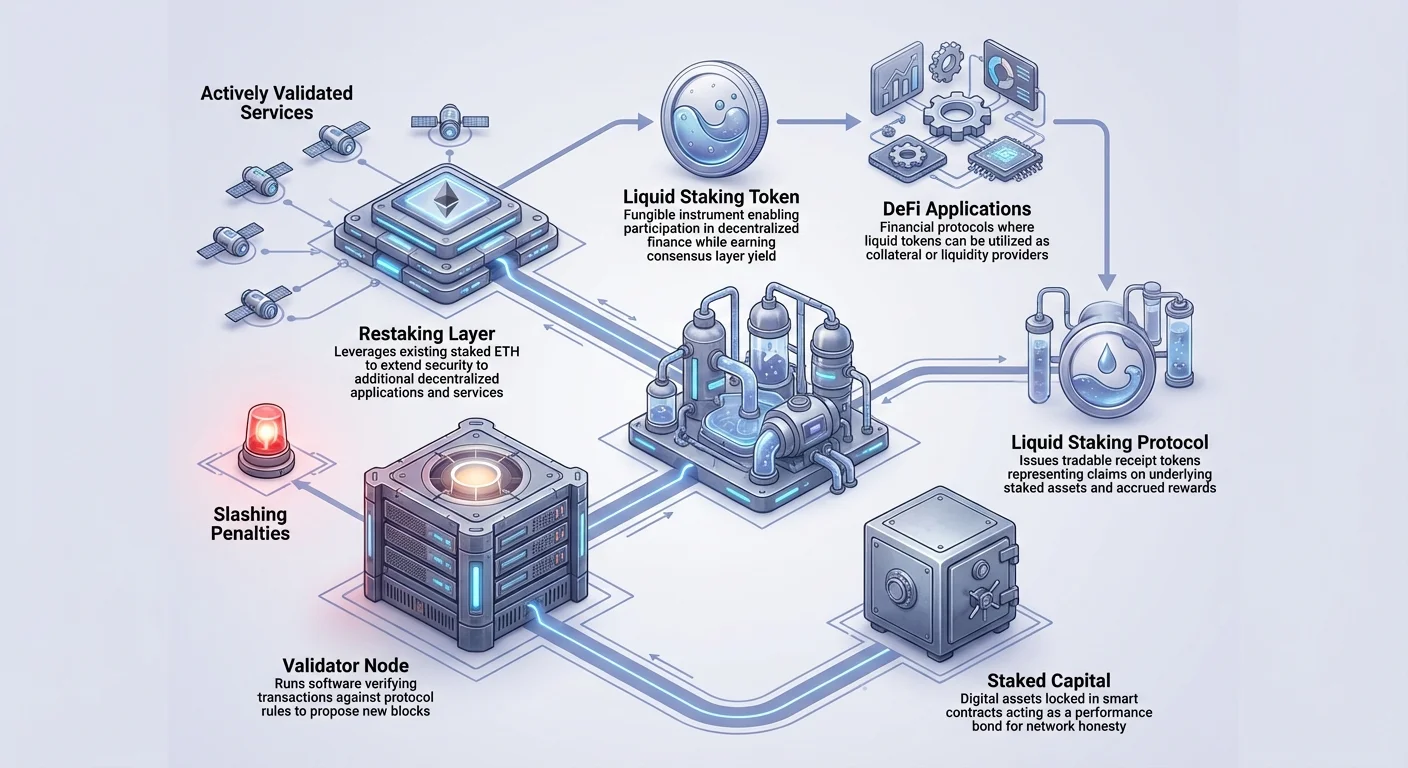
Staking operates on a system of incentives and penalties designed to ensure honest behavior. When a user locks up cryptocurrency, they are essentially posting a performance bond. The network uses these funds as collateral. If the validator performs their duties correctly—processing transactions and proposing valid blocks—they receive rewards. These rewards come from new issuance of the cryptocurrency (inflation) and transaction fees paid by users.
The Role of the Validator
Validators are the workhorses of a PoS blockchain. They run software that verifies transactions against the protocol's rules. When selected, a validator proposes a new block to the chain. Other validators then attest to the validity of that block. This continuous process of proposal and attestation allows the network to reach consensus. The security of the system relies on the assumption that a majority of the stake is held by honest actors who want to protect the value of their assets.
Slashing and Penalties
To prevent malicious behavior, PoS protocols implement "slashing." If a validator attempts to attack the network, such as by signing two different versions of the same block (double-signing) or going offline for extended periods, a portion of their staked assets is confiscated. This financial penalty ensures that the cost of attacking the network exceeds the potential gain. Slashing creates a tangible risk for stakers, making the choice of validator or the management of one's own node a critical decision.
Delegation Models and Participation
Not every crypto holder has the technical expertise or the minimum capital required to run a dedicated validator node. For example, Ethereum requires 32 ETH to run a solo validator, a sum out of reach for many. To solve this, delegation models emerged. Delegation allows users to assign their staking power to a professional validator without transferring custody of their assets.
How Delegation Works
In a delegated system, the token holder selects a public validator and "delegates" their coins to them via a smart contract. The validator performs the technical work of securing the network and earns the rewards. The protocol then splits these rewards between the validator and the delegator, typically deducting a small commission fee for the validator's service. This model allows users to participate in consensus and earn yield with any amount of capital.
Selecting a Trustworthy Operator
Delegation shifts the responsibility from technical maintenance to due diligence. Users must choose validators based on performance metrics. Key factors include uptime (reliability), commission rates, and reputation. A validator with poor uptime may miss out on rewards, reducing the yield for their delegators. Worse, if a validator acts maliciously and gets slashed, the delegators may also lose a portion of their funds depending on the protocol's specific rules.
Centralization Risks in Delegation
A side effect of easy delegation is the tendency for stake to concentrate around a few large, popular validators or exchange-based pools. If too much stake centralizes with a single entity, it undermines the decentralized nature of the network. Protocols often incentivize users to delegate to smaller validators to spread the security load more evenly. Users must balance the convenience of large providers against the health of the ecosystem.
Liquid Staking and Asset Utility
One of the primary drawbacks of traditional staking is illiquidity. When assets are staked, they are locked in a smart contract and cannot be sold, traded, or used as collateral. This "opportunity cost" deterred many traders from participating in consensus. Liquid staking emerged as a solution to unlock the value of staked assets while they continue to secure the network.
The Mechanism of Liquid Staking Tokens (LSTs)
Liquid staking protocols accept user deposits and stake them on their behalf. In return, the user receives a token representing their claim on the underlying asset and the accrued rewards. For instance, depositing ETH into a liquid staking protocol yields a token that tracks the value of ETH plus staking yield. This receipt token is fully transferable and fungible.
Integration with DeFi
The creation of LSTs connects the security layer with the application layer. Users can take their liquid staking tokens and use them across decentralized finance (DeFi) applications. They can be lent out for additional interest, used as collateral for loans, or provided as liquidity in decentralized exchanges. This composability allows capital to be efficient, earning yield from both the consensus layer and the DeFi layer simultaneously.
Comparing Staking Methods
| Feature | Solo Staking | Delegated Staking | Liquid Staking |
|---|---|---|---|
| Custody | Self-custodial | Self-custodial | Smart Contract Risk |
| Liquidity | Illiquid (Locked) | Illiquid (Locked) | High (Tradable Token) |
| Technicality | High (Run Node) | Low (Select Node) | Low (Swap/Deposit) |
Restaking and Shared Security Layers
The innovation in staking does not stop at liquidity. A newer concept known as restaking is expanding the utility of staked assets even further. Restaking allows validators to use their already staked cryptocurrency to secure additional protocols beyond the main blockchain. This concept, pioneered by protocols like EigenLayer, aims to solve the "bootstrapping" problem for new applications.
Extending Security to New Services
Traditionally, a new decentralized service (like an oracle network or a bridge) would need to establish its own set of validators and issue its own token to incentivize them. This is difficult and fragments security. Restaking allows these services, often called Actively Validated Services (AVSs), to "rent" security from existing Ethereum validators. Validators opt-in to secure these new services using their existing stake, earning additional rewards in the process.
Native and Liquid Restaking
Restaking functions through two primary methods. Native restaking involves a validator pointing their withdrawal credentials to the restaking protocol's smart contracts. They run additional software to validate the new services. Liquid restaking allows holders of LSTs to deposit those tokens into restaking pools. This aggregates the power of liquid tokens to provide security to AVSs, simplifying the process for the end user who does not run a node.
The Risks of Leverage
While restaking increases potential yield, it introduces "compounded slashing" risks. A validator securing the main chain and three additional services is now subject to the slashing conditions of four different protocols. If the validator fails in any one of them, the staked assets could be penalized. This creates a complex web of dependencies where a failure in a smaller service could impact the security of the main stake.
Withdrawal Risks and Smart Contract Vulnerabilities
Participating in staking and restaking involves navigating various withdrawal limitations and technical risks. Unlike a bank account where funds are usually accessible on demand, blockchain staking often imposes strict timing constraints to ensure network stability.
Lock-up and Unbonding Periods
Most Proof of Stake networks enforce a lock-up or "unbonding" period. When a user decides to stop staking, they cannot access their funds immediately. This period can range from a few days to several weeks, depending on the protocol. During this time, the assets do not earn rewards but are often still subject to slashing risks. This delay prevents stakers from fleeing the network instantly during a crisis, stabilizing the protocol but reducing flexibility for the user.
Smart Contract and Protocol Risk
DeFi and staking rely entirely on code. If the smart contracts governing a liquid staking pool or a restaking protocol contain bugs, hackers can exploit them. Unlike traditional finance, there is no FDIC insurance or reversible transactions. Even audited contracts can harbor vulnerabilities. Users interacting with these layers must understand that they are adding layers of risk: the risk of the base layer, the risk of the liquid staking provider, and potentially the risk of the restaking protocol.
Inflationary Pressure
Staking rewards are frequently paid out through the issuance of new tokens. This increases the total supply of the cryptocurrency. If the rate of new issuance (inflation) exceeds the demand for the token, the price may decrease over time. A high nominal yield (AP,Y) might be negated by the depreciation of the asset's value. Users must evaluate the "real yield"—the return adjusted for inflation and price action—rather than just the headline number.
Conclusion
Staking has matured from a theoretical consensus mechanism into the backbone of the modern crypto economy. It offers a more energy-efficient and accessible alternative to mining, allowing users to participate directly in network security. Through delegation, even those with modest capital can contribute to the stability of decentralized protocols. The innovations of liquid staking and restaking have further amplified capital efficiency, allowing assets to secure networks while simultaneously participating in the broader DeFi ecosystem.
However, these advancements come with increased complexity. The transition from simple locking of assets to multi-layered restaking protocols introduces new vectors for risk, including smart contract exploits and compounded slashing penalties. Users must navigate trade-offs between liquidity, yield, and security. As the infrastructure continues to evolve, the line between validator and investor blurs, placing the responsibility of due diligence squarely on the participant.
Successful staking requires balancing the desire for yield with a clear understanding of protocol rules and lock-up constraints.