
For most newcomers, Bitcoin is simply an asset on a price chart—a volatile investment that promises high returns. However, understanding Bitcoin's long-term potential requires shifting perspective from short-term market movements to profound economic theory. The ultimate vision for Bitcoin extends far beyond its current use as a speculative asset; it involves the fundamental restructuring of global finance.
This page explores the leading long-term narratives surrounding Bitcoin’s adoption and future valuation. We move past the basics of what Bitcoin is and analyze the speculative scenarios—from the radical concept of Hyperbitcoinization to the technological impact of Layer 2 solutions—that paint a picture of how this digital currency might integrate itself into daily life and international commerce over the next decade.
As we dissect these visions, it is important to remember that these are not guarantees, but potential pathways based on Bitcoin's inherent design, particularly its fixed supply and decentralized nature. Analyzing these narratives helps build a comprehensive investment thesis regarding its role in the future digital economy.
The Foundation of Future Value: Scarcity and Monetary Policy
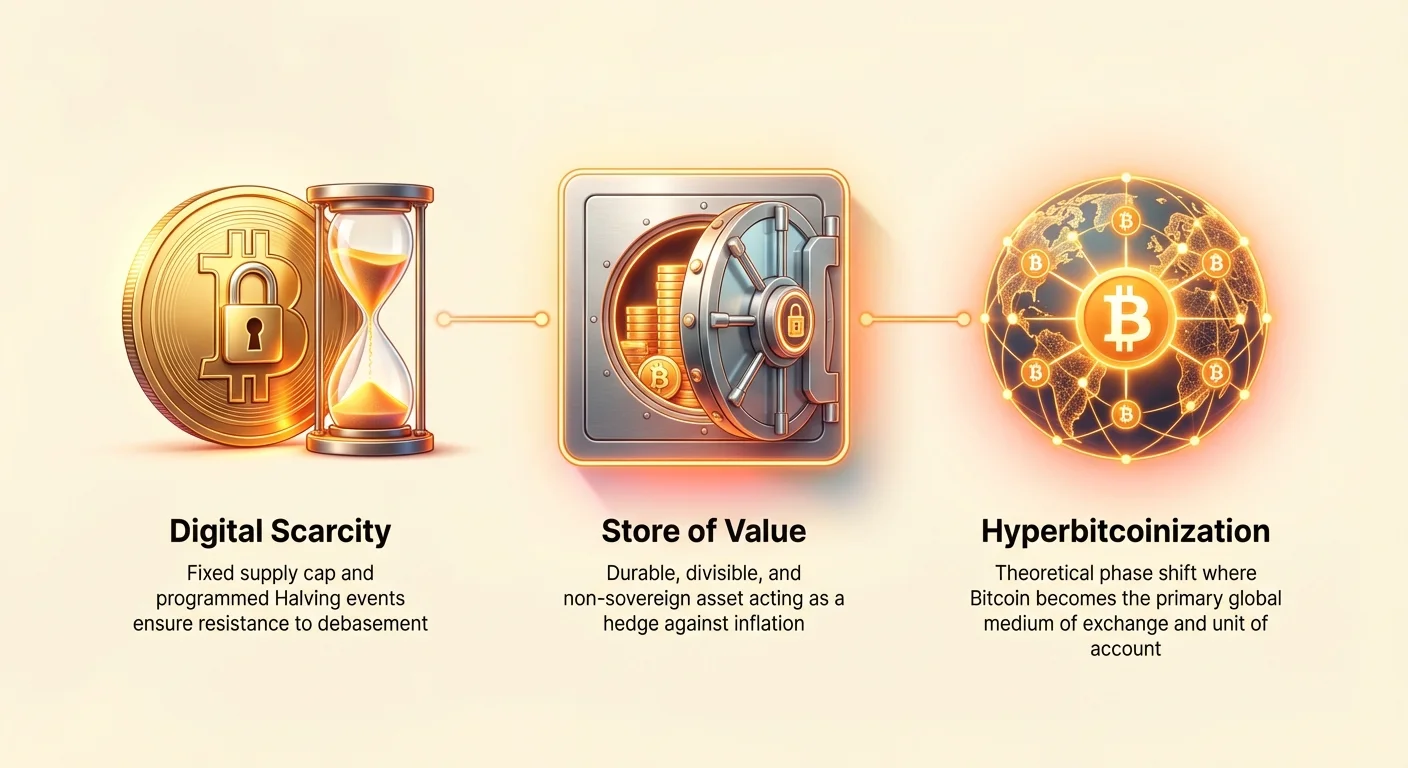
Any projection about Bitcoin's future must begin with its foundational economic policy. Bitcoin is often described as "digital scarcity," defined by two non-negotiable rules: a hard cap of 21 million coins and a predictable reduction in supply issuance known as the Halving.
This fixed, programmatic supply schedule makes Bitcoin fundamentally different from fiat currencies, which can be inflated arbitrarily by central banks. This difference is the core reason why proponents believe Bitcoin will continue to accrue a "monetary premium"—value beyond its utility, simply because it cannot be debased.
The Halving Cycle as a Predictor
The Bitcoin protocol is designed to cut the reward miners receive for validating transactions in half approximately every four years. This event, known as the Halving, results in a sudden, predictable reduction in the new supply entering the market.
Historically, the Halving has been a major factor driving price appreciation and market enthusiasm. While past performance does not guarantee future results, this programmed supply shock fundamentally influences future pricing models. The recurring supply reduction acts as a continuous stress test on demand, forcing the market to reprice the asset based on ever-increasing scarcity relative to demand.
Bitcoin as a Non-Sovereign Store of Value
The current primary narrative for Bitcoin is its role as a superior Store of Value (SoV), often benchmarked against assets like gold. A successful store of value must meet three criteria: it must be durable, divisible, and, most importantly, possess salability across time—meaning it holds purchasing power reliably for years or decades.
Bitcoin’s digital nature makes it durable (non-perishable) and highly divisible (down to eight decimal places, called satoshis). Its programmable scarcity addresses the primary failing of modern fiat currencies: inflation risk. The belief that Bitcoin provides an "exit path" from inflationary fiat systems underpins its current market capitalization and forms the necessary stepping stone toward broader adoption.
The Core Speculative Thesis: Hyperbitcoinization Explained
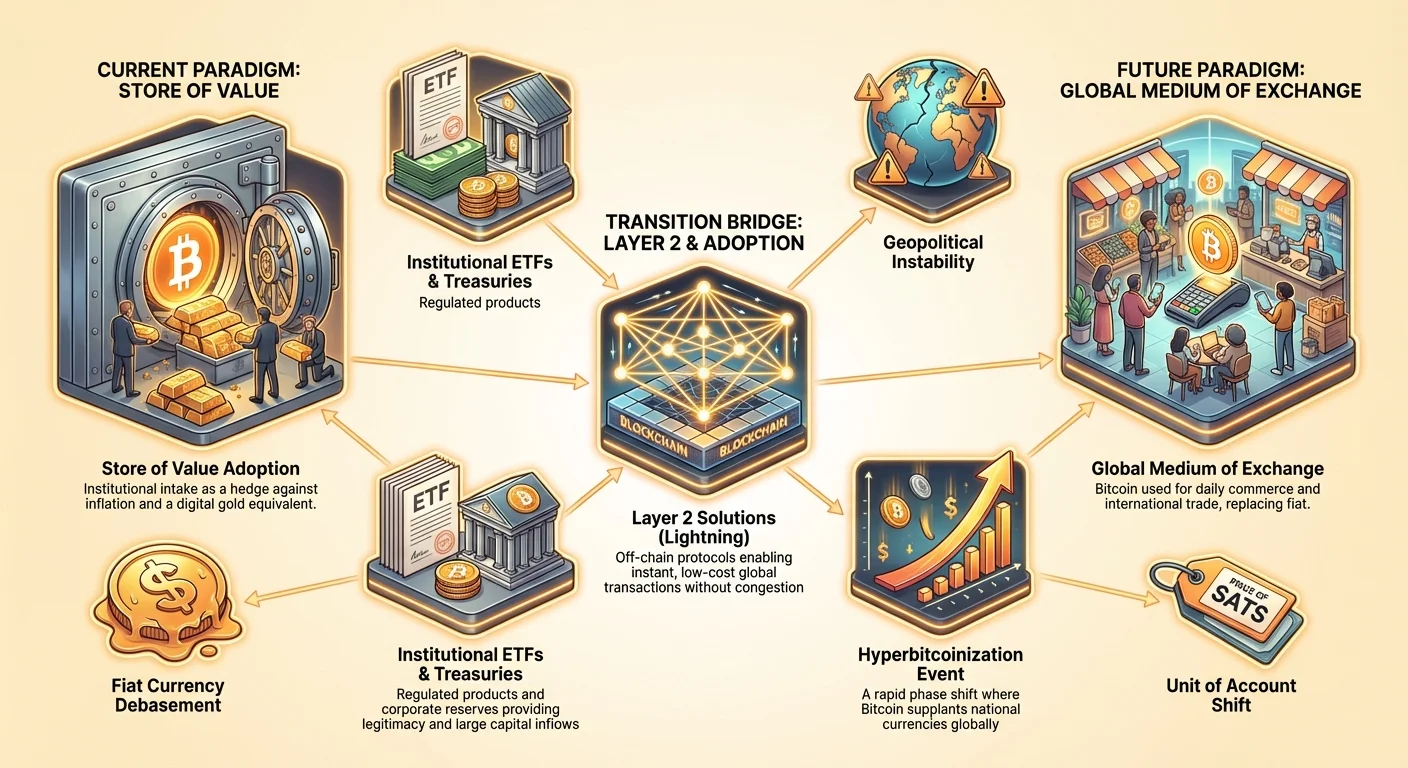
The most radical long-term narrative for Bitcoin is Hyperbitcoinization. This theory posits that Bitcoin will eventually transition from being merely a speculative Store of Value to becoming the world’s primary medium of exchange and, ultimately, the global unit of account.
If successful, Hyperbitcoinization implies a complete phase shift in global economics, where national currencies become obsolete or relegated to niche use cases, and economic calculations worldwide are denominated in Bitcoin (or its smallest unit, the satoshi).
Stage 1: Asset Demonetization (The Store of Value Phase)
We are currently living through the first stage. This phase involves Bitcoin gradually absorbing the value previously stored in other assets perceived as less sound, such as gold, bonds, or real estate (when used purely as a wealth accumulator).
As more individuals, corporations, and eventually, nation-states begin holding Bitcoin, the volatility caused by small volumes decreases. This stabilization reinforces its reliability as an SoV, attracting even more capital. This is the crucial point where Bitcoin achieves deep market liquidity and high velocity of capital flow, proving its durability over the long term.
Stage 2: Unit of Account Shift
The true marker of Hyperbitcoinization is the shift to Bitcoin as the Unit of Account. Currently, prices are denominated in fiat currencies (dollars, euros, yen). If Hyperbitcoinization occurs, prices for goods, wages, and services would be quoted directly in satoshis.
For example, instead of a loaf of bread costing $3.50, it would cost 10,000 satoshis (Sats). This transition happens when people trust the long-term stability and predictability of Bitcoin more than their local fiat currency. Once merchants and employees begin quoting and accepting wages in Bitcoin, its utility as money expands exponentially. This transition requires stability and widespread access, which is where Layer 2 technology becomes essential.
The Role of Fiat Currency Collapse
While many proponents focus on Bitcoin’s strengths, Hyperbitcoinization is often catalyzed by the perceived weaknesses of the existing system. The theory gains traction primarily during periods of high geopolitical instability, uncontrolled fiat inflation, or systemic sovereign debt crises.
In nations experiencing currency collapse (e.g., Venezuela, Lebanon, Argentina), citizens frequently adopt alternative means of value transfer (USD, gold, or crypto). Hyperbitcoinization proposes that, globally, Bitcoin will be the preferred digital solution because it is trust-minimized, borderless, and unconfiscatable, serving as a superior safe haven compared to any single nation's fiat currency. The failure of localized fiat systems acts as the accelerator for global Bitcoin adoption.
Solving the Scalability Challenge: The Layer 2 Revolution
One of the biggest obstacles preventing Bitcoin from becoming the global medium of exchange is its capacity. The Bitcoin blockchain (Layer 1) is intentionally slow, processing only about 7 transactions per second, ensuring security and decentralization above all else. Global commerce requires hundreds of thousands of transactions per second.
The future of bitcoin adoption hinges not on making the base layer faster, but on building efficient infrastructure on top of the base layer. This infrastructure is known as Layer 2.
The Need for Off-Chain Solutions
Layer 2 networks operate "off-chain," meaning transactions are conducted almost instantly between participants and are only settled onto the main Bitcoin blockchain periodically. This approach allows the base layer to remain secure and robust (the "settlement layer") while enabling speed and efficiency above it (the "transaction layer").
The most prominent example of a Layer 2 solution is the Lightning Network. Lightning allows for millions of transactions per second at fractions of a penny. This technology fundamentally changes Bitcoin's utility, transforming it from a slow-moving digital asset into a rapid global cash system.
Instant Global Microtransactions (The Killer App)
The Lightning Network facilitates true global microtransactions—tiny payments previously infeasible due to transaction fees on the main chain. This capability unlocks massive potential use cases:
- Peer-to-Peer Payments: Instantaneous transfers across borders without banking intermediaries.
- Streaming Content: Paying per second for videos, music, or articles, replacing subscription models.
- Machine-to-Machine Payments: Automated payments between Internet of Things (IoT) devices, such as a smart car paying a charging station.
The ability to move small amounts of value instantly and cheaply is often cited as the key technological leap necessary to move Bitcoin from the hands of institutional investors and into everyday consumer use, driving the Hyperbitcoinization Unit of Account shift.
Adoption through Gaming and Decentralized Finance (DeFi)
Initial mass adoption of Layer 2 solutions often comes through industries that demand high transaction speed and low fees, such as gaming and light decentralized finance (DeFi).
- Gaming: Using Lightning for in-game purchases, rewards, and tipping creates immediate utility.
- DeFi on Bitcoin: New protocols built on Layer 2 are beginning to replicate simplified financial services (lending, borrowing) in a trust-minimized way, leveraging Bitcoin’s liquidity and security without congesting the main chain.
The proliferation of easy-to-use Lightning wallets and consumer applications is the practical mechanism by which the bitcoin layer 2 impact will be felt by the average user, even if they never interact directly with the underlying blockchain.
Geopolitical and Institutional Adoption Scenarios
The future trajectory of Bitcoin is heavily influenced by how existing powerful entities—governments, corporations, and regulatory bodies—respond to its growth. Large-scale institutional adoption provides the necessary liquidity and legitimization required for Bitcoin to achieve its long-term potential.
The Central Bank vs. Corporate Treasury Race
In recent years, corporate treasuries (like MicroStrategy) have adopted Bitcoin as a reserve asset to hedge against inflation and preserve capital. This strategy reflects a growing acceptance of Bitcoin as a legitimate hedge.
On the other hand, Central Banks (CBs) are developing Central Bank Digital Currencies (CBDCs) as a direct response to the threat posed by decentralized alternatives. The future monetary landscape might be defined by a tension between highly controlled, programmable CBDCs and the permissionless, trust-minimized nature of Bitcoin.
If more nations and global financial institutions see Bitcoin as a neutral, global reserve asset—similar to how gold was treated internationally—its legitimacy grows, leading to more stable pricing and reduced systemic risk perception.
Responses to Global Systemic Risk
Bitcoin's rise coincided with the global financial crisis of 2008, positioning it as an anti-establishment technology designed specifically to function outside the control of fragile legacy systems.
In scenarios of future global systemic risk (e.g., unexpected regional conflicts, massive supply chain breakdowns, or multi-state economic instability), Bitcoin acts as an increasingly attractive, non-confiscatable digital bearer asset. Geopolitical tension drives individuals and hedge funds toward assets that cannot be frozen or controlled by third parties.
This narrative suggests that the greater the instability in the traditional financial system, the faster the adoption curve for Bitcoin will accelerate, driving its transformation into a necessity rather than a novelty.
Regulatory and ETF Maturation
Regulatory clarity is a dual-edged sword. While governments imposing onerous restrictions could slow adoption, the current trend towards regulated products, such as spot Bitcoin Exchange-Traded Funds (ETFs), signifies institutional acceptance.
ETFs provide regulated access for traditional financial players—pension funds, wealth managers, and large endowments—allowing vast amounts of capital to flow into the asset without the need for self-custody or complex crypto exchange accounts. This maturation lowers the barrier to entry for trillions of dollars in assets under management, effectively integrating Bitcoin into the traditional financial ecosystem and accelerating the future of bitcoin adoption among sophisticated investors.
Alternative Futures: "Moon" Scenarios vs. Steady Maturation
When discussing Bitcoin's future, two timelines often emerge: the rapid "Moon" scenario and the slower, more pragmatic S-Curve adoption.
The Rapid Moon Scenario (Hyperbitcoinization Timeline)
The "Moon" narrative often predicts a rapid, parabolic rise in price driven by a sudden, catastrophic loss of confidence in fiat currencies. In this scenario, Hyperbitcoinization occurs within a single, dramatic decade, pushing Bitcoin's valuation to extremes as it attempts to absorb the entire global market for money, store of value, and sovereign debt. This scenario is highly volatile and assumes near-perfect execution of technological and regulatory steps.
The Steady S-Curve Maturation
A more balanced perspective suggests that Bitcoin adoption will follow an S-curve, similar to previous transformative technologies like the internet or mobile phones. Early adoption is slow (the initial flat part of the S), followed by a sharp acceleration (the steep middle part, driven by Layer 2 and institutional ETFs), and finally, a plateau of near-universal adoption.
This model suggests Bitcoin will stabilize gradually over 20-30 years, becoming a global monetary network alongside traditional systems before eventually overtaking them, leading to a much more manageable and predictable long-term growth trajectory for investors. This view prioritizes stability and security over immediate, radical disruption.
Conclusion
The future of Bitcoin is a complex interplay between technology, macroeconomics, and human psychology. While it currently serves primarily as a speculative Store of Value, the technological advancement of Layer 2 networks like Lightning and the increasing institutional acceptance lay the groundwork for a transition to a true global medium of exchange.
Whether through the dramatic societal shift envisioned by Hyperbitcoinization or the steady, persistent maturation seen in the S-curve adoption model, the narratives point toward Bitcoin playing a critical, foundational role in the coming digital economy. Understanding these long-term visions is crucial for any investor or analyst seeking to build a resilient thesis in the highly competitive and rapidly evolving world of digital assets.