
Decentralized finance offers mechanisms for asset owners to put their holdings to work. Rather than letting digital assets sit idle in a wallet, users can provide liquidity to decentralized exchanges. This process facilitates permissionless trading while offering the provider a share of the fees generated by the platform. However, this activity comes with inherent risks associated with market volatility and asset rebalancing.
To navigate these risks effectively, participants must employ specific strategies that go beyond simple depositing. The goal is to ensure that the rewards earned through fees and additional incentives outweigh any potential value changes that occur due to the mechanics of the liquidity pool. Understanding the interplay between trading volume, fee accumulation, and yield farming incentives is essential for anyone looking to maintain a profitable position in these markets.
The core of this activity revolves around the concept of liquidity. In the context of a decentralized exchange, or DEX, liquidity refers to the pool of assets available for traders to swap against. Without a deep reservoir of assets, trading becomes inefficient. Prices slip, and executing large orders becomes difficult without negatively impacting the market rate. DEXs solve this by crowdsourcing liquidity from users, turning them into market makers who earn a return for their service.
The Mechanics of Liquidity Provision
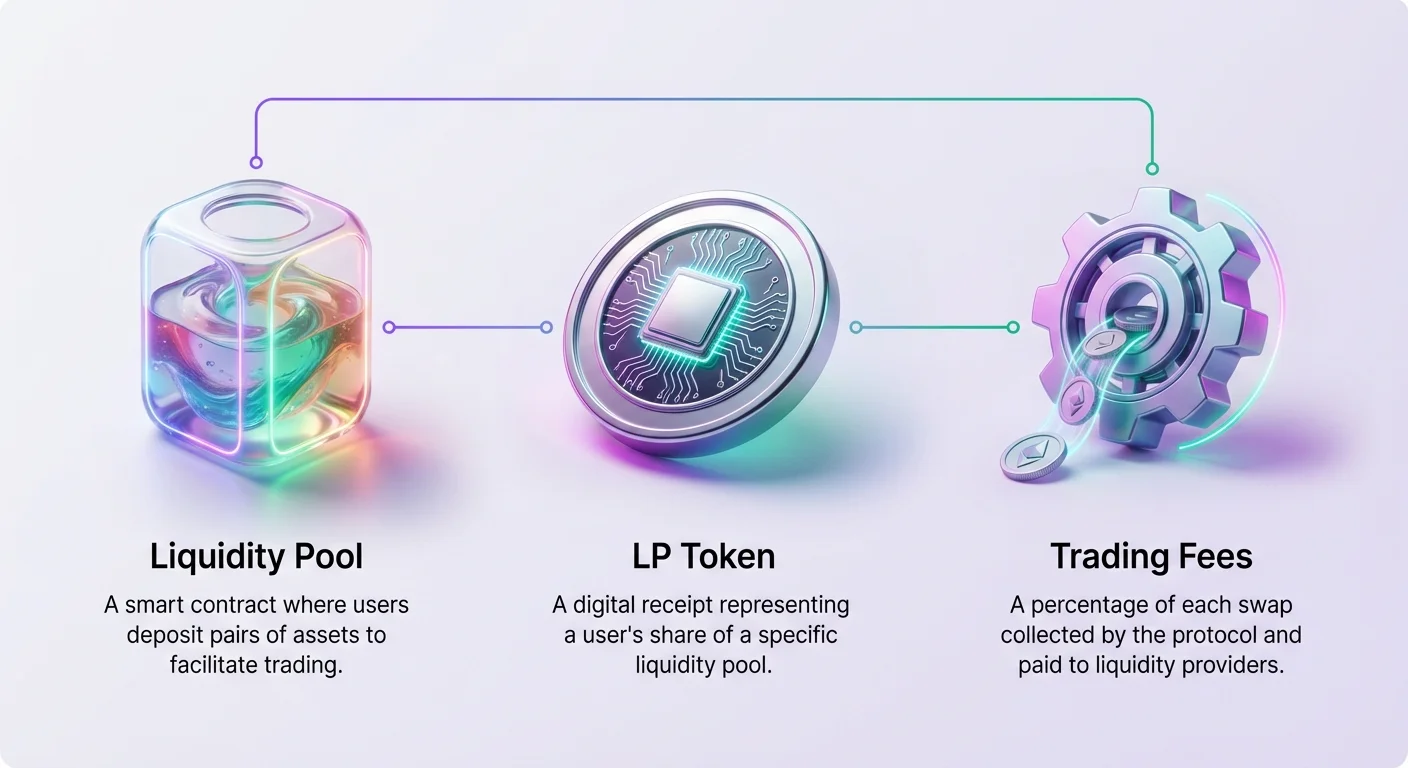
Providing liquidity is the act of depositing assets into a smart contract to facilitate trading for others. This creates a market where users can swap between tokens without needing a centralized intermediary. The protocol governs the pricing and the ratio of assets, ensuring that trades can always be executed as long as there are funds in the pool.
The Automated Market Maker Model
Most decentralized exchanges operate using an Automated Market Maker model. In this system, trading pairs do not rely on an order book of buyers and sellers. Instead, they rely on liquidity pools. A pool is a collection of funds locked in a smart contract. For a standard trading pair, such as VERSE-WETH, the pool holds both assets.
When a user wishes to provide liquidity, they generally must deposit an equal value of both assets. For example, if a user wants to contribute to the VERSE-WETH pool, they cannot simply deposit VERSE. They must calculate the current market value and deposit the equivalent amount of WETH alongside it. This 50/50 value ratio is critical for the mathematical formula that the DEX uses to determine the price of assets during a swap.
Once the assets are deposited, the smart contract takes custody of them. In exchange, the protocol mints a new asset known as a Liquidity Pool token, or LP token. This token acts as a receipt. It represents the user's specific share of the total pool. It is a claim on the underlying assets and any fees that accrue over time.
Asset Rebalancing and Price Shifts
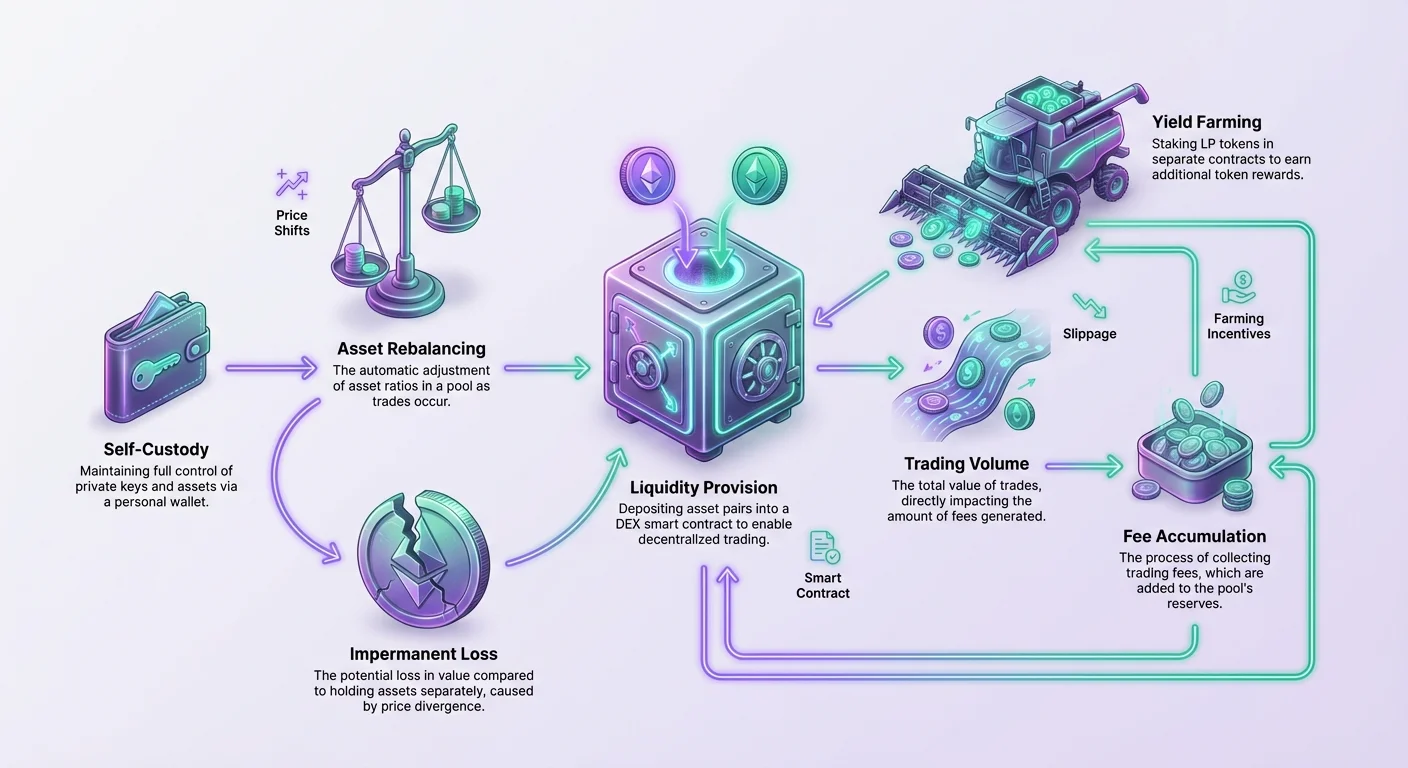
The fundamental risk in this process arises from how the pool handles trades. When a trader swaps one asset for another, they add one type of token to the pool and remove the other. This changes the ratio of assets held in the smart contract. As the ratio changes, the price adjusts automatically to reflect the new scarcity of the removed asset and the abundance of the added asset.
For the liquidity provider, this means the composition of their position changes in real-time. If the price of one asset rises significantly compared to the other, the pool will naturally sell the appreciating asset and buy the depreciating one to maintain the balance. When the provider eventually withdraws their liquidity using their LP token, they will receive a different amount of each asset than they originally deposited.
This shift in asset ratios is the mechanical cause of what is often termed impermanent loss. The value of the withdrawn assets may be lower than if the user had simply held the two assets separately in a wallet. Mitigation strategies focus on ensuring that the income generated from the position is sufficient to cover this potential difference.
The Importance of Fee Revenue
The primary compensation for taking on the risk of asset rebalancing is the exchange fee. On platforms like the Verse DEX, a small percentage of every trade is collected as a fee. Specifically, 0.25% of the trading volume is paid out to liquidity providers. This fee is added directly to the pool, growing the total value of the reserves.
This revenue stream is proportional to the provider's share of the pool. If a user provides 1% of the liquidity, they are entitled to 1% of the fees collected. In a high-volume environment, these fees can accumulate rapidly. The strategy here is to identify pools with sufficient trading volume relative to their size.
If the accumulated fees over the duration of the deposit exceed the loss in value caused by price divergence, the position remains profitable. Therefore, seeking out active trading pairs is a defensive strategy. A stagnant pool with no volume generates no fees, leaving the provider exposed to price volatility with no offsetting income.
Yield Farming as a Strategic Hedge
While trading fees provide a baseline income, they are often insufficient to fully mitigate the risks of high volatility pairs. Advanced mitigation involves layering additional revenue streams on top of standard fee collection. This is where yield farming becomes a critical component of the liquidity provider's toolkit.
Leveraging Farming Incentives
Yield farming allows liquidity providers to put their LP tokens to work. After depositing assets into a pool and receiving the receipt tokens, users can take an additional step. They can deposit these LP tokens into a "farm." A farm is a separate smart contract designed to reward users for keeping their liquidity in the DEX.
The rewards for farming are typically paid in the protocol's native token. For instance, the Verse DEX runs a Verse Ecosystem Incentives program. This program allocates a significant portion of the total token supply to reward community growth. By depositing LP tokens into Verse Farms, providers earn a yield that is separate from and additional to the trading fees.
This secondary yield acts as a powerful hedge. Even if the underlying assets diverge in price, causing a theoretical loss in the principal value, the farming rewards can offset this outcome. In many cases, the Annual Percentage Yield (APY) from farming can be substantial, turning a potentially flat or negative position into a net positive one.
Sustainable Reward Structures
Not all farming opportunities offer the same level of security. Some platforms offer astronomical APYs to attract capital quickly. However, these high rates are often unsustainable. If the rewards are paid in a token that rapidly loses value due to inflation or selling pressure, the mitigation strategy fails.
A robust strategy involves analyzing the source of the rewards. The Verse DEX, for example, allocates rewards linearly on a block-by-block basis. The goal is to incentivize long-term liquidity rather than short-term speculation. The rewards are designed to distribute the token widely while bootstrapping the exchange's functionality.
Investors should look for programs where the APY is attractive but grounded in a long-term distribution model. "Mercenary liquidity" providers often chase the highest possible APY, dump the reward tokens immediately, and then withdraw their liquidity. This hurts the ecosystem. Sustainable farms aim to align the interests of the provider with the health of the DEX.
Calculating Net Position
To effectively mitigate risk, one must look at the total return. The total return is the sum of the trading fees earned plus the value of the farming rewards harvested. This combined total must be compared against the value of the assets if they had been held simply in a wallet.
Farming rewards are dynamic. The APY changes based on how many other people are in the farm. If more people deposit into the farm, the rewards are split among more participants, lowering the individual yield. Conversely, if liquidity leaves, the remaining participants earn a higher share. Monitoring these fluctuations is key to maintaining an efficient hedge.
Selecting the Right Liquidity Pools
The choice of which pair to fund is perhaps the most significant decision a provider makes. Not all pools behave the same way, and the risk profile varies dramatically depending on the assets involved. Strategies for mitigation begin with careful asset selection.
Analyzing Volatility and Correlation
The ideal scenario for a liquidity provider is a pair of assets that move in tandem. If both assets increase or decrease in price at the same time, the ratio between them remains relatively stable. This minimizes the rebalancing that occurs within the smart contract. Stablecoin pairs are the extreme example of this, but they offer lower yields.
When moving beyond stablecoins, users must assess the correlation between the assets. A pair like VERSE-WETH implies that the user is exposed to the price movements of both tokens. If the tokens are uncorrelated—meaning one creates massive gains while the other crashes—the pool will sell the winner to buy the loser. This maximizes the divergence.
Mitigation involves selecting pairs where the user is bullish on both assets long-term. If the user is comfortable holding both VERSE and WETH, the fluctuations in the ratio are less concerning. The provider views the pool as a way to accumulate more of the underperforming asset while earning fees and rewards on the total value.
The Impact of Liquidity Depth
The size of the pool itself, known as its depth, plays a role in risk management. A shallow pool with low liquidity is susceptible to drastic price swings from relatively small trades. This creates a volatile environment where the internal price of the pool can disconnect from the broader market price.
Low liquidity causes slippage. Slippage is the difference between the expected price of a trade and the executed price. In a thin pool, a single large swap can shift the price significantly. For the liquidity provider, this volatility can be dangerous. It creates arbitrage opportunities for traders to extract value from the pool at the expense of the liquidity providers.
Contributing to deeper, more established pools acts as a defensive measure. Deep pools can absorb larger trades with less price impact. This stability protects the provider's principal from wild oscillations that generate losses without generating sufficient fee volume to compensate.
Operational Management of Positions
Successful mitigation is not a "set it and forget it" activity. It requires active management and the use of proper tools to track performance. Users must interact with smart contracts securely and monitor their accruals.
Tracking Rewards and Fees
Modern decentralized exchanges provide analytics pages to help users track their performance. On the Verse DEX, users can view the APY of various pools and track their LP position in the "Pools" tab. Third-party DeFi tools can also be connected to a public address to visualize LP positions across different protocols.
Fees are typically auto-compounded into the pool position. This means the number of LP tokens the user holds remains the same, but the value of underlying assets that those tokens can claim increases. Farming rewards, however, often accumulate in a separate contract and must be claimed.
The timing of claiming rewards can impact the overall return. Since every interaction with a blockchain requires a network transaction fee (paid in the native currency like ETH), claiming rewards too frequently can eat into profits. A strategic approach involves balancing the desire to compound returns with the cost of gas fees.
Understanding Lockup Periods
Flexibility is a crucial component of risk mitigation. If market conditions change rapidly, a provider may need to exit their position to stop losses. Some yield farming protocols impose lockup periods, forcing users to keep their funds deposited for a set time. This prevents the user from reacting to volatility.
The Verse DEX allows for the withdrawal of funds at any time. There is no lockup period for the standard farms. This liquidity is vital. It empowers the provider to un-stake their LP tokens and remove their liquidity from the pool instantly if the market dynamics shift unfavorably. Being able to exit a position on demand is the ultimate stop-loss mechanism.
Self-Custodial Security
All of these strategies rely on the foundation of self-custody. Participating in DeFi requires a digital wallet, also known as a web3 wallet. The best practice is to use a secure self-custody wallet, such as the Bitcoin.com Wallet app.
Self-custody means the user retains full control over their private keys and, by extension, their assets. There is no third party to freeze funds or deny withdrawals. However, this also places the responsibility of security on the user. Managing access to the wallet and ensuring sufficient native currency (like ETH) is available for transaction fees is a prerequisite for any advanced strategy.
The Role of Volume in Fee Generation
Volume is the engine that drives profitability for liquidity providers. Without trading activity, there are no fees. Without fees, the provider is merely exposing themselves to market risk without compensation. Therefore, analyzing volume patterns is a key strategic element.
Identifying High-Activity Pairs
A high APR (Annual Percentage Rate) on a dashboard can be misleading if it is based on a very small pool with sporadic trading. The most robust mitigation strategy focuses on pairs that generate consistent volume. This is because the 0.25% fee is levied on the turnover.
If a pool has $100,000 in liquidity and does $10,000 in daily volume, the fees generated are modest. If that same pool does $500,000 in volume, the returns are substantial. Providers should look for pools where the ratio of volume to liquidity is healthy. This indicates that the capital is being utilized efficiently.
Volatility as a Volume Driver
Paradoxically, volatility can be beneficial for fee generation. When prices move, arbitrage bots and traders become active, swapping assets to capture price differences. This activity generates volume. If the fees earned from this volatility spike exceed the impermanent loss caused by the price shift, the provider wins.
The danger lies in "toxic flow," where the price moves permanently in one direction without retracing. In this scenario, the pool is drained of the valuable asset, and the fees earned are not enough to cover the loss. The ideal environment is high volume with mean-reverting price action—prices that fluctuate wildly but return to a relative baseline.
Advanced Farming Tactics
Farming is more than just depositing tokens. It involves understanding the emission schedule and the behavior of other participants.
Distribution Periods and APY
Farming rewards are often distributed according to a set schedule. On the Verse DEX, the distribution period for farms is typically set at one-week intervals. The APY shown is a projection. It assumes that the current conditions will persist for the duration of the period.
However, the actual return depends on the percentage of the pool that is staked in the farm. If not all liquidity providers bother to stake their LP tokens, the rewards are split among fewer people. This boosts the yield for those who do participate. Savvy providers monitor the participation rate. If a large whale enters the farm, the APY will dilute. If a whale leaves, the APY spikes.
Reinvesting Rewards
A compounding strategy can further mitigate loss. Instead of selling the farming rewards (VERSE) for stablecoins, a provider might choose to pair those rewards with another asset and re-enter a liquidity pool. This creates a feedback loop where the rewards from the first position fund a second position.
This increases the user's overall share of the ecosystem and diversifies their exposure. However, it also increases exposure to the reward token. This approach is aggressive and relies on the long-term belief in the ecosystem's growth and the sustainability of the token's value.
Technical Requirements for Execution
Implementing these strategies requires specific tools and assets. Before attempting to mitigate risks, one must have the operational capacity to execute trades and deposits efficiently.
Essential Components
| Component | Requirement | Function |
|---|---|---|
| Digital Wallet | Self-custodial | Holds assets and signs transactions |
| Native Currency | ETH, BCH, etc. | Pays for blockchain network fees |
| LP Tokens | Pair-specific | Proof of deposit needed for farming |
The wallet acts as the interface. It must be capable of connecting to the DEX site securely. The user needs enough cryptocurrency to cover not just the swap fees, but the approval transactions for smart contracts. Every time a user interacts with a new contract (like a farm), they must pay a fee to authorize that contract to spend their tokens.
The Liquidity Token Receipt
Understanding the LP token is crucial for tracking. It is a standard token that sits in the user's wallet (or in the farm contract). It is not the assets themselves, but a receipt. If a user loses access to their wallet, they lose the receipt and cannot claim the underlying funds.
The ratio of assets returned upon redemption is determined at the moment of withdrawal. The smart contract burns the LP token and releases the proportional share of the pool's current reserves to the user's wallet. This final reconciliation is where the realized gain or loss is crystallized.
Conclusion
Mitigating the risks of liquidity provision requires a multifaceted approach that extends beyond simple asset allocation. By actively participating in fee generation and yield farming, investors can build a buffer against market volatility. The combination of earning 0.25% of trading volume and harvesting additional ecosystem incentives serves to offset the inevitable shifts in asset ratios that occur in decentralized markets.
Success relies on careful selection of liquidity pools, favoring those with sustainable volume and correlated assets. Furthermore, the strategic use of farms allows providers to maximize the utility of their capital. Operational agility—the ability to enter and exit positions without lockups—ensures that providers can react to changing market conditions. Ultimately, the goal is to ensure that the cumulative rewards from fees and farming exceed any divergence in asset value.
Active management of farming rewards and trading fees is the primary defense against volatility in liquidity pools.