
Bitcoin continues to evolve from a simple peer-to-peer cash system into a robust foundation for decentralized finance and complex applications. As adoption grows, the network faces the critical challenge of scaling to accommodate millions of users without sacrificing decentralization or security. The original design, while secure, supports limited transaction throughput. This bottleneck has driven the development of next-generation frameworks designed to optimize how data is stored, verified, and transmitted across the network.
The journey toward a scalable Bitcoin involves a combination of base-layer upgrades and layered protocols. Developers and researchers are constantly exploring methods to compress the state of the blockchain or offload execution to secondary layers. These innovations aim to maximize the efficiency of block space, allowing the network to process orders of magnitude more activity. This evolution is not managed by a central authority but through a consensus-driven process involving developers, miners, and node operators.
From the separation of witness data to the implementation of recursive blockchain structures, the landscape of Bitcoin scaling is diverse. New cryptographic primitives and architectural designs are allowing for denser information packing and faster verification. Understanding these mechanisms requires looking at how the protocol handles data today and how upgrades like Segregated Witness, Taproot, and emerging Layer-2 concepts are reshaping the digital ledger.
The Evolution of Data Efficiency
The quest for scaling began with addressing the fundamental limits of the block size. Early in Bitcoin's history, the 1MB block limit restricted the number of transactions that could be processed every ten minutes. This limitation led to network congestion and higher fees during periods of peak demand, triggering the contentious block size debate. The community realized that scaling required a fundamental change in how transaction data was structured and weighted by the network.
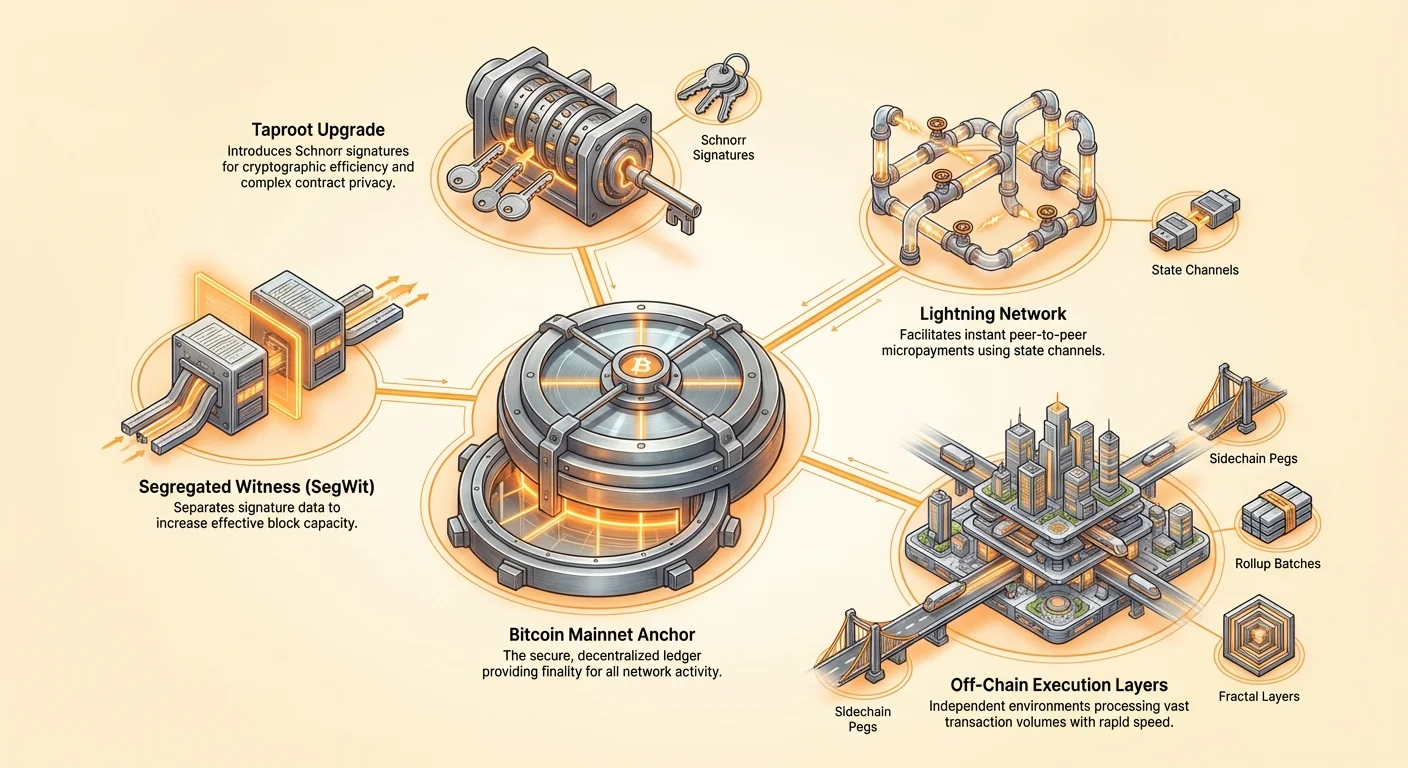
The implementation of Segregated Witness, or SegWit, marked a pivotal shift in this direction. SegWit reorganized the data structure of a block by separating the digital signature, known as the "witness," from the transaction data. Before this upgrade, signatures took up a significant portion of the limited block space. By moving this data to a separate structure, the protocol effectively increased the available space for transactions without technically increasing the original block size limit.
This change introduced the concept of "weight units" to replace the traditional size measurement. In this new system, witness data is counted with less weight than standard transaction data. This modification encouraged users and wallet providers to adopt more efficient transaction formats. The result was an immediate increase in throughput, effectively allowing more activity to settle on the main chain while maintaining compatibility with older nodes.
SegWit also solved a critical technical issue known as transaction malleability. Previously, the unique identifier of a transaction could be modified before it was confirmed on the blockchain. This vulnerability made the development of second-layer protocols difficult and risky. By fixing malleability, SegWit laid the necessary groundwork for advanced scaling solutions, such as the Lightning Network, to operate securely and reliably.
Cryptographic Compression via Taproot
Following the foundation laid by SegWit, the activation of Taproot introduced a new layer of cryptographic efficiency. Taproot was designed to enhance privacy and script processing, but its implications for scaling are equally profound. The upgrade replaced the existing digital signature scheme with Schnorr signatures, enabling advanced privacy and scripting. This mathematical framework allows for key aggregation, a process where multiple public keys and signatures can be combined into a single verifier.
In traditional Bitcoin transactions involving multiple parties, such as multi-signature wallets, each participant's signature had to be recorded on the blockchain individually. This process consumed significant space and revealed the complexity of the transaction to the public. Schnorr signatures enable these multiple signatures to be aggregated into a single signature. To the network, a complex multi-party transaction looks identical to a standard single-user transfer.
This aggregation acts as a form of data compression. By reducing the amount of data required to authorize complex transactions, Taproot frees up block space for other users. This efficiency becomes increasingly important as the network hosts more sophisticated applications, such as CoinJoins or complex smart contract interactions. The reduction in data size translates directly to lower transaction fees and higher network throughput.
Taproot also introduced Merkelized Abstract Syntax Trees, or MAST. This technology changes how smart contracts and spending conditions are processed. Previously, all conditions of a script had to be revealed on the blockchain, regardless of which condition was actually met. MAST allows users to structure complex contracts where only the executed condition is revealed and recorded.
The unexecuted branches of the contract remain hidden and do not take up space on the public ledger. This creates a massive efficiency gain for complex smart contracts. It allows developers to build intricate logic and extensive contingency plans into Bitcoin transactions without burdening the network with excessive data. The combination of Schnorr signatures and MAST represents a significant leap forward in maximizing the utility of every byte of block space.
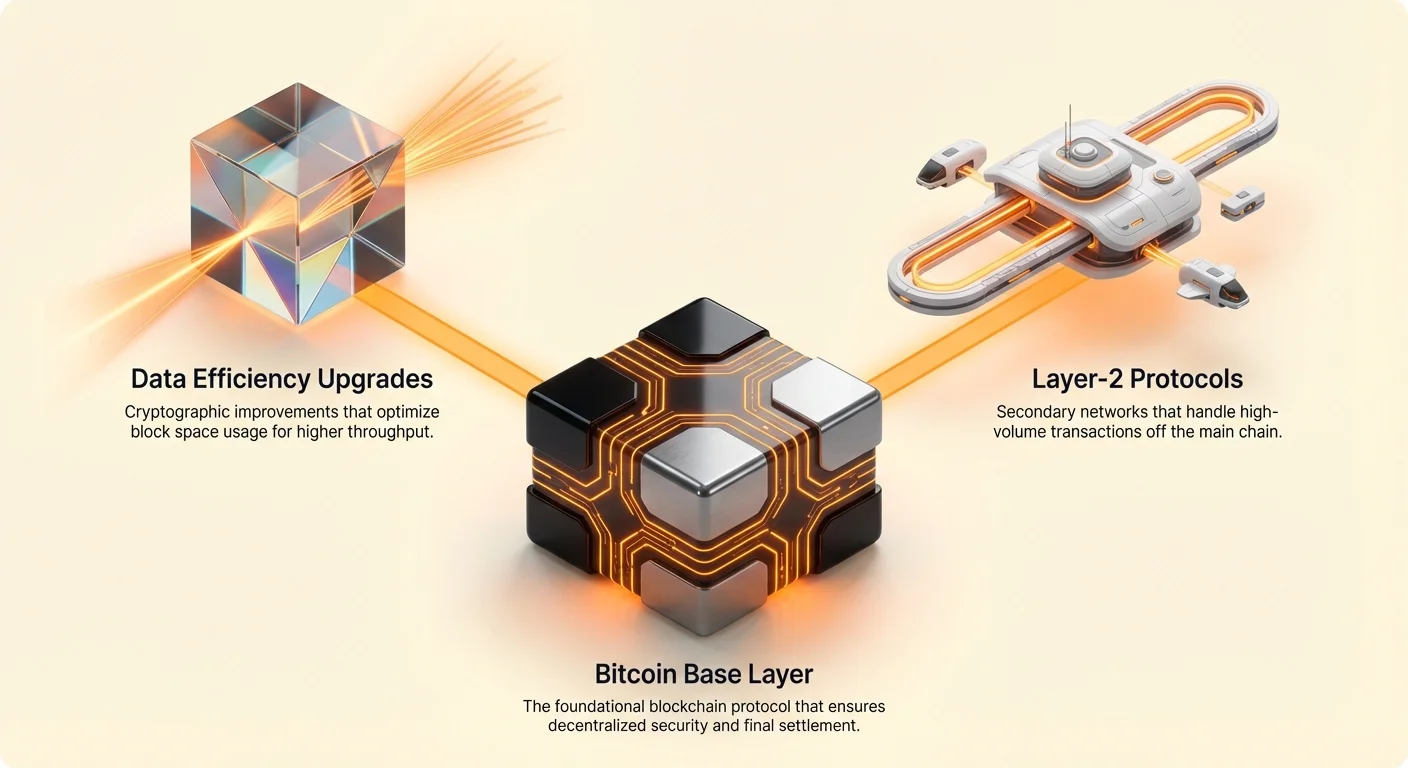
Layer-2 Frameworks and State Channels
While base-layer upgrades improve efficiency, true scalability requires moving execution off the main blockchain. Layer-2 solutions build secondary protocols on top of Bitcoin to handle high-volume transactions. These systems create a separate execution environment where parties can transact instantly and cheaply, using the main blockchain only for final settlement. This approach compresses thousands of interactions into a few on-chain transactions.
The most prominent example of this framework is the Lightning Network. It utilizes state channels to facilitate peer-to-peer micropayments. Two parties open a channel by locking funds into a multi-signature address on the main chain. Once the channel is established, they can exchange unlimited transactions privately and instantly. These updates change the balance of funds between the parties without broadcasting anything to the Bitcoin network.
The "state" of the channel is maintained locally by the participants. Only when the parties decide to close the channel is the final balance broadcast to the blockchain. This process effectively compresses an infinite history of economic activity into just two on-chain events: the opening and the closing transaction. This architecture allows Bitcoin to support retail-level transaction volumes that would be impossible on the base layer alone.
The Role of Rollups and Sidechains
Beyond state channels, the industry is exploring Rollups and Sidechains as methods to scale execution. Sidechains operate as independent blockchains that are pegged to Bitcoin. They utilize their own consensus mechanisms, which allows them to optimize for speed and advanced features that the main chain does not support. Users lock assets on the main chain and receive a corresponding token on the sidechain.
Sidechains like the Liquid Network or Rootstock enable faster settlement times and smart contract capabilities similar to Ethereum. They allow specifically optimized environments for different use cases. For instance, a sidechain can prioritize privacy or high-frequency trading. The main Bitcoin chain serves as the ultimate anchor of value, while the sidechain handles the heavy computational lifting and state management.
Rollups represent another frontier in scaling technology. A rollup bundles or "rolls up" multiple transactions into a single data packet. This batch of transactions is executed off-chain, and a cryptographic proof of their validity is submitted to the main blockchain. This method allows the security of the main chain to cover a vast number of off-chain actions without processing each one individually, serving as a core component of the Layer 2 scaling solutions.
There are different approaches to rollups, including validity rollups and sovereign rollups. Sovereign rollups use Bitcoin primarily for data availability. They publish compressed transaction data to the Bitcoin blockchain but manage their own execution rules and consensus. This allows the rollup to inherit the data durability of Bitcoin while operating with the flexibility of an independent network.
| Scaling Method | Primary Mechanism | Throughput Impact | Security Model |
|---|---|---|---|
| SegWit | Witness data separation | Moderate Increase | Main Chain |
| Lightning | State Channels | High (Millions TPS) | Multisig + Main Chain |
| Sidechains | Two-way Peg | High (Dependent on Chain) | Federation / Merge Mine |
Fractal Bitcoin and Recursive Scaling
A newer concept gaining traction is Fractal Bitcoin. This framework proposes a multi-layered approach using smaller, interconnected blockchains called "fractals." The core idea is to create a recursive structure where these fractal chains operate in parallel to the main Bitcoin blockchain. This design aims to increase transaction throughput significantly while maintaining the core engineering principles of the original protocol.
Fractal Bitcoin operates by routing transactions to specific layers based on their requirements. High-value, low-frequency transactions might settle directly on the main chain or a high-security fractal. Conversely, high-volume microtransactions can be processed on lower-tier fractal chains designed for speed and low fees. This hierarchical sorting ensures that block space is utilized efficiently across the entire network ecosystem.
Crucially, these fractal chains can periodically settle their state onto the main Bitcoin blockchain. This settlement process anchors the security of the fractal layers to the immense hash power of the Bitcoin network. It creates a system where security flows downward from the main chain, while scalability flows upward from the fractal layers.
This recursive model also allows for native support of satoshi-based microtransactions. By handling these small value transfers within the fractal environment, the network avoids clogging the main ledger with "dust" transactions. It represents a structural evolution where the network scales by replicating its own logic in a nested, parallel manner rather than changing the fundamental rules of the base layer.
Bridging and Cross-Chain State
Scaling also involves the efficient movement of state and value between different blockchain environments. Wrapped Bitcoin assets represent a method of compressing Bitcoin's value proposition into formats compatible with other networks. This interoperability allows Bitcoin to be used in decentralized finance applications that exist on chains with higher throughput or different smart contract capabilities.
The mechanisms for creating these wrapped assets vary in centralization and security. Traditional models, such as WBTC, rely on a centralized custodian to hold the actual Bitcoin and issue the tokenized representation. While efficient, this introduces a trusted third party into the scaling stack. If the custodian fails or is compromised, the link between the wrapped token and the underlying Bitcoin is broken.
Decentralized alternatives like tBTC (Threshold Bitcoin) utilize threshold cryptography to manage this state transition. Instead of a single custodian, a network of decentralized nodes manages the Bitcoin deposits. These nodes use multi-party computation to sign transactions and manage the pegged assets. This system ensures that the "state" of the Bitcoin is preserved and portable, providing decentralized Bitcoin interoperability without relying on a single point of failure.
By utilizing these bridges, the Bitcoin ecosystem effectively outsources some of its transaction demand to other chains. Users who want to engage in high-frequency trading or complex lending markets can do so on Ethereum or Solana using wrapped Bitcoin. This reduces the direct load on the Bitcoin blockchain while increasing the utility and velocity of the asset itself.
Scripting Upgrades and Data Inscription
The continued development of Bitcoin's scripting language offers further avenues for optimization. Proposals like OP_CAT (Opcode Concatenate) aim to reintroduce functionality that allows for more efficient data manipulation within scripts. OP_CAT allows two pieces of data in a script's stack to be combined into one.
While this sounds simple, it has profound implications for smart contract efficiency. Currently, combining data requires complex and data-heavy workarounds. OP_CAT would allow developers to simplify these scripts, reducing the amount of code required to execute contracts. This reduction in script size acts as another form of compression, allowing more complex logic to fit into smaller transaction footprints.
Simultaneously, the rise of Ordinals has introduced a new dynamic to block space usage. Ordinals allow for the inscription of arbitrary data, such as images or text, directly onto individual satoshis. While this might seem contrary to scaling (as it adds data), the technology relies on the efficiencies introduced by SegWit and Taproot to function. This phenomenon has sparked intense debate about the best use of block space, but it also highlights the flexibility of Bitcoin's storage capabilities, showing the technology's profound economic impact.
Ordinals utilize the witness data section of a transaction to store this content. Because witness data is discounted in weight, these inscriptions are cheaper to store than standard transaction data. This phenomenon has sparked intense debate about the best use of block space, but it also highlights the flexibility of Bitcoin's storage capabilities. It demonstrates how the "discounted" space created by SegWit can be utilized for novel applications beyond simple financial transfers.
Conclusion
The scaling of Bitcoin is not achieved through a single "silver bullet" technology but through a framework of complementary protocols. From the data optimization of SegWit to the cryptographic efficiency of Taproot, the base layer has become denser and more capable. These upgrades provide the necessary foundation for layers that handle the bulk of execution, such as the Lightning Network, sidechains, and emerging recursive models like Fractal Bitcoin.
As developers continue to refine these technologies, the focus remains on preserving the decentralization that gives Bitcoin its value. Whether through state compression in rollups, threshold cryptography in bridges, or parallel processing in fractal chains, the goal is consistent: to serve a global user base without compromising the network's integrity. The interplay between these layers will define the future capacity of the Bitcoin ecosystem.
Bitcoin scaling is a multi-layered evolution, combining on-chain data efficiency with powerful off-chain execution environments to achieve global capacity.