
Imagine a secure digital vault that doesn’t rely on guards, governments, or central banks for its protection. Instead, this vault is defended by an ever-growing wall of raw computational power, driven by fierce global economic competition. This is the reality of Bitcoin’s security model.
The security of the Bitcoin network is not static; it is dynamic, competitive, and quantifiable. It is measured by the Hashrate—the sheer processing muscle dedicated to mining. But what happens when miners rapidly join or leave the network, or when technology suddenly doubles the efficiency of mining hardware? Without a mechanism to adapt, the system would fail.
This guide delves into Bitcoin’s most ingenious survival mechanism: the Difficulty Adjustment Mechanism (DAM). We will analyze the perpetual competitive cycle—the Hashrate Arms Race—and explain how this seemingly complex algorithm serves as Bitcoin’s adaptive defense layer, ensuring predictable operation and quantifiable security against any external economic shock.

1. The Core Mechanism: Proof of Work and Hashrate
To understand network security, we must first understand the fundamental concept driving it: Proof of Work (PoW). PoW requires miners to expend energy (work) to solve a complex, randomized computational puzzle. The successful miner earns the right to add the next block of transactions to the blockchain.
This work effort is measured in a term known as Hashrate.
What is a "Hash"?
In the context of Bitcoin, a hash is the output of a cryptographic function (specifically SHA-256) that takes any input data—the transaction block header—and transforms it into a fixed-length string of letters and numbers. This process is deterministic: the same input always produces the same output.
The core challenge in PoW is not to find a hash, but to find a hash that meets a specific target requirement, known as the Difficulty Target. For example, the network might demand that the resulting hash must start with a certain number of zeros. Finding this specific target hash is purely a game of trial and error; the only way to succeed is to compute trillions upon trillions of hashes until a lucky attempt meets the target criteria.
Hashrate as a Measure of Economic Commitment
Hashrate is the measure of the aggregate computational speed of all miners combined. It is typically expressed in units like terahashes per second (TH/s) or exahashes per second (EH/s), where one exahash is $1,000,000,000,000,000,000$ hashes per second.
Crucially, Hashrate is not just a technical metric; it is an economic metric. It represents the total real-world investment—in specialized hardware, real estate, and ongoing energy consumption—that participants have dedicated to securing the network.
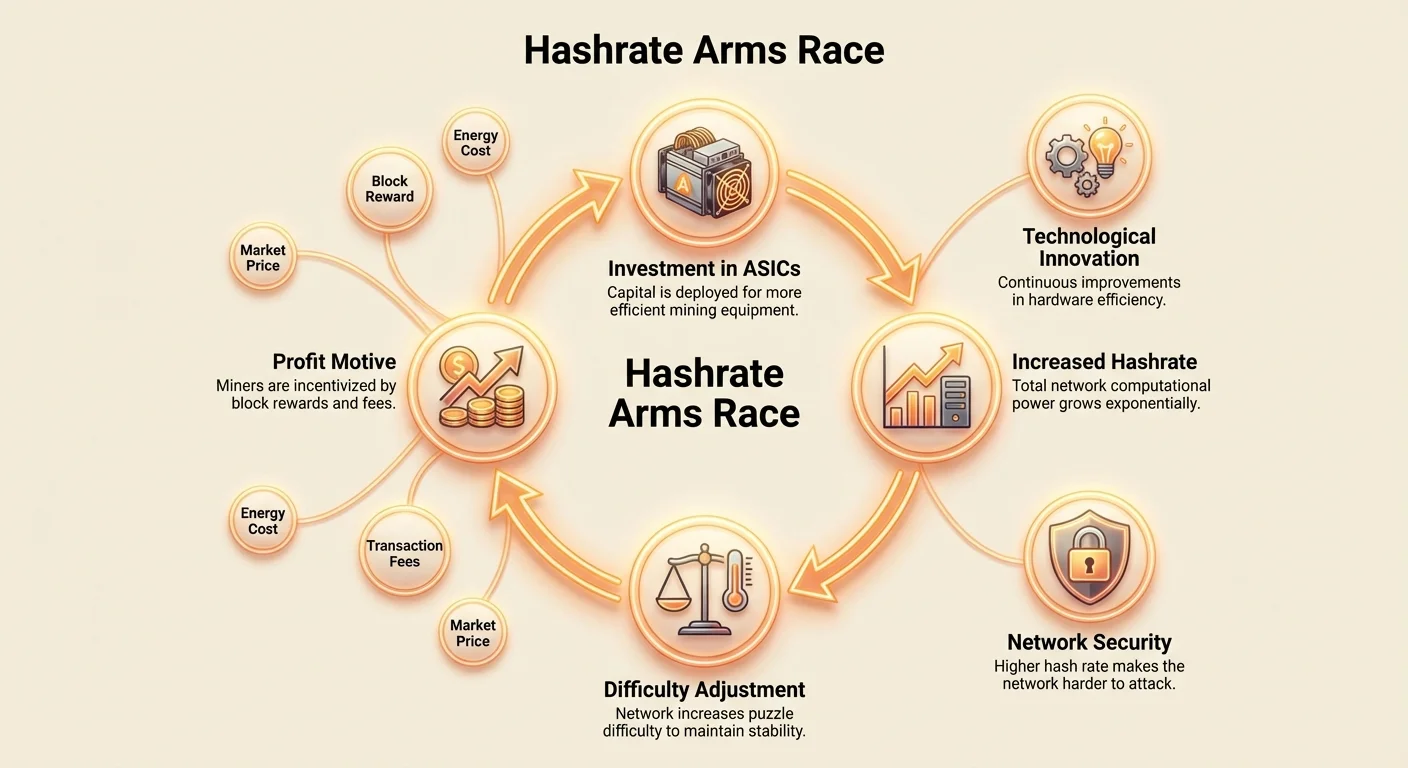
The Arms Race Metaphor: Miners are in a constant, competitive race. If one miner invests in more powerful, energy-efficient equipment (ASICs), they increase their individual probability of winning the block reward. This incentivizes every other miner to upgrade or risk becoming unprofitable. This self-reinforcing cycle of investment and technological improvement is the Hashrate Arms Race, and the resulting massive Hashrate is Bitcoin’s primary defense.
2. Bitcoin’s Clockwork: The Difficulty Adjustment Mechanism (DAM)
The fundamental design goal of the Bitcoin network is consistency: a new block must be found, on average, every 10 minutes. This 10-minute interval ensures that transactions are confirmed reliably and that the rate of new Bitcoin creation (the supply schedule) remains mathematically predictable.
However, the global Hashrate is anything but predictable. It fluctuates wildly based on the price of Bitcoin (which determines profitability), global energy costs, and breakthroughs in ASIC technology. If the Hashrate doubles overnight, blocks would be found every 5 minutes. If half the miners suddenly quit, blocks might take 20 minutes to find.
The Difficulty Adjustment Mechanism (DAM) is the algorithm that corrects this imbalance, acting as the network’s self-correcting thermostat.
Calculating the Adjustment: The 2016 Block Period
Bitcoin doesn't adjust its difficulty based on real-time Hashrate data. Instead, it adjusts the difficulty target only once every 2,016 blocks.
Why 2,016 Blocks? Since the target block time is 10 minutes, 2,016 blocks should theoretically take exactly two weeks (14 days) to be mined (). The network uses this time measurement to adjust the Difficulty Target, ensuring predictable block confirmations.
When the 2,016th block is found, the network performs a calculation:
- Measure Actual Time: It records the total time it took the miners to complete the last 2,016 blocks.
- Compare to Target Time: It compares the actual time to the target time (14 days).
- Adjust Difficulty:
- If the blocks were found faster than 14 days (meaning the Hashrate increased), the difficulty target is adjusted upward, making the puzzle harder.
- If the blocks were found slower than 14 days (meaning the Hashrate decreased), the difficulty target is adjusted downward, making the puzzle easier.
This adjustment is essential for Bitcoin's survival, as it ensures the network adapts to technological progress and economic shifts without human intervention.
The Critical Role of Block Time Stability
The DAM’s function goes beyond simply keeping confirmations regular; it reinforces the incentive structure of the entire system.
- Preventing Hyperinflation/Deflation: The consistent 10-minute block time is the bedrock of Bitcoin's monetary policy. It guarantees the emission schedule—the rate at which new Bitcoin enters circulation—remains precisely fixed and predictable, regardless of how efficient the mining hardware becomes. This predictability is a key reason Bitcoin is considered "hard money."
- Maintaining Transaction Finality: Users rely on predictable confirmation times. If block times varied wildly, the speed and reliability of transactions would degrade, rendering the network unusable for economic activity. The DAM ensures transaction confirmation remains reliably probabilistic, stabilizing the entire user experience.
The Difficulty Ceiling and Floor
The adjustment calculation can be significant, but it is not unlimited. The difficulty is capped to prevent extreme swings. Generally, the difficulty cannot adjust more than four times the previous level, limiting the speed at which the network can react to sudden, massive changes in Hashrate (though in practice, the network usually reacts smoothly).
3. Hashrate and Security: Quantifying Defense
In a traditional financial system, security is guaranteed by legal frameworks, government regulation, and physical vaults. In Bitcoin, security is guaranteed by the economic principle that attacking the network is prohibitively expensive. Hashrate is the quantification of this cost.
The Economic Cost of a 51% Attack
The primary risk to any Proof-of-Work network is a 51% attack. This occurs when a single entity or coordinated group gains control of more than 50% of the total network Hashrate. With this majority, the attacker could effectively censor transactions, stop payments to specific addresses, or, most critically, execute double-spending.
Double-spending involves spending the same Bitcoin twice. An attacker would send a transaction to a merchant (Transaction A) and receive goods, while simultaneously using their majority Hashrate to mine a separate, secret chain that includes a contradictory transaction (Transaction B) sending the same Bitcoin back to themselves. Once their private chain becomes longer than the public chain, the network switches to the attacker’s history, and the merchant’s payment is invalidated.
Quantifying the Defense Layer:
The cost of a 51% attack is essentially the cost required to acquire, power, and cool enough mining hardware to surpass the existing global Hashrate for the duration of the attack.
| Component | Cost Factor | Implication for Security |
|---|---|---|
| Hashrate | A measure of active security effort. | Higher Hashrate requires exponentially more capital expenditure (CAPEX) to challenge. |
| Difficulty | The algorithm that translates Hashrate into required energy expenditure. | Ensures that even if hardware gets cheaper, the sheer volume of work needed remains constant to hit the 10-minute window. |
| Energy Price | Ongoing operational cost (OPEX). | Since mining hardware efficiency is capped by physics, the greatest ongoing cost is electricity. This OPEX acts as a high, sustained barrier to entry for attackers. |
When the Hashrate is high, the financial barrier to entry for a malicious actor is colossal. A successful attack would require the attacker to not only outspend the combined global mining industry but also risk that investment becoming worthless if the network and Bitcoin price collapse due to the attack itself.
Why Difficulty is the Network’s Self-Correction Loop
The difficulty adjustment is the feature that prevents the network from becoming brittle in the face of rapid technological advancements or economic crises. It is Bitcoin’s primary adaptive defense layer.
Scenario 1: Technological Breakthrough (Increased Hashrate) Suppose a new generation of ASICs is released, instantly doubling the network's efficiency.
- Without DAM: Block times fall to 5 minutes. The network would produce Bitcoin twice as fast, shattering the monetary policy.
- With DAM: After two weeks, the difficulty increases dramatically, forcing the miners to do twice the computational work for the same reward. The 10-minute interval is restored, and the security (measured in computational energy) has permanently doubled.
Scenario 2: Economic Shock (Decreased Hashrate) Suppose the price of Bitcoin crashes, forcing unprofitable miners with older hardware to shut down, causing Hashrate to drop by 40%.
- Without DAM: Block times skyrocket, possibly reaching 17 minutes or more. Transactions stall, and the network becomes unusable.
- With DAM: After the extended two-week period, the difficulty is lowered by 40%. The remaining miners, who are now more profitable, can find blocks within the 10-minute window again. The network sacrifices a temporary drop in Hashrate (security) to maintain operational stability and predictability, ensuring survival until economic conditions incentivize miners to return.
The DAM transforms external volatility into internal stability, guaranteeing the system's longevity.
4. Economic Forces Shaping the Hashrate Arms Race
The Hashrate Arms Race is a global, multi-billion-dollar game driven by economic realities. The difficulty adjustment ensures that only the most efficient and well-capitalized operations survive the volatility of the crypto market.
The Role of Application-Specific Integrated Circuits (ASICs)
Early Bitcoin mining was done using standard CPUs and GPUs. However, efficiency quickly became paramount, leading to the development of Application-Specific Integrated Circuits (ASICs).
ASICs are specialized chips designed for one purpose: computing SHA-256 hashes as fast as possible. They are thousands of times more efficient than general-purpose computer hardware.
The Economic Impact of ASICs:
- Professionalization: ASICs transformed mining from a hobby into a highly capitalized, industrial business. This professionalization guarantees robust, large-scale dedication to securing the network.
- Increased Hashrate: Every new generation of ASIC rapidly drives up the total network Hashrate, exponentially increasing security and the cost of attack.
- Punishment of Inefficiency: The difficulty adjustment ensures that older, less efficient ASICs (or those running on expensive electricity) are quickly pushed out of profitability. This continuous pressure forces miners to seek the cheapest energy sources globally, effectively subsidizing the deployment of excess electrical generation capacity, often in renewable energy sectors.
Geographical Centralization Dynamics
The pursuit of the lowest operational costs has naturally led to geographical centralization of mining operations, often clustering in regions with abundant hydropower, cheap natural gas, or stranded renewable energy.
While this geographical clustering may look like centralization on a map, it doesn't necessarily pose a threat to security, provided that the actual owners, pools, and jurisdictions are diverse. The underlying security of Bitcoin rests on the network of full nodes that validate the rules, not solely the location of the miners.
The Pool Problem vs. Node Problem: The most critical decentralization metric is the number of full nodes running the validation software. If miners pool their Hashrate for efficiency (a phenomenon known as mining pools), a few large pools might appear to control a high percentage of the Hashrate. However, these pools typically represent agreements with thousands of distributed, independent miners. If a pool attempts to act maliciously, the individual miners can instantly switch pools, and the thousands of verifying full nodes worldwide will reject any invalid blocks the pool attempts to create.
5. Practical Implications for Users and Investors
Understanding Hashrate and Difficulty is not just an academic exercise; it provides crucial insights into the health, cost, and reliability of the network for everyday users and investors.
Transaction Fees and Hashrate Congestion
While the difficulty adjustment stabilizes block time, it does not directly stabilize transaction capacity. Bitcoin blocks have a limited size, meaning they can only hold a certain number of transactions.
When the network is congested (many users want transactions confirmed immediately), miners prioritize transactions that offer higher fees. Hashrate competition indirectly influences fees in two ways:
- High Hashrate (Competition): A high Hashrate ensures blocks are found reliably every 10 minutes, maximizing the total throughput over time. If Hashrate were low, transactions would back up far worse, leading to massive fee spikes.
- Fee Incentive: As the block subsidy (the new Bitcoin created per block) halves over time (the Halving event), transaction fees become an increasingly important part of the miner's revenue. This ensures miners remain incentivized to secure the network even when the issuance of new Bitcoin eventually stops entirely. This shift guarantees the long-term viability of the security model.
Quantifying Bitcoin Security for Investors
For investors and institutions performing due diligence, Hashrate is the most transparent and easily quantifiable measure of network security.
- Metric 1: Hashrate Trend: A consistently rising Hashrate indicates strong miner confidence in the future profitability and stability of Bitcoin. It shows that capital investment is flowing into the network’s defense.
- Metric 2: Difficulty Trend: Increases in difficulty confirm that the network is successfully adapting to the influx of new capital and maintaining its monetary policy integrity.
- Metric 3: The Cost-to-Attack Analysis: Investors can approximate the real-world cost (hardware CAPEX + energy OPEX) required to launch a 51% attack. This quantification provides a clear, economic justification for Bitcoin’s superior security compared to newer, smaller networks with low Hashrates.
Actionable Tip: Monitoring Network Health
Instead of focusing solely on the price of Bitcoin, sophisticated users and investors should periodically check network statistics, which are publicly available through various online block explorers.
| Statistic to Monitor | Why It Matters | Healthy Range |
|---|---|---|
| Current Hashrate | The total defensive effort. | As high and stable as possible. |
| Next Difficulty Adjustment | Shows the expected change in mining effort. | Look for expected adjustments to confirm the DAM is working as intended. |
| Average Block Time | Indicator of real-time stability. | Should hover consistently around 10 minutes. |
If the Hashrate were to drop significantly without a corresponding difficulty adjustment (a temporary issue), it would signal a brief window of potential vulnerability, although the inherent profitability incentives would rapidly draw dormant miners back online.
Conclusion: A Self-Sustaining Economic Defense
The Hashrate Arms Race is a perpetual motion machine of technological progress and economic competition. Miners invest billions, not out of altruism, but in the rational pursuit of profit. This competition forces the deployment of increasing computational power, which, in turn, is continuously measured and modulated by the Difficulty Adjustment Mechanism.
The DAM is not merely a technical fix; it is the adaptive defense layer that ensures the network's resilience. It guarantees the integrity of Bitcoin's monetary supply and the predictability of its operation, absorbing external shocks from energy crises or technological leaps.
By turning raw energy expenditure into mathematically guaranteed security, Hashrate and difficulty combine to create a verifiable, self-sustaining economic defense system—the bedrock upon which the new digital economy is built.