
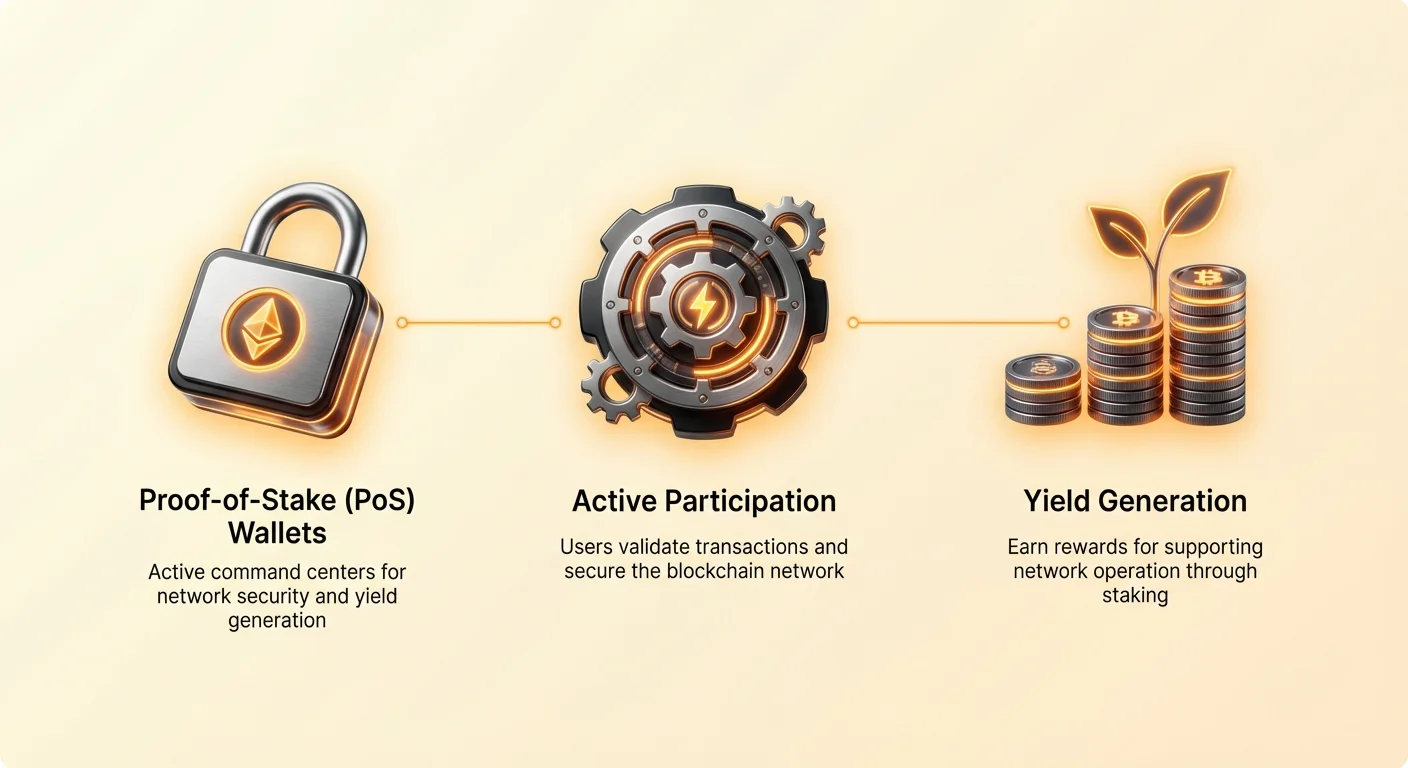
The evolution of cryptocurrency storage has moved far beyond simple digital vaults. In the early days of blockchain technology, wallets were primarily passive tools designed solely to hold keys and protect assets from unauthorized access. As the industry shifted toward Proof-of-Stake (PoS) consensus mechanisms, the role of the wallet fundamentally changed. Modern digital wallets now serve as active command centers where users can participate in network security and earn yield through staking.
This transition requires a deeper understanding of how these applications function. It is no longer enough to simply know how to send and receive funds. Users must now navigate the complexities of delegation, validator selection, and the specific security risks associated with interacting with smart contracts. The interface that holds your funds is now the same tool that generates passive income, creating a dual mandate of accessibility and ironclad security.
At the core of this ecosystem is the concept of staking. This process involves locking up a specific amount of cryptocurrency to support the operation of a blockchain network. In return for this service, the network distributes rewards to the participants. While this sounds like a banking transaction, it is technically distinct. The user is not lending money to a third party; they are using their assets to cryptographically validate transactions on the network.
The Architecture of Staking Wallets
Proof-of-Stake wallets differ from traditional Bitcoin wallets in their connectivity and feature sets. While a Bitcoin wallet primarily manages Unspent Transaction Outputs (UTXOs), a PoS wallet like Phantom or MetaMask must interact with complex on-chain programs. These wallets act as a bridge between the user and the blockchain’s consensus layer. When a user stakes their assets, the wallet sends a specific transaction that signals the network to lock those funds and attribute their voting power to a validator.
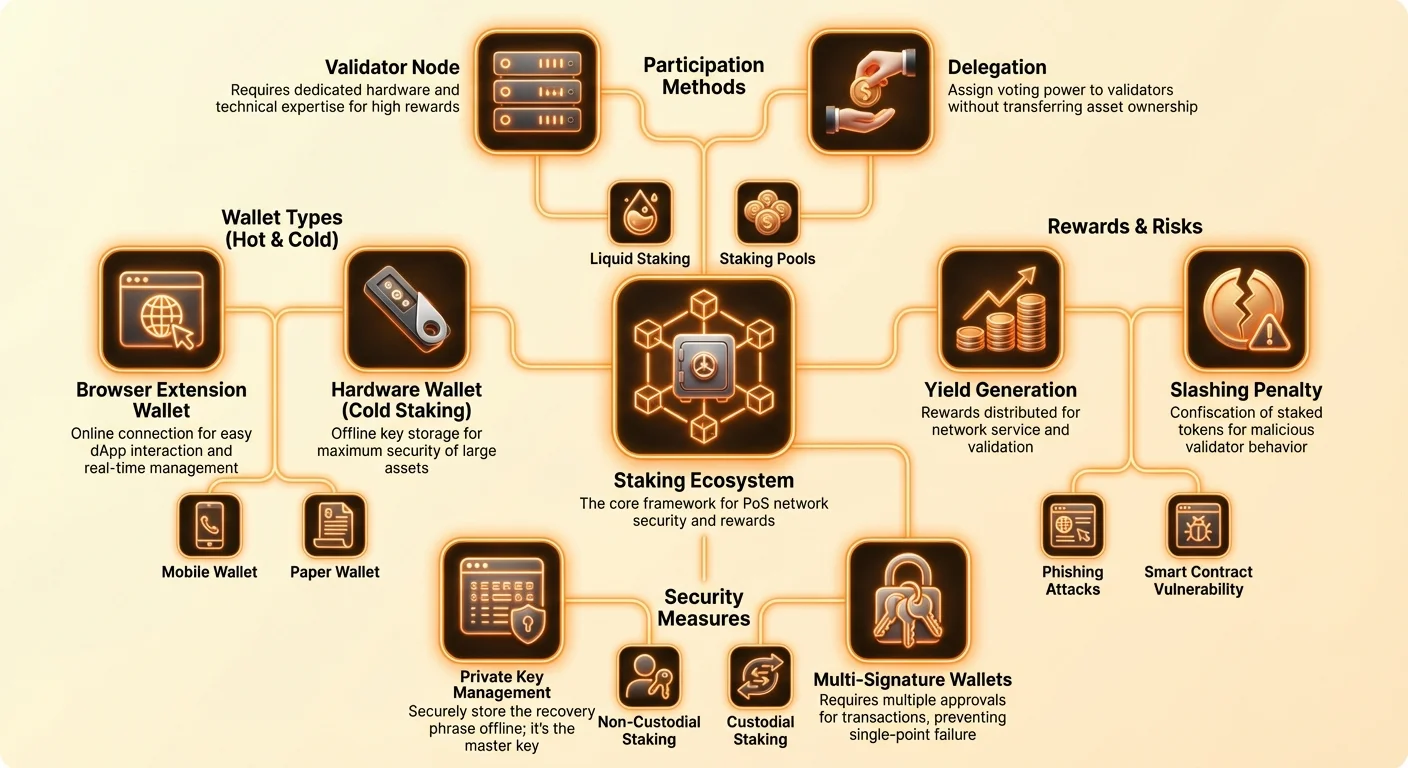
The distinction between "hot" and "cold" environments remains the most critical security factor. Mobile and browser extension wallets are considered "hot" because they maintain a continuous connection to the internet. This connectivity is essential for interacting with Decentralized Finance (DeFi) applications and managing staking positions in real-time. However, this convenience introduces an attack surface that does not exist with offline storage methods.
Browser extension wallets, often used for Ethereum and Solana ecosystems, integrate directly into web browsers like Chrome or Firefox. They allow for seamless signing of transactions when visiting staking dashboards. While efficient, they rely heavily on the security of the underlying computer. If the host machine is compromised by malware, the wallet’s private keys could be exposed. This makes them excellent for managing smaller amounts of active capital but less ideal for long-term storage of substantial wealth.
Validator Nodes versus Delegation
Participating in a Proof-of-Stake network generally happens in two ways: running a validator node or delegating stake. Running a validator node is the equivalent of being a miner in the Bitcoin network. It requires dedicated hardware, 24/7 uptime, and significant technical expertise. The operator is responsible for proposing blocks and voting on the validity of others. This path offers the highest potential rewards but comes with the risk of "slashing," where the network penalizes the node for downtime or malicious behavior.
For the vast majority of users, delegation is the preferred method. Delegation allows a wallet holder to assign their voting power to an existing validator without transferring ownership of the tokens. The assets remain in the user's wallet, locked by a smart contract protocol. This is a critical security feature. Even if the validator node goes offline or is attacked, the delegator’s funds cannot be stolen by the node operator.
Mobile wallets have streamlined this process significantly. Applications built for ecosystems like Solana or Cosmos often include native staking interfaces. A user can select a validator from a list, view the estimated Annual Percentage Yield (APY), and initiate the stake with a few taps. This accessibility has democratized network security, allowing anyone with a smartphone to contribute to blockchain stability.
Yield Generation Mechanics
The yield generated through staking is not interest payment in the traditional financial sense. It is a reward for service. New tokens are minted by the protocol and distributed to validators and their delegators. The rate of return fluctuates based on network parameters, such as the total amount of tokens staked and the specific performance of the chosen validator.
Validators typically charge a commission fee for their services. This fee is deducted from the rewards before they are distributed to the delegators. For example, if a network offers a 5% reward rate and the validator charges a 10% commission, the net yield to the wallet holder would be slightly lower. High-performance wallets often provide data on validator reliability and commission rates to help users make informed decisions.
| Factor | Validator Node | Delegation |
|---|---|---|
| Technical Requirement | High (Server admin) | Low (Basic wallet skills) |
| Risk Profile | Slashing & Maintenance | Smart Contract Risks |
| Capital Required | Often High Minimums | Low / No Minimum |
Another emerging concept is liquid staking. Traditional staking locks assets for a set period, rendering them illiquid. Liquid staking protocols issue a receipt token that represents the staked asset. This receipt token can be traded or used in DeFi applications while the underlying asset continues to earn rewards. While this increases capital efficiency, it introduces an additional layer of smart contract risk that standard delegation does not have.
Security Risks in Proof-of-Stake
The allure of yield often distracts users from the inherent risks of online staking. The most prevalent threat is phishing. Because PoS wallets are frequently used to interact with various decentralized applications (dApps), users are conditioned to approve transaction requests. Malicious actors create fake websites that mimic legitimate staking platforms. If a user inadvertently signs a malicious permission, the attacker can drain the wallet's assets.
Smart contract vulnerabilities also pose a significant danger. When funds are delegated, they are interacting with code deployed on the blockchain. If that code contains a bug or an exploit, the funds could be frozen or stolen. This risk is higher in newer, less-tested protocols and lower in established networks where the code has undergone rigorous audits and stood the test of time.
Slashing is a risk unique to PoS. If a validator acts maliciously—for example, by double-signing a block—the network may confiscate a portion of the staked tokens. While this penalty usually affects the validator operator most severely, some protocols also pass a portion of the penalty on to the delegators. This emphasizes the importance of choosing reputable validators rather than simply chasing the highest advertised yield.
The Role of Hardware Wallets
Hardware wallets remain the gold standard for securing staked assets. These devices generate and store private keys in an offline environment, isolating them from internet-connected devices. This concept, often referred to as "cold staking," combines the security of cold storage with the benefits of yield generation.
When using a hardware wallet for staking, the device acts as a physical key. The user initiates a staking transaction on a computer interface, but the transaction is not valid until it is physically confirmed on the hardware device. The private keys never leave the secure element of the hardware wallet. This means that even if the computer used to view the dashboard is infected with a virus, the attacker cannot withdraw or redirect the funds without physical possession of the device.
Most modern hardware wallets support integration with popular software interfaces. For instance, a Ledger or Trezor can be connected to MetaMask or Phantom. This allows the user to view their portfolio and interact with staking dApps using a familiar interface while maintaining the robust security of offline key storage. It effectively creates a hybrid system: the usability of a hot wallet with the security architecture of a cold vault.
Private Key Management and Recovery
Regardless of the staking method chosen, the foundation of all wallet security is the management of the recovery phrase. This sequence of 12 to 24 words is the master key to the wallet. If a hardware device is lost or a computer crashes, the seed phrase allows the user to regenerate the wallet and access the funds on a new device.
For ultimate security, this phrase should never be stored digitally. It should not be saved in a password manager, photographed, or typed into a cloud-based document. The most secure method is writing the phrase on paper or stamping it into a metal plate, then storing it in a fireproof and waterproof location.
Paper wallets represent an extreme form of this security. A paper wallet is simply a physical printout of the public and private keys. While excellent for long-term holding, they are cumbersome for active staking. To spend or stake funds from a paper wallet, the private key usually must be imported into a software wallet, which temporarily exposes it to the internet. Therefore, hardware wallets are generally preferred over paper wallets for users who intend to actively participate in staking and governance.
Non-Custodial versus Custodial Solutions
The crypto industry offers two primary paths for staking: custodial and non-custodial. Custodial staking occurs on centralized exchanges. The user deposits funds onto the platform, and the exchange handles the technical aspects of staking. In return, the exchange takes a cut of the rewards. This is convenient but violates the core crypto ethos of "not your keys, not your coins." If the exchange becomes insolvent or is hacked, the user's funds are at risk.
Non-custodial staking places full control in the hands of the user. The user holds the private keys and interacts directly with the blockchain via their wallet. This method ensures that the user retains absolute ownership of their assets at all times. While it requires a slightly higher degree of responsibility—specifically regarding key management—it eliminates counterparty risk.
For large amounts of capital, non-custodial staking via a hardware wallet is the only recommended approach. The risk of platform failure in the centralized crypto space has been demonstrated repeatedly. By removing the middleman, the investor ensures that their access to their funds depends only on the blockchain protocol itself, not the financial health of a corporate entity.
Mobile Wallets and Everyday Access
Mobile wallets have become the bridge for daily crypto interaction. Apps designed for iOS and Android offer biometric security, such as fingerprint or facial recognition, adding a layer of protection against unauthorized physical access. These wallets are particularly useful for monitoring staking rewards and governance proposals on the go.
However, mobile devices are susceptible to theft and loss. Furthermore, mobile operating systems are complex environments with many apps installed, increasing the theoretical attack vector. Users should exercise caution when using mobile wallets for high-value transactions. A common strategy is to keep a "savings" account on a hardware wallet for large, long-term staking positions, and a smaller "checking" account on a mobile wallet for daily use and smaller yield farming activities.
When setting up a mobile wallet, it is vital to download the application from official sources. Fake wallet apps that look identical to legitimate ones frequently appear on app stores. These malicious apps are designed to steal the seed phrase during the setup process. verifying the developer and reading reviews is a necessary due diligence step.
Advanced Security: Multi-Signature Wallets
For institutions or individuals managing significant wealth, multi-signature (multi-sig) wallets offer security beyond a single private key. A multi-sig setup requires multiple approvals to authorize a transaction. for example, a 2-of-3 setup would generate three keys, requiring at least two of them to sign off on any withdrawal.
In the context of staking, this prevents a single compromised key from resulting in a total loss of funds. If an attacker manages to steal one private key, they still cannot unstake or withdraw the assets without the second key. This structure is often used by DAO treasuries and investment funds to secure their staked capital.
Setting up a multi-sig wallet requires more technical coordination than a standard wallet. It usually involves coordinating between different devices or even different individuals holding parts of the key set. However, the added security is invaluable for preventing single points of failure in the custody of high-value digital assets.
Privacy Considerations in Staking
While Bitcoin transactions are pseudonymous, Proof-of-Stake networks often have different privacy implications. When a user stakes tokens, their wallet address becomes publicly associated with a specific validator. Over time, this can create a clear pattern of behavior and wealth accumulation that is visible on the public ledger.
Some wallets prioritize privacy features, such as integrating with Tor or VPN services to mask the user's IP address when broadcasting transactions. However, the on-chain links remain visible. Users concerned about privacy may choose to spread their stake across multiple wallets to avoid clustering all their assets in a single, easily trackable address.
It is also worth noting that unlike mining, which can be done anonymously, becoming a validator often requires public identification to attract delegators. Delegators, conversely, can remain relatively anonymous, but their on-chain financial history is permanent. Understanding this transparency is part of the due diligence required before participating in public blockchain consensus.
Conclusion
The landscape of Proof-of-Stake wallets offers a diverse array of tools tailored to different user needs, ranging from high-frequency DeFi interaction to ultra-secure cold storage. Whether using a browser extension for ease of use or a hardware device for maximum protection, the fundamental principles of security remain constant. Users must prioritize the safe generation and storage of private keys, understanding that they are the sole guardians of their wealth.
As the industry matures, the line between savings accounts and investing tools continues to blur. Staking wallets empower individuals to become active participants in the financial infrastructure of the future. By combining the yield generation potential of PoS protocols with rigorous security practices like cold staking and multi-signature authorization, investors can build a resilient and productive digital asset portfolio.
True security in crypto comes from combining offline key storage with vigilant personal management.