
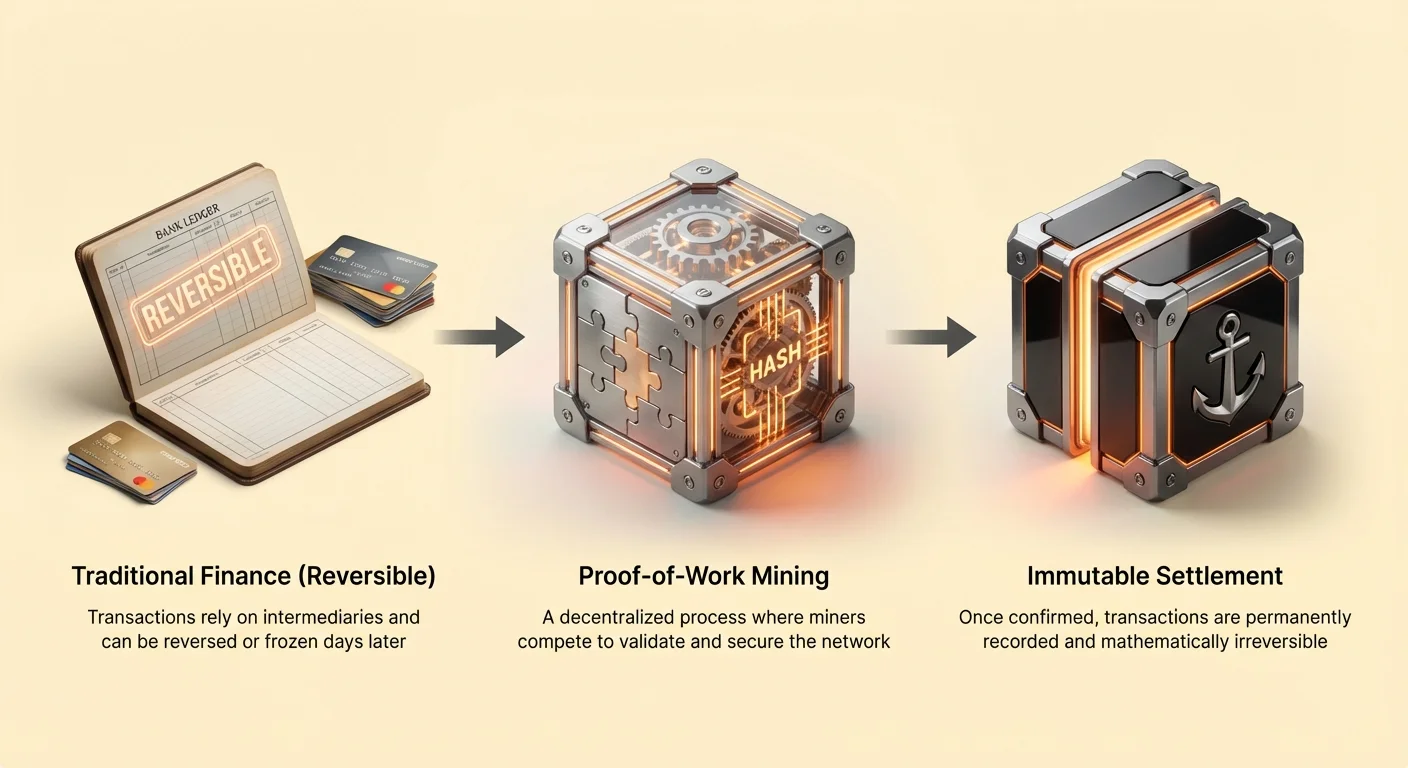
When you send money using a bank transfer or swipe a credit card, you are relying entirely on centralized institutions—banks and payment processors—to verify the transaction and update the ledger. Crucially, these transactions are often provisional; they can be challenged, reversed, or frozen by an intermediary hours or even days later. This system provides safety nets, but it also introduces friction, cost, and censorship.
Bitcoin, the world’s first successful digital cash system, operates on a fundamentally different premise. It eliminates the need for trusted third parties by achieving something called transaction finality. Finality means that once a transaction is processed and recorded onto the network’s public ledger, that record is permanent, unchangeable, and irreversible. It is settled forever.
For newcomers, this concept is often difficult to grasp because we are conditioned to think of digital payments as reversible. Understanding how Bitcoin achieves this ironclad finality—and why it often takes 10 minutes or more—is key to recognizing the system’s unique value proposition: creating self-sovereign, unseizable, and censorship-resistant money. This guide dives into the mechanics, timing, and profound implications of transaction immutability.
The Fundamental Problem Bitcoin Solved: Trust in Digital Payments
Before Bitcoin, digital money was plagued by the fundamental flaw of the "double-spend problem." Because digital information is inherently easy to copy, how could one ensure that a digital token was only used once without relying on a central authority to act as a watchdog?
The Double-Spend Conundrum
The double-spend problem is the technical hurdle that prevented successful digital currencies for decades. If you had a digital file representing $100, what would stop you from copying that file and simultaneously sending it to two different people, effectively spending the same $100 twice?
In traditional finance, the central bank or payment processor maintains a master ledger and checks every transaction against your balance. If you try to spend money you don't have, the central authority rejects the attempt. Satoshi Nakamoto’s breakthrough in creating Bitcoin was solving the double-spend problem without needing that central authority, replacing centralized trust with verifiable, decentralized cryptography.
Reversibility in Traditional Finance
To appreciate Bitcoin's finality, consider the typical reversibility built into existing systems:
- Credit Cards: Credit card transactions are notoriously non-final. A customer can initiate a chargeback weeks or months after a purchase. The merchant loses the revenue and may incur penalty fees. This forces businesses to integrate high-cost risk management systems.
- Bank Transfers (ACH): While faster than chargebacks, even bank transfers can sometimes be clawed back due to fraud or error, meaning the receiving party cannot treat the funds as 100% secure until a lengthy clearance period has passed.
- Central Authority Freezing: In any centralized system, an external entity (the government, the bank, or a court) can unilaterally freeze, seize, or reverse transactions and accounts if deemed necessary, violating the premise of finality.
Bitcoin was designed to eliminate the operational risk and third-party intervention inherent in these reversible systems.
What Exactly Is Transaction Finality?
Transaction finality refers to the point at which a transfer of value is considered complete and irreversible. In the context of Bitcoin, this means the funds have definitively moved from one address to another, and no entity, not even the sender, can reclaim them.
Irreversible Settlement
Bitcoin achieves irreversible settlement through a decentralized process known as mining (Proof-of-Work). Unlike a credit card transaction that is only "authorized" at the time of purchase and settled much later (with the risk of reversal), a Bitcoin transaction is permanently recorded onto the public ledger (the blockchain).
Once a transaction is validated and included in a confirmed block, the network has universally agreed that the state of the money has changed. This is the cryptographic equivalent of signing an unalterable, global contract, instantly removing the need for dispute resolution mechanisms like chargebacks.
Immutability Defined
Immutability, in simple terms, means the inability to be changed. The Bitcoin blockchain is immutable because of its structure: blocks of transactions are cryptographically linked together in a chronological chain.
- Each new block contains a cryptographic hash (a unique digital fingerprint) of the previous block.
- If anyone tried to tamper with a transaction deep within the chain (e.g., changing a $10 transfer to a $1,000 transfer), the hash of that block would change.
- Because the following blocks rely on the original hash, the entire chain built thereafter would instantly become invalid.
- To successfully alter one transaction, the malicious actor would have to re-mine every subsequent block faster than the rest of the global network—a computationally impossible task due to the sheer power protecting the network.
This immutability ensures that once you see your transaction confirmed on the blockchain, you can trust that it will remain there forever.
The Mechanics of Finality: Confirmation and the Blockchain
Finality is not achieved instantly the moment you press "send." It is a gradual, verifiable process dependent on the decentralized creation of new blocks.
From Unconfirmed to Pending
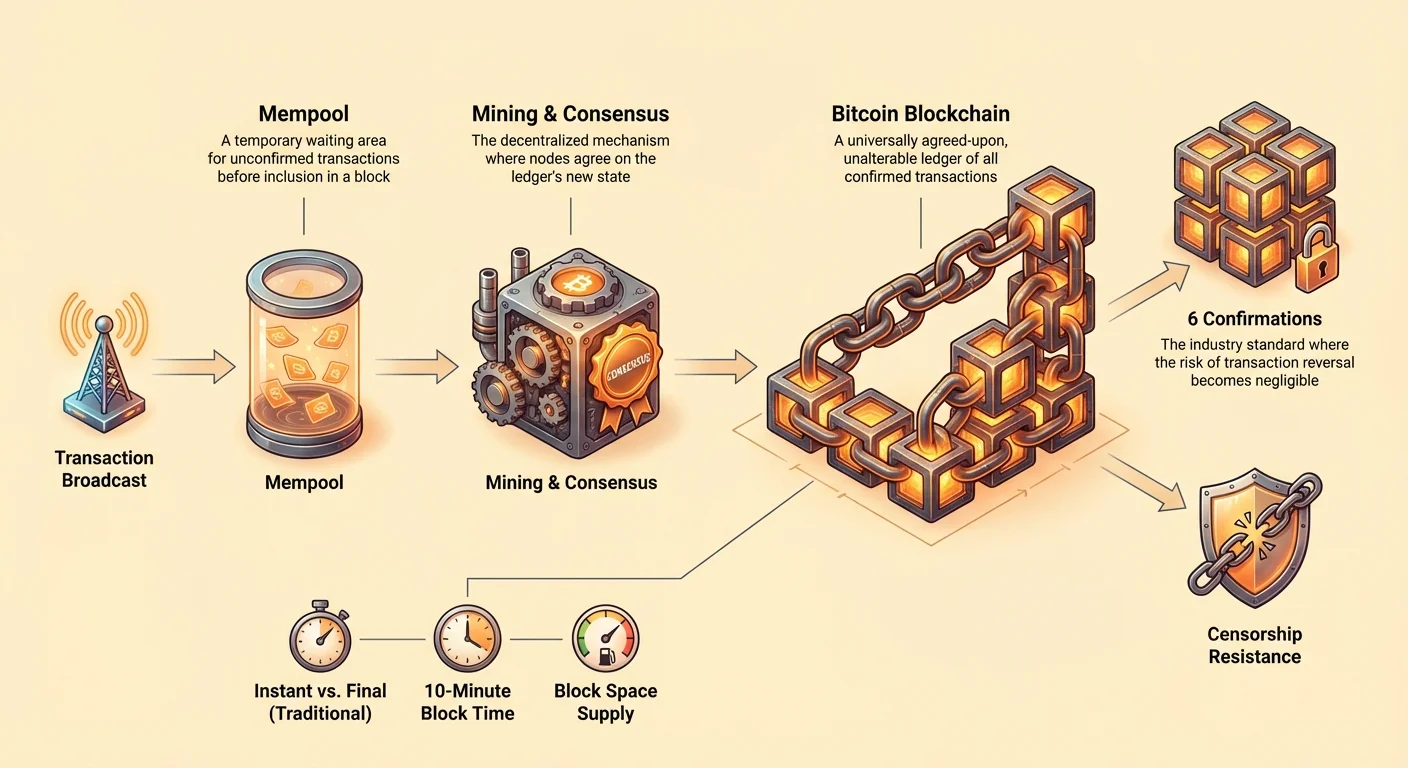
When you initiate a Bitcoin transaction, it is first broadcast to the global network of nodes (computers running the Bitcoin software).
- Broadcasting: Your transaction enters the mempool (memory pool), which is essentially a waiting room for all pending, unconfirmed transactions.
- Validation: Nodes check your transaction to ensure you have the funds and the signature is valid.
- Selection: Miners select transactions from the mempool to include in the next block they are attempting to solve. They prioritize transactions that include higher transaction fees because this acts as a payment for their work.
At this stage, the transaction is unconfirmed. While it is visible to the world, it is still vulnerable to being replaced or ignored if another valid transaction attempts to spend the same funds (though the network rules highly disincentivize this).
The Role of Mining and Proof-of-Work
The transition from pending to final occurs when a miner successfully solves the cryptographic puzzle and adds a new block to the chain. This is the heart of the Proof-of-Work (PoW) consensus mechanism.
The new block containing your transaction is broadcast to the network. Once nodes verify the block's validity, they accept it and begin working on the next block, linking it mathematically to the one that contains your transaction.
The first confirmation is powerful, as it proves your transaction is now officially part of the most recent, valid chain. However, true finality builds over time.
Confirmation Count: When is a Transaction "Final"?
While one confirmation means your transaction is highly likely to be permanent, the security risk (the chance of a reorganization where a competing chain invalidates the current block) decreases exponentially with each subsequent block confirmation.
The common industry standard for declaring a Bitcoin transaction truly immutable and fully settled is six confirmations.
- 1 Confirmation: The transaction is included in a block. For small payments (e.g., buying a coffee), many businesses might accept this risk, as the cost of a sophisticated attack is too high to warrant double-spending a small amount.
- 6 Confirmations: By the time six new blocks have been successfully mined and linked atop the block containing your transaction, the risk of that transaction being reversed or ignored falls to near zero. The computational power required to undo six blocks is practically unattainable for any single entity. This timeframe is typically around one hour (6 blocks x 10 minutes/block).
For large transfers, 6 confirmations provides the absolute assurance of finality that traditional banking systems cannot match.
Confirmation Speed and Network Variables
A frequent point of confusion for newcomers is the difference between the guaranteed finality of Bitcoin and the instantaneous speed of services like PayPal or Visa. Bitcoin sacrifices instant speed for verifiable, trustless security.
The 10-Minute Target Block Time
The Bitcoin protocol is hard-coded to target an average block creation time of approximately 10 minutes. This 10-minute interval is a deliberate design choice that balances speed with security.
If blocks were mined too quickly, the risk of conflicting chains (or "forks") would increase, potentially weakening the consensus mechanism and the immutability promise. By maintaining the 10-minute cadence, the network allows time for the newly found block to propagate globally, ensuring all nodes are working on the same, agreed-upon version of the ledger.
Transaction Fees and Block Space
"How fast are Bitcoin transactions?" The answer depends heavily on the fee you attach to the transaction.
The speed at which your unconfirmed transaction moves from the mempool into a confirmed block is determined by a market dynamic: supply and demand for block space.
- Block Space Supply: A Bitcoin block has a limited size (currently around 1MB of transaction data).
- Transaction Demand: At any given time, hundreds or thousands of transactions might be waiting in the mempool.
- Miner Incentive: Miners are economically incentivized to include transactions that pay the highest fees, maximizing their revenue.
If the network is busy, and you submit a low-fee transaction, it might sit in the mempool for hours or even days until the demand subsides, or until the next "fee market lull." Conversely, a high-fee transaction can be picked up almost immediately and confirmed in the very next 10-minute block.
Distinguishing Speed from Finality
It is critical to distinguish between speed and finality:
| Metric | Traditional Finance (e.g., Wire) | Bitcoin Network |
|---|---|---|
| Speed (Initial Transfer) | Instant/Seconds | Seconds (to enter mempool) |
| Finality (Settlement) | Days (Risk of recall remains) | ~60 minutes (After 6 confirmations) |
| Reversibility | Yes, by central authority | No, mathematically impossible |
While a traditional wire transfer appears instantaneous, the underlying funds are often not settled and guaranteed for days. Bitcoin may take 10–60 minutes to finalize, but once it is final, it is guaranteed by math.
Why Immutability Is the Cornerstone of Self-Sovereignty
The technical reality of finality translates directly into profound philosophical and practical benefits for the user, particularly regarding autonomy and security.
Censorship Resistance
Because Bitcoin transactions are immutable and cannot be reversed by any single party—not a government, a bank, or a company—the system is inherently censorship-resistant.
If you send a valid transaction (signed with your private key and paying the necessary fee), the network's function is simply to process and record it. There is no authority to deem the transaction "illegal," "unauthorized," or "inappropriate."
This is crucial for individuals living under oppressive regimes, journalists, or anyone needing to move funds without fear of institutional interception or blocking.
Unseizability
Immutability ensures that once you secure your funds under your own cryptographic control (self-custody), they are unseizable.
If your funds are held by a bank, a court order can seize them, forcing the bank to alter their internal ledger. If your funds are held in a self-custody Bitcoin wallet, the private key is the only thing that dictates ownership. Since the transaction history recorded on the blockchain is immutable, the network will only recognize a valid transaction initiated by that private key. No external entity can unilaterally issue a command to change the ledger and transfer your money.
Global Access Without Intermediaries
The finality of Bitcoin allows two people, anywhere in the world, to settle a value transfer with the same level of trust as if they were exchanging physical cash—but across vast distances. This eliminates reliance on expensive and often geographically restricted banking intermediaries.
This capability is particularly transformative for cross-border commerce and remittances, where traditional systems impose high fees and lengthy delays precisely because they must involve multiple reversible clearinghouses and correspondent banks.
Practical Implications for Users and Businesses
Understanding transaction finality dictates how users interact with the network, particularly when it comes to security and risk management.
Managing Risk for Merchants
For businesses, especially those conducting international trade or selling high-value digital goods, Bitcoin’s finality eliminates the most destructive risk in e-commerce: chargebacks.
Once a merchant sees six confirmations, the funds are irrevocably theirs. This is often cited as one of the most compelling reasons for high-risk businesses or international sellers to adopt Bitcoin. They exchange the risk of a potential double-spend attack (which is negligible after six confirmations) for the certainty of guaranteed revenue, bypassing the 2-8% fees and legal liabilities associated with credit card processing.
Best Practices for Sending and Receiving
For users, transaction finality requires disciplined attention to confirmation counts and fee selection.
1. Selecting Appropriate Fees
If you need a transaction confirmed quickly (e.g., within the next 10-20 minutes), you must check the current fee market conditions to ensure your fee is competitive enough to be selected by a miner. If speed is irrelevant, you can set a lower fee and wait longer. Miscalculating the fee means your transaction could be stuck in the mempool until network traffic clears.
2. Monitoring Confirmation Counts
As a recipient, always verify the confirmation count based on the value being received:
- Small Value (e.g., under $100): 1-3 confirmations is generally acceptable.
- Medium Value (e.g., $100 to $10,000): Wait for 6 confirmations to achieve full finality assurance.
- High Value (e.g., over $100,000): Some institutions may recommend 10, 20, or even more confirmations as an ultra-conservative measure, although 6 remains the global standard for theoretical impossibility of reversal.
3. Handling Zero-Confirmation Transactions
A zero-confirmation transaction (one that is broadcast but not yet in a block) is not final. While it is acceptable for micropayments where the risk is trivial, merchants should never ship high-value goods or dispense large amounts of digital value based only on a zero-confirmation transaction, as the sender still technically has the opportunity to double-spend before a miner includes it in a block.
Conclusion
Transaction finality is more than just a technical feature; it is the core cryptographic guarantee that underpins Bitcoin’s value proposition. It is the assurance that when money moves, it stays moved, permanently recorded on an immutable ledger available for the entire world to verify.
By accepting a slightly slower settlement time (the 10-minute block average) in exchange for decentralized, mathematical verification, Bitcoin resolves the age-old problem of trust in digital transactions. This immutability is the engine that drives censorship resistance and provides the unique ability for individuals to achieve genuine self-sovereignty over their wealth, guaranteeing that once a transaction is confirmed, it is settled forever.