
Liquidity provision has emerged as a sophisticated method for traders to generate returns in the cryptocurrency market beyond simple price speculation. Unlike traditional directional trading, where profit relies on an asset moving up or down, liquidity provision focuses on capturing the spread between buy and sell orders. This strategy places the trader in the role of a professional market maker. By supplying capital to order books, these participants facilitate smooth trading for others while earning fees or rebates in return.
The evolution of cryptocurrency exchanges has introduced various fee structures that significantly impact the profitability of this strategy. Traditional venues often charge fees for every transaction, but modern platforms have developed tiered systems and zero-fee models to attract liquidity. Understanding the nuance between maker and taker roles is essential for capitalizing on these opportunities.
Traders who master the mechanics of the order book can position themselves to benefit from market volume rather than just volatility. This approach requires a shift in mindset from predicting future prices to managing inventory and execution costs. As the market matures, the competition for liquidity incentives has intensified, leading to more favorable conditions for those willing to provide depth to the market.
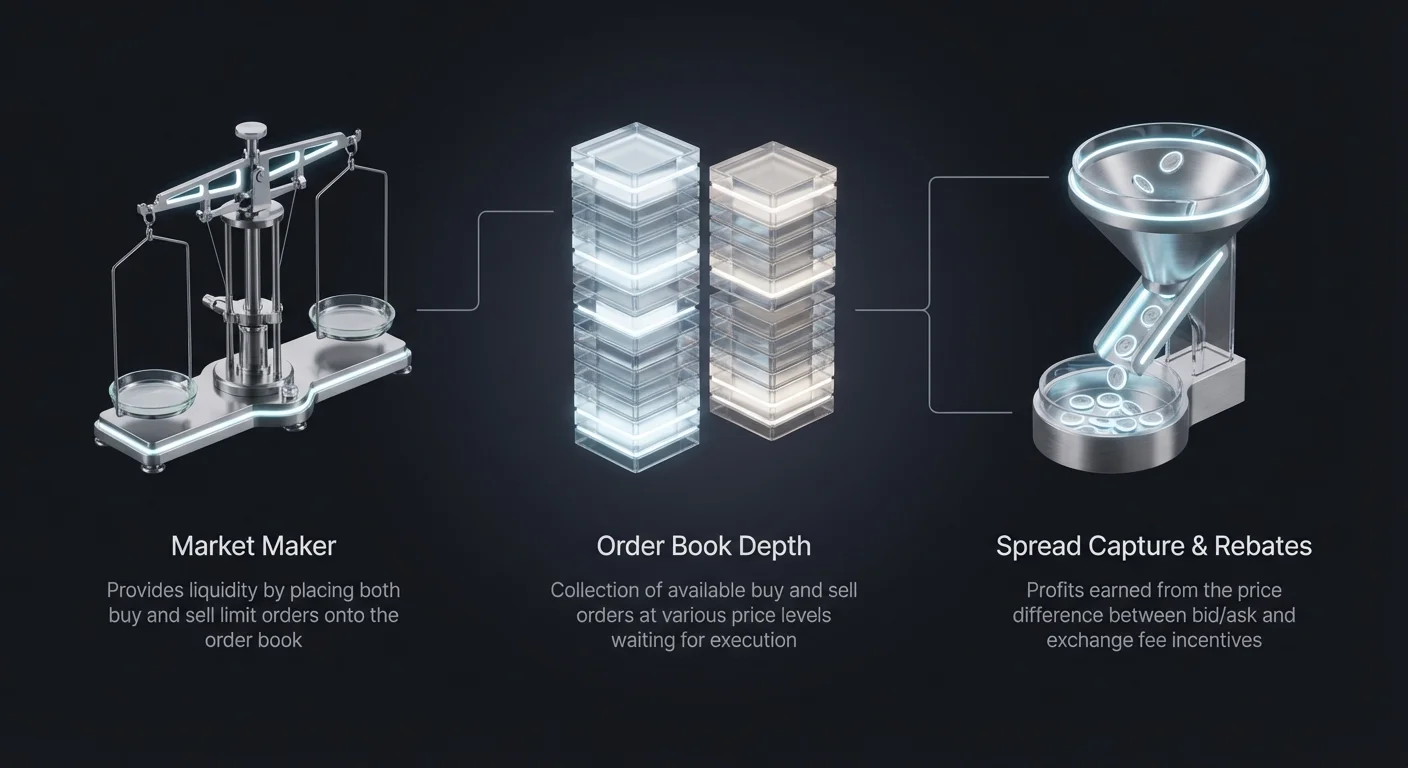
The Mechanics of Market Making
Market making involves placing both buy and sell limit orders for a specific asset at defined price levels. These orders sit in the order book, waiting to be filled by other traders who demand immediate execution. The difference between the highest buy order (bid) and the lowest sell order (ask) is known as the spread. A market maker earns profit by buying at the bid price and selling at the ask price, capturing this difference repeatedly throughout the trading session.
Successful liquidity provision depends heavily on the concept of order book depth. Depth refers to the amount of volume available at specific price levels. A market with deep liquidity can absorb large orders without significant price changes, a phenomenon known as slippage. Exchanges incentivize market makers to provide this depth because it attracts more retail and institutional traders who seek stable execution prices.
The speed of execution plays a vital role in this ecosystem. Limit orders provide the foundation of the market, but they are passive. The market maker must constantly adjust these orders as the underlying price of the asset shifts. If the market moves too quickly in one direction, the market maker risks selling their inventory too early or buying a falling asset too soon.
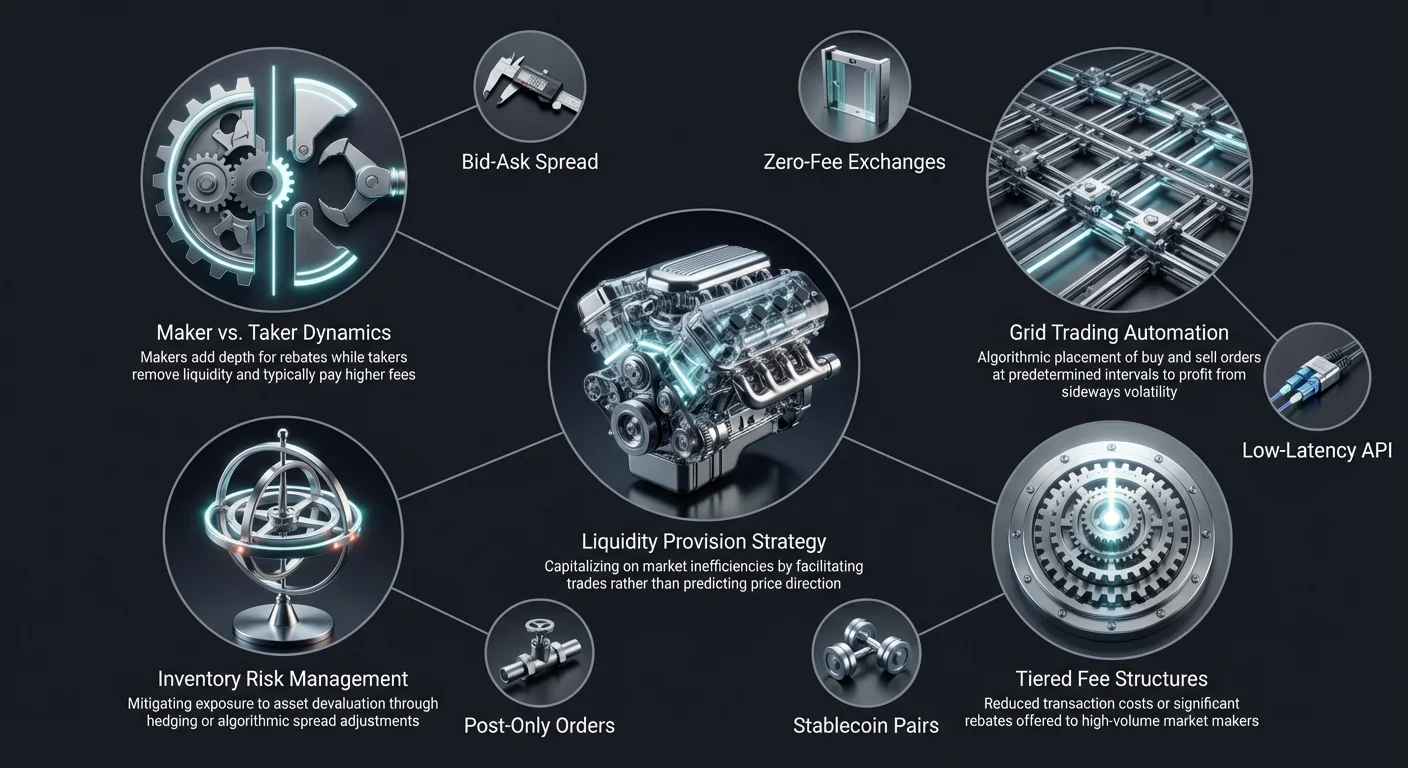
Maker vs. Taker Dynamics
In the context of exchange fee schedules, market participants are categorized into two distinct groups: makers and takers. This distinction is based on how their orders interact with the order book. A "maker" adds liquidity to the book by placing a limit order that does not match immediately with an existing order. These orders "make" the market by increasing the available depth.
Conversely, a "taker" removes liquidity from the order book. Takers place market orders or limit orders that execute immediately against existing bids or asks. Because they are "taking" the available liquidity and reducing market depth, exchanges typically charge them higher fees. This fee structure is designed to discourage the removal of liquidity and encourage the placement of passive orders.
Understanding this dynamic is the cornerstone of a liquidity provision strategy. Profitability often hinges on the gap between the fees paid (or rebates earned) as a maker versus the costs incurred. In many advanced trading environments, the maker fee is significantly lower than the taker fee. In some specific cases, the maker fee is negative, meaning the exchange pays the trader to provide liquidity.
Maximizing Returns with Tiered Fee Structures
Many centralized exchanges employ a tiered fee schedule that rewards high-volume traders. As a trader's 30-day trading volume increases, their transaction fees decrease. This structure is particularly beneficial for liquidity providers, as their strategy inherently involves executing a large number of trades to capture small spreads. Moving up these tiers is crucial for protecting profit margins.
Tiered systems often differentiate strictly between maker and taker fees. For entry-level traders, maker fees might start around 0.1% to 0.4%. However, as volume scales up to millions of dollars per month, these fees can drop to zero or even become rebates. A rebate is a credit added to the trader's account for every limit order filled, effectively turning the cost of trading into a revenue stream.
To maximize these benefits, traders must carefully select exchanges that offer the most aggressive volume incentives. Some platforms also offer fee reductions for holding the exchange's native token or for paying fees using that token. Combining volume-based discounts with token-holding incentives can drastically reduce overhead costs. This reduction lowers the breakeven point for each trade, allowing the market maker to quote tighter spreads and win more order fills.
| Fee Component | Standard Impact | Tiered Benefit |
|---|---|---|
| Maker Fee | Reduces profit per trade | Can become 0% or a rebate |
| Taker Fee | High cost of entry/exit | Reduces significantly with volume |
| Token Discount | N/A | Additional % off total fees |
The Strategic Advantage of Zero-Fee Exchanges
The emergence of zero-fee crypto exchanges has disrupted traditional market making strategies. On these platforms, traders can execute buy and sell orders without paying a commission to the exchange. This environment completely changes the calculus of liquidity provision. Without the burden of fees eroding profits, traders can operate with extremely tight spreads that would be unprofitable on fee-charging venues.
Zero-fee trading allows for high-frequency strategies where the profit per trade is microscopic. In a fee-based environment, a trader might need a price movement of 0.5% just to cover costs. On a zero-fee platform, a price movement of 0.01% could theoretically result in a net profit. This enables scalping strategies and rapid inventory turnover, which are essential for reducing exposure to long-term price volatility.
However, traders must scrutinize how zero-fee exchanges generate revenue. Some may widen the spread artificially or charge higher withdrawal fees to compensate for the lack of trading commissions. It is vital to ensure that the "zero-fee" promise applies to the specific trading pairs and order types being used. Often, zero-fee promotions are limited to specific pairs like BTC/USD or stablecoin swaps.
Automating Liquidity with Grid Trading
Grid trading is a popular automated strategy that mimics the behavior of a market maker. A grid trading bot places a series of buy and sell limit orders at predetermined intervals within a specific price range. As the market fluctuates, the bot automatically buys when the price dips and sells when it rises, capturing the profit from each interval.
This automation is particularly effective in sideways or ranging markets where the price oscillates without a strong trend. By automating the placement of orders, the trader ensures continuous liquidity provision without the need for 24/7 manual monitoring. The grid effectively creates a mesh of liquidity across the order book, capitalizing on normal market volatility.
Key parameters in grid trading include the upper and lower price limits and the number of grid lines. A tighter grid with more lines results in more frequent trades with smaller profits per trade. A wider grid executes fewer trades but captures larger price movements. When combined with a zero-fee or maker-rebate exchange, grid trading becomes a powerful tool for generating passive income from market noise.
Managing Inventory Risk
The primary risk for any liquidity provider is inventory risk. This occurs when the market moves decisively in one direction, leaving the market maker holding a bag of depreciating assets. For example, if a trader has buy orders layered down the order book and the price crashes, those orders will be filled. The trader is then left holding the asset as its value continues to drop.
To mitigate this, professional market makers employ sophisticated inventory management algorithms. These systems adjust the spread and the size of orders based on the current inventory held. If the trader accumulates too much of a specific cryptocurrency, the system might skew the orders to favor selling, thereby reducing the inventory exposure.
Another method of managing risk is hedging. Traders may use futures contracts or options to offset the exposure of their spot market inventory. By taking a short position in the futures market equivalent to their long holdings in the spot market, liquidity providers can neutralize directional risk. This allows them to focus purely on earning the spread and fee rebates without worrying about the overall market direction.
Selecting the Optimal Venue
Choosing the right exchange is a critical decision that impacts the viability of a liquidity provision strategy. Liquidity begets liquidity; therefore, exchanges with higher trading volumes generally offer more opportunities for order fills. However, high-volume exchanges are also more competitive, with professional firms dominating the order book with ultra-low latency connections.
Security is another non-negotiable factor. Since liquidity provision requires keeping assets on the exchange to fund open orders, the platform's security infrastructure is paramount. Traders should prioritize exchanges that utilize cold storage for the majority of user funds, offer two-factor authentication (2FA), and have a clean track record regarding hacks and security breaches.
API connectivity is the third pillar of exchange selection. Automated market making relies on the ability to place, cancel, and modify orders in milliseconds. Exchanges that offer robust, stable, and fast APIs (Application Programming Interfaces) are essential. A lagging API can result in "stale quotes," where a limit order is filled at an unfavorable price because the bot could not cancel it fast enough during a price spike.
The Role of Stablecoins in Liquidity Strategies
Stablecoin pairs, such as USDT/USDC or DAI/USDT, offer a unique environment for liquidity provision. Since these assets are pegged to the same value (usually the US Dollar), the volatility between them is minimal. The price rarely deviates far from parity, meaning the risk of holding a depreciating asset is significantly lower compared to volatile crypto assets like Bitcoin or Ethereum.
In stablecoin markets, the strategy focuses almost entirely on volume. The spreads are incredibly tight, often just a fraction of a cent. Profitability depends on executing a massive number of trades to accumulate rebates or tiny spread captures. This is where tiered fee structures and maker rebates become the primary source of revenue.
However, stablecoin liquidity provision is not risk-free. Traders must consider the de-pegging risk. If one of the stablecoins in the pair loses its peg to the dollar due to regulatory issues or reserve failures, the liquidity provider could end up holding the failed asset. Diversification across multiple stablecoin pairs and monitoring the health of the issuers are necessary precautions.
Zero-Fee Models vs. Spread Costs
It is important to distinguish between exchanges that charge zero commissions and those that make money through spreads. A "no-fee" broker might charge zero commissions but offer a buy price that is higher than the market rate and a sell price that is lower. This hidden cost, known as the spread markup, can be more expensive than a transparent commission fee for high-frequency traders.
True zero-fee crypto exchanges allow orders to interact directly with the order book without a markup. This is the only environment suitable for a genuine market-making strategy. If the platform artificially widens the spread, the market maker cannot quote competitive prices. Traders must verify the fee schedule and market structure to ensure they are accessing a raw order book.
When analyzing a platform, look for transparency in the fee schedule. High-quality exchanges will clearly list maker and taker fees and explicitly state if there are any spread markups. For liquidity provision, direct market access (DMA) is preferred over simplified "convert" interfaces that often hide substantial fees within the exchange rate.
Tokenized Stocks and 24/7 Liquidity
The advent of tokenized stocks has expanded the horizon for liquidity providers. These digital assets represent shares of publicly traded companies but trade on cryptocurrency exchanges. Unlike traditional stock markets that close in the evenings and weekends, tokenized stock markets operate 24/7. This continuous trading session opens new opportunities for market making.
Liquidity providers can capitalize on the off-hours of traditional finance. News affecting stock prices often breaks when the stock market is closed. Tokenized stock markets react immediately, creating volatility and volume that market makers can capture. Furthermore, these markets allow for fractional ownership, meaning liquidity can be provided in smaller increments than traditional full shares.
However, tokenized stocks carry regulatory risks. The legal status of these instruments varies by jurisdiction. Traders must be aware that regulatory actions could impact the liquidity or availability of these tokens. Additionally, the backing of these tokens must be verified; they should be fully collateralized by the actual underlying shares to ensure they track the price accurately.
Infrastructure Requirements for Market Making
Running a serious liquidity provision operation requires robust technical infrastructure. Relying on a home internet connection and a standard laptop is rarely sufficient for consistent profitability. Network latency—the time it takes for data to travel between the trader and the exchange—can make the difference between a profitable trade and a loss.
Professional liquidity providers often use virtual private servers (VPS) located near the exchange's servers. This minimizes latency, allowing the trading bot to react to market data faster than competitors. Redundancy is also critical; if one server fails, a backup system should take over to manage open orders and prevent exposure to market moves.
Security protocols must extend to the infrastructure as well. API keys used by trading bots should have restricted permissions. For example, an API key should be enabled for trading but disabled for withdrawals. This ensures that even if the server is compromised, an attacker cannot drain the funds from the exchange account.
Tax Implications of High-Frequency Trading
Liquidity provision strategies generate a high volume of transactions. Every time a buy or sell order is filled, it is considered a taxable event in many jurisdictions. This can lead to a massive number of reportable events for a single tax year. The administrative burden of tracking thousands of small trades is a significant consideration for market makers.
The classification of income is another complex area. In some regions, profits from trading are treated as capital gains, while in others, high-frequency trading might be classified as business income. The tax rates and reporting requirements differ vastly between these classifications. Maker rebates might also be treated as income separate from trading profits.
Traders must utilize specialized crypto tax software capable of ingesting API data from exchanges to calculate gains and losses accurately. Attempting to calculate taxes manually for a market-making strategy is practically impossible. It is advisable to consult with a tax professional who understands the nuances of crypto trading to ensure compliance and optimized tax planning.
Advanced Cross-Exchange Arbitrage
A sophisticated extension of liquidity provision is cross-exchange arbitrage. This involves providing liquidity on one exchange while hedging the position on another. For instance, a trader might place a buy order on Exchange A. As soon as that order is filled, the bot immediately sells the same amount on Exchange B, where the price might be slightly higher.
This strategy effectively combines market making with arbitrage. It allows the trader to capture the spread on Exchange A while neutralizing inventory risk by offloading the asset on Exchange B. This technique requires holding balances on multiple exchanges and managing the transfer of funds between them to rebalance inventory.
Zero-fee and tiered fee exchanges are particularly potent for this strategy. If Exchange A offers a maker rebate and Exchange B offers zero fees, the cost of executing the two legs of the arbitrage is minimized. This allows the trader to profit from even smaller price discrepancies between the two venues, increasing the frequency of trading opportunities.
Evaluating Liquidity Depth and Slippage
When selecting markets for liquidity provision, analyzing the existing liquidity depth is crucial. A market with a "thin" order book—where there are few orders at each price level—is highly volatile. While this volatility can offer large spreads, it also increases the risk of the price blowing through the market maker's orders, leading to rapid accumulation of inventory at bad prices.
Conversely, a "thick" order book with massive depth is very stable but often has very tight spreads. In these markets, the competition among market makers is fierce. The price might sit at a certain level for a long time, meaning limit orders may not get filled frequently. The ideal environment for a newer market maker is often a mid-cap asset with moderate volatility and moderate depth.
Slippage analysis helps in setting the grid parameters or spread width. By looking at historical trade data, a trader can see how often large market orders clear out the book. If slippage is common, the market maker should widen their spread to compensate for the increased risk of volatility.
Decentralized vs. Centralized Liquidity Provision
While this guide focuses on centralized exchanges (CEX), it is worth noting the parallel world of decentralized exchanges (DEX). On a CEX, liquidity provision is done via the order book. On a DEX, it is done via Automated Market Maker (AMM) pools. The mechanics are different; DEX liquidity providers deposit tokens into a pool and earn a share of trading fees.
CEX liquidity provision offers more control. A trader can choose the exact price at which they want to buy or sell. In a DEX pool, the protocol determines the price based on the ratio of assets in the pool. This leads to "impermanent loss," a risk unique to AMMs where the provider would have been better off just holding the tokens.
For active traders who want to manage their entry and exit points precisely, centralized exchanges with zero fees or rebates offer a superior environment. The ability to use limit orders allows for strategic positioning that is not possible in the passive pooling model of most decentralized exchanges.
Order Types and Strategic Execution
To execute a liquidity provision strategy effectively, traders must master various order types beyond the standard limit order. While the basic limit order is the primary tool for making markets, advanced order types can help manage risk and optimize execution.
"Post-Only" orders are essential for market makers. This order type ensures that the limit order is added to the order book and not executed immediately against an existing order. If a standard limit order would result in an immediate match (making the trader a taker), a post-only order will be rejected or adjusted. This guarantees that the trader always pays the maker fee (or receives the rebate) and never accidentally pays the higher taker fee.
"Iceberg" orders allow traders to hide the full size of their order. If a market maker wants to provide a large amount of liquidity without signaling their intent to the entire market, they can use an iceberg order. This displays only a small portion of the order at a time, reloading as it gets filled. This prevents other bots from front-running the large order.
The Impact of Market Sentiment on Liquidity
Market sentiment significantly influences the behavior of takers. In a strong bull market, takers are aggressive buyers. A liquidity provider selling into this buying pressure (selling calls or placing sell limit orders) will see their sell orders filled rapidly. The challenge then becomes re-buying the inventory at a lower price when the market keeps moving up.
In a bear market, the dynamic flips. Takers are aggressive sellers. The liquidity provider's buy orders get hit, and they accumulate assets. If the sentiment is overwhelmingly negative, the asset price may not bounce back quickly enough to sell at a profit. Understanding the macro sentiment helps market makers adjust their bias.
In a bullish environment, a market maker might skew their grid or orders to hold more inventory, anticipating price appreciation. In a bearish environment, they might skew to hold more stablecoins (cash) and only buy at significantly lower levels. Adapting the strategy to the prevailing sentiment is key to survival.
| Market Condition | Taker Behavior | Market Maker Risk | Strategy Adjustment |
|---|---|---|---|
| Bullish | Aggressive Buying | Selling too early | Skew inventory to asset |
| Bearish | Aggressive Selling | Buying falling knife | Skew inventory to cash |
| Ranging | Balanced | Low | Balanced grid / tight spread |
Monitoring and Analytics
Continuous monitoring is non-negotiable. Market conditions change rapidly in crypto. A set-and-forget strategy usually leads to losses over the long term. Traders need real-time analytics to track their fill rates, current inventory, and profit/loss (PnL).
Fill rate is a key metric. It measures the percentage of placed orders that actually get executed. A low fill rate might indicate that the spread is too wide or that the bot is too slow to update orders. A very high fill rate might indicate the spread is too tight, and the trader is leaving money on the table (selling too cheap or buying too expensive).
PnL monitoring should separate fee rebates from trading profit. This helps the trader understand the source of their revenue. If the trading PnL is negative but the rebate PnL is positive, the strategy relies entirely on the exchange's incentive structure. If the exchange changes its fee model, the strategy fails. Ideally, the strategy should be profitable on trading alone, with rebates acting as a bonus.
Leveraging High-Frequency Data
To compete with professional trading firms, retail liquidity providers are increasingly turning to high-frequency data feeds. Standard market data updates might occur once every second, but in the world of crypto, prices can move significantly in milliseconds. Accessing websocket feeds that push data changes instantly allows the market maker to react faster.
This data includes not just the last traded price, but the entire state of the order book. By analyzing the "level 2" or "level 3" data (which shows all individual orders), a trader can spot imbalances. If a massive sell wall appears in the order book, the market maker can pull their buy orders before the wall is dumped into them.
Using this granular data requires more processing power and sophisticated code, but it provides a significant edge. It transforms liquidity provision from a passive, reactive strategy into a proactive one that anticipates short-term order flow imbalances.
Future Trends in Liquidity Provision
The landscape of liquidity provision is shifting toward democratization. Historically, market making was the domain of institutions with proprietary software. Now, exchanges are building tools like grid bots directly into their interfaces (as seen with Bitget and others). This allows retail traders to deploy liquidity strategies without writing code.
Furthermore, the line between CEX and DEX is blurring. "Hybrid" exchanges are emerging that attempt to offer the speed of a CEX with the non-custodial security of a DEX. Liquidity provision on these platforms may involve unique fee structures or token-based incentives that reward early adopters.
As artificial intelligence (AI) advances, we can expect "smart" liquidity bots that adjust their parameters dynamically based on machine learning models. These bots will analyze volatility, volume, and sentiment in real-time to optimize spreads and grid ranges, potentially lowering the barrier to entry for sophisticated market making even further.
Conclusion
Liquidity provision offers a compelling alternative to directional trading, allowing participants to capitalize on market inefficiencies and exchange incentives rather than price predictions. By utilizing limit orders, traders act as the backbone of the exchange ecosystem, stabilizing prices and deepening the market. The profitability of this approach is heavily influenced by the venue's fee structure, making zero-fee and tiered exchanges essential tools for the modern market maker.
Success in this arena requires a disciplined approach to inventory management and a thorough understanding of market microstructure. Whether utilizing automated grid bots or sophisticated API-driven algorithms, the goal remains the same: to capture the spread while minimizing risk. As the crypto landscape evolves, the integration of advanced tools and favorable fee models will continue to empower traders to professionalize their liquidity strategies.
Success in liquidity provision comes from managing risk and costs, not predicting where the price goes next.