
Every time you send an email, save a photo, or check your bank balance, a massive decentralized system is updating its "state"—the current record of all relevant information. Blockchains are no different. They are essentially global, digital ledgers that must keep meticulous track of asset ownership.
If this fundamental tracking system is inefficient, insecure, or difficult to audit, the entire network fails. The way a blockchain chooses to manage this critical data—the record of who owns which asset—is known as its state management model.
When analyzing major blockchains like Bitcoin and Ethereum, we find two dominant and fundamentally different approaches to state management: the Unspent Transaction Output (UTXO) model and the Account-based model. This technical distinction is not just a coding preference; it dictates how the blockchain handles transaction security, privacy, scalability, and, crucially, its ability to run complex programs like smart contracts. Understanding the trade-offs between UTXO and Account models is essential for grasping the underlying engineering philosophy of the cryptocurrency landscape.
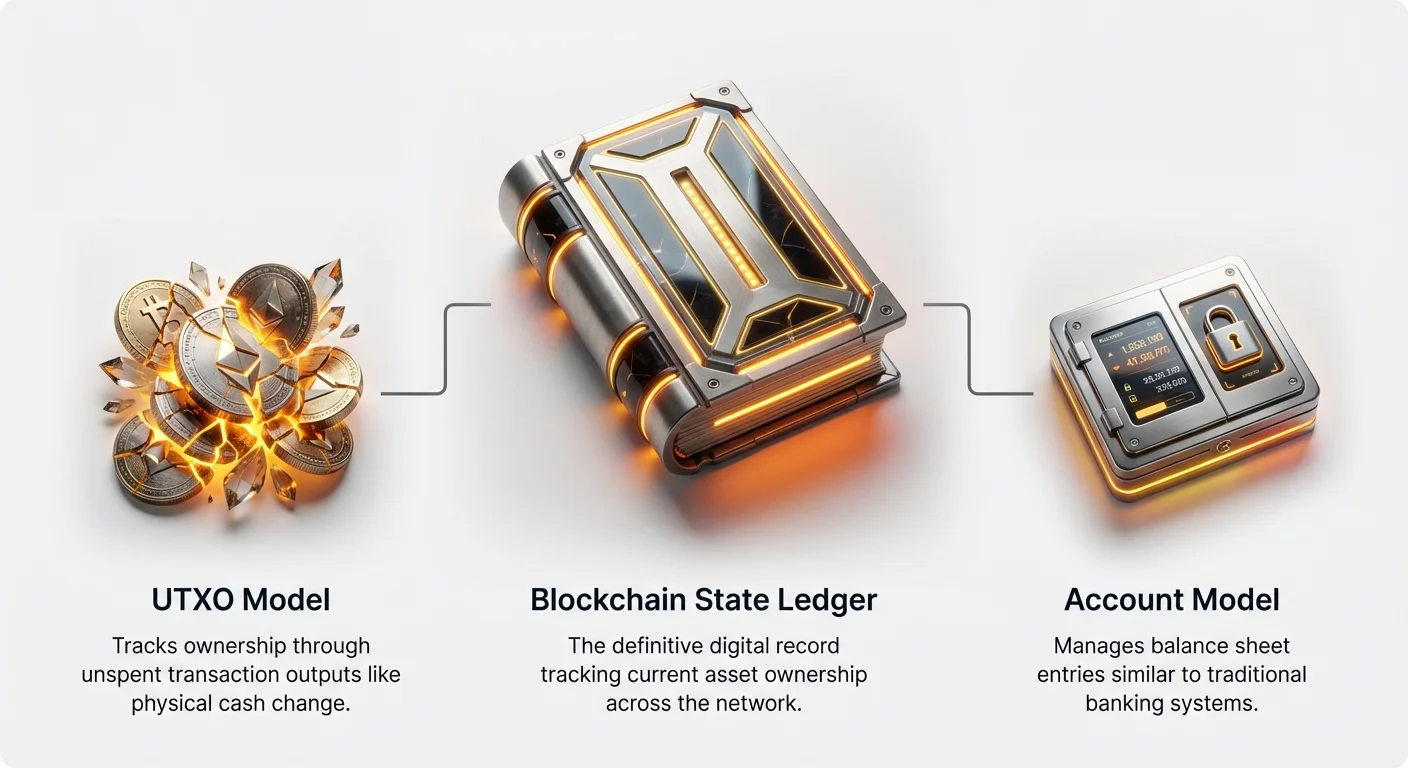
Defining Blockchain State Management: The Digital Ledger Metaphor
Before diving into the models, we must define State. In blockchain terminology, the state is the aggregate collection of all verified data up to the most recently added block. It represents the current, definitive snapshot of the entire system.
Imagine a traditional physical ledger book. The ledger's state is the sum of all its entries at the current page. If you want to confirm a transaction is valid, you must refer to the state. In a blockchain, this validation process involves proving that the sender genuinely owns the assets they intend to spend.
The two primary state management solutions tackle this proof of ownership in vastly different ways, affecting efficiency and computational overhead:
- UTXO Model (Unspent Transaction Output): Tracks ownership based on the history of transactions, treating money like physical cash. (Used primarily by Bitcoin, Litecoin, and early variants.)
- Account Model: Tracks ownership using simple account balances, similar to a traditional bank. (Used primarily by Ethereum, Solana, and most smart contract platforms.)
Model 1: The UTXO Model (Bitcoin's Approach)
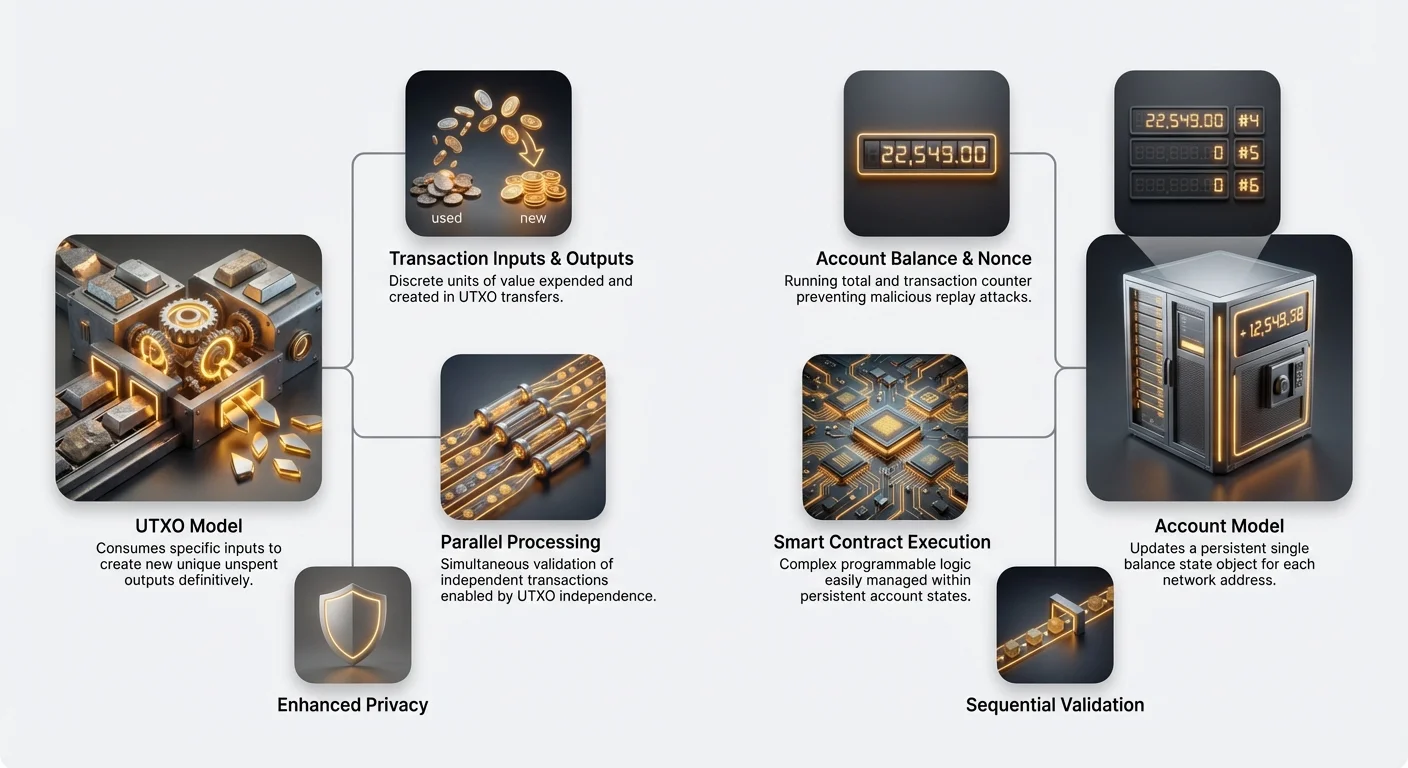
The UTXO model is the mechanism originally pioneered by Bitcoin. It does not use the concept of an "account" with a running balance. Instead, it views the cryptocurrency as a collection of fragmented, discrete units of value defined by previous transactions.
How UTXOs Work: The Digital Cash Analogy
To understand UTXO, ditch the idea of a bank balance and think instead of physical cash or gift cards.
When you receive Bitcoin, you are not increasing a single balance number; you are receiving a specific, individual unit of value—an output from the previous sender’s transaction. This unit is now Unspent Transaction Output (UTXO).
Key Characteristic: When you want to spend value, you must spend the entire UTXO.
- Example: Imagine you have two UTXOs: one worth 0.5 BTC and one worth 0.2 BTC. Your wallet calculates your total balance as 0.7 BTC by summing them up. If you want to spend 0.3 BTC, you must use the 0.5 BTC UTXO as input. You send 0.3 BTC to the recipient, and the remaining 0.2 BTC is returned to you immediately as a brand-new UTXO (the "change") associated with a new address you control.
Transaction Process Flow
A UTXO transaction is essentially a contract that proves two things:
- Inputs: Which existing, unspent UTXOs are being consumed. (Requires a digital signature proving ownership of the address linked to those UTXOs.)
- Outputs: Where the value is going. (This creates new UTXOs that are now "locked" to the recipient's public key.)
The fundamental rule is that the sum of the inputs must always equal the sum of the outputs plus the transaction fee. This structure ensures cryptographic integrity; if you try to spend a UTXO that has already been spent, the network immediately rejects the transaction as invalid (a double-spend attempt).
Core Benefits: Security, Privacy, and Parallelization
The UTXO model offers several powerful advantages rooted in its design purity:
1. Enhanced Transaction Security and Atomicity
UTXOs are inherently atomic. When a transaction is validated, the inputs are consumed and immediately cease to exist in the global state, making the transition from unspent to spent definitive and clear. This rigid, mathematically verifiable process makes it very difficult for attackers to manipulate transaction history.
2. Improved Transaction Privacy
Because UTXO wallets are encouraged to generate a new address for every change output, the model naturally breaks the link between transactions. While a single large address balance can be tracked in an account model, the UTXO model forces observers to trace a fragmented web of newly created, single-use addresses, adding a layer of obfuscation. This enhances transaction privacy.
3. High Parallel Processing Capability
One of the most significant technical advantages of UTXO is scalability through parallelization. Since the network only needs to verify that the specified inputs (UTXOs) have not already been spent, two separate transactions that consume entirely different UTXOs can be processed simultaneously without risk of interfering with each other's state. This allows miners and validators to process a high volume of transactions concurrently, improving the theoretical speed of the system.
Model 2: The Account Model (Ethereum's Approach)
The Account-based model is the approach adopted by Ethereum and most other smart contract platforms. This model is much easier for users to grasp because it mimics familiar systems like traditional bank accounts or email accounts.
How Accounts Work: The Traditional Bank Account Analogy
In the Account model, every user or contract holds a single, persistent state object (the account) that tracks its running balance.
When a user wants to send assets, the transaction simply deducts value from the sender's account balance and adds it to the recipient’s account balance.
Ethereum recognizes two types of accounts, both managed through the same underlying mechanism:
- Externally Owned Accounts (EOAs): Controlled by private keys (the accounts users hold in their wallets).
- Contract Accounts: Accounts that hold the immutable code and storage data for smart contracts. These accounts are controlled by code, not by private keys.
Efficiency in Smart Contracts
The primary reason the Account model was adopted by Ethereum is its superior efficiency for complex computing and smart contract execution.
Imagine a smart contract that manages a decentralized lending pool. The contract needs to know the current balance of collateral held by Borrower A and the current interest rate stored in its own internal memory.
In the Account model:
- The contract can instantly query the current balance associated with Borrower A’s single account address.
- The contract’s internal state (e.g., the interest rate variable) is easily modified and consistently tracked within its own persistent state object.
This simplified, centralized state makes running sequential, multi-step programs (smart contracts) much easier and less resource-intensive than trying to coordinate the consumption and creation of dozens of individual UTXOs within a complex computational environment.
Core Drawbacks: Complexity of Global State and Replay Attacks
While efficient for computation, the Account model presents different engineering challenges:
1. Complexity of Global State Verification
In the UTXO model, the global state is simply the set of all unspent outputs. In the Account model, the global state is the current balance, code, and storage of every single account on the network. This comprehensive state must be updated and verified with every transaction. To prevent errors, transactions typically must be processed sequentially, limiting the parallelization benefits inherent to the UTXO system.
2. Nonce Management and Security
To prevent a transaction from being broadcast multiple times (known as a replay attack), every account in the Account model must track a nonce (a unique transaction count). If you send a transaction with nonce #5, the network must verify that nonce #4 has already been processed. If the nonce is wrong or reused, the transaction is rejected. This adds a critical layer of state tracking that is necessary for security but adds complexity compared to the UTXO model, where a spent UTXO simply cannot be used again.
3. Reduced Transaction Privacy
Since users must consistently use the same account address to maintain their balance, linking transactions and tracing asset movement is generally much simpler in an Account model than in a UTXO model. This places a greater burden on the user to employ secondary tools (like mixers or advanced privacy solutions) if they wish to obfuscate their financial activity.
Direct Comparison: UTXO vs. Account (The Trade-Offs)
The decision between the UTXO and Account models is a foundational engineering trade-off that highlights different priorities within the Blockchain Trilemma (Decentralization, Security, Scalability).
| Feature | UTXO Model (Bitcoin) | Account Model (Ethereum) |
|---|---|---|
| Analogy | Physical Cash / Vouchers | Traditional Bank Account |
| How Balance is Calculated | Sum of all linked Unspent Transaction Outputs (UTXOs). | Single, persistent balance number associated with an address. |
| Transaction Validation | Check if UTXO input exists and is signed by owner. | Check if sender's balance > transaction amount, and if the nonce is correct. |
| Smart Contract Efficiency | Difficult to implement complex, layered contracts. | Excellent for managing complex internal state and computation. |
| Privacy | High. Encourages the use of new addresses (change outputs). | Moderate. Addresses are reused, simplifying tracing. |
| Scalability (Parallelization) | High. Transactions consuming different UTXOs can be processed concurrently. | Low. Requires more sequential processing to ensure global state consistency. |
Usability and Efficiency
From a pure user experience standpoint, the Account model is simpler. When you open an Ethereum wallet, you see a single, familiar balance number. The user doesn’t need to worry about change outputs or managing fragmented assets.
However, the UTXO model provides transactional efficiency at the protocol level. Because the network only has to verify the existence of the specific UTXO inputs, validation is lightweight. In the Account model, the network must verify and update the entire account state, including its code and storage variables, which is a heavier computational lift, especially for smart contract interactions.
Security and Privacy Implications
The UTXO model is often lauded for its inherent security purity. Because a transaction input must be an unspent output, the simple act of spending eliminates the possibility of double-spending the exact same unit of value.
From a privacy perspective, the transaction privacy UTXO model offers a crucial advantage. Since every transaction inherently fragments the value and generates a new change address, analysts must work harder to link all those disparate addresses back to a single human owner.
In contrast, the Account model's simplicity (reusing one address) comes at the cost of privacy. For example, if a user performs one public transaction on Ethereum, every subsequent transaction from that same EOA is easily linked back to the originating address, creating a transparent, public financial history unless advanced privacy tools are used.
Scalability and Performance (Parallelization)
The concept of parallelization is key to a blockchain's throughput (how many transactions it can handle per second).
UTXO Advantage: Because transactions only rely on specific, previously created UTXOs, the system can easily distribute the verification load. If Alice is spending UTXO A and Bob is spending UTXO B, the network can process both transactions simultaneously without any risk of conflict. This makes the UTXO model highly effective for horizontal scaling layers.
Account Model Challenge: If Alice and Bob are both interacting with the same smart contract (Contract X), the network must ensure that Contract X’s state is updated correctly after Alice’s transaction before Bob’s transaction is processed. If they are processed simultaneously, a conflict could arise, leading to an incorrect global state. This necessity often forces blockchains using the Account model to rely on more sequential processing, creating a bottleneck that hinders raw transaction speed, a common challenge addressed by layer-2 scaling solutions.
Hybrid and Advanced State Management Solutions
The limitations of both models have spurred innovation. Modern blockchains often seek to achieve the computational flexibility of the Account model while retaining some of the security and parallelization benefits of UTXO.
UTXO-based Smart Contracts (e.g., Cardano)
Projects like Cardano recognized the security benefits of the UTXO structure but needed smart contract functionality. They implemented the Extended UTXO (EUTXO) model, which allows UTXOs to carry embedded logic and state information.
This approach maintains the parallelization benefits of UTXO—because even smart contract transactions consume inputs and create new outputs—while supporting complex programs. However, it requires developers to adopt a fundamentally different, and often more challenging, programming paradigm than the familiar Account model found in Ethereum.
Modified Account Models (e.g., Solana)
Solana, a high-throughput blockchain, also struggles with the inherent sequential processing limitation of the classic Account model. To address this, Solana uses a modified Account model that requires every transaction to explicitly list all the accounts it intends to read from or write to.
By knowing exactly which accounts are involved beforehand, the system’s validator can intelligently schedule transactions, processing non-overlapping transactions in parallel. This is a crucial engineering innovation that allows Account-based blockchains to achieve high scalability while retaining the simplified computational model necessary for complex applications.
Conclusion
Blockchain state management is the silent engine that determines the security, privacy, and performance of a decentralized network.
The UTXO model, exemplified by Bitcoin, prioritizes cryptographic purity, security, and parallel processing capabilities, making it the ideal architecture for a decentralized digital cash system that requires strict transactional integrity. Its trade-off is complexity for developers trying to build sophisticated applications.
The Account model, utilized by Ethereum and most DeFi platforms, prioritizes ease of development and robust computational environment management, making it the optimal choice for smart contracts and decentralized applications that require frequent state updates. Its trade-off is generally lower transactional privacy and difficulty achieving high parallel throughput without complex layering solutions.
As blockchain technology matures, we see networks adopting hybrid solutions, proving that neither model is definitively superior. Instead, the choice reflects the core mission of the network: UTXO for maximizing security and monetary integrity; Account models for maximizing smart contract flexibility and application development.