
Welcome to the cutting edge of blockchain engineering. While core decentralized networks like Bitcoin and Ethereum offer unparalleled security and resistance to censorship, they struggle to handle the transaction volume needed for global adoption. This bottleneck—the inability to process thousands of transactions per second—is often referred to as the Scalability Crisis.
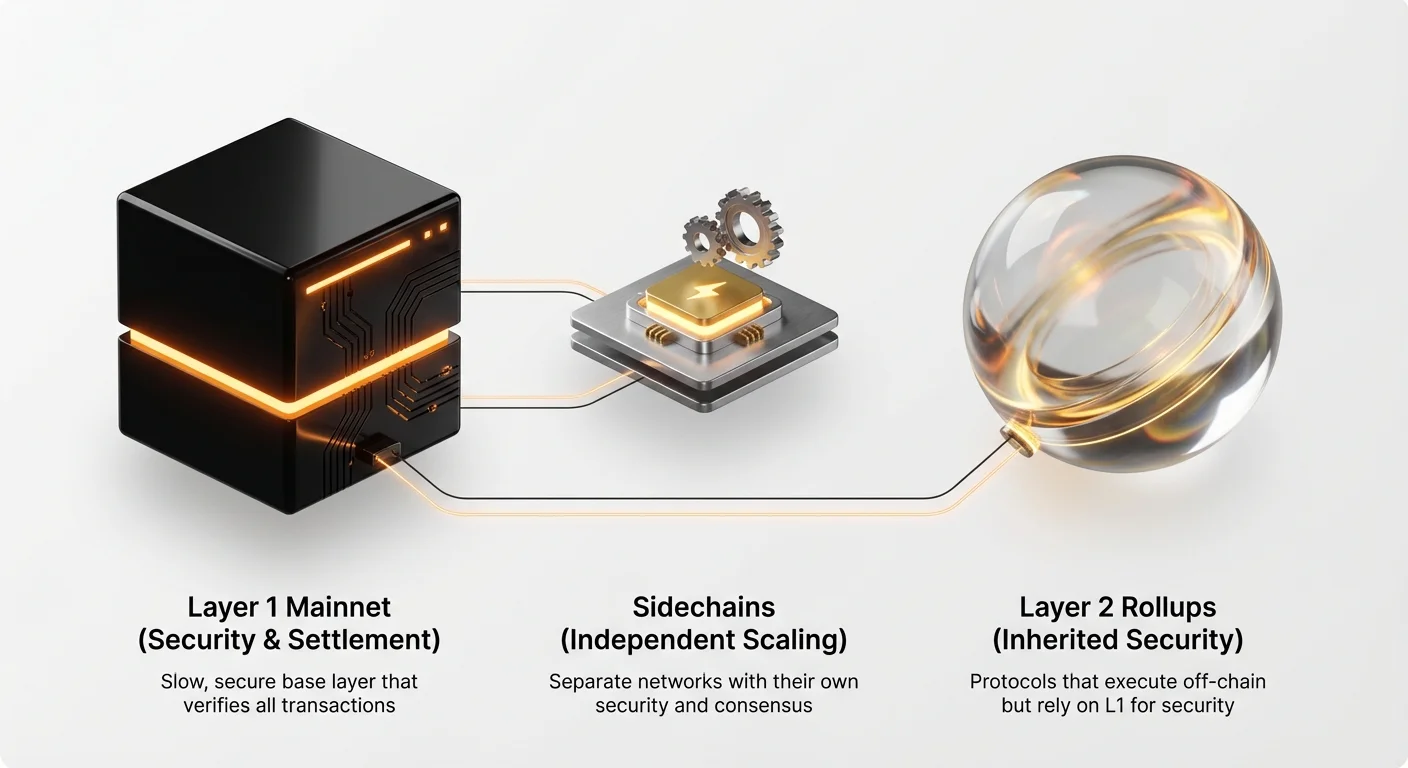
To address this, the industry has developed various "off-chain" solutions designed to move heavy transactional lifting away from the main blockchain, known as Layer 1 (L1), while still leveraging its foundational security. These solutions fall primarily into two camps: independent Sidechains and dependent Layer 2 (L2) networks, with Rollups dominating the L2 landscape.
This article provides a critical, comparative analysis of these scaling methods. We will move beyond simple definitions to explore the complex engineering trade-offs each solution makes in the battle to achieve high throughput without sacrificing the core tenets of decentralization and security—the very things that make blockchain technology revolutionary. Understanding these fundamental architectural differences is essential for navigating the decentralized future.
Understanding Layer 1 Limitations: The Need for Scaling
The primary blockchains (Layer 1s) are designed around the principle of maximum security and decentralization. Every validator must agree on every transaction, and every participant must be able to verify the entire history of the chain. This comprehensive approach is what prevents attacks and maintains trustlessness, but it comes at a steep cost: speed.
The Blockchain Trilemma Revisited
The "Blockchain Trilemma," a concept foundational to network engineering, posits that decentralized networks can only achieve two out of three desirable characteristics simultaneously: Decentralization, Security, and Scalability.
- Decentralization: Having thousands of nodes run by independent entities globally.
- Security: High cost to attack the network and cryptographic immutability.
- Scalability: High transaction throughput (fast processing) and low fees.
Layer 1 networks like Ethereum prioritize decentralization and security, sacrificing scalability. They intentionally limit block size and frequency to ensure that the chain can be verified and run by commodity hardware anywhere in the world. If L1s were fast enough to handle global traffic, their data requirements would skyrocket, forcing small participants offline and leading to centralization.
The Cost of Security and Finality
When a Layer 1 network is congested, transaction fees (gas) rise dramatically because users are bidding against each other for limited block space. Furthermore, the time it takes for a transaction to be truly "final" (i.e., irreversible) can be long.
Scaling solutions aim to provide the speed and low cost necessary for everyday applications, turning the secure, slow L1 into a settlement layer—the ultimate judge and data storage layer—while handling execution off-chain.
Scaling Approach 1: Sidechains
Sidechains represent the most straightforward way to relieve congestion. A Sidechain is an independent, separate blockchain network running parallel to the main L1 chain.
How Sidechains Work: Separate Consensus
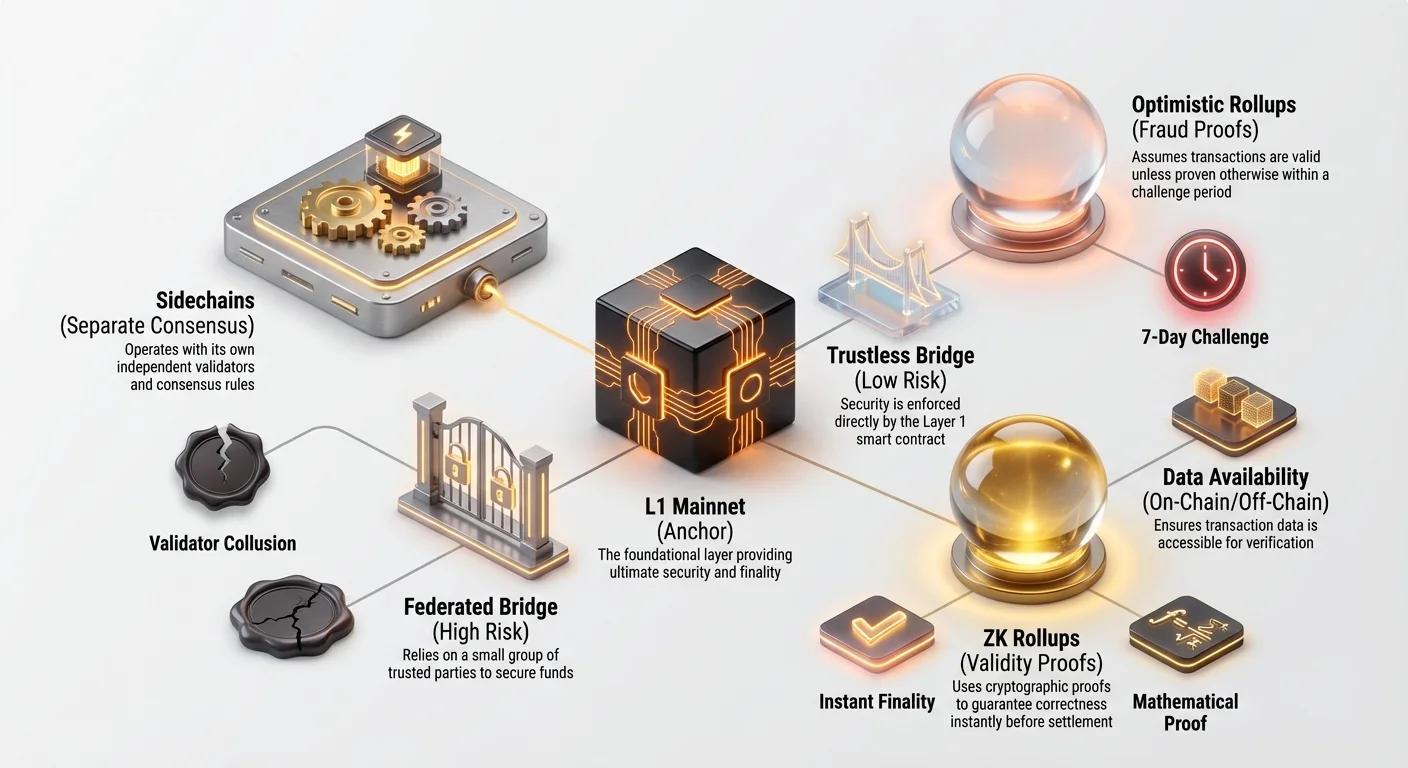
Unlike L2 solutions (which we will cover next), a Sidechain operates with its own set of rules, its own native token (for gas/fees), and, crucially, its own independent consensus mechanism.
For example, a Sidechain might use Proof-of-Stake (PoS) with a smaller, predefined set of validators (nodes) chosen for their speed and efficiency. Since fewer participants need to agree on transactions, the Sidechain can process transactions much faster and cheaper than the L1.
Key Features of a Sidechain:
- Autonomy: It can execute its own network upgrades without affecting the L1.
- Dedicated Scalability: It is engineered for raw speed and low cost.
- Separate Security: Its security relies entirely on its own validator set.
Key Tradeoffs: Security and Trust
The core drawback of a Sidechain is that it does not inherit the full security of the L1.
If a Sidechain’s validator set is compromised—for instance, if a majority of the validators collude—they could steal assets locked on the Sidechain. Users must have sufficient trust in the Sidechain’s economic security (the value staked by its validators) rather than the security of the L1 network (like Ethereum, which has a massive, diverse, and well-vetted validator base).
In the context of the Blockchain Trilemma, Sidechains primarily prioritize Scalability, achieving this by moderately sacrificing Decentralization (fewer validators) and relying on their own, often smaller, security budget instead of the L1's robust protection.
Bridging Mechanics and Security Risks
To use a Sidechain, users must move their native L1 assets onto the Sidechain—a process called bridging.
- Locking: The L1 asset (e.g., ETH) is locked in a smart contract on the L1 chain.
- Minting: An equivalent wrapped token (e.g., wETH) is minted on the Sidechain.
This bridge contract, which holds the locked funds, is the critical vulnerability point. Since the Sidechain’s validators control the minting and burning process, the security of the bridge is directly tied to the security of the Sidechain’s validators and its proprietary bridge software.
The Risk: If the Sidechain validators are dishonest or the bridge software is exploited, the funds locked on the L1 side can be drained. Several high-profile crypto exploits have occurred precisely at these Sidechain bridges, highlighting their security limitations compared to solutions that utilize L1 security guarantees.
Scaling Approach 2: Layer 2 Solutions
Layer 2 (L2) solutions are protocols built on top of an existing Layer 1 blockchain, with the explicit goal of handling transaction execution while using the L1 for settlement and security validation.
What Defines an L2? The Security Inheritance
The distinguishing factor between an L2 and a Sidechain is the L2’s reliance on the L1 for security. A true L2 solution must provide a mechanism that allows the L1 network to enforce transaction validity, even if the L2 operators attempt to cheat.
In simple terms, an L2 handles two out of the three crucial steps:
- Execution (Off-Chain): Transactions are processed quickly by the L2 network.
- Data Availability & Settlement (On-Chain): The compressed results (the "proof" or the summary data) are posted back to the L1 chain.
Because the data is posted back to the L1, any user can theoretically reconstruct the state of the L2 and verify that everything was done correctly, making the security inherited from the robust, decentralized Layer 1.
Plasma and State Channels: Historical Context
While Rollups dominate the L2 conversation today, early attempts at true L2 scaling involved:
1. Plasma
Plasma proposed a framework where child blockchains (like nested layers) could settle back to the main chain. It was designed to move asset transfers off-chain.
- Limitation: While highly scalable, Plasma made it difficult for users to safely withdraw funds. If an attacker created a fraudulent block, every honest user had to process a complex set of exit transactions to prove their state, leading to complicated and potentially congested withdrawal mechanics.
2. State Channels
State Channels (like the Lightning Network for Bitcoin) allow two parties to conduct an unlimited number of transactions privately, off-chain, only opening and closing the channel with two on-chain transactions.
- Limitation: They only work well for direct, bilateral transactions between two specific parties, limiting their use for general-purpose DeFi applications where interaction with hundreds of smart contracts is required.
These early L2 methods paved the way for Rollups, which offer the security of L2 with the general-purpose execution power needed for complex smart contracts.
The Modern Scaling Solution: Rollups
Rollups are the undisputed champion of L2 scaling today. They solve the Plasma problem by simplifying the mechanism for proving validity and ensuring that all necessary transaction data is readily accessible.
How Rollups Achieve Scale: Batching Transactions
The core innovation of a Rollup lies in data compression and batching.
- Gather: An L2 operator (sometimes called a sequencer) gathers hundreds or thousands of transactions submitted by users.
- Execute: These transactions are processed off-chain.
- Compress: The Sequencer calculates the resulting new "state" of the chain (who owns what).
- Roll Up: The sequencer bundles the compressed transaction data and the new state proof into a single large package and posts this single transaction to the Layer 1 chain.
Instead of L1 processing 100 transactions individually, it only verifies one batch transaction. This dramatically lowers the cost per user transaction and increases throughput.
Optimistic Rollups: Trust, But Verify
Optimistic Rollups operate on the belief that all transactions processed off-chain are valid unless proven otherwise. This is the "Optimistic" assumption.
How They Work:
- When a batch of transactions is posted to L1, the Optimistic Rollup system assumes the sequencer was honest and executed the code correctly.
- The system then enforces a Challenge Period (typically 7 days). During this week-long window, anyone watching the network can submit a Fraud Proof if they detect an invalid transaction or a dishonest state change.
- If a Fraud Proof is submitted and validated by the L1, the fraudulent block is reverted, and the dishonest sequencer is penalized (slashed).
Tradeoffs:
| Aspect | Description |
|---|---|
| Security | High. Inherits L1 security via the fraud proof mechanism. |
| Speed/Cost | Fast execution and low fees off-chain. |
| Withdrawal Time | Slow. Users must wait the entire Challenge Period (7 days) to ensure their funds are not part of a fraudulent batch. |
| Ease of Implementation | Easier to implement complex smart contract code, as they rely on running the L1 code interpreter (EVM). |
Use Case: Ideal for general DeFi and large applications where the trade-off of a slow withdrawal period (which can be bypassed by using L2 liquidity providers known as fast bridges) is acceptable for high, secure throughput.
ZK Rollups: Math Over Money
Zero-Knowledge (ZK) Rollups operate using cryptography rather than economic incentives (slashing) to guarantee correctness. Instead of proving fraud after the fact, they prove validity before settlement.
How They Work:
- The sequencer executes the batch of transactions off-chain.
- Instead of waiting a week, the sequencer immediately generates a cryptographic proof—a Zero-Knowledge Validity Proof (e.g., zk-SNARK or zk-STARK).
- This proof mathematically assures the L1 contract that the new state change resulted correctly from the compressed batch of transactions, without revealing the raw data of those transactions (hence "Zero-Knowledge").
- The L1 network simply verifies this complex mathematical proof, which is much faster than verifying every transaction individually.
Tradeoffs:
| Aspect | Description |
|---|---|
| Security | Highest. Mathematical validity proofs guarantee correctness instantly. |
| Speed/Cost | Fast execution and low fees. Instant finality on L1 settlement. |
| Withdrawal Time | Fast. Funds can be withdrawn immediately after the validity proof is verified on L1 (usually minutes). |
| Ease of Implementation | Historically challenging. Generating ZK proofs is computationally expensive and requires highly specialized circuits, making it harder to support general L1 code initially. (This challenge is rapidly diminishing with new ZK-EVM technology.) |
Use Case: Ideal for payments, high-frequency trading, and any application requiring rapid finality and maximum security assurances. ZK technology is often seen as the long-term future of scaling due to its instant, verifiable guarantees.
Specialized Execution Environments
While Rollups are the standard L2 solution, scalability architecture continues to evolve, creating specialized execution environments that make different trade-offs regarding data availability.
The Role of Data Availability (DA)
For a system to be fully secure and enforce the L1 guarantees, every participant must be able to verify the correct state. This requires Data Availability (DA)—the guarantee that the raw transaction data is published somewhere accessible.
- Standard Rollups (Optimistic & ZK): High DA. They post all transaction data directly onto the L1 chain (in compressed form). This is expensive but maximally secure.
Validiums: Off-Chain Data
A Validium is a ZK-based scaling solution that posts the validity proof to the L1 (just like a ZK Rollup) but keeps the raw transaction data off-chain.
- How it Works: Data is stored by a separate set of data availability committees or operators rather than on the L1 blockchain.
- Trade-off: Since the expensive part (posting all data) is avoided, Validiums achieve massive scalability—often significantly higher transaction capacity than standard Rollups. However, if the off-chain data providers fail or censor the data, users cannot easily reconstruct the state, potentially making withdrawal difficult (though not allowing theft, thanks to the ZK proof on L1).
- Security: Validiums have lower security than standard Rollups because they introduce a small amount of trust in the data keepers, reducing the full inheritance of L1 security.
Comparing the Data Availability Spectrum
We can visualize the different scaling solutions based on where they keep the most expensive component: the data.
| Solution Type | Proof Posted to L1 | Data Posted to L1 | Security Reliance | Primary Trade-off |
|---|---|---|---|---|
| ZK Rollup | Yes (Validity Proof) | Yes (Compressed) | Layer 1 | High L1 gas fees for data |
| Optimistic Rollup | No (Relies on L1 contract) | Yes (Compressed) | Layer 1 | 7-Day withdrawal delay |
| Validium | Yes (Validity Proof) | No (Kept Off-Chain) | Off-Chain Keepers | Reduced decentralization/data certainty |
| Sidechain | No | No (Kept on Sidechain) | Sidechain Validators | Independent, separate security |
Volitions: A concept emerging in the ZK space, Volitions allow users within the same network to choose their data availability model on a transaction-by-transaction basis: either maximum security (ZK Rollup mode, high fee, L1 data) or maximum speed (Validium mode, low fee, off-chain data).
Cross-Chain Interoperability and Bridging Risks
Regardless of whether a user is moving assets to a Sidechain or an L2, they must use a bridge. Interoperability—the ability for two distinct blockchains to communicate and move assets—is critical for a multi-chain ecosystem, but it is also the source of the greatest current risk.
The Weakest Link: Bridging Mechanics
A bridge is essentially a mechanism that validates and transfers ownership of assets between two networks. The security of this mechanism depends entirely on the technology underpinning the scaling solution.
1. Trustless Bridging (L2 Rollups)
L2 Rollups use trustless (or minimally trusted) bridges because the L1 contract directly enforces the rules.
- Optimistic Withdrawal: A user sends a transaction back to L1, triggering the 7-day challenge period. If no fraud is proven, the L1 contract releases the funds. The security is enforced by the L1 state.
- ZK Withdrawal: A user requests a withdrawal, and the L2 generates a ZK proof of the ownership change. Once the L1 verifies this mathematical proof, the funds are released.
In both cases, you only need to trust the security model of the Layer 1 blockchain itself.
2. Federated/Multi-Sig Bridging (Sidechains)
Sidechains typically use a federated bridge controlled by a multi-signature wallet or a set of trusted validators.
- The L1 assets are held by this defined group of trusted parties.
- To unlock the assets and move them back to L1, a majority of these parties (e.g., 7 out of 9 signatories) must agree.
The risk here is one of collusion or compromise. If enough validators are compromised, they can steal all funds locked in the bridge. Since Sidechain security is separated from L1, these bridges are significantly more vulnerable and represent the greatest systemic risk in the broader crypto ecosystem today.
Best Practices for Cross-Chain Activity
For beginners, interacting with bridges requires extreme caution:
- Prioritize L2 Native Bridges: Whenever possible, use the official, native bridge provided by a true L2 Rollup (e.g., Arbitrum’s bridge to Ethereum). These rely on the L1 security model (fraud proofs or validity proofs).
- Avoid Third-Party Bridges for Large Sums: While faster, third-party liquidity networks and bridges often introduce extra smart contract risk.
- Understand Sidechain Risk: Recognize that moving assets to a Sidechain means accepting the specific economic and technical security risks of that independent network and its validator set.
Comparative Analysis: Sidechains vs. Layer 2 Rollups
The choice between a Sidechain and an L2 Rollup represents a fundamental philosophical and engineering decision about where security should reside.
The Security vs. Autonomy Spectrum
| Feature | Sidechains (e.g., Polygon PoS) | Layer 2 Rollups (e.g., Optimism, zkSync) |
|---|---|---|
| Security Foundation | Independent; secured by its own token and validator set. | Inherited; secured by the computational and economic power of the Layer 1. |
| Decentralization | Lower. Smaller, faster validator sets are common. | Higher. Utilizes the full decentralization of the L1 for settlement. |
| Throughput | High. Can be engineered for maximum speed. | Very High. Limited primarily by L1 data bandwidth constraints. |
| Bridge Risk | High. Relies on the security of the federated validator group. | Low. Rely on cryptographic proofs enforced by the L1 smart contract. |
| L1 Congestion Impact | Minimal. Fees remain stable even if L1 is busy. | Direct. L2 fees increase when L1 is congested, as data posting costs rise. |
| Development Autonomy | High. Can change rules and fork independently. | Low. Must adhere to the rules and smart contract parameters set on the L1. |
User Experience and Interoperability Flow
From a user experience perspective, both L2s and Sidechains aim for fast, cheap transactions. However, the differences emerge when moving assets:
Sidechain UX:
- Deposits: Fast. You lock the funds on L1, and the Sidechain validators confirm the transaction quickly, minting the corresponding asset.
- Withdrawals: Fast. Once the Sidechain validators agree, they signal the L1 contract to release the assets.
- Security Context: The user is operating in a new security domain.
L2 Rollup UX:
- Deposits: Fast. The L2 bridge confirms the deposit quickly and immediately begins processing transactions.
- Optimistic Withdrawals: Slow (7-day wait).
- ZK Withdrawals: Fast (minutes).
- Security Context: The user remains under the L1 security umbrella.
Practical Consideration: For applications that require total sovereignty, custom cryptography, or highly specialized consensus (like a gaming chain or a compliance-heavy environment), a Sidechain might be preferred. For general decentralized finance (DeFi), where the movement of money requires maximum trust and safety, L2 Rollups are the superior choice.
The Future of Scaling: Modular Blockchains
The scaling debate is leading to an architectural shift toward Modular Blockchains. Instead of expecting one chain to handle all tasks (execution, consensus, data availability, settlement), the future sees specialized layers handling different tasks.
- Settlement Layer (L1): Provides the base layer of security and dispute resolution (e.g., Ethereum).
- Data Availability Layer: Dedicated networks optimized solely for storing and serving data cheaply, which L2s can reference (e.g., Celestia).
- Execution Layer (L2): Optimized for running smart contracts and processing transactions quickly (e.g., Rollups).
This modular approach allows each component to be optimized for its specific function, maximizing both scalability and decentralization. The Rollup model is perfectly suited for this future, cementing its place as the dominant paradigm for high-security scaling.
Conclusion: Engineering for Trust
The challenge of scalability is not just about making blockchains faster; it’s about making them faster without requiring trust in a centralized party.
Sidechains, while effective at increasing throughput, demand that users trust a specific, limited set of validators. This shifts the point of failure from the L1’s decentralized consensus to the Sidechain’s proprietary security model and bridge.
Layer 2 Rollups, particularly ZK Rollups, offer a powerful alternative. By using cryptographic proofs and anchoring their data and security directly to the highly decentralized L1, they allow users to achieve lightning-fast transactions while maintaining the trustless guarantee that underpins the entire promise of cryptocurrency.
As the industry matures, the focus continues to shift away from independent security models (Sidechains) toward robust, mathematically verifiable inheritance models (Rollups). For the average user, learning to distinguish between these solutions is the key to assessing risk and safely navigating the rapidly expanding ecosystem of digital assets.