
The world of cryptocurrency can often feel like a landscape of competing technologies, each promising a faster, cheaper future. Solana stands out as one of the few blockchain networks engineered specifically for speed and massive throughput, making it highly suitable for mainstream consumer applications. Its ability to process thousands of transactions per second for fractions of a penny is what gives it the potential to compete with traditional financial systems.
For the new user or the seasoned crypto enthusiast looking to integrate digital assets into their daily financial life, understanding the core tools—the "utility stack"—is essential. This guide moves beyond simple comparisons to provide a strategic blueprint for using Solana effectively. We will cover the foundational wallets required for secure asset management, the smart derivative strategies that allow you to earn passive income, and the revolutionary payment rails that bring crypto spending into the real world.
The goal here is not just to list tools, but to show you how to connect them, allowing you to maximize rewards, minimize friction, and strategically integrate this high-speed network into your consumer experience, transforming you from a basic holder into a Solana power user.
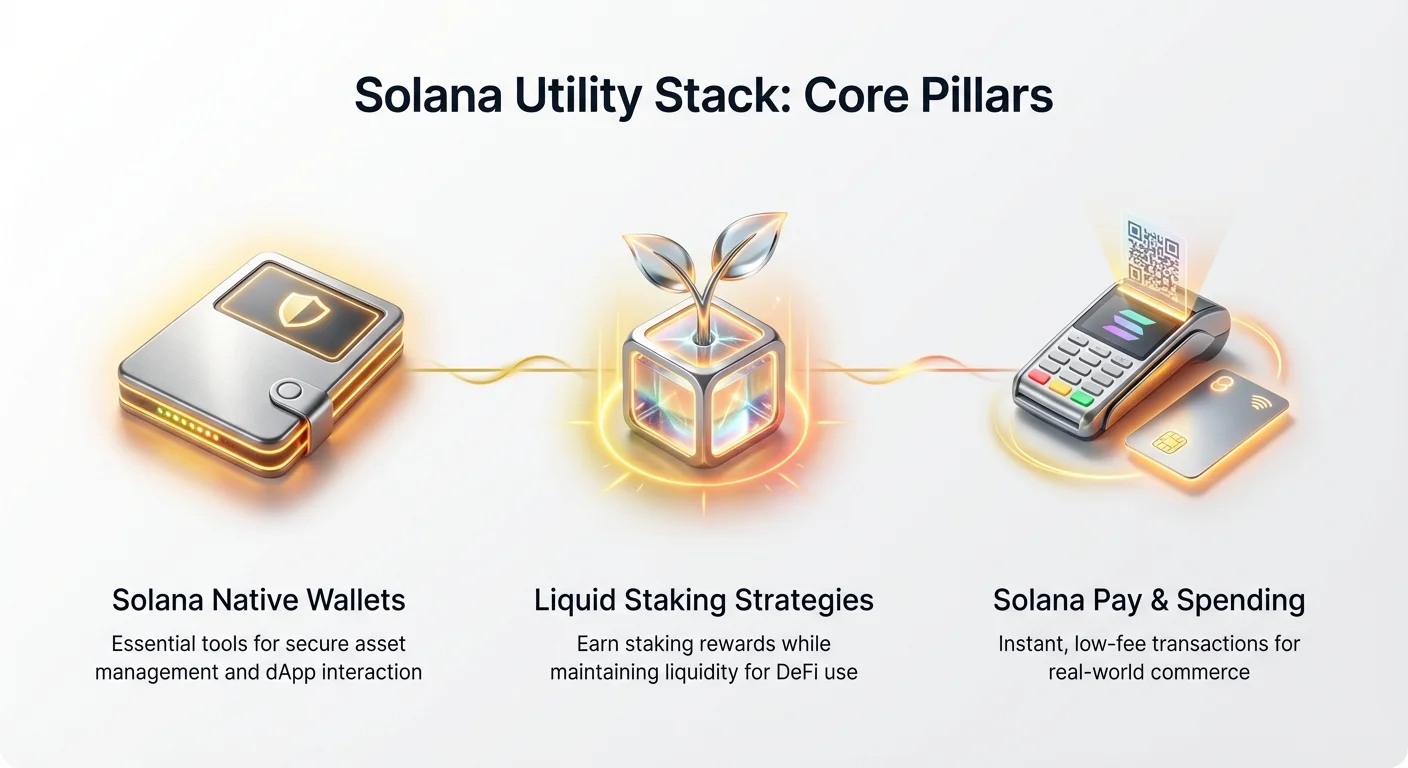
The Foundation: Choosing Your Solana Native Wallet
Every journey into the Solana ecosystem begins with a wallet. Unlike bank accounts, crypto wallets don't actually hold your assets; they hold the cryptographic keys that prove you own your assets on the public blockchain. For Solana, you must choose a wallet optimized to handle the network's native token (SOL) and its specific token standard (SPL tokens).
Custodial vs. Non-Custodial Basics
Before selecting a platform, it is crucial to understand the two fundamental types of wallet security:
- Custodial Wallets: These are typically provided by centralized exchanges (like Binance or Coinbase). The exchange holds your private keys, meaning they are the custodian of your funds. While convenient, this requires you to trust the exchange, and if the exchange is compromised or fails, your funds are at risk.
- Non-Custodial Wallets: These give you, and only you, complete control over your private keys, usually represented by a 12 or 24-word "seed phrase." This offers maximum security and self-sovereignty, but also maximum responsibility. If you lose your seed phrase, your assets are gone forever. For interacting with decentralized applications (dApps) on Solana, a non-custodial wallet is a necessity.
Key Players: Phantom vs. Solflare
The Solana ecosystem is dominated by two highly recommended non-custodial wallets, both known for their seamless integration, security features, and user experience.
Phantom Wallet: The Ecosystem Gateway
Phantom is often the first wallet recommended to new Solana users due to its sleek design and ease of use. It functions as a browser extension (like MetaMask on Ethereum) and a mobile app.
- Key Features: Built-in staking directly within the interface (simple for beginners), clear display of collectibles (NFTs), and automatic identification of malicious websites or transaction risks.
- Best For: New users, NFT collectors, and those seeking the highest degree of user-friendliness.
Solflare Wallet: Advanced Control and Hardware Integration
Solflare is another powerhouse, often favored by users who need more sophisticated control or maximum hardware security.
- Key Features: Strong integration with major hardware wallets (like Ledger) from the start, advanced portfolio management tools, and support for native token accounts.
- Best For: Experienced users, those who prioritize hardware wallet security, and users managing large amounts of value.
Setting Up for Success: Best Practices
Regardless of which wallet you choose, proper setup is critical to securing your funds and maximizing your utility:
- Secure the Seed Phrase: Write down your 12 or 24-word seed phrase physically (do not store it digitally on your computer or phone). Store it in multiple secure locations, ideally fireproof and waterproof.
- Use Hardware Wallets: For significant crypto holdings, always connect your hot wallet (like Phantom or Solflare) to a cold storage device (hardware wallet). This means that even if your computer is compromised, no transaction can be completed without a physical confirmation press on the separate device.
- Set Up Multiple Accounts: Within a single wallet, you can create multiple unique addresses. Use one for day-to-day spending and interaction (your "hot account") and another for long-term holding (your "vault account"). This limits exposure if your active account interacts with a risky dApp.
Maximizing SOL: Liquid Staking Strategies
Once you have a secure wallet, the next step for any power user is to put their SOL to work. Solana uses a Proof-of-Stake (PoS) consensus mechanism, meaning holders can "stake" their SOL to network validators to help secure the chain and earn rewards. Traditional staking, however, locks up your funds.
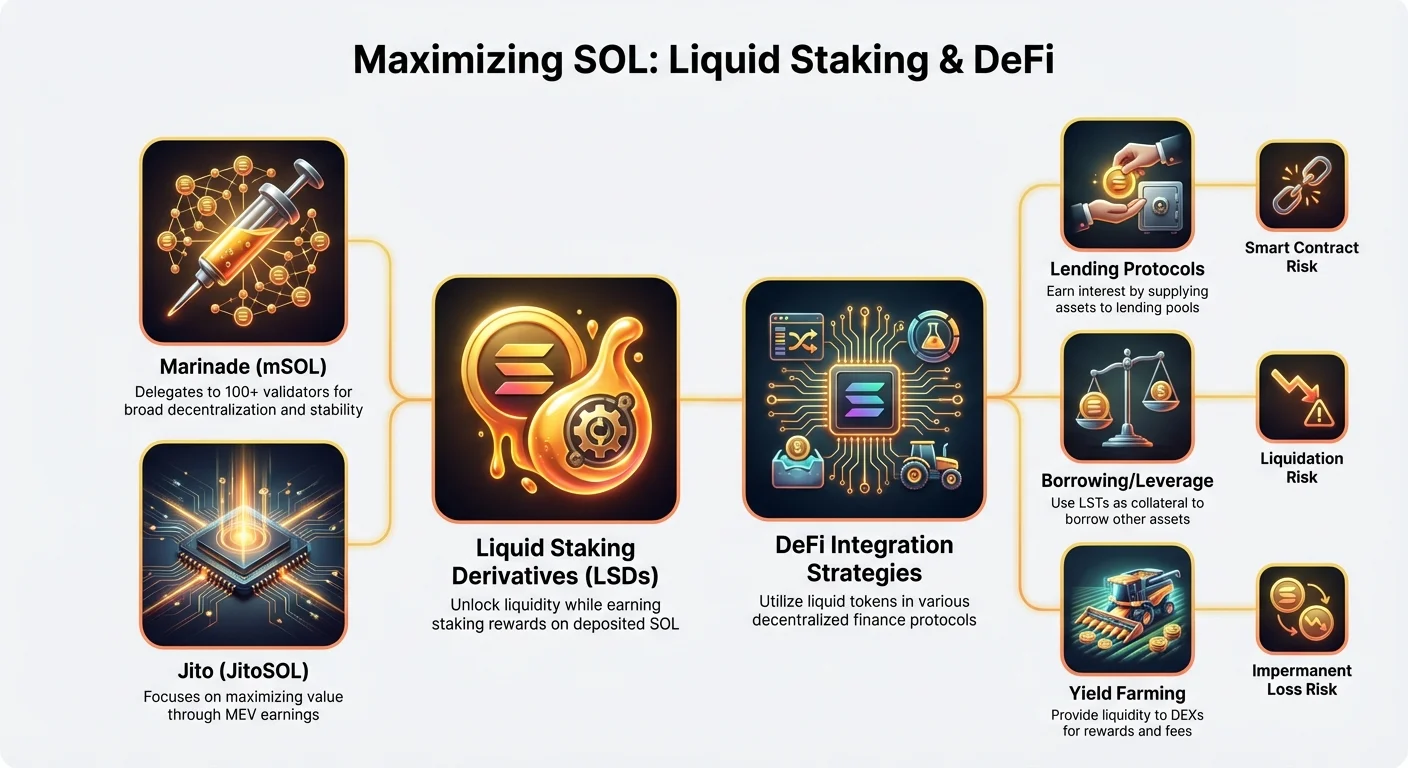
This is where liquid staking derivatives (LSDs) come in—a strategic tool that allows users to earn staking rewards while maintaining liquidity for use in the broader decentralized finance (DeFi) ecosystem.
What is Liquid Staking and Why Use It?
Staking involves delegating your SOL to a validator, which typically locks the assets for a short period. Liquid staking solves the illiquidity problem by issuing a token, known as a derivative, immediately upon staking.
- The Mechanism: When you deposit 1 SOL into a liquid staking protocol, you immediately receive a token like JitoSOL or mSOL. This derivative token represents your staked SOL plus any accrued rewards.
- The Benefit (Double-Dipping): Because the derivative token is liquid, you can use it in other DeFi protocols (like lending or borrowing platforms) while the underlying SOL continues to earn staking rewards. This simultaneous earning potential is what makes liquid staking a powerful optimization strategy.
The Major Providers: Jito and Marinade
The two dominant players in the Solana liquid staking space offer similar services but with slightly different operational models and benefits:
Marinade Finance (mSOL)
Marinade was one of the first and remains the largest liquid staking provider on Solana. It aims for broad decentralization.
- Delegation Strategy: Marinade delegates staked SOL across more than 100 validators using an automated "Marinade Stake Pool." This approach helps spread delegation risk across a diverse set of validators, promoting network health and resilience.
- Benefits: High decentralization and stability.
Jito (JitoSOL)
Jito introduced a unique mechanism focused on maximizing the value captured from Maximal Extractable Value (MEV). MEV refers to the profit validators can make by strategically ordering transactions.
- Delegation Strategy: Jito funnels staked SOL to validators running Jito's specialized software, which aims to distribute MEV earnings back to JitoSOL holders.
- Benefits: Potential for higher annual percentage yield (APY) compared to traditional staking due to the inclusion of MEV rewards.
Strategic Integration with DeFi
For the Solana power user, the strategy is simple: never let assets sit idle. Once you hold a liquid staking token (LST) like JitoSOL or mSOL, you unlock powerful earning potential.
| Strategy | Description | Risk Profile |
|---|---|---|
| Lending | Deposit your LST (e.g., mSOL) into a decentralized lending protocol (e.g., Solend). You earn two layers of yield: staking rewards plus lending interest. | Low to Moderate (Smart contract risk) |
| Borrowing/Leverage | Use the LST as collateral to borrow another asset (like USDC). This can be used to purchase more SOL or LSTs, leveraging your position (high risk, high reward). | High (Liquidation risk) |
| Yield Farming | Pair the LST with another asset (e.g., JitoSOL/USDC) to provide liquidity to a decentralized exchange (DEX). You earn staking rewards, trading fees, and often a governance token incentive. | Moderate to High (Impermanent loss risk) |
Actionable Tip: Always compare the APYs offered by different liquid staking pools and verify that the protocols you use your LSTs on (lending/DEX) have been properly audited. This multi-layered approach to earning is central to the "Optimization" mindset of a Solana utility user.
Spending Power: Solana in the Real World
The true utility of a fast blockchain like Solana is realized when it moves beyond trading and enters the realm of everyday transactions. Solana’s low latency and minimal fees have fostered the development of sophisticated payment tools designed to challenge traditional card networks.
Understanding Solana Pay
Solana Pay is not a wallet or a card; it is an open-source payment protocol—a set of standards that defines how digital currency transactions happen instantly between a consumer and a merchant.
The Protocol’s Advantage
Solana Pay fundamentally cuts out the middlemen—the banks, card networks (Visa/Mastercard), and payment processors—that charge high fees (2-4%) and impose transaction delays (days).
- For the Consumer: Transactions are instant, confirmed in under one second, and cost less than $0.001. The consumer simply scans a QR code generated by the merchant using any Solana-compatible wallet (Phantom, Solflare).
- For the Merchant (Target Keyword: solana pay merchants): Merchants receive funds instantly in their chosen currency (SOL, USDC, or a mix) without worrying about chargebacks or 30-day settlement delays. This drastically reduces operational overhead.
Practical Use Cases and Adoption
While still growing, Solana Pay is being integrated into various platforms globally, making it a viable alternative for payment processing.
- E-commerce Plugins: Platforms are emerging that allow Shopify or WooCommerce stores to accept Solana Pay transactions, automatically converting the received crypto to fiat if desired.
- Point-of-Sale (POS) Integration: Small businesses and brick-and-mortar stores can utilize tablets or phones to generate Solana Pay QR codes for in-person transactions.
- Digital Goods: The low fees make Solana Pay ideal for micropayments, subscriptions, and purchasing in-game assets or NFTs, where a $5 transaction shouldn't incur a $0.50 processing fee.
Solana-Enabled Crypto Cards
Despite the elegance of Solana Pay, the global financial infrastructure still runs primarily on traditional card networks. For consumers who want to spend their SOL and SPL tokens anywhere in the world (coffee shops, gas stations), crypto cards provide the necessary bridge.
Connecting the Digital Wallet to Physical Spending
Many services offer crypto debit cards, often powered by centralized exchanges or fintech companies. For the Solana user, the key is finding cards that support high-speed SOL or USDC (which runs natively on Solana).
- Mechanism: When you use a crypto card (Target Keyword: best solana crypto card), the provider instantly liquidates a tiny portion of your stored crypto (like SOL or USDC) to fiat currency (USD or EUR) at the point of sale.
- Optimization: Look for cards that minimize conversion fees and, crucially, offer generous rewards, such as cashback in crypto or native tokens. These rewards can offset the slight costs associated with liquidation, adding another layer to your utility stack optimization.
Strategic Insight: While a crypto card is necessary for broad acceptance, a true Solana power user prioritizes using Solana Pay whenever possible, as it is cheaper, faster, and truly decentralized.
Advanced Utility: Solana’s Broader Ecosystem Services
The utility stack extends beyond core payments and staking. Solana's speed and low costs have made it a preferred layer for various high-frequency decentralized applications (dApps), creating new avenues for consumer utility.
Decentralized Identity and Data Management
The ability to perform millions of transactions cheaply is key to building complex, high-utility tools like decentralized identity management.
- Self-Sovereign Identity: Projects on Solana are building tools that allow users to own and control their digital identity credentials and data (known as Self-Sovereign Identity, or SSI). Instead of tech giants holding your information, your wallet holds the proof of your identity, which you can selectively share.
- Data Timestamping: Businesses can use Solana to cheaply timestamp and record sensitive data or supply chain events, guaranteeing immutability without the high costs of older blockchains. For the consumer, this translates to verified, trustworthy product information.
Low-Fee Gaming and NFT Utility
For many users, their first interaction with Solana is through non-fungible tokens (NFTs) or blockchain games. Solana’s low transaction fees make these experiences viable in a way that is impossible on high-fee networks.
- In-Game Transactions: In traditional gaming, every micro-transaction (buying a skin, trading an item) is processed through a centralized server. On Solana, players can trade assets instantly on-chain without the fees eating into their small purchases. This enables a true digital economy within the game.
- High-Frequency Trading: Solana’s speed makes it the natural home for professional decentralized finance (DeFi) trading platforms and derivatives exchanges that require instantaneous order books, rivaling traditional stock exchanges. While this is primarily an advanced institutional utility, it underpins the liquidity and market efficiency available to all Solana users.
Optimization Tips for Solana Power Users
To fully exploit the potential of the Solana utility stack, integrating these tools requires technical know-how.
Tip 1: Understanding Priority Fees
While Solana fees are incredibly cheap, during periods of extreme network congestion, transactions can fail or be delayed. Solana implemented "Priority Fees" (a small, optional tip to the validator) to ensure your transaction is processed quickly.
- Strategy: When interacting with popular NFT mints or during major market events, manually setting a small priority fee in your wallet ensures time-sensitive transactions are confirmed instantly, giving you a competitive edge.
Tip 2: Managing Token Accounts
Solana requires a minimum balance of SOL (called the "rent exemption") for every token account you own (e.g., holding USDC, NFTs, or an LST). While small, these add up.
- Strategy: If you are finished using a specific token (e.g., you sold all of your rare NFT collection), close the corresponding token account within your wallet. This instantly returns the locked "rent" amount of SOL back into your main wallet balance, slightly optimizing your capital usage.
Tip 3: Cross-Chain Connectivity
A power user recognizes that crypto is a multi-chain world. Many Solana wallets and services now integrate cross-chain bridges (like Wormhole or Jupiter’s routing tools) that allow you to move stablecoins and other assets between Solana and networks like Ethereum or Polygon.
- Strategy: Learn how to bridge efficiently. Sometimes, the cheapest place to acquire USDC or another asset is on a different chain, which can then be brought to Solana’s high-speed ecosystem for spending or trading at a lower overall cost.
Conclusion
The Solana Utility Stack is a cohesive set of tools designed for speed, efficiency, and maximization of capital. By moving beyond simply holding SOL, and strategically integrating high-performance wallets like Phantom and Solflare with powerful derivative tools like JitoSOL and mSOL, users unlock superior passive income.
Furthermore, by understanding and utilizing Solana Pay, you can access a payment rail that is faster and cheaper than existing card networks, seamlessly integrating decentralized finance into daily commerce. For the crypto novice, mastering this stack provides a robust entry point into high-speed Web3 utility. For the experienced user, it offers the ultimate blueprint for capitalizing on one of the most performance-focused blockchains in the industry. The future of consumer finance demands speed, and the Solana utility stack delivers the foundational tools to take full advantage.