
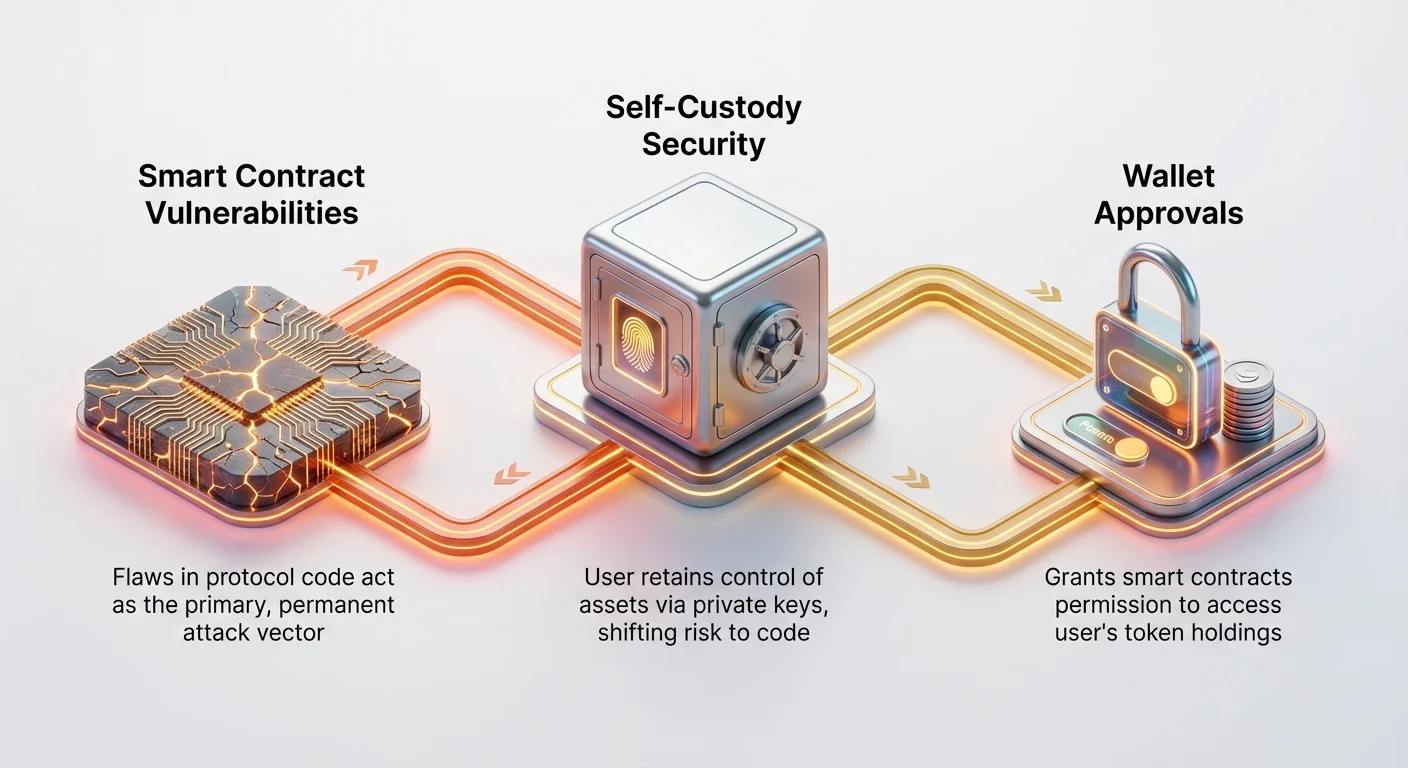
When you engage with decentralized finance (DeFi) and use a Decentralized Exchange (DEX), you are stepping into a revolutionary ecosystem where you, and only you, retain control of your assets. Unlike centralized exchanges (CEXs), where the company holds your private keys, DEXs operate entirely through self-executing contracts on a blockchain. This self-custody model is the core promise of DeFi, but it fundamentally shifts the burden of security.
For new users, understanding DEX security goes far beyond simply safeguarding a private key. It requires an appreciation for the underlying code—the smart contracts—that manage billions of dollars in assets. If that code has a flaw, there is no central authority to call for a refund; the exploit is permanent and instantaneous.
This comprehensive guide is designed to navigate the complexities of DEX security. We will explore the critical smart contract vulnerabilities that have led to major DeFi losses, explain the rigorous processes platforms use (or should use) to audit their code, and look ahead to the next generation of trading architecture—Intent-Based Trading—which promises to make decentralized trading safer, cheaper, and more efficient for everyone.
The Core Security Difference: Why DEX Risk is Unique
Before diving into code vulnerabilities, it is crucial to understand why decentralized security differs so drastically from traditional finance or centralized crypto trading.
1. Self-Custody vs. Custodial Risk
In a centralized exchange (CEX), the primary risk is custodial. You deposit funds, and the CEX holds the private keys on your behalf. If the CEX’s servers are hacked, or if the company goes bankrupt, your funds are at risk.
On a DEX, the risk is non-custodial. Your funds always remain in your wallet, managed by your private key, until you interact with a smart contract. The risk shifts from "Will the company be hacked?" to "Is the smart contract code flawless?" If the code contains a bug or loophole, assets can be exploited directly from the contract's pool, regardless of how securely you safeguard your own wallet.
2. Understanding Wallet Approvals (Token Allowances)
One of the most common user security pitfalls involves wallet permissions, or token allowances. When you use a DEX for the first time, you must grant the DEX’s smart contract permission to access a specific amount of your tokens (e.g., 100 USDT) to facilitate a trade. This permission is called a token allowance.
The Risk: Many users grant "unlimited" allowances for convenience. If you grant unlimited approval to a faulty or exploited smart contract, an attacker who gains control of that contract could potentially drain all of that token type from your wallet, not just the amount needed for the single trade.
Best Practice: Always review and approve the minimum required token allowance, or use tools available in your wallet to periodically revoke unnecessary or "unlimited" permissions granted to old or unused smart contracts.
Smart Contract Vulnerabilities: Common DEX Exploits Explained
Smart contracts are the backbone of any DEX, acting as automated treasurers and traders. While ingenious, these contracts are written code, and code is susceptible to human error and deliberate exploitation.
Understanding these exploit types is essential, as it highlights the necessity of thorough auditing and careful protocol selection.
1. Re-entrancy Attacks: The Recursive Thief
The re-entrancy attack is perhaps the most infamous type of smart contract exploit, popularized by the 2016 DAO hack on Ethereum.
How Re-entrancy Works
Imagine a smart contract that manages deposits and withdrawals. A simple withdrawal process looks like this:
- Check the user's balance.
- Send the requested funds to the user.
- Update (zero out) the user's balance in the contract ledger.
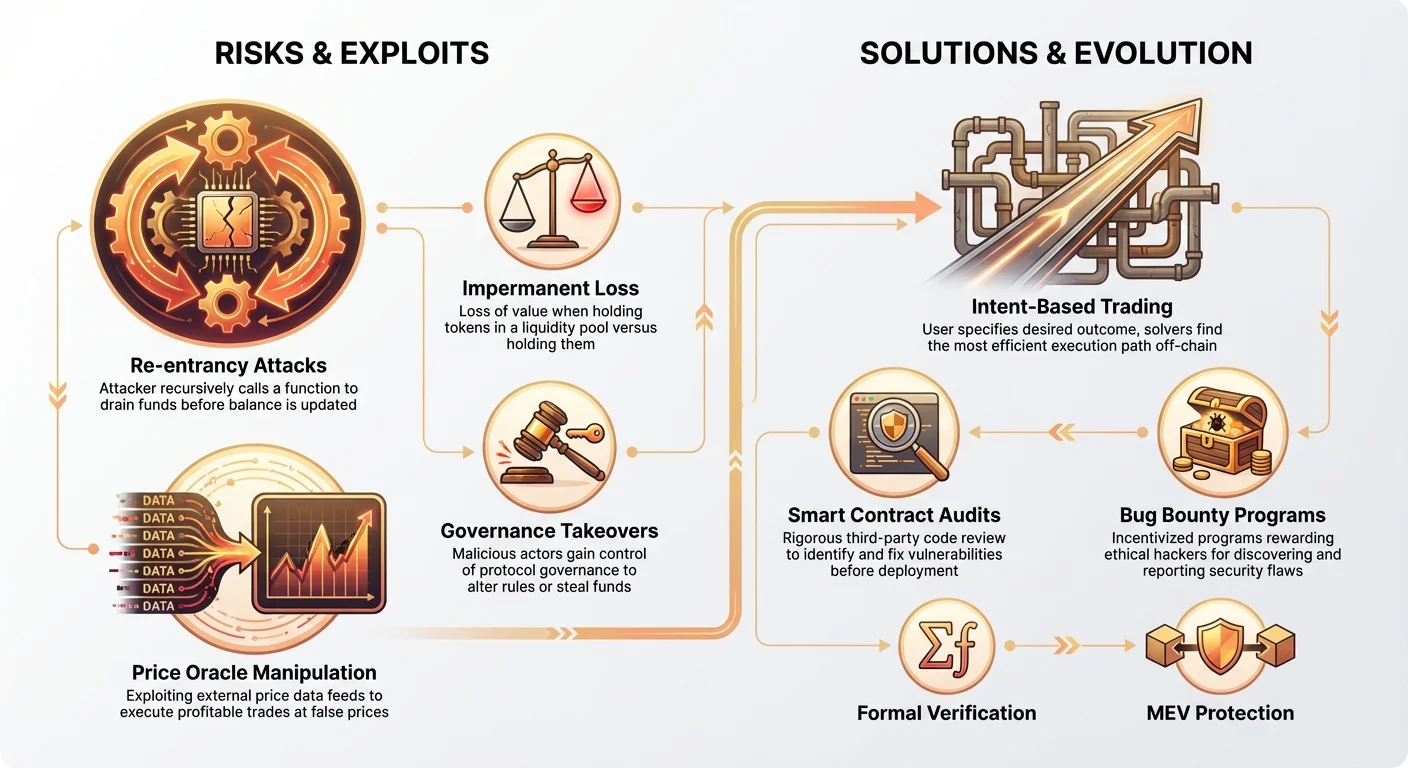
In a re-entrancy attack, the attacker manipulates Step 2. If the smart contract sends funds before it updates the ledger (Step 3), the attacker can deploy a malicious contract designed to immediately call the victim contract’s withdrawal function again during the brief window when the ledger thinks the balance is still full. The contract repeats the process recursively, draining the pool before the initial transaction ever reaches Step 3.
Mitigation: Modern smart contracts prevent this by strictly enforcing the "Checks-Effects-Interactions" pattern: all ledger updates (Effects) must happen before any external fund transfers (Interactions).
2. Price Oracle Manipulation
DEXs rely on timely and accurate data, especially token prices, to determine the exchange rate for swaps or to liquidate leveraged positions. This external data is fed into the blockchain via tools called price oracles.
The Flash Loan Vector
Price oracle manipulation attacks often utilize flash loans, which are loans that must be borrowed and repaid within a single block transaction. Flash loans allow an attacker to instantly obtain a massive amount of capital without any collateral.
The Exploit Scenario:
- Borrow: The attacker takes out a huge flash loan (e.g., $10 million in Token A).
- Manipulate: They use that $10 million to execute massive, rapid trades on a low-liquidity spot DEX, temporarily spiking the price of Token B relative to Token A within that specific DEX’s pool.
- Exploit: They then execute a separate profitable operation (e.g., buying a large amount of Token B cheaply or liquidating another user’s loan) based on the artificially inflated price reported by the manipulated oracle.
- Repay: The attacker repays the flash loan, having made a massive profit from the intermediate, exploited step.
Mitigation: Reputable DeFi protocols no longer rely on single-source, vulnerable price feeds. They use decentralized and aggregated oracles (like Chainlink) that draw data from multiple independent sources, making short-term manipulation impossibly expensive.
3. Economic and Governance Risks
Not all exploits involve code bugs. Some leverage the logic or structure of the protocol itself.
Impermanent Loss and Liquidity Pools
Liquidity Providers (LPs) deposit pairs of tokens into an Automated Market Maker (AMM) pool to facilitate trading. They earn fees, but they also risk impermanent loss (IL). IL occurs when the price ratio of the deposited assets shifts after the deposit. If one token’s price skyrockets, the AMM automatically sells the rising asset for the stable asset to maintain the 50/50 balance. When the LP withdraws their capital, they may find they would have had more value simply holding the assets outside the pool.
While not an "exploit," IL is an intrinsic economic risk LPs must account for, and poorly structured AMM mechanics (e.g., specific curve functions) can exacerbate it.
Governance Takeovers (Rug Pulls)
A rug pull occurs when the project developers retain "admin keys" or sufficient voting power through a centralized governance structure to unilaterally change the smart contract rules. They can use this power to:
- Drain the entire liquidity pool (a direct exit scam).
- Change the fee structure entirely for their benefit.
Mitigation: Look for protocols that have fully relinquished administrative control and utilize robust, decentralized governance mechanisms, ensuring no single entity can execute arbitrary changes.
Security Mitigation: The Role of Audits and Standards
For a new DEX user, how can you gauge the safety of a platform? The answer lies in transparency, formal auditing, and ongoing bug detection programs.
1. Smart Contract Audits: The Technical Vetting Process
A smart contract audit is a rigorous, third-party examination of a protocol's code base aimed at finding vulnerabilities before the contracts are deployed live on the blockchain.
Audit Standards and Requirements
A credible audit typically involves:
- Manual Code Review: Experienced auditors read every line of code, checking for known patterns of weakness (like re-entrancy vectors).
- Automated Tooling: Using specialized software to scan for common errors, potential overflows, and inefficient gas usage.
- Economic Logic Review: Testing how the contract handles edge cases related to price feeds, fee collection, and liquidity calculation to ensure economic stability.
- Final Report: A public report detailing all found vulnerabilities (critical, major, minor), the team’s response, and confirmation that fixes have been implemented.
Actionable Tip: Always check a DEX’s documentation for their audit history. Reputable protocols are audited by highly respected security firms (e.g., Certik, ConsenSys Diligence) and make their reports public. If a project has no publicly verifiable audit, it should be considered high-risk.
2. Going Beyond Audits: Bug Bounties and Formal Verification
While an audit is a snapshot in time, maintaining security requires continuous effort.
Bug Bounty Programs
Many established DEXs run continuous bug bounty programs. These programs offer substantial financial rewards (often thousands to millions of dollars) to white-hat hackers or security researchers who ethically discover and responsibly disclose vulnerabilities. A robust bounty program incentivizes security experts to help the platform rather than exploit it.
Formal Verification
Formal verification represents the highest standard of security assurance. This process uses mathematical methods to prove, with certainty, that a smart contract behaves exactly as intended under all possible conditions. While complex and time-consuming, protocols handling the largest pools of capital often employ formal verification to guarantee the integrity of their most critical functions.
3. The Evolving Regulatory Landscape for DEXs
As DEX usage explodes, global regulatory bodies are struggling to fit these decentralized entities into existing financial frameworks. This evolving landscape has critical implications for security and user protection.
The Problem of Jurisdiction
Who is responsible when a DEX fails?
- The Code: The contract itself is immutable once deployed.
- The Developers: They may have launched the code and then disappeared.
- The Front-End Interface: The website users interact with is often controlled by a centralized entity, even if the trading occurs on-chain.
- Liquidity Providers: They are simply users providing capital.
Regulators, particularly in the US and Europe, are increasingly focusing on the entities that control the front-end user experience and the initial launch team. As regulation matures, it will likely mandate higher standards for smart contract auditing, KYC/AML checks on liquidity providers, and clearer liability frameworks, potentially leading to safer platforms for retail users.
The Next Evolution: Intent-Based Trading Architecture
The current standard for DEX interaction, based on Automated Market Makers (AMM), requires users to specify exactly how a trade should be executed (e.g., "swap Token A for Token B through this specific liquidity pool"). This imperative approach leads to inefficiency and exposes users to market exploitation.
A significant shift is now underway toward Intent-Based Trading, a paradigm that drastically simplifies the user experience while radically improving security and execution quality.
1. The Problems Intents Seek to Solve
Traditional DEX swaps face two major issues that Intents are designed to fix:
A. Maximal Extractable Value (MEV)
MEV refers to the profit miners (or validators) and specialized bots can make by observing the transaction queue (the mempool) and strategically inserting, reordering, or censoring users’ transactions.
- Front-Running: A bot sees a large buy order for Token X, quickly executes its own buy order just before the user's transaction, waits for the user's transaction to drive up the price, and then immediately sells for a small, guaranteed profit. This increases slippage and cost for the original user.
- Sandwich Attacks: Bots sandwich a large trade between two smaller, manipulated trades, costing the user valuable funds.
B. Execution Complexity and Failed Transactions
Complex swaps—especially those needing to route through multiple liquidity pools across different chains—can be difficult for a user’s wallet to correctly calculate, often resulting in failed transactions and wasted gas fees.
2. Defining Intent-Based Trading
In an Intent-Based system, the user does not specify how the trade happens; they only specify the desired outcome.
Traditional Swap (Imperative): "I want to sell 1 ETH using Uniswap V3, routed through the DAI pool, to get at least 1,750 USDC."
Intent (Declarative): "I want to receive at least 1,750 USDC for my 1 ETH."
The intent is then passed off-chain to a network of specialized actors called Solvers.
3. How Intent Solvers Work
Solvers are professional, specialized participants (often sophisticated trading firms) who compete to fulfill the user’s intent in the most efficient and least costly way possible.
The process flows as follows:
- User Broadcasts Intent: The user signs a cryptographically verifiable message stating their desired outcome (e.g., 1 ETH for 1,750 USDC) and submits it to the network.
- Solvers Compete: Solvers analyze the intent. They run complex algorithms to determine the best execution route: checking various DEXs, CEXs, aggregators, and even finding private counterparties.
- Best Solution Selected: The Solver who proposes the solution offering the best price and execution conditions for the user wins the right to execute the trade.
- Execution: The winning Solver executes the trade entirely on-chain, often paying the gas fees themselves, and sends the final tokens directly to the user's wallet.
4. Intent Architecture and Enhanced Security
Intent-based systems significantly boost user security:
- MEV Protection: Because the trade execution is handled off-chain by private solvers, the trade details are not immediately exposed in the public mempool before execution. This eliminates the opportunity for front-running and sandwich attacks.
- Reduced Transaction Risk: The user only signs the high-level intent, not the complex series of on-chain operations. Since the Solver handles the execution, they bear the risk of gas inefficiency or transaction failure. The user only pays when the guaranteed outcome is achieved.
- Improved Pricing: The competitive nature of Solvers ensures the user always gets the optimal price possible across the entire ecosystem, not just within a single DEX pool.
Protocols like CowSwap and the emerging infrastructure used by UniswapX are pioneering this intent-based structure, signaling a major move toward creating a true marketplace for liquidity where security and efficiency are handled by specialized professionals.
Conclusion: Securing Your Future in Decentralized Finance
Navigating the world of decentralized exchanges offers unparalleled freedom, but it demands an active and educated approach to security. The self-custody nature of DEXs means the user must trust the code—the smart contracts—more than they trust any central entity.
For users, diligence remains paramount: understanding wallet permissions, seeking out protocols with robust and public audit histories, and recognizing the intrinsic risks like impermanent loss are foundational steps.
For the industry, the ongoing evolution toward Intent-Based Trading represents a crucial step forward. By outsourcing the complexity of execution to professional solvers and shielding users from malicious practices like MEV, decentralized finance is moving toward a more secure, efficient, and user-friendly experience that fulfills the promise of truly permissionless global finance. As these new architectures mature, the security vulnerabilities that plague existing DEX models will gradually diminish, creating a more stable foundation for the future of crypto trading.