
The landscape of digital asset ownership has shifted dramatically from simple buy-and-hold strategies to active capital utilization. In the early days of cryptocurrency, holding assets in a secure wallet was the primary method of investment. Today, the ecosystem offers diverse methods to put idle digital capital to work. Two primary approaches have emerged as the dominant methods for earning returns: network staking and active yield generation through decentralized finance (DeFi).
These two strategies represent different layers of the blockchain technology stack. Staking operates at the infrastructure level, providing the fundamental security and consensus that allows the network to exist. In contrast, yield generation strategies typically operate at the application level, facilitating financial services like trading and lending. Choosing between these paths requires a clear understanding of the technical mechanics involved.
Investors must weigh the trade-offs between passive security contributions and active market participation. While staking is often viewed as the digital equivalent of a savings bond, DeFi yield generation functions more like providing liquidity to a bustling marketplace. Both offer rewards, yet they carry distinct risk profiles and technical requirements. Understanding the nuances of each is essential for anyone looking to optimize their digital asset portfolio.
The Foundation of Network Security: Cryptocurrency Staking
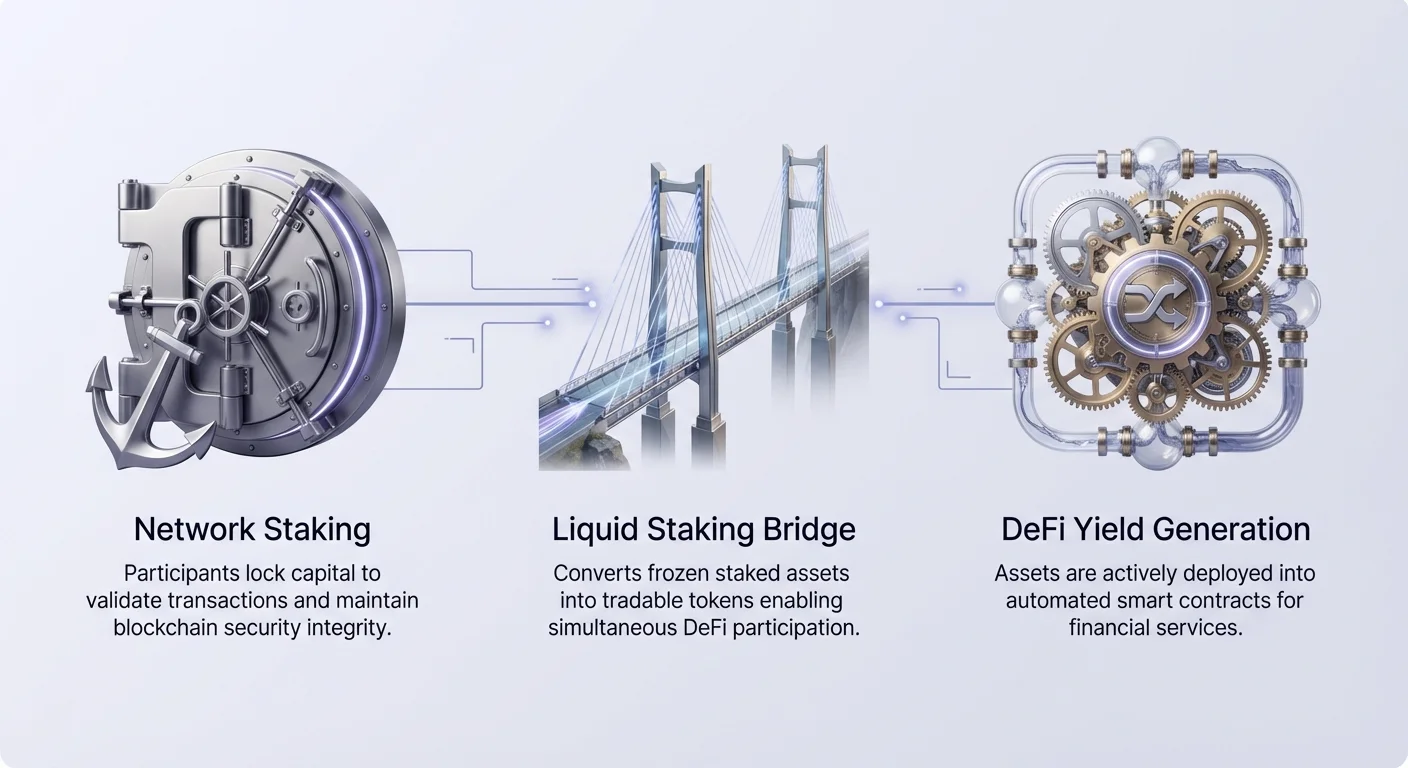
Staking is fundamentally a mechanism for consensus and security in Proof of Stake (PoS) blockchains. Unlike early cryptocurrencies that relied on energy-intensive mining, modern networks often use financial commitment to validate transactions. When a user stakes their cryptocurrency, they are locking up capital to guarantee the honesty of the network's ledger.
The Evolution from Mining to Staking
The history of blockchain consensus began with Proof of Work (PoW). In this system, miners competed to solve complex mathematical puzzles to validate blocks. While secure, this method faced significant challenges regarding energy consumption and scalability. It required massive hardware investments and electricity usage, limiting who could participate in network maintenance.
Proof of Stake emerged as an energy-efficient alternative. First proposed in 2011 and implemented by Peercoin in 2012, PoS replaced physical mining rigs with virtual capital. In this model, the right to validate transactions is determined by the number of coins held and locked in the system. This shift democratized network security, allowing anyone with capital to participate without running an industrial server farm.
Major networks like Ethereum have since transitioned to this model, solidifying staking as a core pillar of the crypto industry. This transition highlighted a move toward sustainable security models that do not require immense electrical output. It also aligned the incentives of the network verifiers with the health of the asset itself.
How Staking Generates Rewards
The economic model of staking is often compared to a bank paying interest on deposits. However, the source of the yield is technically different. Banks lend deposits to generate interest. In crypto staking, rewards are programmed into the protocol itself. They serve as an incentive for users to lock away their liquidity.
When a participant locks their coins, the network uses that stake to vouch for the validity of new blocks. If the node performs its duties correctly, the protocol issues new coins or distributes transaction fees to the staker. This payment is the "yield" received by the asset holder. It is compensation for the opportunity cost of locking capital and the service of securing the blockchain.
The rate of these rewards varies based on network activity and the total amount of capital staked. If fewer people stake, the protocol often raises the reward rate to attract more security. Conversely, as more capital floods in to secure the network, the individual yield may dilute. This dynamic self-regulates the security budget of the blockchain.
Validators and Delegation
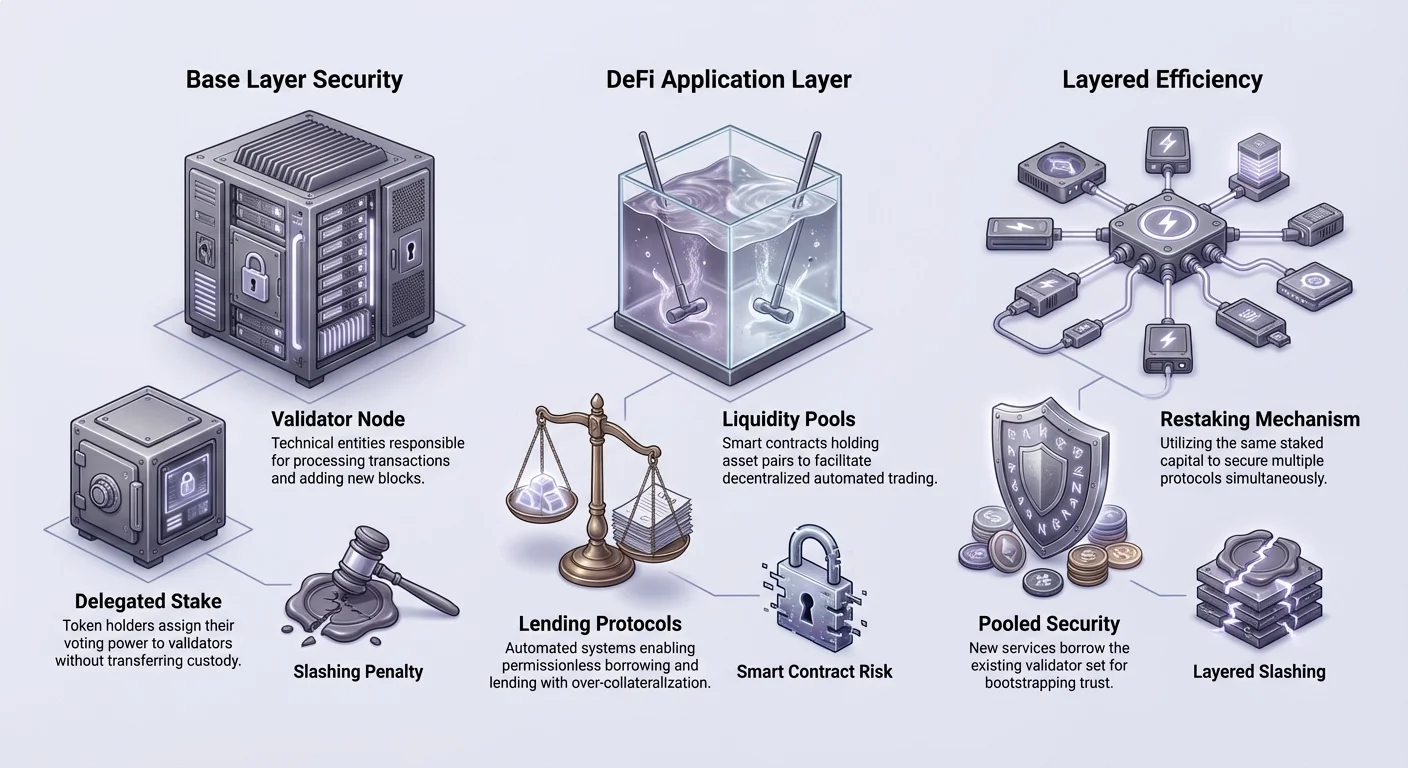
Participating in staking can take two primary forms: running a validator node or delegating stake. Running a validator is the "native" method. It requires technical expertise, reliable hardware, and 24/7 internet connectivity. Validators are directly responsible for processing transactions and adding blocks to the chain.
For most users, delegation is the more accessible path. Delegation allows a token holder to assign their staking power to a professional validator without transferring custody of their assets. The validator performs the technical work and charges a small fee from the rewards generated. The remaining yield is passed back to the delegator.
This system allows for broad participation in network security. However, it introduces a need for due diligence. Delegators must choose reliable validators. If a validator goes offline or acts maliciously, the protocol may penalize the stake through a process called slashing. This underscores that staking is not risk-free; it requires active selection of trustworthy partners.
Active Yield Generation Through Decentralized Finance
While staking secures the blockchain, decentralized finance (DeFi) builds financial applications on top of it. Active yield generation involves deploying assets into smart contracts to facilitate services like trading or lending. This approach moves beyond the passive role of a validator and steps into the shoes of a market maker or banker.
Automated Market Making and Liquidity Provision
One of the most prominent innovations in DeFi is the Decentralized Exchange (DEX). Unlike centralized exchanges that rely on order books and intermediaries, DEXs use a model called Automated Market Making (AMM). This system relies on pools of tokens provided by users to facilitate trades.
In this model, a user deposits a pair of assets, such as ETH and a stablecoin, into a smart contract. This pool of funds allows other traders to swap one asset for the other instantaneously. In return for providing this liquidity, the depositor earns a portion of the trading fees generated by the platform.
This process creates "crowd-sourced" liquidity. It eliminates the need for large institutional market makers to facilitate trading. Anyone with a wallet can become a liquidity provider. However, this activity carries specific risks, such as impermanent loss, where the value of holding the tokens in a pool becomes less than simply holding them in a wallet due to price divergence.
Smart Contract Lending and Borrowing
DeFi lending protocols have revolutionized how debt markets function. In the traditional world, obtaining a loan requires credit checks and bank approval. In DeFi, the process is permissionless and automated via smart contracts. Users can deposit their crypto assets into a pool to be lent out to borrowers.
These loans are typically over-collateralized to manage risk. For example, a borrower might need to deposit $200 worth of Ethereum to borrow $100 worth of stablecoins. This ensures that if the borrower defaults or the value of the collateral drops, the lenders can be repaid through liquidation. The smart contract handles this logic automatically without human intervention.
Lenders in this system earn interest paid by the borrowers. The rates are dynamic, adjusting in real-time based on supply and demand. If demand for loans is high, interest rates rise to attract more capital. This transparent and automated system creates a high-yield savings account alternative, though with significantly higher volatility and technical risk than a traditional bank.
Bridging the Divide: Liquid Staking Protocols
A significant innovation has emerged to bridge the gap between the security of staking and the utility of DeFi. Known as liquid staking, this mechanism attempts to solve the primary drawback of traditional staking: illiquidity. When assets are locked in a PoS consensus mechanism, they typically cannot be used for anything else.
Solving the Liquidity Dilemma
In a standard staking setup, once a user delegates their tokens, those funds are frozen. They cannot be traded, used as collateral, or sold until an unstaking period passes. This lock-up period can range from days to weeks, depending on the specific blockchain. During this time, the user is exposed to market volatility without the ability to exit their position.
Liquid staking protocols address this inefficiency. When a user stakes through a liquid staking provider, the protocol issues a "receipt token" or Liquid Staking Token (LST). This token represents the user's claim on the underlying staked assets and the rewards they are accruing.
Crucially, this receipt token is fully transferable. A user can stake their ETH, receive a token like stETH, and then hold that token in their wallet. The underlying ETH continues to secure the network and earn rewards, but the user retains a liquid asset that tracks the value of the original deposit.
The Mechanics of Liquid Staking Tokens (LSTs)
The utility of LSTs extends beyond simple holding. Because these tokens are standard assets on the blockchain, they can be integrated into DeFi applications. A user can take their liquid staking token and deposit it into a lending protocol as collateral. Alternatively, they could provide liquidity in a DEX using the LST.
This creates a layered earning potential. The user earns the base staking yield from the network consensus layer. Simultaneously, they can earn yield from DeFi activities using the liquid token representation. This capital efficiency makes liquid staking a powerful tool for maximizing returns.
However, it introduces smart contract risk. The user is no longer just trusting the blockchain protocol; they are also trusting the code of the liquid staking provider. If the smart contract governing the LST has a bug, the claim to the underlying staked assets could be compromised.
The Frontier of Yield: Restaking Mechanics
Restaking is a newer concept that pushes the idea of capital efficiency even further. It allows validators to utilize their staked cryptocurrency across multiple protocols simultaneously. This mechanism aims to extend the security of a major blockchain, like Ethereum, to other smaller applications or services.
Extending Security to New Services
The core idea of restaking is "pooled security." New decentralized applications, such as blockchain bridges, oracle networks, or data availability layers, typically need to bootstrap their own set of validators. This is difficult and expensive. Restaking allows these services to "borrow" the security of an existing validator set.
Validators on the main network can opt-in to secure these additional services using the same staked capital. By doing so, they commit to an additional set of rules and conditions. In exchange for taking on this extra responsibility, they receive additional rewards from the services they are securing.
This creates a marketplace for decentralized trust. A single unit of capital can effectively do double or triple duty, securing the base layer chain while simultaneously validating data for an oracle service. This greatly increases the potential revenue for a staker without requiring additional capital injection.
The Risk and Reward Profile of Restaking
While restaking amplifies yield, it also compounds risk. The primary risk in staking is slashing—a penalty for validator misbehavior. In a restaking scenario, the validator is subject to slashing conditions from multiple protocols. If a validator fails to meet the requirements of a specific oracle service they opted to secure, they could lose a portion of their principal stake.
This introduces complex interdependencies. A technical failure in a secondary protocol could trigger a loss of funds on the main layer. Additionally, there is a concern regarding centralization. If restaking offers significantly higher yields, it naturally attracts more capital. This could lead to a concentration of stake among a few large operators who have the technical capacity to manage complex restaking configurations.
Investors participating in restaking must assess whether the incremental yield justifies the multiplied slashing risk. It transforms a relatively simple security role into a complex portfolio of technical responsibilities.
Navigating Risks in Yield Strategies
Regardless of whether one chooses staking, active DeFi participation, or restaking, the risk landscape is distinct from traditional finance. The phrase "not your keys, not your crypto" applies, but in DeFi, even holding the keys does not mitigate all dangers. Risks here are often programmatic and systemic.
Technical and Smart Contract Vulnerabilities
The foundation of all these strategies is code. Smart contracts are deterministic programs that execute rules without human oversight. While this eliminates bias, it means that errors are permanent. A bug in a lending protocol or a liquid staking contract can be exploited by hackers to drain funds.
Source code audits by security firms are the standard defense against this. However, audits do not guarantee safety; they only reduce the probability of oversight. Even audited "blue chip" DeFi protocols have faced exploits. The complexity of the code often correlates with risk. A simple staking contract is generally safer than a complex yield-farming strategy involving multiple automated steps.
Phishing presents another technical vector. Malicious websites often mimic legitimate DeFi applications. If a user connects their wallet to a fake site, they may inadvertently sign a transaction that grants the attacker permission to withdraw their funds. Verifying URLs and checking for security certificates are critical user habits.
Systemic and Market Risks
Beyond code bugs, there are economic risks. Volatility is inherent to crypto assets. In lending protocols, if the value of collateral drops rapidly, the smart contract will liquidate the position to protect the lender. This can happen faster than a user can react, resulting in total loss of the collateralized asset.
"Rug pulls" are a specific type of fraud prevalent in the DeFi space. In this scenario, developers create a project, attract liquidity with promises of high yields, and then maliciously remove the liquidity or sell their insider tokens, causing the price to crash to zero. This highlights the importance of researching the team and the distribution of tokens.
Below is a comparison of the primary risks associated with each strategy:
| Risk Factor | Direct Staking | DeFi Yield / Lending | Restaking |
|---|---|---|---|
| Slashing | Yes (Protocol penalty) | No | Yes (Multiple layers) |
| Smart Contract Bug | Low (Protocol level) | High (App level) | Very High (Multi-app) |
| Impermanent Loss | No | Yes (Liquidity pools) | No |
| Liquidity Lock-up | Yes (Unbonding period) | Varies (Usually liquid) | Yes (Complex unbonding) |
Strategic Allocation: Choosing Your Path
Selecting the right strategy depends heavily on an investor's technical comfort and time horizon. There is no one-size-fits-all solution, as the spectrum ranges from "set and forget" to "active daily management."
For the risk-averse participant, native staking or delegation remains the gold standard. It offers the most direct alignment with the blockchain's success. The risks are primarily limited to the protocol's survival and the validator's performance. This path is ideal for long-term holders who wish to accumulate more of the base asset without exposing themselves to smart contract exploits found in complex DApps.
Active DeFi yield generation is better suited for those who treat their portfolio as a business. Providing liquidity or lending requires monitoring market rates, assessing collateral ratios, and watching for smart contract upgrades. The potential returns are often higher than staking, but they require active management to mitigate impermanent loss and liquidation risks.
Liquid staking and restaking offer a middle ground but require a nuanced understanding of layered risk. They are best for users who want to maximize capital efficiency and are comfortable with the idea that their assets are securing multiple layers of the technology stack.
Self-custody remains the common thread across all these options. Using a non-custodial wallet ensures that the user interacts directly with the blockchain. This eliminates counterparty risk associated with centralized exchanges, which can go bankrupt or freeze withdrawals. Whether staking or farming yield, retaining control of private keys is the prerequisite for true participation in decentralized finance.
Conclusion
The choice between passive staking and active yield generation defines the modern crypto investor's journey. Staking offers a stable, security-focused baseline, allowing users to earn rewards by maintaining the integrity of the network. It is the bedrock of the Proof of Stake economy, prioritizing asset preservation and steady accumulation over aggressive growth.
Conversely, the world of DeFi and restaking opens doors to higher potential returns through financial utility and risk layering. These strategies transform idle assets into productive capital, facilitating trade and lending across the ecosystem. However, this increased utility comes with the burden of smart contract risks, economic volatility, and the need for constant vigilance.
Ultimately, the most effective strategy often involves a blend of these approaches. By understanding the technical mechanics and risk profiles of each, investors can construct a balanced portfolio that secures the network while capturing the upside of decentralized financial markets.
True financial sovereignty requires not just holding assets, but understanding the technical mechanisms that secure and grow them.