
The decentralized finance (DeFi) ecosystem has evolved far beyond simple token swaps and static staking. While initial yield farming offered high but volatile returns, professional users and capital allocators quickly realized that basic strategies were inherently speculative due to price volatility.
True self-sovereignty in finance requires not just access to tools, but the sophisticated understanding necessary to manage risk. For those focused on capital preservation and maximizing risk-adjusted returns, the goal shifts from achieving the highest possible Annual Percentage Yield (APY) to achieving the highest sustainable yield with minimal market exposure.
This guide moves beyond the basics of providing liquidity and staking. We will delve into advanced strategies specifically designed to neutralize price volatility risks—primarily Impermanent Loss (IL)—by employing techniques derived from traditional finance, such as hedging with derivatives. The focus here is on transforming volatile DeFi yields into predictable, stable income streams.
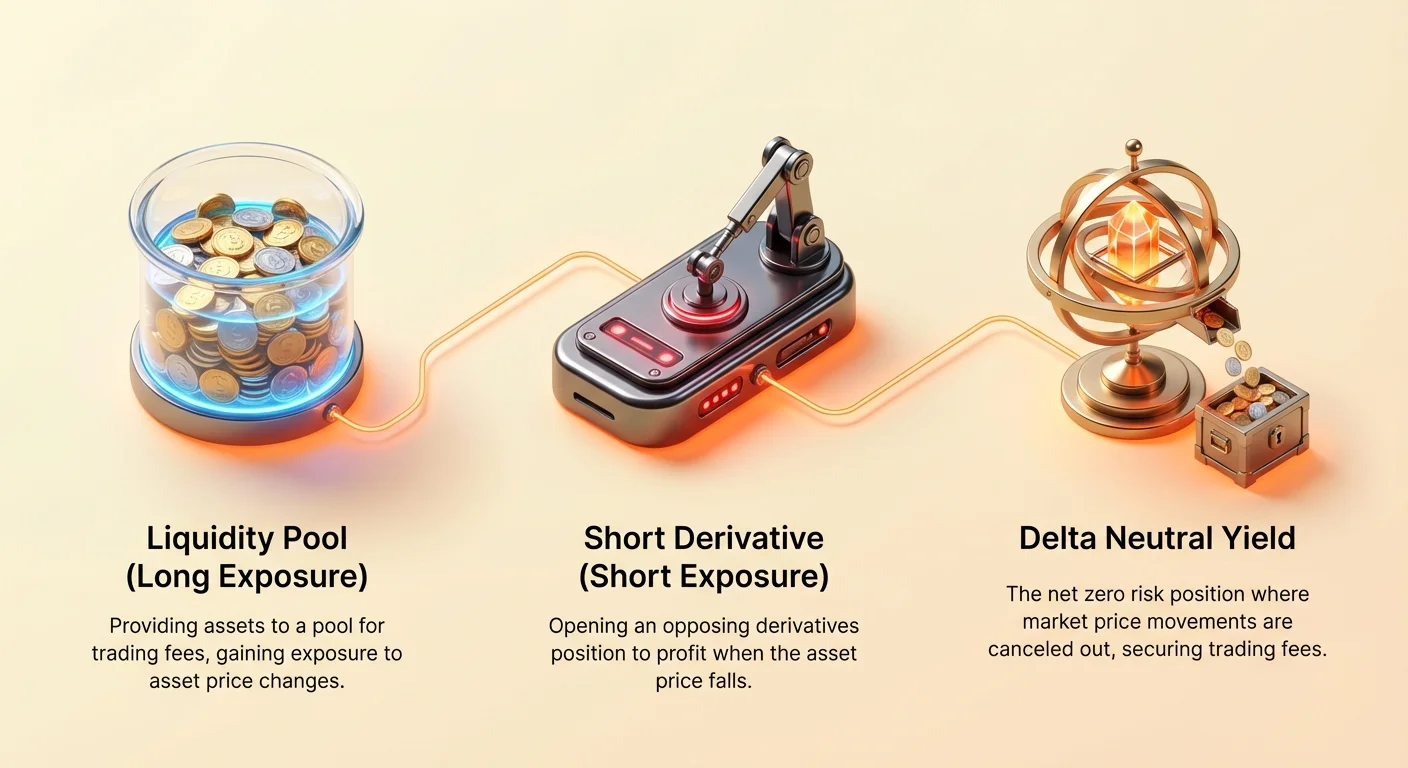
The Primary Barrier: Understanding and Mitigating Impermanent Loss (IL)
Impermanent Loss (IL) is the single greatest risk to liquidity providers (LPs) who are not actively managing their positions. Before implementing any advanced yield strategy, it is crucial to fully grasp how IL erodes capital and how initial defenses can be established.
The Mechanics of Impermanent Loss
Impermanent Loss occurs when the price ratio of assets held within a liquidity pool (LP) deviates from the ratio at the time of deposit. Since automated market makers (AMMs) maintain a constant product (X * Y = K), the pool automatically sells the asset that is increasing in price and buys the asset that is decreasing in price to maintain balance.
In simple terms: If you deposit 1 ETH and 2,000 USDC into a pool, and the price of ETH doubles, the AMM protocol ensures that your position still holds $4,000 worth of assets. However, because the pool forced you to sell some ETH as the price rose, you now hold less ETH and more USDC than if you had simply held the initial 1 ETH and 2,000 USDC in your own wallet. The difference in value between simply holding the assets versus providing liquidity is the Impermanent Loss.
Mitigation through Stable Pools and Flexible Ratios
The simplest way to reduce IL exposure is to choose pools where asset divergence is minimal or mathematically limited:
- Stablecoin Pools (Near-Zero IL): Pools consisting entirely of pegged assets (e.g., USDC/DAI/USDT) eliminate market divergence risk, as the assets are designed to remain close to $1. While minor de-pegging events can cause small, temporary losses, the risk of significant IL is negligible. These pools are the safest base for advanced strategies.
- Weighted Pools (Risk Reduction): Some AMM protocols allow for asymmetric pool ratios, such as 80/20 or 95/5. If you deposit 95% stablecoin and 5% volatile asset, the pool’s sensitivity to the volatile asset’s price change is greatly diminished compared to a standard 50/50 pool. This offers a way to capture a small amount of volatile asset upside while significantly reducing IL risk.
The Problem with Simple Yield: Why Hedging is Necessary
Even with the highest trading fees, IL often cancels out or overwhelms the yield generated by LP positions during periods of high volatility. For institutional capital or users prioritizing capital preservation, relying on trading fees alone is insufficient. The only way to guarantee the fee-based yield (the true engine of the farm) is to completely strip away the risk associated with asset price fluctuation—a process known as Delta Neutrality.
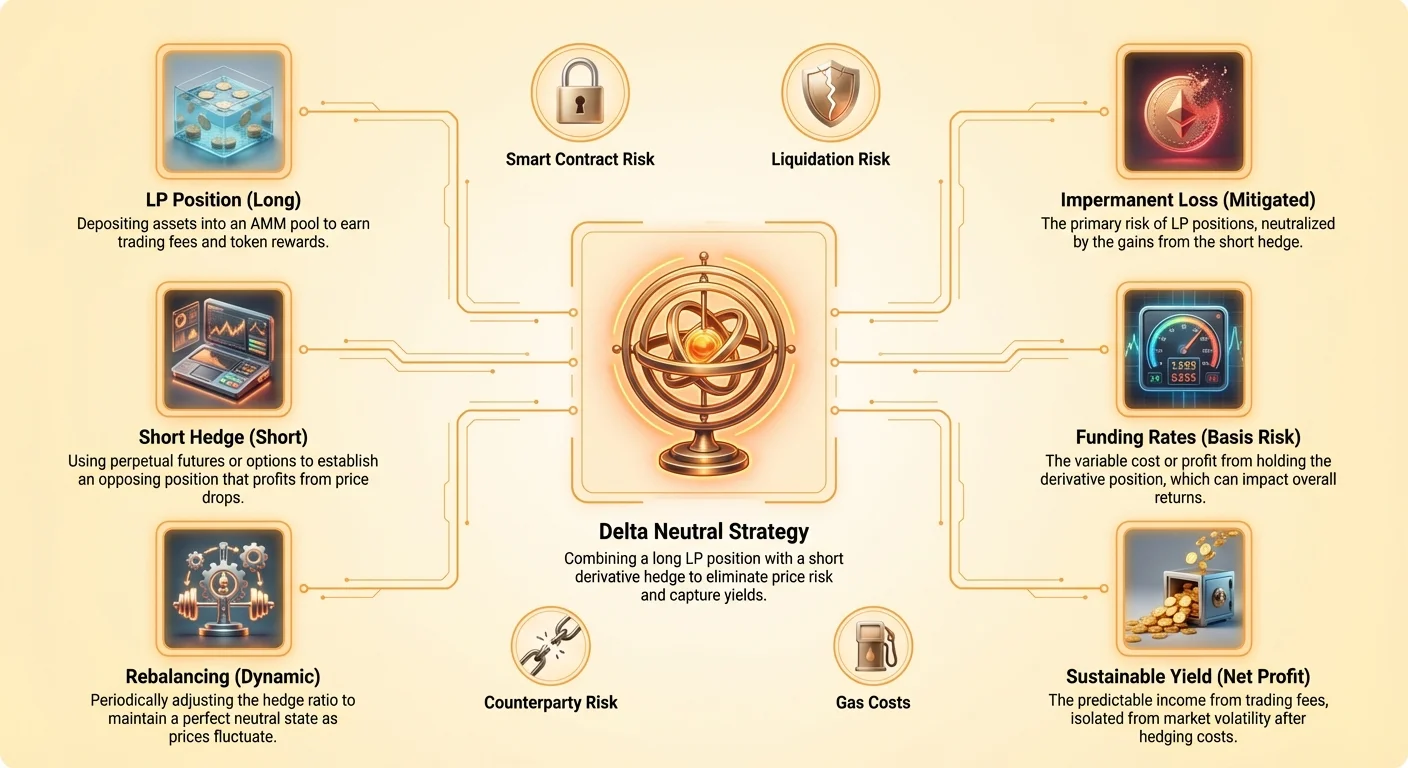
Introduction to Delta Neutral Farming
Delta Neutral farming is an advanced DeFi strategy that involves simultaneously holding an LP position while establishing a perfectly balanced opposing position in the derivatives market (usually perpetual futures).
Defining "Delta Neutrality"
In finance, Delta measures the sensitivity of an asset’s price to a change in the underlying market price.
- If you buy 1 ETH, your delta is +1 (you gain $1 for every $1 ETH increases). This is a Long Delta position.
- If you sell 1 ETH short, your delta is -1 (you gain $1 for every $1 ETH decreases). This is a Short Delta position.
When you deposit into a 50/50 ETH/USDC liquidity pool, you are effectively taking a long position on ETH (your delta is positive, though less than +1).
A Delta Neutral position aims for a net Delta of zero. By combining the long exposure from the LP position with an equal and opposite short exposure, the entire position becomes immune to directional price movement. The only remaining profit source is the trading fees generated by the LP pool.
The Core Mechanism: LP Position + Short Hedge
Executing a delta neutral strategy requires access to a decentralized or centralized derivatives exchange alongside a chosen liquidity pool.
Step 1: Establish the Long Position (The LP)
Assume the current price of ETH is $2,000.
- You allocate $4,000 total capital.
- You deposit 1 ETH and 2,000 USDC into a 50/50 AMM pool.
- Result: You now have positive delta exposure (you benefit if ETH rises, but you risk IL).
Step 2: Establish the Short Position (The Hedge)
- Simultaneously, you open a short position for 1 ETH on a perpetual futures platform.
- Perpetual futures track the underlying asset price but allow you to short without an expiration date.
- Since the LP position is equivalent to a long position of 1 ETH, you short 1 ETH to cancel out the exposure.
- Result: Your net delta is now zero (1 ETH long - 1 ETH short = 0).
Strategy Outcome Analysis
If the price of ETH increases to $3,000:
- LP Loss (IL): The LP position suffers IL because the pool sold some of your ETH.
- Hedge Gain: Your short futures position loses $1,000 in value, but you gain capital on the LP side. Crucially, if the hedge is perfectly balanced, the loss on the short position equals the IL sustained by the LP.
- Net Profit: Zero (excluding trading fees).
If the price of ETH decreases to $1,000:
- LP Gain (Versus Holding): The LP position value is lower.
- Hedge Gain: Your short futures position gains $1,000.
- Net Profit: Zero (excluding trading fees).
In both scenarios, the trading fees generated by the LP pool become the guaranteed profit, isolated from market volatility.
Practical Execution: Building and Maintaining the Hedge
While the theory of delta neutrality is straightforward, its execution involves navigating complex variables, primarily funding rates and the need for constant rebalancing. This is where the difference between a high-level speculator and a professional capital manager becomes apparent.
Managing Funding Rates (Basis Risk)
Perpetual futures contracts are designed to closely track the price of the underlying asset. They achieve this through a mechanism called the Funding Rate.
- If the futures contract price is trading higher than the spot price (i.e., people are highly optimistic and bidding up the future), long position holders pay a fee (the funding rate) to short position holders.
- If the futures contract price is trading lower than the spot price, short position holders pay long position holders.
In a delta neutral strategy, you are paying or receiving this funding rate on your short hedge.
The Crucial Insight: If you can execute a delta neutral strategy where you receive the funding rate (i.e., short holders are being paid by long holders), you are effectively earning three layers of yield:
- LP Trading Fees
- LP Token Emission Rewards (if applicable)
- Funding Rate Payments (The short hedge becomes a positive income stream)
This funding rate variability is known as Basis Risk. A professional farmer must constantly calculate whether the expected trading fees outweigh the cost of the funding rate paid on the short hedge.
Calculating and Adjusting the Hedge Ratio
In traditional 50/50 pools (like Uniswap V2), the exposure ratio is effectively 1:1, meaning 100% of the volatile asset needs to be hedged. However, in concentrated liquidity pools (like Uniswap V3), the calculation becomes more complex.
Concentrated Liquidity pools: These pools only provide liquidity within a specific price range. If the price moves outside your range, all your assets convert to the less valuable asset, and your position is no longer active in fee generation. This makes the delta calculation dynamic.
Actionable Tip: Advanced strategies often require dynamic hedging tools or vaults that automatically adjust the short position leverage based on the current price relative to the LP range. If the price is near the edge of the range, the delta exposure may be close to 1:1. If the price is exactly in the middle of the range, the delta exposure might be closer to 0.5:1.
Auto-Balancing and Slippage Costs
A delta neutral position is not "set and forget." As the price of the volatile asset changes, the weights in the LP position shift.
- If ETH rises, the LP position sells ETH, meaning your effective long exposure shrinks.
- To maintain neutrality, you must also reduce your short position.
These adjustments mean periodically buying back some of the short position (or selling more short) and paying transactional gas fees and slippage. These costs are the Operational Cost of maintaining the hedge.
Best Practice: The total yield derived from LP fees and funding rates must exceed the combined cost of the funding rate payment (if paying) and the gas/slippage costs of rebalancing, otherwise the strategy is unprofitable. For capital managers, automating this rebalancing via smart contract vaults is often the most cost-effective solution.
Yield Maximization Techniques: Stablecoin Leverage
Once the primary risk of volatility (IL) has been neutralized using derivatives, the next step is maximizing the yield generation through prudent application of leverage, particularly within low-risk stablecoin environments.
The Strategy: Borrowing to Boost Stablecoin Yields
Stablecoin farming (e.g., earning 4-6% APY on a USDC/DAI pool) is low-risk but offers modest returns. To increase capital efficiency, users employ lending protocols (like Aave or Compound) to loop stablecoin positions.
The Loop Mechanism:
- Deposit $10,000 USDC as collateral into a lending protocol.
- Borrow $7,000 DAI against the USDC collateral (maintaining a safe Loan-to-Value, or LTV, ratio).
- Use the $7,000 DAI to provide liquidity in a high-yield DAI/USDC pool, earning trading fees and staking rewards.
- Optionally, the yield earned in Step 3 can be converted back to USDC and deposited as additional collateral, increasing the borrowing base for the next loop.
This strategy uses leverage to magnify the base yield of the low-risk asset. If the base yield is 5% and you maintain a 50% LTV, you can effectively boost your annualized return significantly, minus the cost of borrowing.
Managing Liquidation Risk in Stablecoin Loops
While the difference between USDC and DAI is usually negligible, this strategy introduces a new type of risk: De-pegging Liquidation Risk.
The major risk event is if the collateral stablecoin (e.g., USDC) suddenly loses its peg relative to the borrowed asset (e.g., DAI). If USDC drops to $0.90 while DAI holds $1.00, your collateral value has fallen by 10%, potentially pushing your LTV above the liquidation threshold.
Mitigation:
- Low LTV: Always maintain a conservative LTV ratio (e.g., 60-70%) well below the platform’s liquidation threshold (often 85%).
- Asset Quality: Only use high-quality, battle-tested stablecoins (USDC, DAI, USDT).
- Monitoring: Implement monitoring tools that alert you immediately if your LTV approaches a danger zone.
Advanced Option Strategies for Secondary Yield
For highly experienced users, a delta neutral LP position provides the perfect foundation for structured products, adding a secondary layer of premium yield.
The core idea is to use the perfectly hedged asset as collateral for selling options, generating income from market participants willing to pay a premium for insurance or leverage.
Example: Selling Covered Calls
- You have 1 ETH fully hedged in a delta neutral position.
- You sell a Covered Call option, giving the buyer the right (but not the obligation) to buy your 1 ETH at a strike price higher than the current market price.
- You collect the premium (the option price) immediately.
- If the price stays below the strike price, the option expires worthless, and you keep the premium and your delta neutral fees.
- If the price rises above the strike price, the option is exercised. Your 1 ETH is sold, but your derivative hedge simultaneously captures the price move, neutralizing the loss of the asset.
This provides an additional, predictable premium layer on top of your existing delta neutral yield, although it adds significant complexity and counterparty risk depending on the options platform used.
Assessing True Risk: Deconstructing the "Degen Score"
In the DeFi space, high APYs are often misleading. A professional approach requires a rigorous deconstruction of the advertised yield to determine the true, risk-adjusted return, often informally referred to as calculating the "Degen Score." A low Degen Score indicates a safe, sustainable yield.
Deconstructing the Annual Percentage Yield (APY)
APYs are often inflated by two factors:
- Sustainable Yield (Trading Fees): This is the predictable income generated by users swapping assets within your LP. This yield is generally sustainable and directly correlated to network activity.
- Inflationary Yield (Token Emissions): This is the high-percentage reward paid out in the farm’s native governance token (e.g., FARM, GOV). This token often experiences severe price depreciation as the high emission rate floods the market.
Professional Filtration: A savvy investor discounts or entirely ignores the token emission yield when calculating the viability of a long-term position. The focus must be on whether the sustainable trading fee yield, minus hedging costs (funding rates), provides an acceptable risk-adjusted return. If the strategy relies solely on token emissions, it is inherently unsustainable.
Analyzing Basis Risk and Counterparty Risk
The main risks in advanced farming are often not related to the underlying assets themselves, but the platforms used to execute the strategy.
1. Basis Risk (The Cost of the Hedge)
As discussed, Basis Risk is the risk that the funding rate paid on your short hedge may be volatile or persistently negative, effectively eating away at your LP fees.
Mitigation: Choose platforms (CEX or DEX) with deep liquidity in their derivatives markets, which typically stabilizes the funding rate. Track historical funding rates to model your worst-case hedging cost.
2. Counterparty and Smart Contract Risk
When engaging in multi-layer strategies, you exponentially increase your exposure to failures in smart contract code or centralization risk.
- Smart Contract Risk: The potential for a bug or exploit in the LP protocol, the lending protocol, or the derivatives protocol.
- Custody Risk: If you use a Centralized Exchange (CEX) for your derivatives hedge, you are exposed to that exchange's solvency risk.
Best Practice: Prioritize audited protocols and consider using decentralized perpetual futures platforms (DEX derivatives) to reduce the counterparty risk associated with holding collateral on a CEX.
Best Practices for Capital Preservation
Maintaining profitability in advanced DeFi requires discipline and constant monitoring:
| Best Practice | Rationale |
|---|---|
| Use Self-Custodial Wallets | Retain direct control over your assets and keys. Use robust smart contract wallets if relying on automated strategies. |
| Verify Audits | Only deploy capital into protocols that have successfully completed multiple, reputable third-party security audits. |
| Decentralize the Hedge | Whenever possible, execute your derivatives hedge on a robust Decentralized Exchange (DEX) to eliminate exchange insolvency risk (CEX Counterparty Risk). |
| Monitor Funding Rates Daily | Immediately adjust or close positions if the cost of the hedge (the funding rate) is consistently higher than the LP yield. |
| Stress Test LTV | If using stablecoin leverage, calculate the precise de-peg percentage required to trigger liquidation and maintain a buffer 15-20% above that threshold. |
Conclusion
Advanced DeFi farming strategies are the bridge between speculative crypto investing and professional capital management. By deploying delta neutral techniques, users move from guessing price direction to isolating and capturing the sustainable yield generated by network activity.
While strategies involving perpetual futures, options, and stablecoin leverage introduce complexities like Basis Risk and LTV monitoring, they offer the highest risk-adjusted returns available in decentralized finance. The goal is no longer to chase the highest advertised APY, but to achieve a low Degen Score—a high return with minimal inherent risk—making the volatility of the crypto market irrelevant to your ongoing income stream. Mastering these tools is the key to building self-sovereignty in the new digital economy.