
Decentralized finance has fundamentally altered how individuals interact with their capital. In the traditional financial world, assets often sit idle, generating little to no value unless they are actively managed by third-party intermediaries. The emergence of blockchain technology introduced the concept of putting money to work through automated, transparent protocols. Among the most significant developments in this arena is the transition from simple holding strategies to active participation in network security through staking.
As the ecosystem matured, users sought ways to improve the efficiency of these deployed assets. The initial model of staking required a rigid lock-up of funds, effectively removing liquidity from the market in exchange for security duties. While this secured the network, it created an opportunity cost for the asset holder. This inefficiency drove the innovation of new financial primitives designed to maximize the utility of every token.
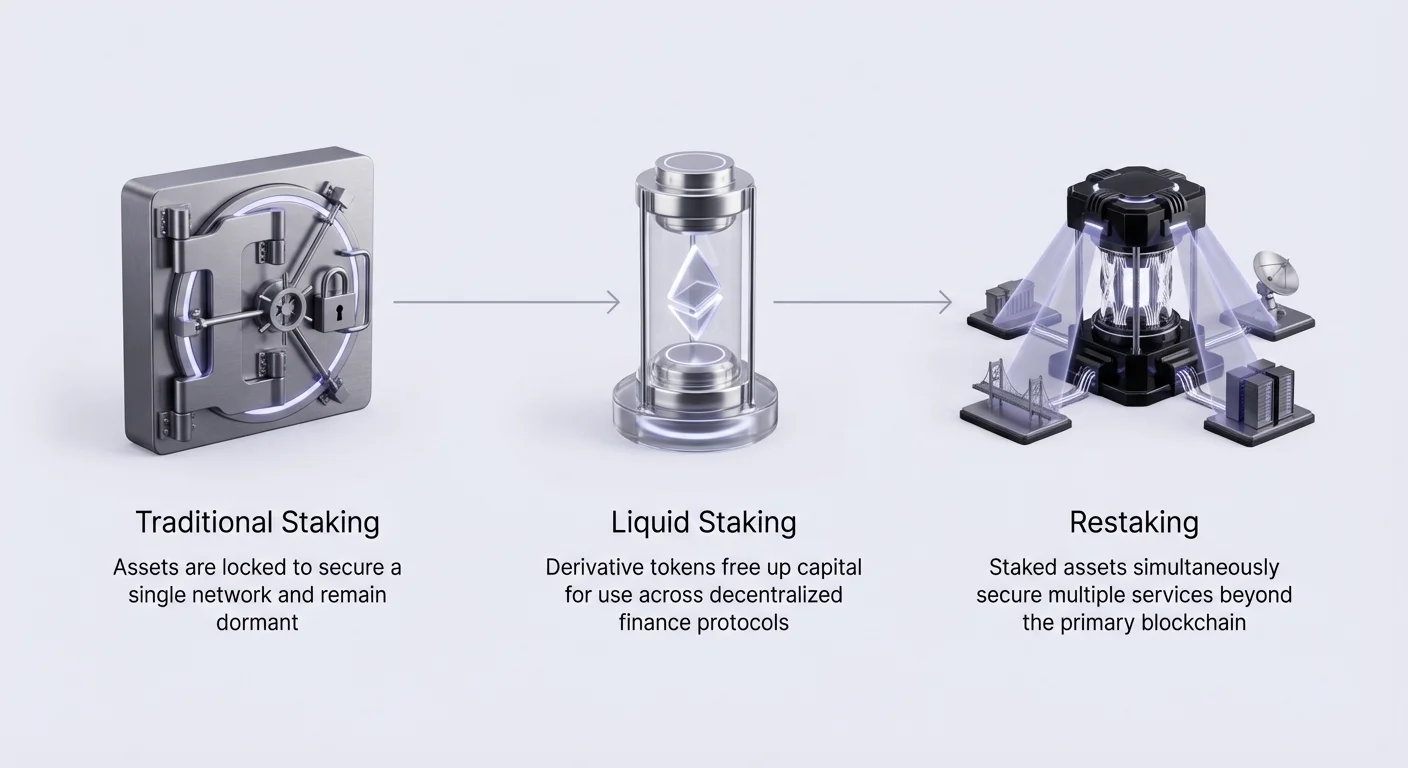
Restaking represents the latest evolution in this pursuit of capital efficiency. It allows the same underlying capital to secure multiple networks simultaneously. By extending the security trust of a major blockchain to other applications and services, restaking creates a more interconnected and resource-efficient ecosystem. This mechanism transforms staked assets from a single-purpose security deposit into a flexible foundation for a wider decentralized architecture.
The Foundation of Network Security
To understand the significance of restaking, one must first grasp the underlying mechanics of Proof-of-Stake (PoS) systems. Unlike earlier consensus mechanisms that relied on energy-intensive hardware, PoS networks secure their history and transaction validity through financial commitment. Validators essentially put a security deposit down to vouch for the accuracy of the ledger.
The Role of the Validator
In a Proof-of-Stake network, validators are the backbone of the system. They are responsible for processing transactions, storing data, and adding new blocks to the blockchain. To ensure these actors behave honestly, the protocol requires them to lock up a specific amount of the network's native cryptocurrency. This staked amount acts as collateral for network security.
If a validator attempts to attack the network or fails to perform their duties correctly, a portion of this collateral can be seized. This penalty mechanism aligns the financial incentives of the validator with the health of the network. The security of the entire system relies on the total economic value of the assets staked.
Economic Security Limitations
While effective, the traditional staking model has a limitation regarding capital utility. Once an asset is staked to a validator, it is typically dedicated solely to that specific network. A validator securing the Ethereum network, for instance, cannot simultaneously use those same 32 ETH to secure a separate bridge or oracle network.
This fragmentation means that every new decentralized service must bootstrap its own set of validators and economic security from scratch. This process is expensive and difficult, often leading to lower security for emerging projects. The capital is "siloed," protecting only one castle when it could potentially defend a kingdom.
The Liquidity Challenge in Staking
The primary drawback of early staking implementations was the complete loss of liquidity. When a user deposited funds into a smart contract to earn staking rewards, those funds became inaccessible for other purposes. They could not be traded, used as collateral for loans, or deployed in other yield-generating strategies without first going through an unstaking process.
Unstaking often involves a waiting period, known as an unbonding period, which can last days or weeks. During this time, the user receives no rewards and cannot access the principal. This structure forces a difficult choice upon the asset holder: contribute to network security and earn a yield, or retain liquidity to react to market conditions and opportunities. This binary choice hindered the overall efficiency of the market, leaving vast amounts of capital dormant in staking contracts.
Liquid Staking Derivatives
The market responded to the liquidity problem with the invention of Liquid Staking Tokens (LSTs). These tokens fundamentally changed the user experience of securing a blockchain. When a user stakes through a liquid staking protocol, the protocol mints a derivative token that represents a claim on the underlying staked asset and its accrued rewards.
Mechanics of Receipt Tokens
Liquid staking works by issuing a "receipt" for the deposited assets. For example, if a user deposits ETH into a liquid staking protocol, they receive a token like stETH in return. This receipt token tracks the value of the original deposit.
Because these tokens are standard ERC-20 compatible assets, they can be transferred and traded just like any other cryptocurrency. The underlying asset remains locked in the staking contract, performing its validation duties, but the value is now represented by a liquid instrument. This effectively unbinds the value from the lock-up period.
Utility in Decentralized Finance
The introduction of LSTs allowed users to deploy their staked value across the broader DeFi ecosystem. A user could hold the liquid token to earn staking rewards while simultaneously using that token as collateral in a lending protocol or providing liquidity in a decentralized exchange.
This innovation laid the groundwork for restaking. Once the market accepted that a staked asset could have a liquid representation, the next logical step was to find ways to utilize that staked value to provide security for more than just the base layer chain. LSTs proved that capital could be multitasking.
Defining Restaking
Restaking is a method that enables the use of staked cryptocurrency to secure additional protocols beyond the primary blockchain. It breaks the "one asset, one network" paradigm. In this model, the trust and economic security established on a large, robust network can be exported to other applications.
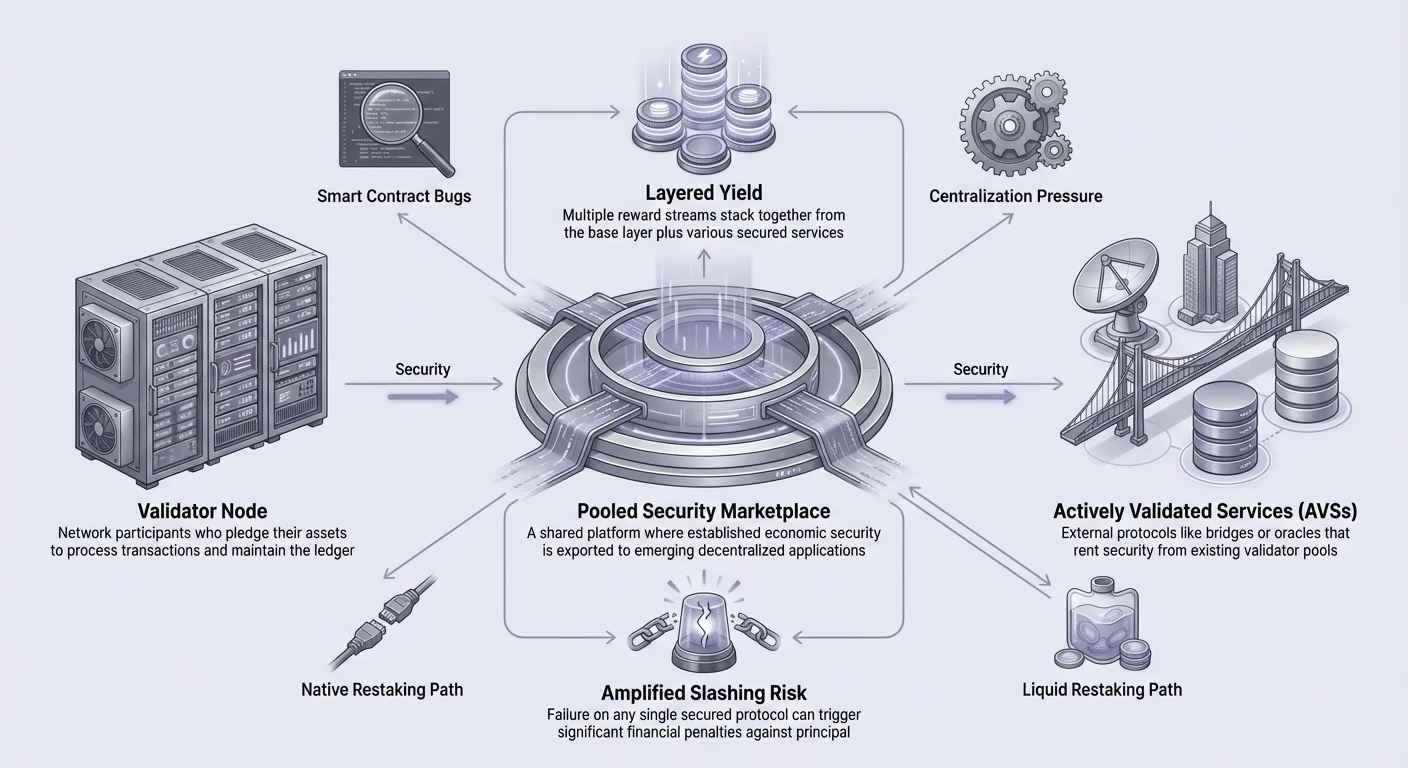
These applications, often referred to as Actively Validated Services (AVSs), might include data availability layers, oracle networks, sidechains, or bridges. Instead of each of these services needing to recruit their own validators and convince users to buy and stake a new proprietary token, they can leverage the existing pool of validators and capital from an established network.
This process creates a pooled security marketplace. Validators can opt-in to secure these additional services using their existing stake. In exchange for taking on the additional responsibility and risk, they receive additional rewards. The result is a system where the same unit of capital exerts much greater economic influence.
Methods of Implementation
Restaking generally occurs through two distinct pathways: Native Restaking and Liquid Restaking. Both achieve the goal of capital efficiency but require different levels of user involvement and technical expertise.
Native Restaking
Native restaking is designed for users who operate their own validator nodes. In this scenario, a validator who has already staked ETH directly to the beacon chain points their withdrawal credentials to the restaking smart contracts.
This process requires the validator to run additional software modules for the specific services they choose to secure. It is a technical commitment that involves managing hardware and ensuring uptime for multiple protocols simultaneously. The validator retains full control over their assets but assumes direct responsibility for the operational risks.
Liquid Restaking
Liquid restaking is the more accessible option for the average user. This involves taking a Liquid Staking Token (LST)—which already represents staked assets—and depositing it into a restaking protocol.
The user does not need to run a node or manage complex software. They simply transfer their LSTs to a smart contract that manages the restaking process on their behalf. The protocol handles the delegation to operators who perform the validation tasks. This method adds another layer of abstraction but significantly lowers the barrier to entry.
The Ecosystem of Actively Validated Services
The beneficiaries of restaking are the various decentralized protocols that require high levels of security but lack the resources to build a massive validator set. These are known as Actively Validated Services (AVSs). In the current landscape, launching a new decentralized network is incredibly capital intensive.
Without restaking, a new oracle network would need to issue a token, incentivize thousands of users to buy and stake that token, and maintain a validator network large enough to prevent attacks. This is a high barrier to entry that stifles innovation.
With restaking, these services can "rent" security. They can tap into the billions of dollars of economic security already present on Ethereum or other major chains. By offering rewards to existing validators, an AVS can launch with a level of security that would otherwise take years to build. This democratizes access to robust decentralized infrastructure.
Economic Implications and Yield
The primary driver for users to participate in restaking is the potential for enhanced yield. By securing multiple protocols, the staked asset becomes a productive worker with multiple jobs.
Stacking Rewards
In a traditional staking setup, the yield is derived from a single source: the inflation rewards and transaction fees of the base layer network. Restaking introduces the concept of yield layering. A user earns the base staking rate plus the rewards offered by the additional services they are securing.
For example, a validator might earn 4% from Ethereum staking, plus an additional 2% for securing a data availability layer, and another 1% for securing a bridge. These rewards stack on top of each other, significantly boosting the Annual Percentage Yield (APY) without requiring additional capital injection.
Fee Generation
The sustainability of these rewards comes from the utility provided. AVSs generate revenue through fees paid by developers or applications that use their services. These fees are then passed on to the restaking validators.
This creates a more direct correlation between the value provided by the validator and the compensation received. It moves the industry away from purely inflationary token rewards toward a "real yield" model based on service fees. The efficiency gains reduce the cost of capital for the services while increasing the return on capital for the stakers.
Technical and Financial Risks
While the benefits of restaking are clear, the introduction of pooled security brings new risks. The interconnected nature of the system means that failures can have cascading effects. Users must understand the specific dangers before participating.
Slashing Amplification
The most significant risk in restaking is the compounding of slashing conditions. When an asset secures one network, it is subject to one set of rules. If the validator misbehaves, they lose money. In restaking, that same asset is pledged to multiple protocols, each with its own slashing criteria.
If a validator fails to meet the uptime or accuracy requirements of an AVS, they can be slashed, even if they performed perfectly on the base layer. This magnifies the operational risk. A technical glitch or software bug in the additional node software could lead to a loss of principal.
Smart Contract Complexity
Restaking protocols involve complex layers of smart contracts. Every new layer of code introduces the potential for bugs or exploits. Users are trusting not only the base layer code and the liquid staking code but also the restaking protocol code and the specific code of the AVSs.
If the restaking smart contract contains a vulnerability, it could be exploited by hackers to drain the deposited funds. Unlike the base layer protocol, which is battle-tested over years, many AVSs and restaking layers are new and experimental.
Centralization Vectors
There is also a concern regarding centralization. If restaking becomes highly lucrative, it may encourage the professionalization of validation. Large, sophisticated node operators who can manage the complexity of securing dozens of AVSs may outcompete smaller home stakers.
This could lead to a scenario where a handful of large entities control the majority of the stake and the security of multiple networks. This concentration of power could undermine the decentralized ethos of the blockchain ecosystem and create single points of failure.
| Risk Category | Description | Consequence |
|---|---|---|
| Slashing | Penalties for validator errors | Loss of staked principal |
| Contract | Bugs in protocol code | Potential theft of funds |
| Centralization | Stake concentration | Reduced network censorship resistance |
Future Outlook for Shared Security
The adoption of restaking signals a shift toward a modular blockchain architecture. The industry is moving away from monolithic chains that try to do everything, toward a system of specialized layers that share a common security foundation.
As this technology matures, we can expect to see a proliferation of specialized services that were previously too expensive to secure. This could include high-performance gaming networks, decentralized social media graphs, and complex financial engines. The ability to rapidly spin up secure infrastructure will likely accelerate the pace of innovation in the Web3 space.
However, the long-term stability of this model remains to be tested. The market will need to find an equilibrium between the demand for security and the willingness of validators to accept additional risk. Governance mechanisms will play a crucial role in determining which services are safe to restake and how penalties are adjudicated.
Conclusion
Capital efficiency through restaking represents a significant leap forward for decentralized finance. By allowing staked assets to serve multiple purposes simultaneously, the ecosystem can achieve higher levels of security and utility without requiring exponential growth in liquidity. This innovation solves the cold start problem for new applications and provides higher reward potential for asset holders.
However, this efficiency comes at the cost of increased complexity and risk. The layering of protocols creates a dense web of dependencies where technical failures or malicious acts can have amplified consequences. As the sector evolves, participants must carefully weigh the lure of higher yields against the realities of compounded slashing risks and smart contract vulnerabilities.
Restaking transforms idle crypto assets into flexible security tools, maximizing rewards while requiring careful management of the amplified risks.