
Sa mahigit isang dekada, ang Bitcoin ay nagsilbing pundasyon ng digital na kakulangan at self-sovereignty, na pangunahing gumagana bilang matibay, hindi mababago na ledger para sa paglilipat ng halaga. Gayunpaman, ang arkitektura na dinisenyo ni Satoshi Nakamoto—bagaman rebolusyonaryo—ay may mga likas na limitasyon, partikular na tungkol sa scripting flexibility, privacy, at transactional efficiency.
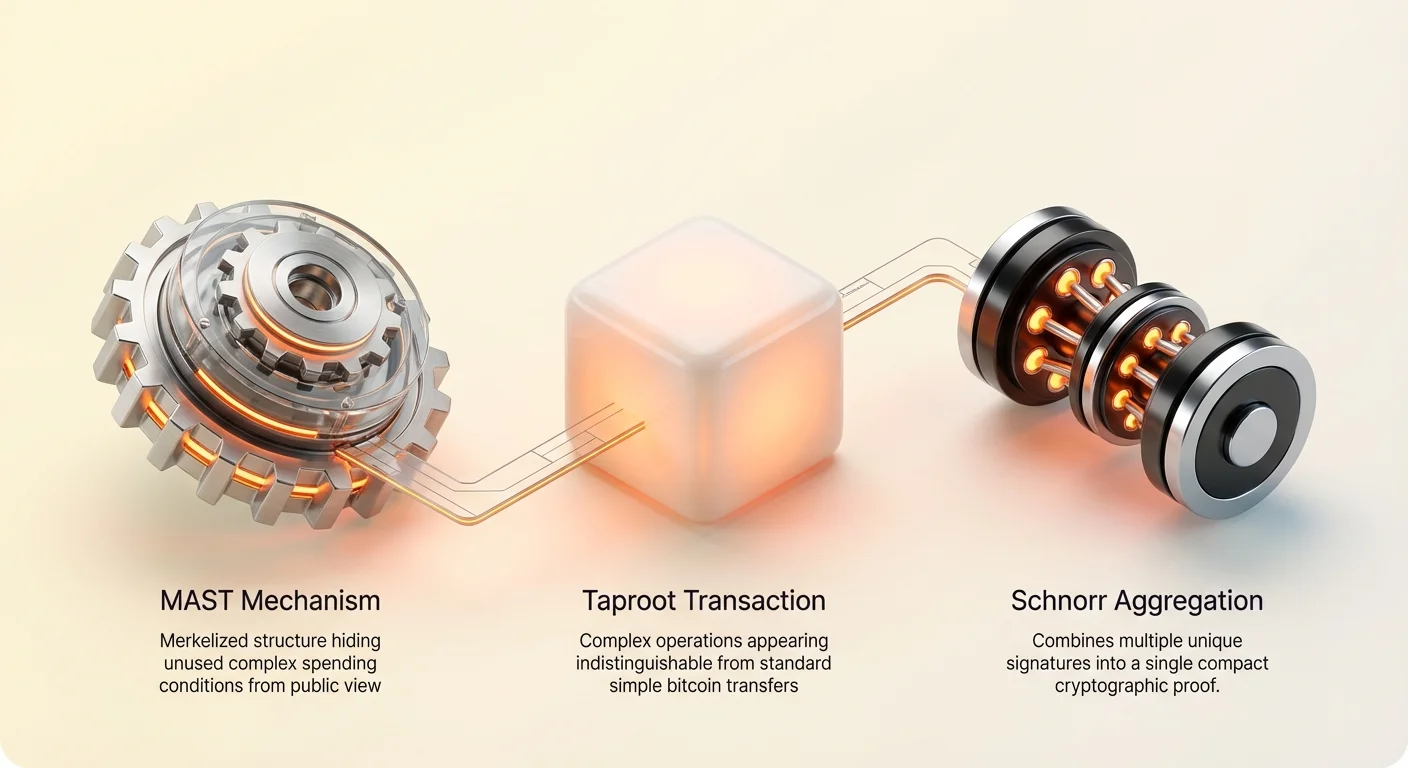
Ang Taproot upgrade, na aktibado noong huling bahagi ng 2021, ay kumakatawan sa pinakamahalagang pagpapabuti sa base layer (Layer 1) ng Bitcoin mula sa SegWit noong 2017. Ang Taproot ay hindi isang single feature; sa halip, ito ay isang sopistikadong bundle ng tatlong magkakaugnay na teknolohiya: MAST (Merkelized Abstract Syntax Trees), Schnorr Signatures, at Pay-to-Taproot (P2TR) addresses.
Ang upgrade na ito ay radikal na nagbabago sa paraan kung paano ipinapatupad ang mga complex transactions sa network. Habang ang mga lumang transaksyon ay nag-broadcast ng bawat potensyal na spending condition sa buong mundo—na gumagamit ng mahalagang block space at nagpapakita ng sensitive data—ang Taproot ay nagbibigay-daan sa mga complex scripts na magmukhang hindi matutukoy mula sa simple, single-signature payments. Ang architectural shift na ito ay dramatikong nagpapabuti sa privacy, binabawasan ang mga gastos, at, kritikal na, naglalagay ng matibay na infrastructural groundwork na kinakailangan para sa Bitcoin upang suportahan ang advanced smart contracts at scaled Layer 2 (L2) solutions tulad ng Lightning Network. Ang aming pokus dito ay hindi lamang ano ang Taproot, kundi paano ito nagbibigay kapangyarihan sa mga developer na bumuo ng susunod na henerasyon ng decentralized finance at self-custody tools sa pinakamasekurong blockchain sa mundo.
The Problem Taproot Solves: Bitcoin's Original Scripting Limitations
To understand the genius of Taproot, we must first recognize the constraints of Bitcoin’s original scripting language. Bitcoin uses a simple, stack-based language (often called Script) to define the rules for spending funds.
Anatomy of a Simple Bitcoin Transaction
Before Taproot, most Bitcoin transactions utilized either Pay-to-Public-Key-Hash (P2PKH), which is the standard single-signature payment, or Pay-to-Script-Hash (P2SH), which allowed for more complex rules like multi-signature requirements or time-locks.
When you spend funds using P2SH, the network must verify that the conditions you set (the script) are met. Crucially, when a transaction is spent, the entire script is published on the blockchain, along with the proof (the signature) that satisfies it.
For instance, if you set up a multi-signature transaction requiring 2 out of 3 keys to agree (a 2-of-3 multisig), the public record would show all three potential keys, the requirement (2-of-3), and the two required signatures, regardless of how simple the actual execution was.
The Cost of Complex Transactions
This requirement to publish the entire, potentially complex spending script had significant drawbacks:
- Reduced Privacy (Information Leakage): Revealing the entire script exposes all possible ways the funds could have been spent, even if only one path was ultimately chosen. In the 2-of-3 example, the identities of all three key holders are exposed, even if they were dormant.
- Increased Transaction Size and Fees: Complex scripts, especially those involving many participants or conditional time-locks, take up much more block space. Since fees are primarily determined by transaction size, this made sophisticated custody solutions (like corporate treasury multi-sig or intricate inheritance plans) very expensive and inefficient.
- Lack of Fungibility: Fungibility means that one unit of a currency is interchangeable with any other. When a complex script is clearly visible on the blockchain, it makes that specific transaction output look different from a standard, simple transaction output. This visual distinction can make it easier for external parties to track certain types of funds, harming the overall fungibility of Bitcoin.
MAST: Making Complex Scripts Look Simple
Merkelized Abstract Syntax Trees (MAST) is the core cryptographic concept that allows Taproot to solve the transparency and efficiency problems inherent in P2SH.
Understanding Merkel Trees
To grasp MAST, we must first understand the Merkle Tree (also known as a Hash Tree). This data structure is foundational to Bitcoin itself, as every block uses a Merkle Tree to efficiently summarize all transactions within that block.
A Merkle Tree works like a digital filing system:
- Each piece of data (in the case of MAST, this is a potential spending condition, or "script path") is individually hashed.
- These individual hashes are paired and hashed together, moving up the tree structure.
- This process continues until all the data is condensed into a single, summary hash called the Merkle Root.
The powerful advantage of the Merkle Root is that it allows anyone to verify that a specific piece of data is included in the set, simply by providing a small number of intermediate hashes (the Merkle Path) rather than having to show all the data.
How MAST Hides Unexecuted Conditions
MAST applies this Merkle Tree concept to the spending conditions of a transaction.
Imagine a complex smart contract that has four possible paths for spending funds:
- Path A: Alice and Bob both sign (standard spending).
- Path B: After 90 days, only Alice can sign (time-lock recovery).
- Path C: After 180 days, only a backup key signs (inheritance/safety).
- Path D: Requires input from an oracle (e.g., weather data trigger).
Using the old P2SH model, all four paths (A, B, C, and D) would be exposed on the blockchain when the funds are spent.
Using MAST:
- Each path (A, B, C, D) is the "leaf" of a Merkle Tree.
- All four paths are summarized into a single MAST Root.
- When Alice and Bob execute Path A, they only publish the script for Path A and the small cryptographic proof (the Merkle Path) necessary to prove that Path A is included in the MAST Root.
The critical benefit: The existence of Paths B, C, and D is revealed by the Merkle Root, but their actual scripting content remains completely private and unpublished on the chain. Only the executed path is revealed, leading to massive space savings and increased confidentiality.
Practical Example: The Multi-Sig Scenario
Consider a corporate treasury that requires a 3-of-5 multi-signature agreement for routine expenses, but also requires a simplified 1-of-5 signature path (after 6 months) for emergency liquidation if the company dissolves.
- Pre-MAST: The standard 3-of-5 script and the emergency 1-of-5 script must both be broadcast to the chain, increasing transaction size and revealing the emergency spending rules to everyone.
- With MAST: If the 3-of-5 path is used, only the 3-of-5 script is broadcast, along with the small proof that it belongs to the contract. The 1-of-5 emergency liquidation path remains hidden within the MAST Root, only revealed if it is actually executed later.
MAST fundamentally transforms complex conditions into efficient, compact, and private proofs.
Schnorr Signatures: The Key to Efficiency and Privacy
While MAST addresses script complexity, the second major component of Taproot—Schnorr signatures—addresses signature efficiency, security, and anonymity. Bitcoin originally used the Elliptic Curve Digital Signature Algorithm (ECDSA). Schnorr is a mathematically superior alternative that brings two immense benefits: signature aggregation and enhanced security proofs.
The Technical Superiority of Schnorr vs. ECDSA
ECDSA signatures, while secure, are bulky and necessitate individual verification. If a transaction requires three signatures, the blockchain requires three separate blocks of signature data, and the network nodes must verify those three distinct blocks sequentially.
Schnorr signatures, based on simpler math and security assumptions, offer a significant advantage: linearity. This means that multiple public keys can be combined into a single, valid aggregated public key, and multiple signatures can be combined into a single, valid aggregated signature.
Signature Aggregation: Batch Verification and Efficiency
Signature aggregation is perhaps the most visible improvement Taproot brings to scaling:
- Multi-Party Efficiency: In a 5-of-5 multi-signature transaction using Schnorr, the five required public keys can be cryptographically merged into one new public key, and the five corresponding signatures can be merged into a single, aggregated signature.
- Blockchain Interpretation: To the rest of the Bitcoin network, this aggregated transaction looks exactly like a standard, single-signature payment (P2PKH).
- Verification Speed: Nodes verify this single aggregated signature faster than verifying five individual ECDSA signatures. This improvement saves computational power for every network participant and drastically reduces the data size of complex transactions.
This capability is revolutionary for multi-party applications like corporate custody, joint ownership wallets, and, most importantly, Layer 2 scaling solutions.
The Privacy Dividend (Key Aggregation and the P2TR Format)
The ability to aggregate keys and signatures provides a critical boost to privacy and fungibility.
If a multi-sig transaction looks identical to a standard single-signature transaction, outside observers cannot determine if the transaction was complex (requiring multiple parties, time-locks, or specialized contracts) or simple (just one person sending money).
This introduces true output uniformity to the network, meaning sophisticated smart contract outputs are functionally indistinguishable from simple peer-to-peer payments. This significantly strengthens Bitcoin's fungibility, ensuring all satoshis are treated equally by observers.
Taproot Explained: The Seamless Integration of MAST and Schnorr
Taproot is the overarching implementation that ties MAST for conditional execution and Schnorr for signature efficiency together under a new, unified address type.
Pay-to-Taproot (P2TR) Addresses
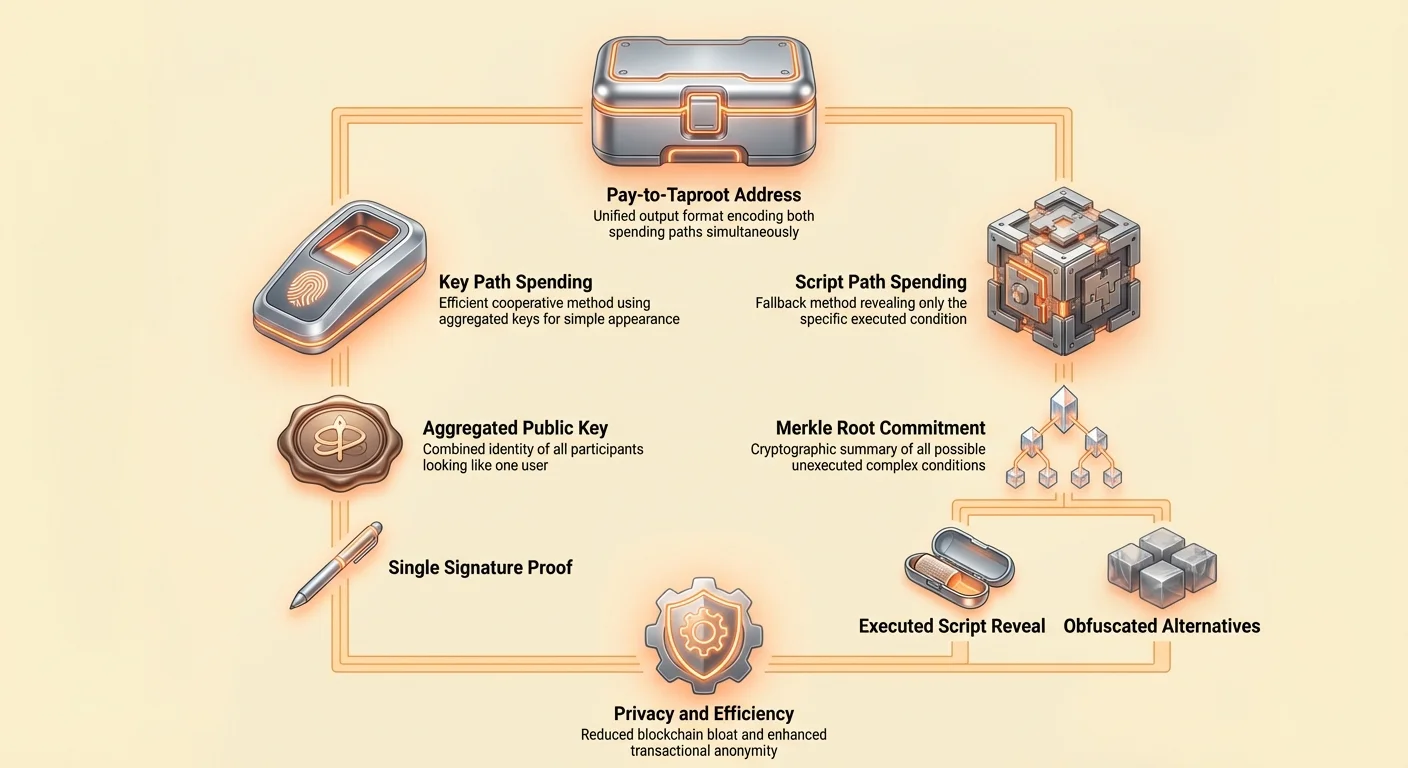
Taproot introduces a new standard output type called Pay-to-Taproot (P2TR). P2TR outputs encode not just a single public key, but a combination of a public key (for the Schnorr key aggregation path) and the Merkle Root of all potential spending scripts (for the MAST script path).
When funds are sent to a P2TR address, the transaction effectively locks the funds using two distinct methods simultaneously: the Key Path and the Script Path.
The Key Path vs. The Script Path (The Choice Mechanism)
Taproot is designed around a simple, efficient trade-off: if all parties cooperate, use the simple, cheap path; if they disagree or require complex conditions, use the slightly more expensive but robust path.
1. The Key Path (The Ideal Scenario)
The Key Path is the preferred and most efficient way to spend funds locked in a P2TR output. This path is activated when all original participants agree on the spending conditions and cooperate.
- How it works: All participants aggregate their public keys into a single Taproot key, and then aggregate their signatures into a single Schnorr signature.
- Result: The on-chain transaction looks exactly like a standard, single-signer P2PKH transfer. The entire MAST structure remains hidden, saving space and preserving privacy. This path is maximally cheap and efficient.
2. The Script Path (The Conditional Scenario)
The Script Path is activated if the participants cannot cooperate, or if the transaction requires a predetermined script condition (like a time-lock or the input of an oracle).
- How it works: The spending transaction reveals the specific script condition that was met (e.g., "Time-lock of 90 days has passed") and the small Merkle Proof required to validate that this script was indeed part of the original MAST Root.
- Result: This transaction is slightly larger than the Key Path, but still significantly smaller and more private than the old P2SH model, because it only reveals the one executed script, keeping all other potential spending conditions private.
Achieving Script Obfuscation
The combination of the Key Path and the Script Path achieves a powerful property called script obfuscation.
From the perspective of an outside observer analyzing the blockchain:
- If the Key Path is used (which is anticipated to be the most common usage for cooperative parties, especially in L2 solutions), the transaction is completely opaque and private. It looks like simple spending.
- Even if the Script Path is used, the observer only learns about the specific condition that was met, not the details of all the alternative conditions that were also possible.
This seamless integration ensures that simple, cooperative uses are highly efficient, while complex, conditional uses remain highly private—a massive leap forward for Layer 1 flexibility.
Ang Epekto ng Taproot sa Modernong Pag-unlad ng Bitcoin
Ang Taproot ay hindi lamang cosmetic upgrade; ito ay ang pinakakritikal na infrastructure update na nagbibigay-daan sa Bitcoin na lumampas sa basic value transfer at pumasok sa realm ng sophisticated decentralized applications.
Scaling Layer 2 Solutions (Lightning Network Efficiency)
Ang Lightning Network, ang pangunahing L2 scaling solution ng Bitcoin, ay lubos na umaasa sa multi-signature channels at time-locks para sa security. Ang Taproot ay direktang tumutugon sa pain points ng pagbubukas at pagsara ng mga channel na ito.
Bago ang Taproot, ang pagbubukas at pagsara ng Lightning channel ay nangangailangan ng visible multi-signature transactions (karaniwang 2-of-2), na bulky, mahal, at madaling makilala bilang L2 activity.
Gamit ang Taproot at Schnorr Signatures:
- Channel Opening: Ang pagbubukas ng Lightning channel ay maaaring gumamit ng Key Path. Ang funding transaction ay ngayon mukhang simple 1-of-1 transaction sa chain, na drastikal na binabawasan ang block footprint at nagpapataas ng privacy.
- Cooperative Closing: Kung ang channel ay isasara nang cooperatively (ang pinakakaraniwang scenario), ang Key Path ay gagamitin muli, na minimi ang fees at nananatiling hindi matutukoy mula sa standard payments.
- Non-Cooperative Closing: Kung kinakailangan ang non-cooperative closure, ang Script Path (na kinabibilangan ng time-lock conditions) ay gagamitin, ngunit salamat sa MAST, lamang ang kinakailangang, relevant na kondisyon ang inilalathala, na nagse-save pa rin ng space kumpara sa lumang model.
Ang efficiency gain na ito ay malaki ang pagbabawas sa gastos ng participation sa Lightning Network, na nag-e-encourage ng mas malawak na adoption at pagpapabuti ng bilis at reliability ng instant Bitcoin payments.
Pagbibigay-daan sa Complex Smart Contracts
Habang ang Ethereum ay purpose-built para sa Turing-complete smart contracts, ang design ng Bitcoin ay pinaghuhulog ang security at immutability, na ginagawang intentionally restrictive ang scripting language nito. Ang Taproot ay hindi nagbabago ng fundamental focus na ito, ngunit ginagawang far more practical at affordable ang execution ng sophisticated Bitcoin smart contracts.
Mga key areas na nakikinabang mula sa Taproot:
- Discreet Log Contracts (DLCs): Ang DLCs ay nagbibigay-daan sa mga parties na mag-execute ng contracts batay sa input ng external data source (isang oracle), tulad ng sports scores o stock prices, nang hindi nagpapakita ng contract details sa network. Ang MAST capability ng Taproot ay perpekto para rito, na nagtatago ng maraming potensyal na outcomes at nagpapakita lamang ng single result na napili ng oracle.
- Covenants: Ang covenants (ang kakayahang i-restrict ang paano maaaring gagastusin ang isang UTXO sa hinaharap) ay makapangyarihang tools para sa paglikha ng complex, self-enforcing financial products. Ang Taproot ay nagbibigay ng kinakailangang flexibility sa loob ng L1 scripting environment upang gawing viable at efficient ang covenants (madalas na pinagsama sa iba pang proposed opcodes).
- Advanced Treasury Management: Ngayon, ang mga corporations ay maaaring magdisenyo ng highly complex, nested multi-sig scenarios na may specialized recovery keys, time-locks, at emergency liquidation paths, nang hindi nagkakaroon ng massive fees o nagpapakita ng kanilang proprietary key management scheme sa publiko.
Pagbabawas ng On-Chain Footprint at Transaction Fees
Ang net result ng Schnorr aggregation at MAST efficiency ay ang pagbabawas sa overall data na kinakailangan upang mag-execute ng complex transactions.
Sa pamamagitan ng pag-shrinking ng average transaction size para sa multi-sig at L2 applications, ang Taproot ay nagbabawas ng overall network congestion. Ito ay direktang nagiging:
- Mas Mababang Fees: Mas kaunti ang data ay mas mababa ang gastos para sa user.
- Mas Mabilis na Confirmations: Ang mas kaunting data processing ay tumutulong sa mga miners at nodes na mag-operate nang mas mabilis at efficiently.
- Nadagdag na Capacity: Habang hindi pure block size increase ang Taproot, ang optimization nito ng transaction data ay functionally nagpapataas ng bilang ng complex transactions na maaaring magkasya sa isang single block.
Mga Philosophical at Architectural Implications
Ang Taproot ay hindi lamang technical update; ito ay isang philosophical statement na nagpapatunay sa ebolusyon ng Bitcoin habang pinapanatili ang mga core security tenets nito. Ang aktibasyon nito ay nangangailangan ng near-unanimous community support (ang "Speedy Trial" soft fork mechanism), na nagpapakita ng commitment ng ecosystem sa disciplined, backward-compatible growth.
Trade-offs: Decentralization laban sa Scripting Power
Ang historical debate sa crypto ay madalas na naglalagay ng Bitcoin (na nagbibigay prayoridad sa security at decentralization) laban sa mga platform tulad ng Ethereum (na nagbibigay prayoridad sa scripting flexibility at feature richness). Ang Taproot ay maingat na nagna-navigate sa trade-off na ito.
Hindi tulad ng mga upgrades na maaaring magkompromiso sa full node operability o mag-introduce ng highly complex consensus rules, ang Taproot ay isang non-controversial optimization. Ito ay gumagamit ng existing, proven cryptographic principles (Merkle trees, elliptic curves) upang mag-achieve ng efficiency gains nang hindi nangangailangan ng mas makapangyarihang hardware o pagbabago ng security model.
Ang kakayahang i-introduce ang flexibility (smart contracts, complex logic) sa pamamagitan ng Script Path habang pinapanatili ang efficiency at privacy ng simple payments sa pamamagitan ng Key Path ay tinitiyak na ang Bitcoin ay maaaring suportahan ang advanced development nang hindi nagkompromiso sa status nito bilang pinakamatibay na decentralized ledger.
Taproot bilang Enabler para sa Bitcoin DeFi
Habang ang term "DeFi" (Decentralized Finance) ay madalas na nauugnay sa high-speed altcoin networks, isang robust, secure form ng Bitcoin-backed DeFi ay lumalabas. Ang Taproot ay sentral dito.
Ang kasalukuyang hamon para sa Bitcoin DeFi ay ang Layer 1 transactions ay maaaring mabagal at mahal. Ang Taproot ay ginagawang mas mura ang pagtatag ng L1 foundations na kinakailangan para sa L2/L3 applications, na nagbubuhay ng gap sa pagitan ng security ng Bitcoin at functional requirements ng DeFi.
Halimbawa, ang mga potensyal na future upgrades—tulad ng pag-enable ng makapangyarihang scripting opcode na OP_CAT (na nagbibigay-daan sa data concatenation at dynamic script construction)—ay tunay na viable at efficient lamang dahil ang Taproot ay naglagay na ng groundwork para sa compact, private script execution sa pamamagitan ng MAST. Ang Taproot ay hawak ang cryptographic privacy at efficiency, na nagbibigay-daan sa future consensus changes na tumutok lamang sa pagpapalawak ng logical functionality.
Sa esensya, ang Taproot ay nagbibigay ng kinakailangang plumbing na nagbibigay-daan sa mga developer na bumuo ng complex, ngunit affordable, applications sa tuktok ng Bitcoin, na nagbabago ng paradigm mula sa Bitcoin bilang merely digital gold patungo sa Bitcoin bilang infrastructure layer para sa global decentralized finance.
Konklusyon
Ang Taproot upgrade, na nag-i-integrate ng MAST at Schnorr signatures sa P2TR format, ay nagpapahiwatig ng monumental shift sa architectural potential ng Bitcoin. Ito ay ang culmination ng mga taon ng collaborative research na naglalayong panatilihin ang fundamental security ng Bitcoin habang vastly expanding ang utility nito.
Para sa mga baguhan at developers, malinaw ang takeaway: Ang Taproot ay fundamentally nag-o-optimize ng efficiency ng bawat complex interaction sa Bitcoin. Sa pamamagitan ng paggawa ng multi-signature transactions, time-locks, at conditional scripts na mukhang simple, single-key payments, ang Taproot ay nagpapahusay sa user privacy, binabawasan ang fees, at tinitiyak ang greater fungibility sa buong network.
Kritikal na, ang Taproot ay nagsisilbing bedrock para sa scaling future ng Bitcoin. Sa pamamagitan ng paggawa ng Layer 2 solutions tulad ng Lightning Network na mas mura at mas pribado na gamitin, at sa pamamagitan ng pagbibigay-daan sa efficient execution ng advanced smart contracts tulad ng DLCs, ang Taproot ay naglagay na ng Bitcoin ng kakayahang hawakan ang complexity na kinakailangan ng susunod na henerasyon ng self-sovereign financial tools. Ito ay tinitiyak na ang pinakamasekurong monetary network sa mundo ay handa rin na maging flexible platform para sa decentralized innovation.