
Navigating the complex terminology of the cryptocurrency industry can be daunting for newcomers and experienced investors alike. The terms "crypto," "coins," and "tokens" are often used interchangeably in casual conversation, but they represent distinct concepts within the digital asset ecosystem. Understanding the hierarchy and technical differences between these assets is essential for grasping how the market functions. This knowledge helps investors evaluate the underlying technology, use cases, and potential risks associated with different projects.
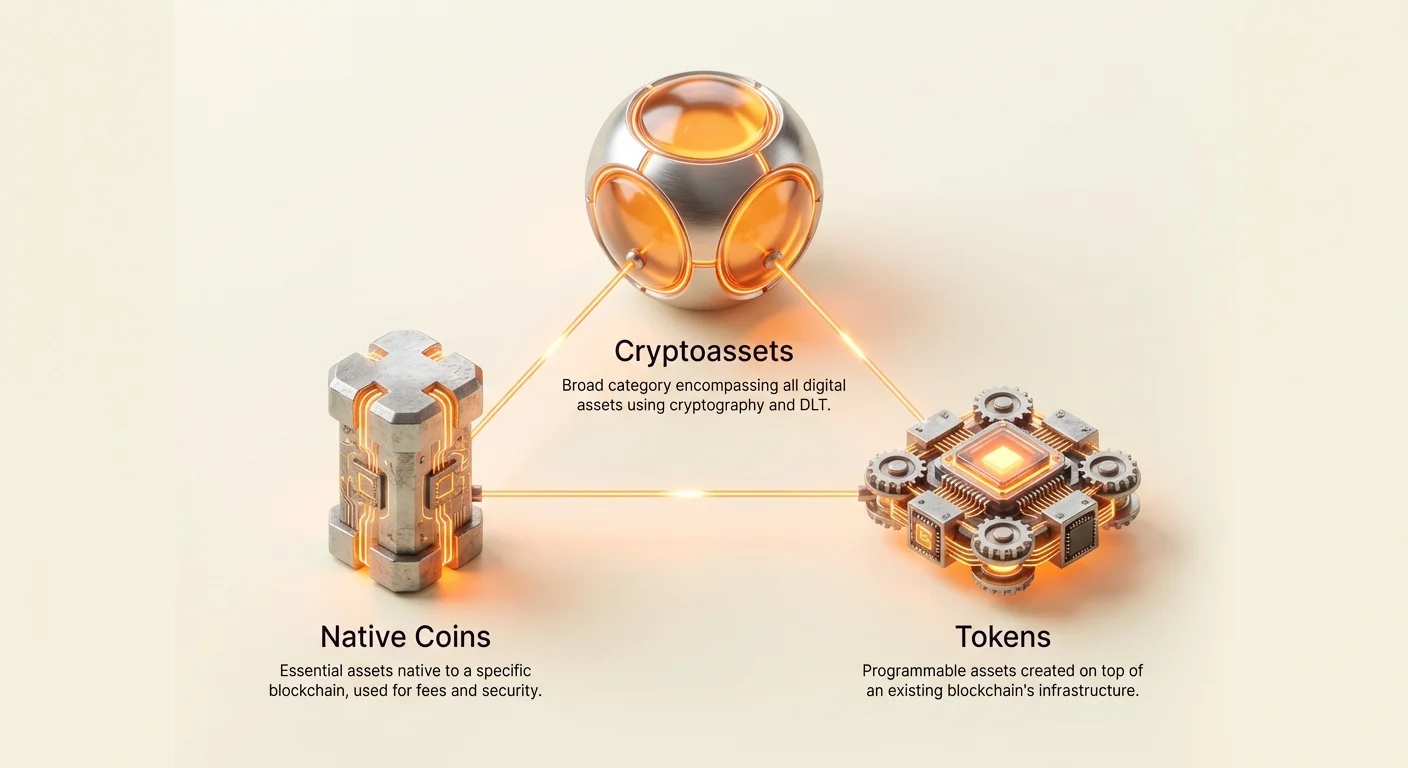
At the highest level, "cryptoasset" serves as the umbrella term for all digital assets that utilize cryptography and distributed ledger technology. This broad category encompasses everything from cryptocurrencies designed to act as money, to utility tokens that power applications, and unique digital collectibles. By breaking down these categories, we can see that not all digital assets serve the same purpose. Some act as digital gold, others as fuel for a network, and some as voting shares in a decentralized organization.
The Evolution of Value and Money
To truly understand digital assets, one must first grasp the history and function of money itself. Money is not a static concept but a technology that has evolved over thousands of years to solve specific economic problems. Its primary role is to facilitate trade by acting as a medium of exchange, a unit of account, and a store of value.
From Barter to Digital
Early commerce relied on barter systems, where goods were exchanged directly for other goods. This system was inefficient due to the "double coincidence of wants," meaning both parties had to desire exactly what the other offered. Society eventually moved to commodity money, using items with intrinsic value like shells or precious metals. Gold became the standard due to its rarity and physical properties.
Eventually, representative money emerged, where paper certificates represented a claim on physical commodities. This evolved into modern fiat money, which acts as legal tender by government decree. Fiat currency relies entirely on public trust and central bank policy rather than physical backing. The digital age has now introduced a new phase: decentralized digital currency. These assets operate without central intermediaries, challenging the traditional monopoly governments hold over money issuance.
The Properties of Sound Money
For any asset to function effectively as money, it must possess specific characteristics. Historical forms of money like gold were successful because they were durable, portable, divisible, uniform, and limited in supply. Fiat currencies excel at portability and divisibility but often fail at maintaining limited supply due to inflationary policies.
Digital assets like Bitcoin attempt to combine the best properties of both gold and fiat. They offer the portability of digital information while enforcing strict scarcity through code. This mathematical scarcity addresses the inflation risks associated with modern fiat currencies. By automating the monetary policy, digital assets aim to provide a more reliable store of value over long time horizons.
| Property | Gold | Fiat Currency | Bitcoin |
|---|---|---|---|
| Durability | High | Low (Physical wear) | High (Digital) |
| Portability | Low | High | High |
| Scarcity | High | Low (Unlimited) | High (Fixed) |
The Technological Foundation
The architecture that powers digital assets is blockchain technology. At its core, a blockchain is a digital record of transactions that is copied and distributed across a network of computers. This decentralized structure ensures that no single entity controls the data, making the system resistant to failure and censorship.
Understanding Blockchain Mechanics
A blockchain consists of a chain of data blocks. Each block contains a list of verified transactions. When a new block is filled, it is cryptographically linked to the previous one, creating an unbroken history. This linkage makes the ledger immutable; altering a past transaction would require changing every subsequent block, which is computationally impossible on a secure network.
The security of this system relies on consensus mechanisms. In networks like Bitcoin, "miners" solve complex mathematical problems to validate transactions and secure the network. This process requires significant energy and computational power, which acts as a barrier against fraud. Other networks use different validation methods, but the goal remains the same: to maintain a secure, transparent, and decentralized ledger without intermediaries.
The Layered Architecture
Blockchain ecosystems are often described in layers, each serving a distinct function. Layer 1 represents the base protocol, such as the Bitcoin or Ethereum networks. These layers handle the fundamental security, consensus, and final settlement of transactions. They are the foundation upon which everything else is built.
Layer 2 solutions sit on top of the base layer to improve scalability. They process transactions off the main chain to increase speed and reduce costs, later settling the final results on Layer 1. Above this, Layer 3 applications provide the user interface and specific utility for consumers. Understanding these layers is crucial for categorizing different digital assets, as the value of a coin or token often depends on where it sits in this stack.
Distinguishing Coins from Tokens
The most fundamental distinction in the digital asset hierarchy is the difference between a "coin" and a "token." While the lines can sometimes blur in casual conversation, the technical definitions are clear based on where the asset lives and how it functions.
A "coin" is the native asset of a specific blockchain. For example, Bitcoin (BTC) is the native coin of the Bitcoin blockchain, and Ether (ETH) is the native coin of the Ethereum blockchain. These coins are essential to the operation of their respective networks. They are used to pay for transaction fees, reward miners or validators, and secure the network infrastructure.
In contrast, a "token" is an asset created on top of an existing blockchain. Tokens do not have their own independent ledger; instead, they rely on the infrastructure of a host blockchain, such as Ethereum or Solana, to record transactions. Developers create tokens using smart contracts, which are self-executing programs that define the rules of the asset.
This distinction affects utility and security. A coin's security is tied directly to the strength of its own network's consensus. A token's security depends on the host blockchain. If the Ethereum network were to fail, all tokens built upon it would also be compromised. However, creating a token is significantly easier than launching a new coin, as it does not require building a network from scratch.
The Diverse World of Tokens
Tokens represent a much broader category of use cases than native coins. Because they are programmable, tokens can represent virtually anything: ownership in a project, access to a service, or even real-world assets like real estate. The functionality of a token is limited only by the imagination of its creators.
Utility and Access
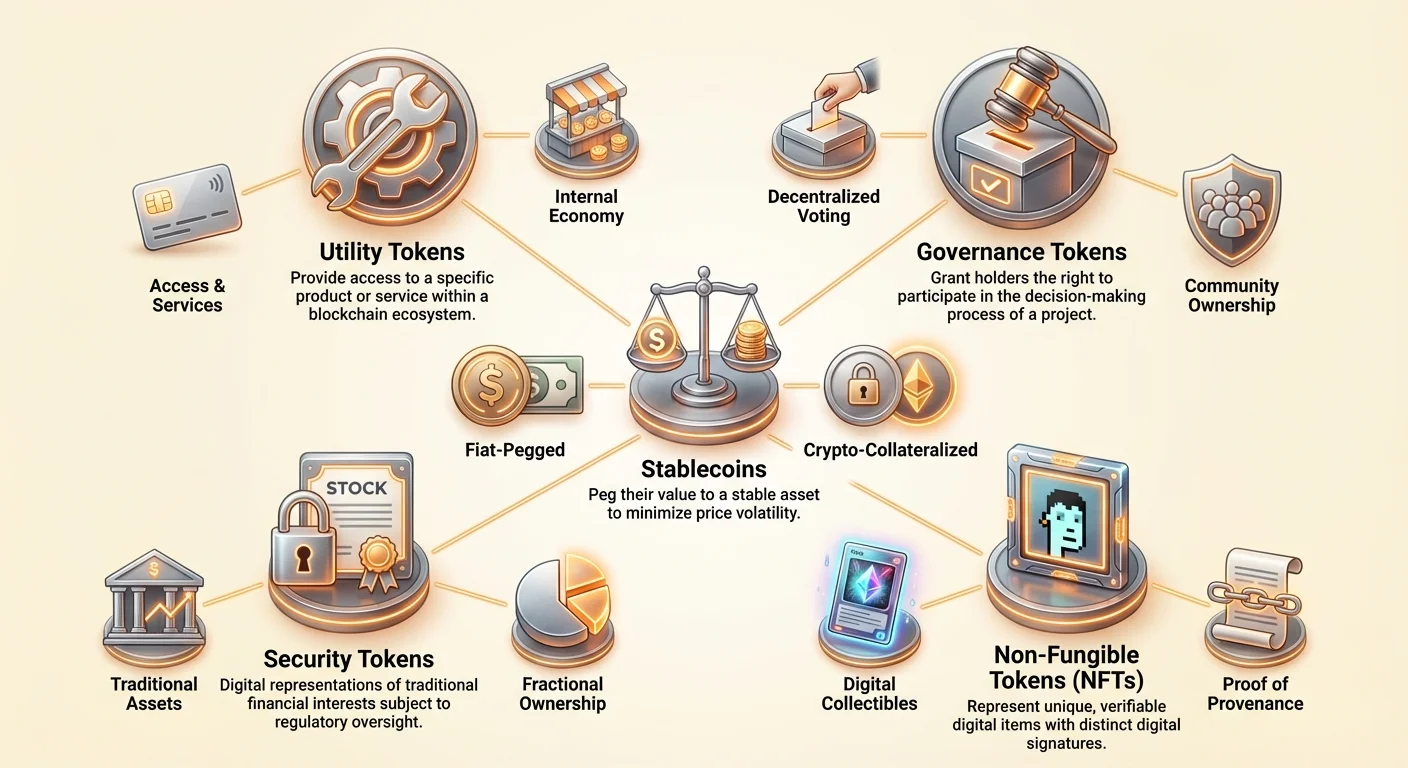
Utility tokens are designed to provide access to a specific product or service within a blockchain ecosystem. They function similarly to a paid API key or a subway ticket. For instance, a decentralized cloud storage network might require users to pay in a specific utility token to store their files.
These assets create an internal economy for the application. The value of a utility token is theoretically driven by the demand for the service it unlocks. If more people want to use the application, demand for the token increases. However, holding a utility token does not grant ownership rights in the company that built the platform.
Governance and Control
Governance tokens represent a shift toward decentralized management. They grant holders the right to participate in the decision-making process of a project or protocol. This is often seen in Decentralized Autonomous Organizations (DAOs), where token holders vote on upgrades, fee structures, and treasury management.
This model aligns the incentives of the users with the success of the platform. If a protocol generates revenue, governance token holders may vote to distribute those funds or reinvest them in growth. This creates a sense of community ownership that is absent in traditional centralized services.
Security and Ownership
Security tokens are digital representations of traditional financial interests. They are designed to represent ownership in an underlying asset, such as shares in a company, bonds, or real estate. Unlike utility tokens, security tokens are explicitly investment contracts and are subject to strict regulatory oversight.
These tokens promise to modernize traditional finance by offering benefits like instant settlement, 24/7 trading, and fractional ownership. For example, a high-value commercial building could be tokenized, allowing investors to buy small fractions of the property and receive a share of the rental income.
The Role of Stablecoins
Volatility is a defining characteristic of the cryptocurrency market. While this volatility offers opportunities for high returns, it makes many digital assets poor candidates for day-to-day payments or short-term savings. Stablecoins were created to address this issue by pegging their value to a stable asset, most commonly the US dollar.
Centralized Stability
The most widely used stablecoins are centralized. These are issued by a central entity that holds reserves of fiat currency or equivalent assets. For every unit of the stablecoin issued on the blockchain, the issuer holds one dollar in a bank account. This allows users to redeem their tokens for fiat currency, ensuring the peg remains stable.
Centralized stablecoins act as a bridge between traditional finance and the crypto economy. They allow traders to move into a stable asset without leaving the blockchain ecosystem. However, they introduce counterparty risk. Users must trust that the issuer actually possesses the reserves they claim and that the funds will not be frozen by regulators.
Decentralized Mechanisms
Decentralized stablecoins attempt to maintain a stable value without relying on a central authority or fiat reserves. Instead, they use cryptoassets as collateral and smart contracts to manage the supply. Users lock up assets like Ethereum to mint new stablecoins.
If the value of the collateral drops, the system automatically liquidates assets to protect the peg. Other algorithmic models attempt to control supply through incentives, encouraging users to mint or burn tokens based on market demand. These systems offer greater transparency and censorship resistance but often carry higher risks of failure during extreme market volatility.
| Type | Backing | Risk Factor |
|---|---|---|
| Centralized | Fiat Reserves | Custodial/Regulatory |
| Decentralized | Crypto Collateral | Market Volatility |
| Algorithmic | Incentives/Code | Peg Failure |
Non-Fungible Tokens and Unique Assets
While most cryptocurrencies are "fungible," meaning one unit is identical to another, Non-Fungible Tokens (NFTs) represent unique assets. Each NFT has a distinct digital signature that separates it from all others. This technology allows for the creation of verifiable digital scarcity for unique items.
NFTs have found their primary use case in digital art, collectibles, and gaming items. They provide proof of ownership and provenance, solving the problem of infinite reproduction in the digital world. Beyond art, NFTs can represent financial positions, such as liquidity provided to a decentralized exchange, or digital identity credentials.
The value of an NFT is derived from different sources than standard cryptocurrencies. While a Bitcoin has value due to its monetary properties, an NFT's value is often subjective, based on cultural significance, rarity, or utility within a specific game or community.
The Altcoin Landscape
The term "altcoin" refers to any cryptocurrency other than Bitcoin. This broad category includes thousands of projects, ranging from major infrastructure platforms like Ethereum to small, experimental tokens. Altcoins exist to target niches that Bitcoin does not address, such as smart contract functionality, higher transaction speeds, or privacy features.
Many altcoins drive innovation in the industry. They serve as testing grounds for new consensus mechanisms and economic models. However, the altcoin market is also fraught with risk. Many projects fail to gain traction, suffer from security vulnerabilities, or turn out to be scams.
Investors often look to altcoins for higher potential growth compared to established assets like Bitcoin. However, this potential comes with significantly higher volatility and liquidity risk. Distinguishing between legitimate innovation and hype is a critical skill in navigating the altcoin market.
Privacy, Regulation, and Control
As the digital asset ecosystem matures, it increasingly intersects with traditional legal and regulatory frameworks. Two opposing forces often define this intersection: the drive for censorship resistance and the requirement for regulatory compliance.
The Importance of Censorship Resistance
Censorship resistance is a core tenet of cryptocurrency. It refers to the ability of a network to process transactions regardless of the participants' identity or the nature of the transaction. A truly censorship-resistant asset ensures freedom to transact, freedom from confiscation, and transaction immutability.
In traditional finance, intermediaries can freeze assets or block transactions at the request of governments or private entities. Cryptocurrencies offer an alternative where the user retains full control. This is particularly vital in regions with unstable governments, capital controls, or high inflation. It protects individuals from financial repression and ensures that money remains personal property rather than a liability of a bank.
Know Your Customer Regulations
On the other side of the spectrum lies "Know Your Customer" (KYC). These are regulatory standards that require financial institutions to verify the identity of their clients. The goal is to prevent money laundering, fraud, and terrorist financing. Most centralized exchanges now require users to submit government ID and proof of address before trading.
While KYC enhances security and allows for institutional adoption, it creates a centralized database of sensitive user information, which can be a target for hackers. It also introduces friction for the unbanked, who may lack formal documentation. The tension between the open, permissionless nature of blockchain and the strict compliance requirements of governments remains a central theme in the evolution of digital assets.
Conclusion
The digital asset hierarchy is a structured ecosystem where different types of assets serve unique roles. Native coins provide the foundation and security for blockchain networks, acting as the primary store of value and medium of exchange. Tokens leverage this foundation to offer utility, governance, and representation of other assets, expanding the capabilities of blockchain technology beyond simple currency.
Understanding the distinctions between these assets is more than a semantic exercise. It creates a framework for evaluating value and risk. Whether dealing with the stability of centralized fiat-pegged tokens or the experimental nature of decentralized governance, recognizing the technical and economic differences enables more informed participation in the digital economy.
True understanding of digital assets comes from recognizing that not all crypto is money, but all crypto represents a shift toward user-controlled value.