
Entering the world of digital assets often begins with Bitcoin (BTC), the foundational layer of the crypto economy. However, the vast majority of innovation and potential market upside resides in the thousands of alternative coins, or "altcoins." Managing a portfolio dominated by altcoins requires a distinct shift in mindset from traditional finance.
The common misconception is that simply owning ten different altcoins constitutes diversification. In reality, the crypto market is famously correlated—when Bitcoin drops, nearly every other asset drops with it, often harder and faster. This high correlation means that most crypto portfolios are dangerously concentrated, regardless of the number of tokens they hold.
This guide provides a quantitative, financial modeling perspective on managing altcoin risk. We will move beyond simple market capitalization rankings and introduce frameworks used by professional asset managers, such as Beta analysis and sector rotation strategies, to build a truly resilient and strategically diversified portfolio capable of weathering market storms.
Understanding Altcoins and the Problem of Concentrated Risk
To manage altcoin risk effectively, we must first establish what we are managing against, and why standard diversification rules break down in this volatile environment.
What Defines an Altcoin?
The term "altcoin" is a simple abbreviation for "alternative coin," encompassing every cryptocurrency created after Bitcoin. Altcoins are not a single class of asset; they represent a sprawling ecosystem of diverse technological applications, including:
- Layer 1 Infrastructure (L1s): These are foundational blockchains like Ethereum, Solana, and Avalanche, which host applications and process transactions.
- Decentralized Finance (DeFi): Tokens tied to lending protocols, decentralized exchanges (DEXs), and automated market makers (AMMs).
- Utility and Governance Tokens: Assets that grant holders the right to vote on protocol changes or pay for network services.
- Memecoins and Cultural Tokens: Assets driven primarily by community sentiment and social momentum rather than core utility.
While the functions of these tokens vary wildly, their price movements often remain tightly linked, which leads us to the core challenge of altcoin portfolio management.
The Problem of Cryptographic Correlation
In traditional asset management, true diversification involves combining assets with low correlation—for example, pairing stocks with bonds, or comparing Bitcoin vs. Gold in a 60/40 Portfolio. When one asset underperforms, the others hold steady or appreciate, buffering the overall portfolio.
In the crypto market, empirical data shows that during periods of market stress (bear markets or flash crashes), the correlation between Bitcoin and almost all major altcoins approaches 1.0 (perfect correlation).
Why correlation is so high:
- Retail Sentiment: Market crashes are often driven by generalized panic. Investors frequently liquidate altcoins first to generate liquidity, pushing prices down simultaneously.
- Liquidity Pairing: Many altcoins are predominantly traded against BTC or ETH. When those base assets decline, the altcoin’s price in USD declines even if the altcoin/BTC ratio remains stable.
- Systemic Risk: Regulatory uncertainty, macro trends (like interest rate hikes), or major exchange failures affect the entire crypto sector universally.
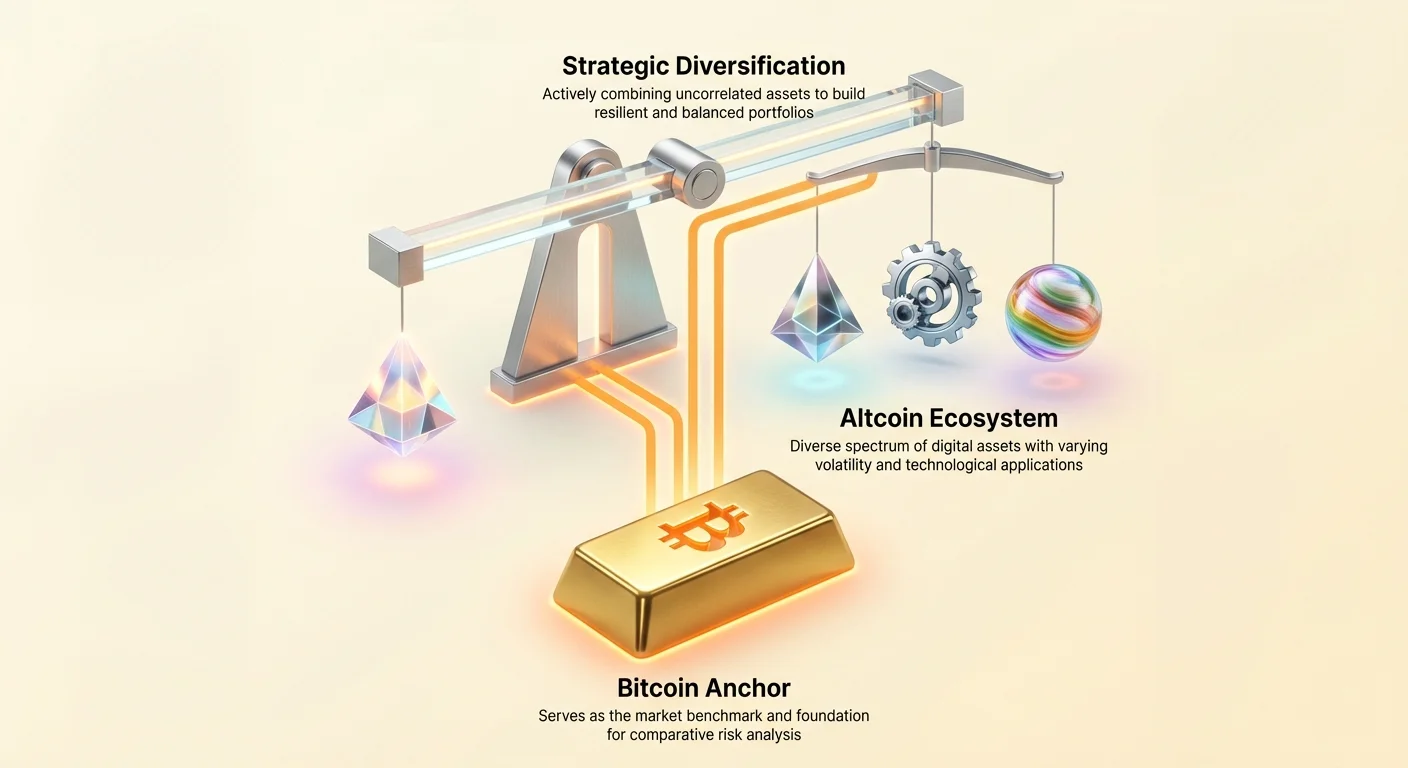
Therefore, the goal of strategic altcoin diversification is not merely to own many coins, but to identify and combine assets that exhibit less correlation to the overall market when volatility strikes.
The Core Concept: Portfolio Diversification in Crypto
Strategic diversification in the digital asset space means actively seeking assets that react differently to Bitcoin’s price action, thereby lowering the portfolio’s overall volatility profile.
Simple Diversification vs. Strategic Diversification
Simple (Naive) Diversification: This strategy involves spreading capital across a large number of assets based purely on market cap or popularity. Example: Investing 1% of your portfolio in 100 different top-200 market cap altcoins. The Flaw: If all 100 coins drop 70% during a bear market, you still lose 70% of your capital. You have diversified the asset pool but not the risk.
Strategic Diversification: This strategy involves allocating capital across different risk profiles, blockchain architectures, and use cases, with the explicit goal of minimizing overall portfolio Beta (a measure we will define shortly). Example: Pairing high-beta, high-risk DeFi tokens with low-beta, battle-tested L1 infrastructure, and hedging with yield-generating stablecoins. This mix aims to ensure that when risk assets perform poorly, conservative assets retain value or generate compensating income.
Why Bitcoin (BTC) is Often the Benchmark
Bitcoin serves as the de facto benchmark for the entire crypto asset class for several key reasons:
- Longevity and Network Effect: BTC is the oldest, most recognized, and most decentralized asset, giving it a unique status often compared to digital gold.
- Liquidity: Bitcoin possesses the deepest liquidity of any crypto asset, making it the least susceptible to catastrophic crashes caused by single large trades.
- Entry Point: Institutional capital often enters the crypto space via Bitcoin products (like ETFs), making its price movement a primary indicator of macro institutional appetite for the asset class.
Consequently, when evaluating altcoins, we generally measure their risk and return relative to Bitcoin. This comparison tool is known as Beta.
Quantifying Risk: Altcoin Beta Analysis
Beta () is arguably the most essential quantitative tool for strategic altcoin portfolio management. It allows us to move past qualitative assessments of risk and apply a measurable standard.
What is Beta in Traditional Finance?
In traditional finance (TradFi), Beta measures the sensitivity of an individual asset's price movement compared to the movement of the overall market benchmark (usually the S&P 500).
- Benchmark Beta (1.0): If an asset has a Beta of 1.0, it is expected to move in tandem with the market. If the S&P 500 rises 5%, the asset should rise 5%.
- High Beta (> 1.0): If an asset has a Beta of 1.5, it is considered more volatile than the market. If the S&P 500 rises 5%, this asset is expected to rise 7.5% (5% x 1.5). Conversely, if the market falls 5%, the asset is expected to fall 7.5%.
- Low Beta (< 1.0): If an asset has a Beta of 0.5, it is less volatile. If the market rises 5%, the asset may only rise 2.5%. These assets offer crucial defensive characteristics during downturns.
Applying Crypto Beta to Altcoins
We apply this identical concept to crypto assets, substituting the S&P 500 with Bitcoin (BTC) as the benchmark.
Interpreting Altcoin Beta:
| Altcoin Beta Range | Interpretation | Strategic Implication |
|---|---|---|
| Beta > 1.5 (High) | Extremely high correlation and volatility relative to BTC. | Used for aggressively magnifying returns during bull runs. Highest drawdown risk. (e.g., small-cap DeFi tokens, new L1s) |
| Beta ≈ 1.0 | Moves roughly in line with the market benchmark (BTC). | Core portfolio assets that track overall crypto growth. (e.g., major L1s like Ethereum) |
| Beta < 0.8 (Low) | Exhibits reduced volatility and correlation to BTC. | Defensive allocation designed to preserve capital during market consolidation or downturns. (e.g., certain stablecoin protocols, highly utilized utility tokens) |
| Negative Beta | Moves in the opposite direction of BTC (extremely rare, often temporary). | The holy grail of diversification—a true hedge. (e.g., certain inverse derivatives or assets reacting to isolated local events). |
Actionable Tip: Calculate or track the rolling 90-day Beta of your major altcoin holdings against BTC. If your portfolio is overloaded with high-Beta assets (Beta > 1.5), your risk exposure is exponentially higher than a simple calculation of your asset allocation might suggest.
The Hidden Danger: Ecosystem Correlation (Layer 1 Risk)
Even if you successfully diversify across different sectors (DeFi, Gaming, Infrastructure), a portfolio remains concentrated if all assets reside on the same base blockchain. This introduces ecosystem correlation, a form of risk that Beta analysis alone cannot fully capture.
Analyzing Intra-Ecosystem Correlation
Ecosystem correlation, or "L1 Risk," refers to the tendency of all tokens built upon a single Layer 1 blockchain to suffer simultaneous, catastrophic losses if the L1 itself faces a critical failure, security breach, or regulatory crackdown.
Consider a scenario where an investor allocates funds to a DEX token, a lending token, and a decentralized identity token. If all three are built on the same base chain (e.g., Chain X), and Chain X experiences a critical bug that halts block production for 48 hours:
- Operational Failure: All applications cease functioning.
- Liquidity Crisis: Users panic-sell L1 tokens and related ecosystem tokens.
- Regulatory Scrutiny: The entire ecosystem is questioned, creating negative sentiment.
In this instance, the investor has perfectly diversified function (DEX vs. Lending vs. Identity) but failed to diversify platform risk. The correlation of these three tokens, despite their different uses, approaches 1.0 because they share a single underlying dependency: the reliability and security of Chain X.
Best Practice: When designing a portfolio, treat diversification across L1s as a separate, essential layer of risk mitigation. This is key to understanding the asset hierarchy defined by scalability. Ensure your major sector exposures are spread across Ethereum, Solana, Cosmos, and other robust, independent ecosystems.
The Impact of Bridge and Interoperability Risk
Interoperability protocols (bridges) allow assets to move between disparate L1 ecosystems. Learn more about how to use bridges safely. While these are vital for the growth of a multi-chain future, they introduce new points of correlation risk.
A major hack on a popular cross-chain bridge does not just harm the bridge token; it damages the security perception of every chain connected to that bridge and can destabilize assets wrapped on those chains.
Liquidity and Risk Mitigation:
- Avoid Over-Reliance: Do not concentrate large amounts of capital in assets that rely on a single, experimental bridge solution.
- Focus on Native Assets: Prioritize owning native assets on their primary, most secure chain (e.g., holding ETH on the Ethereum mainnet) rather than holding a bridged version on a smaller L1, which adds smart contract risk to your portfolio.
Advanced Portfolio Techniques: Sector Rotation
Since the crypto market operates in distinct cycles—driven by narratives, technological breakthroughs, or macro events—strategic investors utilize sector rotation to capitalize on these shifts while actively reducing risk exposure to currently "hot" but highly volatile areas.
Identifying Crypto Sectors
Crypto assets can be broadly grouped by their primary function, which often dictates their risk profile and performance during different market phases: see our detailed guide on functional breakdown of categories and risk.
- Core Infrastructure (Low Beta): Bitcoin, high-security Layer 1s, decentralized storage networks. These hold value best during consolidation.
- Decentralized Finance (DeFi) (Medium/High Beta): Lending, swapping, stablecoin protocols. They perform strongly when capital is flowing and users are seeking yield.
- Consumer/Ecosystem (High Beta): Gaming, NFTs, Metaverse tokens. These are typically the last to move in a bull cycle, offering the highest volatility and risk exposure.
- Privacy and Security (Variable Beta): Assets focused on anonymity or specific security functions. These sometimes show decoupling from general market sentiment, often reacting instead to regulatory or political events.
Managing Risk Through Cyclical Shifts
Sector rotation involves moving capital proactively out of sectors that have achieved maximum growth and into undervalued sectors or defensive positions.
| Market Phase | Sector Performance (Typically) | Strategic Action |
|---|---|---|
| Early Bull Market | Capital flows into Bitcoin and primary Layer 1s (Infrastructure). | Allocate aggressively to high-quality L1s and infrastructure assets. |
| Mid-Cycle Expansion | Capital rotates from L1s into high-yield DeFi and early-stage gaming. | Reduce L1 exposure; increase allocation to proven DeFi protocols and select consumer tokens (Medium Beta). |
| Late Cycle / Peak | Frenzied activity in high-Beta, low-liquidity sectors (memecoins, new NFT projects). | Exit high-Beta/high-risk positions. Increase allocation to stablecoins and low-Beta infrastructure (defensive positioning). |
| Bear Market / Consolidation | Price stabilization; focus shifts to staking rewards and operational utility. | Focus on assets offering strong real yield and high utility (e.g., those collecting transaction fees). |
By utilizing sector rotation, you don't merely diversify passively; you actively manage your portfolio's aggregate Beta, reducing high-risk exposure when the market becomes frothy and volatile.
Mitigating Practical Risks: Liquidity and Uncorrelated Assets
Quantitative modeling (like Beta analysis) is crucial, but it must be paired with practical, operational risk management. For altcoins, the two most critical operational risks are liquidity and the lack of true hedges.
The Liquidity Trap: Exiting Positions Safely
Liquidity refers to how easily an asset can be bought or sold without significantly affecting its market price. The smaller the altcoin, the lower its liquidity, and the higher the risk.
Slippage and Market Impact: If you invest in a micro-cap altcoin that looks cheap (say, $10 million market cap), and you allocate $100,000 to it, you own 1% of the entire outstanding supply.
If you later try to sell that $100,000 position quickly, there may not be enough buyers on the decentralized exchange (DEX) at the current price. Your sale will "eat up" the existing order book, resulting in slippage—the execution price is significantly worse than the quote price. In extreme cases, selling a large position can crash the asset's price, meaning you realize only a fraction of the paper gains.
Liquidity Risk Management Best Practices:
- Volume Check: Prioritize assets with high daily trading volume (e.g., at least $5 million to $10 million daily) relative to the size of your potential investment.
- Market Depth: Check the order book or liquidity pool depth on the exchanges where the asset trades. Can the market absorb your target investment size without 2% or 3% slippage?
- Portfolio Weighting: Keep illiquid, small-cap altcoins to a very small, non-critical portion of your portfolio (often called the "Venture Capital" bucket), where the risk of poor execution is tolerable.
Finding Truly Uncorrelated Assets
While crypto correlation is high, there are assets that sometimes exhibit a lower Beta or even temporary negative correlation, providing a defensive buffer. Finding truly uncorrelated assets is paramount for portfolio stability.
1. Stablecoins and Real Yield: USDC and USDT generally have a Beta near zero against BTC (as their value is pegged to the dollar). Allocating a portion of your portfolio to stablecoins, and then placing them in audited DeFi protocols to generate real yield (e.g., lending or staking pools), allows that portion of your capital to grow even while the rest of the market crashes.
2. Privacy Assets and Protocol Utility: Certain privacy-focused coins or specific utility tokens (like those associated with decentralized compute or storage) sometimes react more strongly to their native operational milestones or regulatory threats than to the general crypto macro narrative. While not perfectly uncorrelated, they often provide defensive characteristics during market dips if their underlying utility remains strong.
3. Inverse Assets: For sophisticated investors, utilizing derivatives, such as shorting BTC or investing in inverse tokens, can provide a direct negative correlation. However, these tools carry significant liquidation and counterparty risks and are generally only recommended for advanced users familiar with leverage and collateral management.
Building a Resilient Altcoin Portfolio (Actionable Steps)
Effective altcoin portfolio construction is an exercise in intentional risk allocation, ensuring that volatility is applied only where the potential reward justifies it.
Establishing Clear Risk Buckets
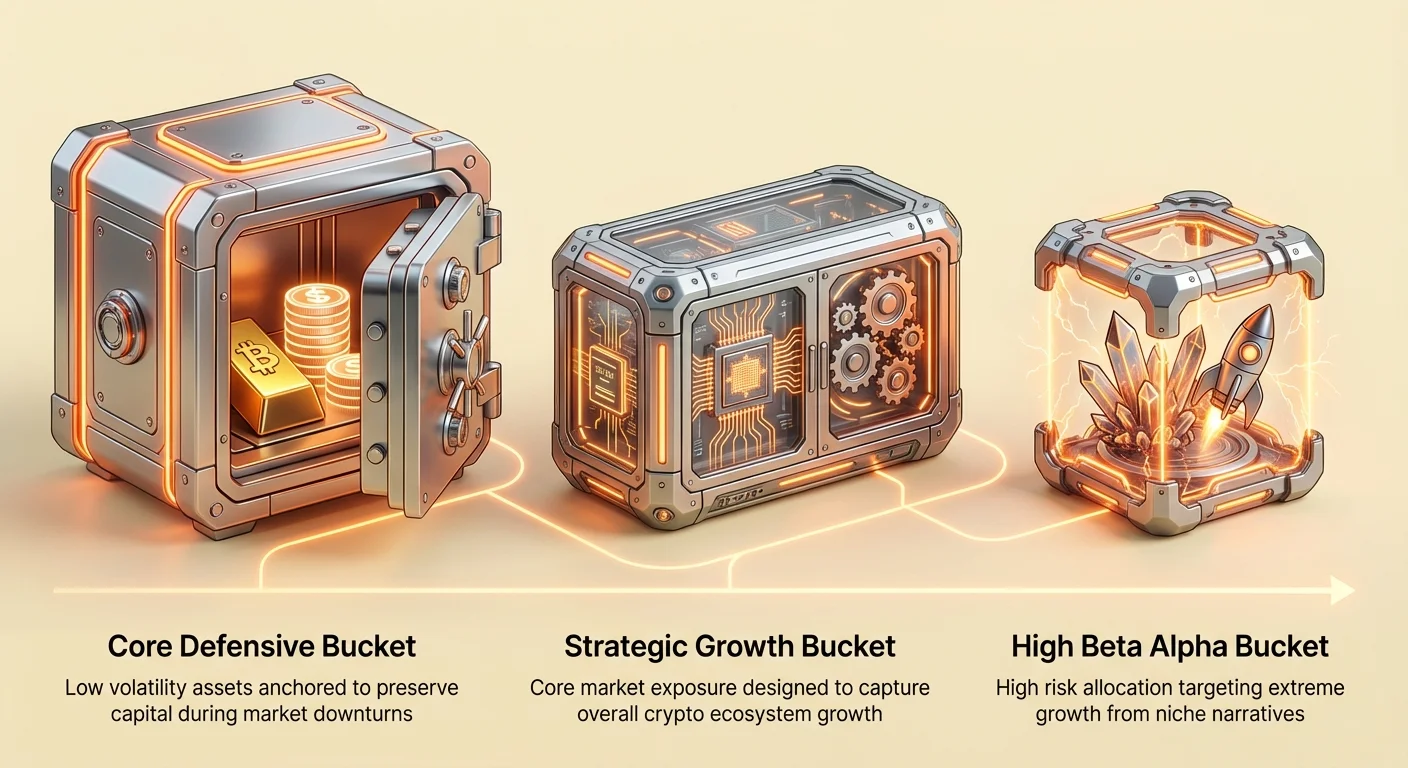
Instead of thinking of your portfolio as a list of tokens, define it by "Risk Buckets," which directly correspond to Beta thresholds. This structure ensures that potential losses from high-risk assets are offset by the stability of core holdings.
| Risk Bucket | Target Beta (vs. BTC) | Allocation (Example) | Purpose |
|---|---|---|---|
| Bucket 1: Core/Defensive | < 0.8 | 40% - 50% | Capital preservation, yield generation, and low volatility anchor. Includes BTC, high-liquidity stablecoins to generate yield, and mature L1 infrastructure. |
| Bucket 2: Strategic Growth | 0.9 - 1.3 | 30% - 40% | Core market exposure. Includes major L1s (ETH, SOL), established DeFi protocols, and market-leading exchange tokens. Designed to keep pace with overall crypto market growth. |
| Bucket 3: High-Beta / Alpha | > 1.5 | 10% - 20% | Highest risk. Targets extreme growth. Includes micro-cap tokens, new gaming projects, experimental DeFi, and tokens relying on niche narratives. |
By adhering to these buckets, you impose quantitative discipline. If your High-Beta bucket grows to 30% of the portfolio during a bull market, it’s a clear signal to rebalance and de-risk.
Rebalancing and Monitoring Beta Over Time
The work of risk management is never static. Altcoins are inherently subject to rapid shifts in technology, regulation, and market sentiment, meaning their Beta coefficients are not fixed.
Periodic Review and Rebalancing: Regularly review the Beta of your holdings (monthly or quarterly). If a high-Beta token experiences a large run-up in price, its weight in the portfolio increases, elevating the portfolio's overall risk profile.
Rebalancing Example:
- Your strategic growth token (Beta 1.2) doubles in value, increasing your overall portfolio allocation in that bucket from 30% to 45%.
- Action: Sell a portion of that high-performing token and reinvest the profits into your Core/Defensive bucket (stablecoins or BTC).
- Result: You lock in gains, reduce your overall portfolio Beta, and ensure you have dry powder to buy back in during the inevitable downturn.
The Correlation Stress Test: To truly understand the resilience of your portfolio, run mental "stress tests." Ask yourself: "If the largest regulatory body bans staking, which assets survive?" or "If Bitcoin drops 30% over a week, what is the maximum expected drawdown of my portfolio based on the aggregate Beta?" By constantly questioning the correlation between your holdings under various adverse scenarios, you uncover and mitigate hidden risks.
Conclusion
Building a resilient altcoin portfolio is a blend of technological understanding and disciplined financial modeling. In a market defined by high correlation and extreme volatility, simple diversification across many tokens is insufficient.
By adopting quantitative tools like Beta analysis, actively managing ecosystem correlation risk by spreading assets across different Layer 1s, and implementing strategic sector rotation, investors can transcend the limitations of the correlated crypto market. The focus shifts from merely seeking high returns to intentionally controlling risk, ensuring that when the inevitable downturns arrive, your portfolio is structured to preserve capital and survive to capitalize on the next growth cycle. Self-sovereignty requires not just owning your assets, but understanding the mechanisms of risk that govern their value.