
Bitcoin was designed as a decentralized peer-to-peer electronic cash system. Its primary focus has always been security and censorship resistance rather than raw speed. As the network grew in popularity, a critical bottleneck emerged regarding transaction throughput. The original design supports approximately seven transactions per second.
This limitation often results in network congestion during periods of high demand. When the mempool fills up, transaction fees rise significantly, and confirmation times extend. This dynamic makes the base layer impractical for small, everyday payments like buying a cup of coffee.
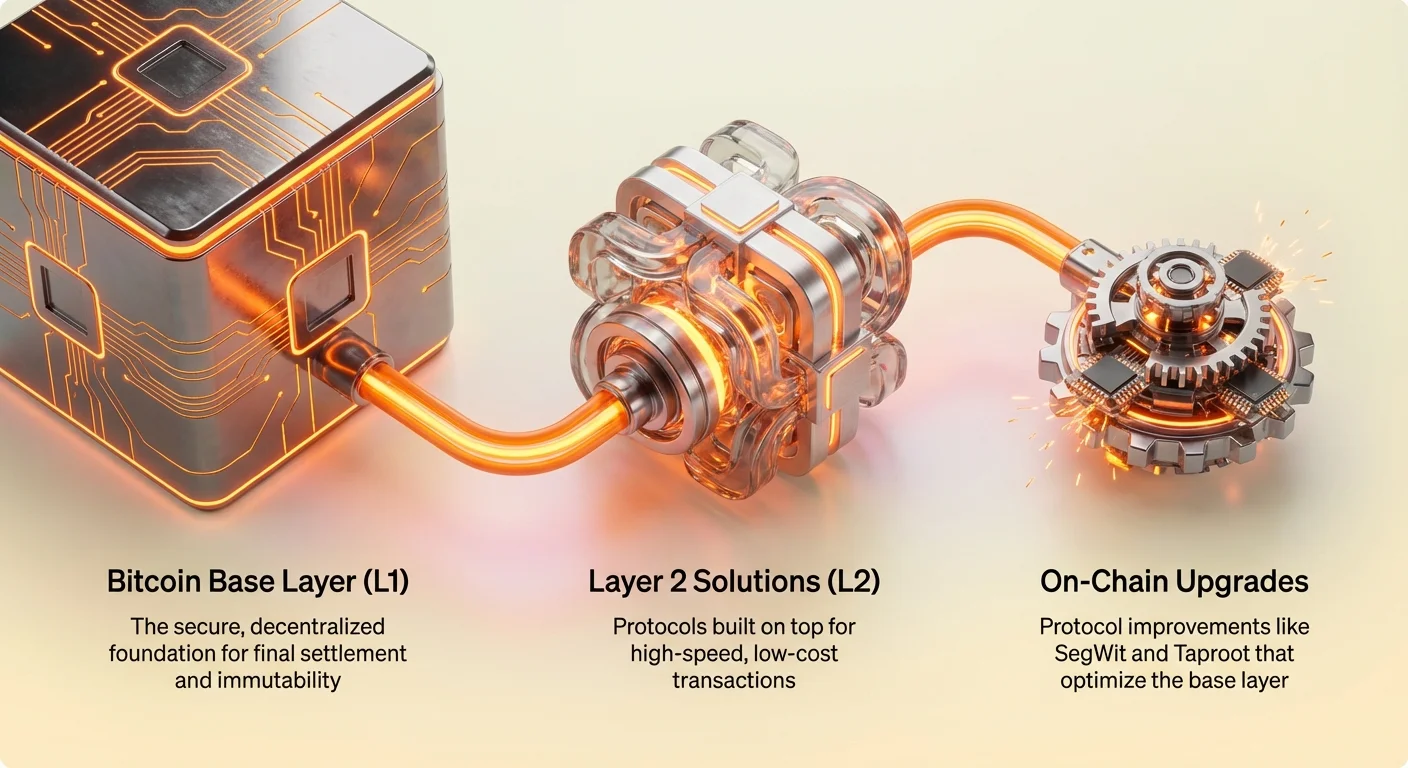
To address this without compromising the network's core values, developers utilize a layered approach. This strategy involves building secondary protocols on top of the main blockchain. These layers handle high-volume processing while relying on the base layer for final settlement and security.
The Governance of Protocol Evolution
Understanding how Bitcoin scales requires understanding how the protocol changes. Unlike centralized systems where a CEO mandates upgrades, Bitcoin evolves through a process of consensus building. There is no formal government or ruler. Instead, stakeholders must agree on changes.
Bitcoin Improvement Proposals
The mechanism for introducing upgrades is the Bitcoin Improvement Proposal. Developers draft these technical documents to suggest changes to the code. These proposals undergo rigorous peer review and public debate. The goal is to achieve "rough consensus," meaning most participants are satisfied that objections are wrong or addressed.
Once a proposal has sufficient support, it is integrated into the Bitcoin Core software. However, the upgrade does not activate until a defined threshold of the network nodes installs the new version. This ensures that the users, not just the developers, retain ultimate control over the protocol's rules.
The Role of Consensus
Consensus is the bedrock of the network. Miners, node operators, and end-users form a system of checks and balances. Miners produce blocks, but nodes validate them. If miners attempt to push valid blocks that violate the protocol rules enforced by nodes, the nodes will simply reject them.
This dynamic ensures that no single group can hijack the network. Economic incentives force miners to follow the consensus rules, or they risk mining on a chain that the economic majority ignores. This stability makes upgrades difficult but ensures that only critical, widely accepted changes occur.
On-Chain Upgrades: Laying the Foundation
Before Layer 2 solutions could flourish, the base layer needed optimization. Several key upgrades have improved Bitcoin's efficiency and ability to support complex protocols. These on-chain improvements paved the way for modern scaling solutions.
Segregated Witness (SegWit)
Activated in 2017, Segregated Witness was a pivotal upgrade. It addressed a transaction malleability bug and increased the effective block size. SegWit works by separating the digital signature data, known as the "witness," from the transaction data.
By moving this data to a separate structure, SegWit allowed more transactions to fit into a single block. This effectively increased the block size limit without a hard fork. Crucially, fixing the malleability issue made it safer to build second-layer protocols like the Lightning Network.
The Taproot Upgrade
Activated in November 2021, Taproot further enhanced privacy and efficiency. It combined three BIPs to introduce Schnorr signatures and Merkelized Abstract Syntax Trees (MAST). Schnorr signatures allow multiple signatures to be aggregated into one.
This aggregation reduces the data size of complex multi-signature transactions. It makes complex smart contracts look identical to standard transactions on the blockchain. This efficiency gain reduces fees and improves privacy, while MAST enables more complex conditions for spending Bitcoin.
The Fork in the Road: Hard vs. Soft Forks
Scaling debates have not always been peaceful. The community has historically fractured over how best to increase capacity. The most significant disagreement led to the creation of Bitcoin Cash in 2017. This event highlighted the difference between soft forks and hard forks.
Soft Forks and Backward Compatibility
Most successful upgrades, like SegWit and Taproot, are soft forks. These are backward-compatible changes. Nodes running older software can still recognize blocks created by nodes running the new software. This allows the network to upgrade gradually without splitting.
Soft forks respect the opt-in nature of the network. Users who do not wish to upgrade are not forced off the network, although they may miss out on new features. This method is preferred for maintaining network cohesion and preventing fragmentation.
Hard Forks and Network Splits
A hard fork occurs when a protocol change is not backward compatible. Nodes running the old software view the new blocks as invalid. If the entire community does not agree to upgrade simultaneously, the chain splits in two.
The Bitcoin Cash fork was a result of a disagreement over block size. Proponents wanted to increase the block size limit to handle more transactions on-chain. The majority of the Bitcoin network rejected this, preferring to scale via Layer 2 solutions to preserve decentralization. This resulted in two separate currencies with shared history but different futures.
Understanding Layer 2 Architectures
Layer 2 (L2) solutions are protocols built on top of the main Bitcoin blockchain. Their purpose is to process transactions off the main chain to increase speed and lower costs. They periodically settle the final state of these transactions on the Bitcoin mainnet.
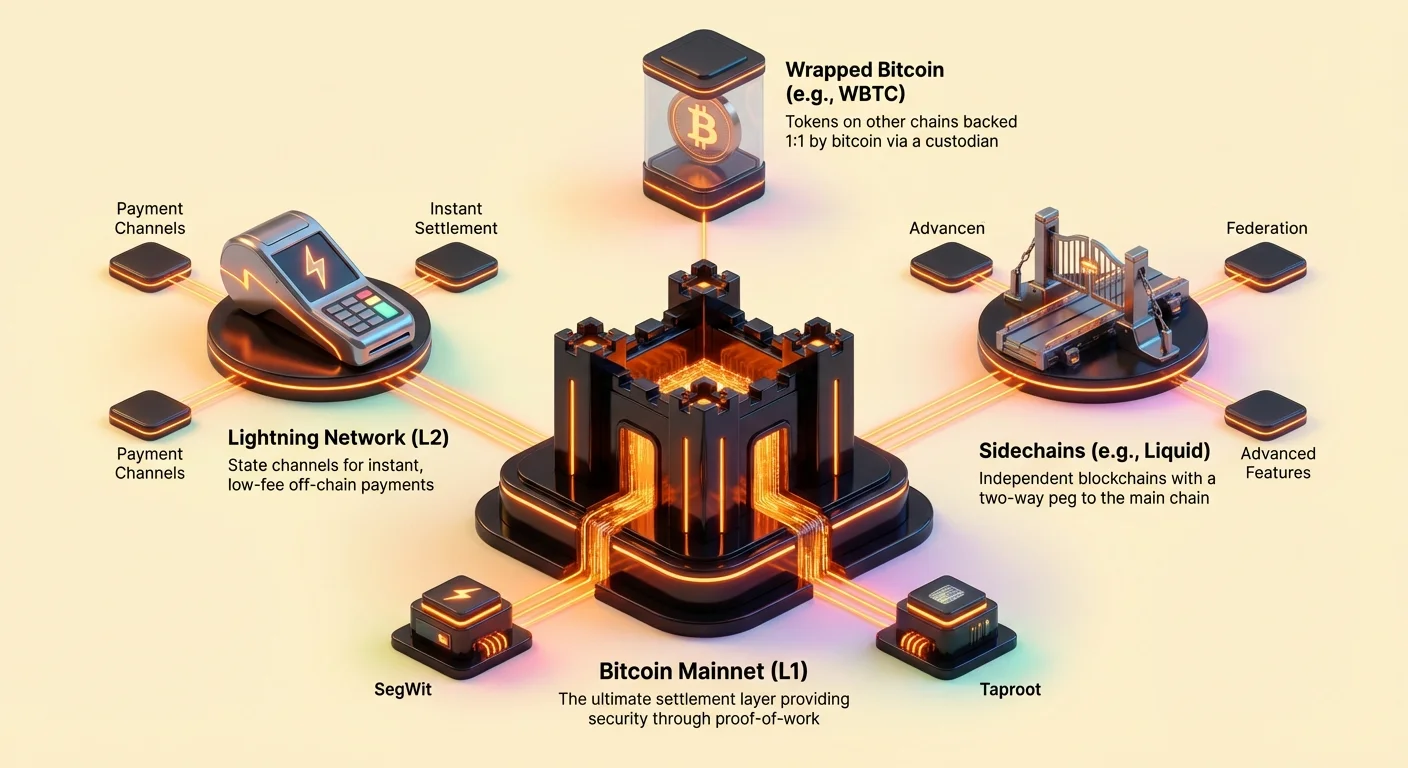
This architecture creates a separation of duties. The main chain serves as the settlement layer, providing ultimate security and immutability. The second layer acts as the execution layer, handling high throughput and complex programmability.
| Feature | Layer 1 (Bitcoin) | Layer 2 Solutions |
|---|---|---|
| Primary Role | Settlement & Security | Execution & Speed |
| Throughput | ~7 TPS | Thousands of TPS |
| Cost | High (variable) | Low (often negligible) |
The Security Trade-off
The relationship between layers involves trade-offs. Layer 1 offers the highest security because it is protected by the immense hash power of the Bitcoin mining network. Layer 2 solutions often derive security from Layer 1 but introduce their own risks.
Some L2s rely on their own consensus mechanisms or validators. Others, like state channels, rely on the ability to broadcast a penalty transaction to Layer 1 if a counterparty cheats. Understanding these nuances is essential for users navigating the scaling landscape.
The Lightning Network
The Lightning Network is the most prominent Layer 2 solution for Bitcoin. It uses a system of state channels to allow two parties to transact rapidly and cheaply. These transactions occur off-chain and are only recorded on the blockchain when the channel is opened or closed.
How Payment Channels Work
To use the Lightning Network, two parties create a payment channel by locking a certain amount of Bitcoin into a multi-signature address. This opening transaction is recorded on the blockchain. Once confirmed, the channel is open.
The parties can then send funds back and forth instantly. Each transaction updates the "state" of the channel, redistributing the balance between them. These updates are signed by both parties but are not broadcast to the blockchain. This avoids mining fees and confirmation delays for every individual payment.
Closing and Settlement
When the parties finish transacting, they close the channel. The final state, reflecting the current balance of each party, is broadcast to the Bitcoin network. The blockchain settles the funds according to this final distribution.
Crucially, the network allows for routing. You do not need a direct channel with everyone you pay. If Alice has a channel with Bob, and Bob has a channel with Carol, Alice can pay Carol through Bob. This network effect allows for global connectivity with minimal on-chain footprint.
Sidechains and Federation
Sidechains offer a different approach to scaling. A sidechain is an independent blockchain that runs in parallel to Bitcoin. It has its own consensus rules and can support features that Bitcoin does not, such as faster block times or advanced smart contracts.
The Two-Way Peg mechanism
Connecting a sidechain to Bitcoin requires a two-way peg. Users send Bitcoin to a specific address on the main chain, where it is locked. The sidechain then mints an equivalent amount of a token that represents the locked Bitcoin.
When a user wants to return to the main chain, they burn the sidechain tokens. The main chain then releases the original Bitcoin. This mechanism allows assets to move between chains, enabling users to leverage the features of the sidechain while retaining exposure to Bitcoin's price.
Security and Consensus Models
Unlike the Lightning Network, sidechains often do not inherit Bitcoin's security directly. They are responsible for their own security. This is often managed by a federation or a unique consensus mechanism.
A federation is a group of functionaries who manage the two-way peg. They validate transfers and ensure the peg remains solvent. While efficient, this introduces a trust assumption. Users must trust the federation not to collude and steal the locked funds. Examples like the Liquid Network use this federated model.
Bridging Bitcoin to DeFi
The rise of Decentralized Finance (DeFi) on Ethereum created a demand to use Bitcoin in smart contracts. Since Bitcoin does not natively support complex stateful contracts, "wrapped" versions of Bitcoin were developed to bridge the asset to other chains.
Centralized Wrapping: WBTC
Wrapped Bitcoin (WBTC) is an ERC-20 token on Ethereum backed 1:1 by Bitcoin. It relies on a custodial model. Users send Bitcoin to a merchant, who initiates a minting process with a custodian. The custodian holds the real Bitcoin and mints the WBTC.
This model is efficient but centralized. Users must trust the custodian and the merchant network. The reserves are verifiable on-chain, but the physical custody of the asset depends on a trusted third party. This introduces counterparty risk that decentralized purists often seek to avoid.
Decentralized Bridging: tBTC
Threshold Bitcoin (tBTC) offers a decentralized alternative. It uses a network of random nodes running threshold cryptography. No single signer has full control over the Bitcoin wallet. Instead, a group of signers must agree to move funds.
Threshold Bitcoin (tBTC) offers a decentralized alternative. It uses a network of random nodes running threshold cryptography. No single signer has full control over the Bitcoin wallet. Instead, a group of signers must agree to move funds.
| Type | Custody Model | Trust Assumption |
|---|---|---|
| WBTC | Centralized Custodian | Trust the company |
| tBTC | Decentralized Threshold | Trust the code/network |
| cbBTC | Centralized Exchange | Trust Coinbase |
Emerging Innovation: Ordinals and Inscriptions
While Layer 2s focus on financial transactions, other innovations are expanding Bitcoin's utility for data. Bitcoin Ordinals is a protocol that assigns a unique number to individual satoshis based on the order they were mined.
Inscribing Data on Satoshis
Using the Ordinals protocol, users can "inscribe" data directly onto a specific satoshi. This data can be text, images, or even video. This effectively creates Non-Fungible Tokens (NFTs) that are native to the Bitcoin blockchain.
Unlike Ethereum NFTs, which often point to off-chain storage, Ordinal inscriptions are stored directly on the blockchain. This permanence is attractive to collectors. However, it has sparked debate about blockchain bloat and whether non-financial data should occupy valuable block space.
Technical Enablers
Ordinals were made possible by the SegWit and Taproot upgrades. SegWit discounted the cost of witness data, making it cheaper to store large data files. Taproot removed certain size limits on transaction scripts.
These unintended consequences of upgrades demonstrate the permissionless nature of Bitcoin. Once the rules are set, developers can use them in creative ways that the original architects may not have anticipated.
Fractal Bitcoin and Recursive Scaling
As the demand for block space grows, new scaling concepts continue to emerge. Fractal Bitcoin is a proposed framework that uses a multi-layered approach. It envisions a network of smaller, interconnected blockchains called "fractals."
Parallel Processing
These fractal chains operate in parallel to the main chain. They can process transactions independently, significantly increasing the total throughput of the system. Transactions are routed to the appropriate fractal based on size and priority.
The state of these fractals is periodically settled on the main Bitcoin blockchain. This structure mimics the self-similar patterns found in fractals in nature. It aims to provide unlimited scaling by adding more layers as demand increases, all anchored to Bitcoin's security.
Smart Contracts and OP_CAT
Bitcoin's scripting language is intentionally limited to ensure security. However, there is a growing push to enable more complex smart contracts on the base layer. One such proposal is the reinstatement of an old opcode called OP_CAT.
Restoring Functionality
OP_CAT (Concatenate) allows two pieces of data to be combined in a script. It was removed in the early days of Bitcoin due to concerns about memory usage. Modern hardware and better understanding of the protocol have led developers to propose its return.
If enabled, OP_CAT could allow for "covenants." These are scripts that restrict how funds can be spent in future transactions. This would enable more advanced on-chain vaults, better bridges, and more efficient Layer 2 constructions without needing a full Turing-complete language.
The Trade-off Landscape
Scaling Bitcoin is not about finding a single perfect solution. It is about managing trade-offs. Every solution prioritizes different attributes of the "Blockchain Trilemma": decentralization, security, and scalability.
Speed vs. Trust
Layer 2 solutions like Lightning prioritize speed and low cost but introduce complexity in channel management. Sidechains offer advanced features but often require trusting a federation. Wrapped assets offer DeFi access but introduce counterparty risk.
Users must choose the tool that fits their needs. For high-value settlement, the main chain is best. For buying coffee, Lightning is superior. For decentralized finance, a sidechain or bridged asset might be necessary.
Complexity and User Experience
The proliferation of layers increases technical complexity. Managing channels, bridging assets, and understanding peg mechanisms can be daunting for average users. The challenge for the industry is to abstract this complexity away.
Wallets and applications are increasingly handling these details in the background. Ideally, a user should not need to know if they are using Lightning, a sidechain, or the main chain. They simply want a fast, secure payment experience.
Conclusion
The Bitcoin scaling ecosystem has evolved from simple block size debates into a diverse landscape of layered protocols. Solutions like the Lightning Network address the need for instant payments, while sidechains and wrapped assets unlock complex functionality and DeFi integration.
Upgrades like SegWit and Taproot have proven that the base layer can evolve to support these innovations without sacrificing security. However, each step forward involves calculating trade-offs between decentralization, speed, and ease of use.
The future of Bitcoin lies in the seamless integration of these layers. As technology matures, the distinction between on-chain and off-chain activities will blur, offering a unified experience that maintains the core principles of sound money.
Bitcoin scales through layers, allowing users to choose between the ultimate security of the main chain and the speed of secondary protocols.