
มากว่า 10 ปีแล้วที่ Bitcoin ได้ทำหน้าที่เป็นพื้นฐานของความขาดแคลนทางดิจิทัลและอธิปไตยส่วนบุคคล โดยหลักแล้วทำหน้าที่เป็นบัญชีแยกประเภทที่แข็งแกร่งและไม่สามารถเปลี่ยนแปลงได้สำหรับการโอนมูลค่า อย่างไรก็ตาม สถาปัตยกรรมที่ออกแบบโดย Satoshi Nakamoto—แม้จะปฏิวัติ—ก็มาพร้อมกับข้อจำกัดโดยธรรมชาติ โดยเฉพาะอย่างยิ่งในเรื่องความยืดหยุ่นของสคริปต์ ความเป็นส่วนตัว และประสิทธิภาพการทำธุรกรรม
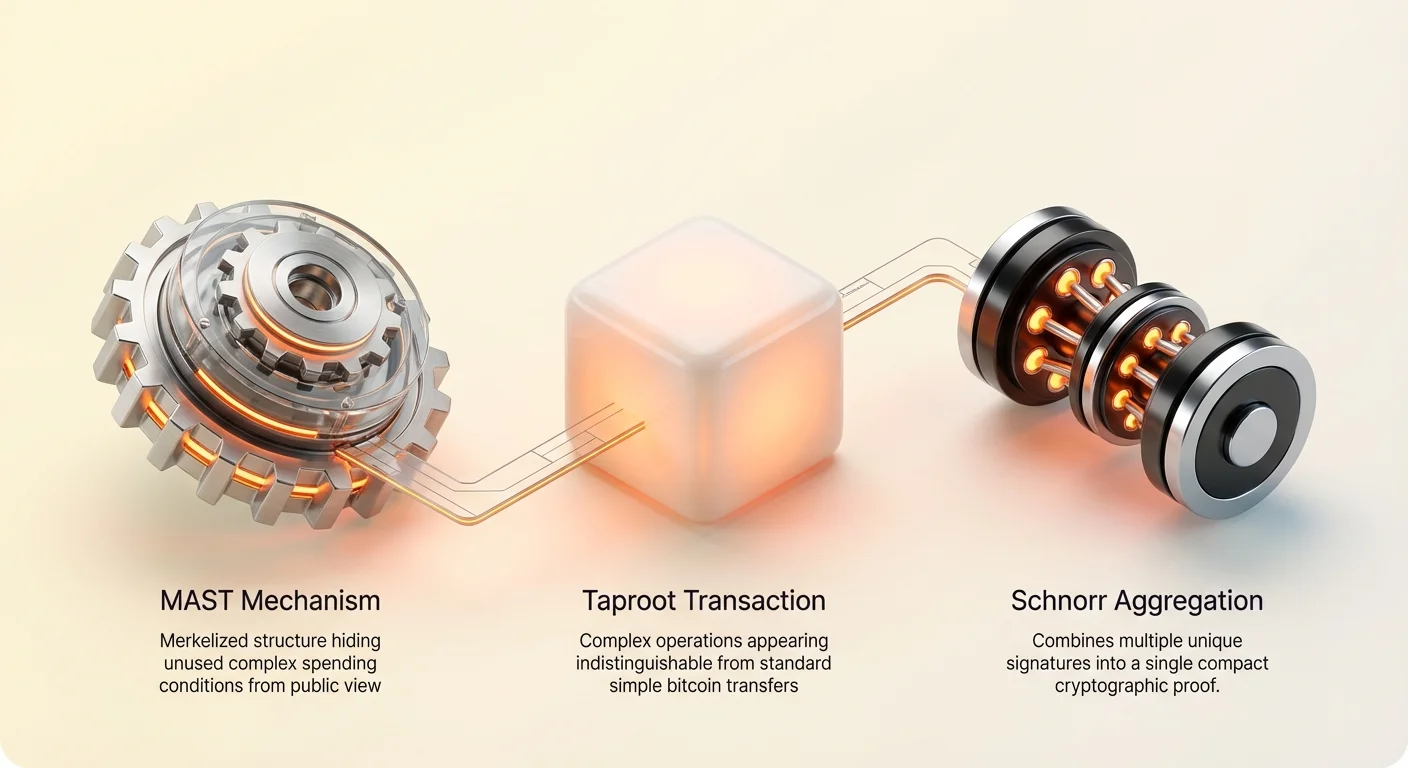
การอัปเกรด Taproot ที่เปิดใช้งานในปลายปี 2021 ถือเป็นการปรับปรุงที่สำคัญที่สุดต่อชั้นฐาน (Layer 1) ของ Bitcoin นับตั้งแต่ SegWit ในปี 2017 Taproot ไม่ใช่คุณสมบัติเดี่ยว แต่เป็นชุดเทคโนโลยีที่เกี่ยวข้องกันสามอย่างอย่างซับซ้อน: MAST (Merkelized Abstract Syntax Trees), Schnorr Signatures, และ Pay-to-Taproot (P2TR) addresses.
การอัปเกรดนี้เปลี่ยนแปลงพื้นฐานวิธีการดำเนินการธุรกรรมที่ซับซ้อนบนเครือข่าย ขณะที่ธุรกรรมเก่าจะประกาศเงื่อนไขการใช้จ่ายที่เป็นไปได้ทั้งหมดไปยังโลก—ใช้พื้นที่บล็อกที่สำคัญและเปิดเผยข้อมูลที่ละเอียดอ่อน—Taproot ช่วยให้สคริปต์ที่ซับซ้อนดูไม่แตกต่างจากชำระเงินแบบเดี่ยวลายเซ็นง่ายๆ การเปลี่ยนแปลงทางสถาปัตยกรรมนี้ปรับปรุงความเป็นส่วนตัวอย่างมาก ลดต้นทุน และที่สำคัญ วางรากฐานโครงสร้างที่แข็งแกร่งที่จำเป็นสำหรับ Bitcoin เพื่อรองรับสัญญาอัจฉริยะขั้นสูงและโซลูชัน Layer 2 (L2) ที่ขยายขนาดได้ เช่น Lightning Network จุดมุ่งเน้นของเราที่นี่ไม่ใช่แค่ อะไร Taproot คือ แต่ วิธีที่ มันช่วยให้ผู้พัฒนาสร้างแพลตฟอร์มการเงินกระจายอำนาจและเครื่องมือดูแลตนเองรุ่นต่อไปบนบล็อกเชนที่ปลอดภัยที่สุดในโลก
The Problem Taproot Solves: Bitcoin's Original Scripting Limitations
To understand the genius of Taproot, we must first recognize the constraints of Bitcoin’s original scripting language. Bitcoin uses a simple, stack-based language (often called Script) to define the rules for spending funds.
Anatomy of a Simple Bitcoin Transaction
Before Taproot, most Bitcoin transactions utilized either Pay-to-Public-Key-Hash (P2PKH), which is the standard single-signature payment, or Pay-to-Script-Hash (P2SH), which allowed for more complex rules like multi-signature requirements or time-locks.
When you spend funds using P2SH, the network must verify that the conditions you set (the script) are met. Crucially, when a transaction is spent, the entire script is published on the blockchain, along with the proof (the signature) that satisfies it.
For instance, if you set up a multi-signature transaction requiring 2 out of 3 keys to agree (a 2-of-3 multisig), the public record would show all three potential keys, the requirement (2-of-3), and the two required signatures, regardless of how simple the actual execution was.
The Cost of Complex Transactions
This requirement to publish the entire, potentially complex spending script had significant drawbacks:
- Reduced Privacy (Information Leakage): Revealing the entire script exposes all possible ways the funds could have been spent, even if only one path was ultimately chosen. In the 2-of-3 example, the identities of all three key holders are exposed, even if they were dormant.
- Increased Transaction Size and Fees: Complex scripts, especially those involving many participants or conditional time-locks, take up much more block space. Since fees are primarily determined by transaction size, this made sophisticated custody solutions (like corporate treasury multi-sig or intricate inheritance plans) very expensive and inefficient.
- Lack of Fungibility: Fungibility means that one unit of a currency is interchangeable with any other. When a complex script is clearly visible on the blockchain, it makes that specific transaction output look different from a standard, simple transaction output. This visual distinction can make it easier for external parties to track certain types of funds, harming the overall fungibility of Bitcoin.
MAST: ทำให้สคริปต์ที่ซับซ้อนดูเรียบง่าย
ต้นไม้ไวยากรณ์นามธรรมเมอร์เคลไลซ์ (MAST) คือแนวคิดทางคริปโตกราฟีหลักที่ช่วยให้ Taproot สามารถแก้ปัญหาความโปร่งใสและประสิทธิภาพที่เป็นปัญหาพื้นฐานใน P2SH
การทำความเข้าใจต้นไม้เมอร์เคิล
เพื่อเข้าใจ MAST เราต้องเข้าใจต้นไม้เมอร์เคิล (หรือที่รู้จักในชื่อ Hash Tree) ก่อน โครงสร้างข้อมูลนี้เป็นรากฐานของ Bitcoin เอง เนื่องจากบล็อกทุกบล็อกใช้ต้นไม้เมอร์เคิลเพื่อสรุปธุรกรรมทั้งหมดในบล็อกนั้นอย่างมีประสิทธิภาพ
ต้นไม้เมอร์เคิลทำงานเหมือนระบบจัดไฟล์ดิจิทัล:
- ชิ้นส่วนข้อมูลแต่ละชิ้น (ในกรณีของ MAST คือเงื่อนไขการใช้จ่ายที่เป็นไปได้ หรือ “script path”) จะถูกรวบรวมแฮชแยกต่างหาก
- แฮชเดี่ยวเหล่านี้จะถูกรวบคู่และแฮชรวมกัน โดยเลื่อนขึ้นไปในโครงสร้างต้นไม้
- กระบวนการนี้ดำเนินต่อไปจนกว่าข้อมูลทั้งหมดจะถูกบีบอัดให้เหลือแฮชสรุปเดียวที่เรียกว่า Merkle Root
ข้อได้เปรียบอันทรงพลังของ Merkle Root คือช่วยให้ใครก็ตามสามารถยืนยันว่าชิ้นส่วนข้อมูลเฉพาะเจาะจงนั้นรวมอยู่ในชุดนั้น โดยเพียงแค่ให้แฮชกลางจำนวนน้อย (Merkle Path) แทนการต้องแสดง ทั้งหมด ของข้อมูล
MAST ซ่อนเงื่อนไขที่ยังไม่ถูกเรียกใช้อย่างไร
MAST นำแนวคิดต้นไม้เมอร์เคิลนี้ไปประยุกต์ใช้กับเงื่อนไขการใช้จ่ายของธุรกรรม
ลองนึกภาพสัญญาอัจฉริยะที่ซับซ้อนซึ่งมีเส้นทางที่เป็นไปได้สี่เส้นทางสำหรับการใช้จ่ายเงินทุน:
- เส้นทาง A: Alice และ Bob ลงนามทั้งคู่ (การใช้จ่ายมาตรฐาน)
- เส้นทาง B: หลังจาก 90 วัน เฉพาะ Alice เท่านั้นที่ลงนามได้ (การกู้คืนแบบล็อกเวลา)
- เส้นทาง C: หลังจาก 180 วัน เฉพาะคีย์สำรองที่ลงนาม (มรดก/ความปลอดภัย)
- เส้นทาง D: ต้องการข้อมูลนำเข้าจาก oracle (เช่น ตัวกระตุ้นข้อมูลสภาพอากาศ)
โดยใช้โมเดล P2SH รุ่นเก่า เส้นทางทั้งสี่ (A, B, C และ D) จะถูกเปิดเผยบนบล็อกเชนเมื่อเงินทุนถูกใช้จ่าย
โดยใช้ MAST:
- เส้นทางแต่ละเส้นทาง (A, B, C, D) คือ “ใบ” ของต้นไม้เมอร์เคิล
- เส้นทางทั้งสี่ถูกสรุปให้เป็น MAST Root เดียว
- เมื่อ Alice และ Bob ดำเนินการ Path A พวกเขาจะเผยแพร่เฉพาะสคริปต์ของเส้นทาง A และหลักฐานคริปโตกราฟีขนาดเล็ก (Merkle Path) ที่จำเป็นเพื่อพิสูจน์ว่า Path A รวมอยู่ใน MAST Root
ประโยชน์สำคัญ: การมีอยู่ของเส้นทาง B, C และ D ถูกเปิดเผยโดย Merkle Root แต่เนื้อหาสคริปต์จริงของมันยังคงเป็นส่วนตัวโดยสมบูรณ์และไม่ถูกเผยแพร่บนเชน เฉพาะเส้นทางที่ถูกดำเนินการเท่านั้นที่ถูกเปิดเผย ส่งผลให้ประหยัดพื้นที่มหาศาลและเพิ่มความลับข้อมูล
ตัวอย่างในทางปฏิบัติ: สถานการณ์ Multi-Sig
พิจารณาคลังเงินของบริษัทที่ต้องการการลงนามแบบ 3 จาก 5 สำหรับค่าใช้จ่ายประจำ แต่ยังต้องการเส้นทางลงนามแบบง่าย 1 จาก 5 (หลัง 6 เดือน) สำหรับการชำระบัญชีฉุกเฉินหากบริษัทเลิกกิจการ
- ก่อน MAST: สคริปต์มาตรฐาน 3 จาก 5 และสคริปต์ฉุกเฉิน 1 จาก 5 ต้องถูกกระจายไปยังเชนทั้งคู่ เพิ่มขนาดธุรกรรมและเปิดเผยกฎการใช้จ่ายฉุกเฉินให้ทุกคนทราบ
- ด้วย MAST: หากใช้เส้นทาง 3 จาก 5 จะกระจายเฉพาะสคริปต์ 3 จาก 5 พร้อมหลักฐานขนาดเล็กว่ามันเป็นส่วนหนึ่งของสัญญา เส้นทางชำระบัญชีฉุกเฉิน 1 จาก 5 ยังคงซ่อนอยู่ใน MAST Root และจะถูกเปิดเผยเฉพาะเมื่อถูกดำเนินการจริงในภายหลัง
MAST เปลี่ยนแปลงเงื่อนไขที่ซับซ้อนให้กลายเป็นหลักฐานที่มีประสิทธิภาพ แน่นหนา และเป็นส่วนตัวอย่างสิ้นเชิง
Schnorr Signatures: The Key to Efficiency and Privacy
While MAST addresses script complexity, the second major component of Taproot—Schnorr signatures—addresses signature efficiency, security, and anonymity. Bitcoin originally used the Elliptic Curve Digital Signature Algorithm (ECDSA). Schnorr is a mathematically superior alternative that brings two immense benefits: signature aggregation and enhanced security proofs.
The Technical Superiority of Schnorr vs. ECDSA
ECDSA signatures, while secure, are bulky and necessitate individual verification. If a transaction requires three signatures, the blockchain requires three separate blocks of signature data, and the network nodes must verify those three distinct blocks sequentially.
Schnorr signatures, based on simpler math and security assumptions, offer a significant advantage: linearity. This means that multiple public keys can be combined into a single, valid aggregated public key, and multiple signatures can be combined into a single, valid aggregated signature.
Signature Aggregation: Batch Verification and Efficiency
Signature aggregation is perhaps the most visible improvement Taproot brings to scaling:
- Multi-Party Efficiency: In a 5-of-5 multi-signature transaction using Schnorr, the five required public keys can be cryptographically merged into one new public key, and the five corresponding signatures can be merged into a single, aggregated signature.
- Blockchain Interpretation: To the rest of the Bitcoin network, this aggregated transaction looks exactly like a standard, single-signature payment (P2PKH).
- Verification Speed: Nodes verify this single aggregated signature faster than verifying five individual ECDSA signatures. This improvement saves computational power for every network participant and drastically reduces the data size of complex transactions.
This capability is revolutionary for multi-party applications like corporate custody, joint ownership wallets, and, most importantly, Layer 2 scaling solutions.
The Privacy Dividend (Key Aggregation and the P2TR Format)
The ability to aggregate keys and signatures provides a critical boost to privacy and fungibility.
If a multi-sig transaction looks identical to a standard single-signature transaction, outside observers cannot determine if the transaction was complex (requiring multiple parties, time-locks, or specialized contracts) or simple (just one person sending money).
This introduces true output uniformity to the network, meaning sophisticated smart contract outputs are functionally indistinguishable from simple peer-to-peer payments. This significantly strengthens Bitcoin's fungibility, ensuring all satoshis are treated equally by observers.
Taproot Explained: The Seamless Integration of MAST and Schnorr
Taproot is the overarching implementation that ties MAST for conditional execution and Schnorr for signature efficiency together under a new, unified address type.
Pay-to-Taproot (P2TR) Addresses
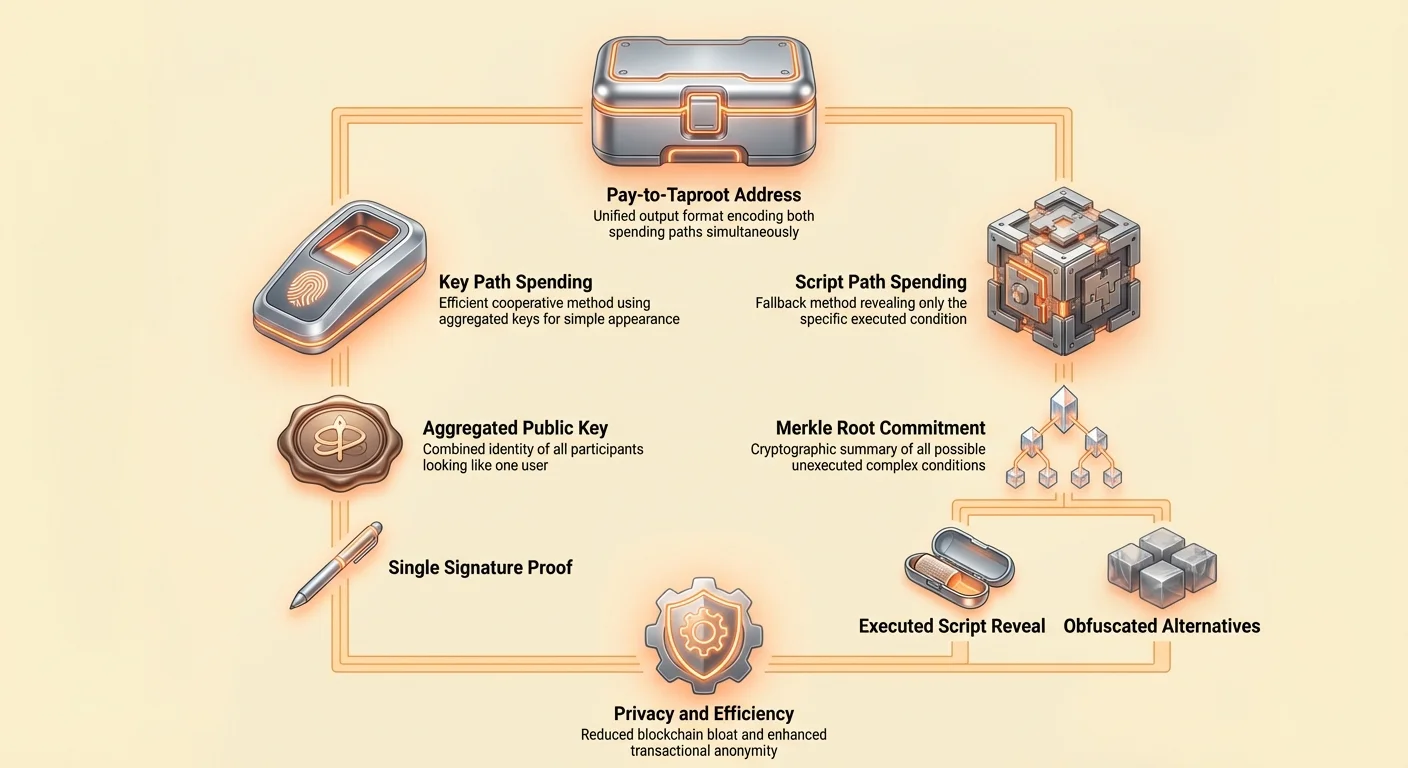
Taproot introduces a new standard output type called Pay-to-Taproot (P2TR). P2TR outputs encode not just a single public key, but a combination of a public key (for the Schnorr key aggregation path) and the Merkle Root of all potential spending scripts (for the MAST script path).
When funds are sent to a P2TR address, the transaction effectively locks the funds using two distinct methods simultaneously: the Key Path and the Script Path.
The Key Path vs. The Script Path (The Choice Mechanism)
Taproot is designed around a simple, efficient trade-off: if all parties cooperate, use the simple, cheap path; if they disagree or require complex conditions, use the slightly more expensive but robust path.
1. The Key Path (The Ideal Scenario)
The Key Path is the preferred and most efficient way to spend funds locked in a P2TR output. This path is activated when all original participants agree on the spending conditions and cooperate.
- How it works: All participants aggregate their public keys into a single Taproot key, and then aggregate their signatures into a single Schnorr signature.
- Result: The on-chain transaction looks exactly like a standard, single-signer P2PKH transfer. The entire MAST structure remains hidden, saving space and preserving privacy. This path is maximally cheap and efficient.
2. The Script Path (The Conditional Scenario)
The Script Path is activated if the participants cannot cooperate, or if the transaction requires a predetermined script condition (like a time-lock or the input of an oracle).
- How it works: The spending transaction reveals the specific script condition that was met (e.g., "Time-lock of 90 days has passed") and the small Merkle Proof required to validate that this script was indeed part of the original MAST Root.
- Result: This transaction is slightly larger than the Key Path, but still significantly smaller and more private than the old P2SH model, because it only reveals the one executed script, keeping all other potential spending conditions private.
Achieving Script Obfuscation
The combination of the Key Path and the Script Path achieves a powerful property called script obfuscation.
From the perspective of an outside observer analyzing the blockchain:
- If the Key Path is used (which is anticipated to be the most common usage for cooperative parties, especially in L2 solutions), the transaction is completely opaque and private. It looks like simple spending.
- Even if the Script Path is used, the observer only learns about the specific condition that was met, not the details of all the alternative conditions that were also possible.
This seamless integration ensures that simple, cooperative uses are highly efficient, while complex, conditional uses remain highly private—a massive leap forward for Layer 1 flexibility.
ผลกระทบของ Taproot ต่อการพัฒนา Bitcoin สมัยใหม่
Taproot ไม่ใช่แค่อัปเกรดทางความงาม แต่เป็นการอัปเดตโครงสร้างพื้นฐานที่สำคัญที่สุดที่ช่วยให้ Bitcoin ก้าวข้ามการโอนมูลค่าพื้นฐานและเข้าสู่ขอบเขตของแอปพลิเคชันกระจายอำนาจที่ซับซ้อน
การขยายขนาดโซลูชัน Layer 2 (ประสิทธิภาพ Lightning Network)
Lightning Network โซลูชันการขยายขนาด L2 หลักของ Bitcoin พึ่งพาช่องลายเซ็นหลายรายและ time-locks สำหรับความปลอดภัย Taproot จัดการปัญหาการเปิดและปิดช่องเหล่านี้โดยตรง
ก่อน Taproot การเปิดและปิดช่อง Lightning ต้องการธุรกรรมลายเซ็นหลายรายที่มองเห็นได้ (โดยทั่วไป 2-of-2) ซึ่งใหญ่ แพง และระบุได้ง่ายว่าเป็นกิจกรรม L2
ด้วย Taproot และ Schnorr Signatures:
- การเปิดช่อง: การเปิดช่อง Lightning สามารถใช้ Key Path ธุรกรรมทุนดูเหมือนธุรกรรม 1-of-1 ง่ายๆ บนเชน ลดรอยเท้าบล็อกอย่างมากและเพิ่มความเป็นส่วนตัว
- การปิดร่วมมือ: หากปิดช่องร่วมมือ (สถานการณ์ที่พบบ่อยที่สุด) จะใช้ Key Path อีกครั้ง ลดค่าธรรมเนียมและไม่แตกต่างจากการชำระเงินมาตรฐาน
- การปิดไม่ร่วมมือ: หากจำเป็นต้องปิดไม่ร่วมมือ จะใช้ Script Path (ซึ่งรวมเงื่อนไข time-lock) แต่ขอบคุณ MAST เผยแพร่เฉพาะเงื่อนไขที่เกี่ยวข้องที่จำเป็น ยังคงประหยัดพื้นที่เทียบกับโมเดลเก่า
การเพิ่มประสิทธิภาพนี้ลดต้นทุนการเข้าร่วม Lightning Network อย่างมาก ส่งเสริมการนำไปใช้อย่างกว้างขวางและปรับปรุงความเร็วและความน่าเชื่อถือของการชำระเงิน Bitcoin ทันที
การเปิดใช้งานสัญญาอัจฉริยะที่ซับซ้อน
ขณะที่ Ethereum สร้างขึ้นเพื่อสัญญาอัจฉริยะ Turing-complete การออกแบบ Bitcoin ให้ความสำคัญกับความปลอดภัยและ immutability ทำให้ภาษาสคริปต์จำกัดโดยตั้งใจ Taproot ไม่เปลี่ยนจุดมุ่งเน้นพื้นฐานนี้ แต่ทำให้การดำเนินการสัญญาอัจฉริยะ Bitcoin ที่ซับซ้อนปฏิบัติได้และราคาถูกลงมาก
พื้นที่สำคัญที่ได้รับประโยชน์จาก Taproot:
- Discreet Log Contracts (DLCs): DLCs ช่วยให้ฝ่ายต่างๆ ดำเนินการสัญญาตามข้อมูลจากแหล่งภายนอก (oracle) เช่น คะแนนกีฬาหรือราคาหุ้น โดยไม่เปิดเผยรายละเอียดสัญญาให้เครือข่าย ความสามารถ MAST ของ Taproot เหมาะสมสำหรับสิ่งนี้ ซ่อนผลลัพธ์ที่เป็นไปได้จำนวนมากและเปิดเผยเฉพาะผลลัพธ์เดียวที่ oracle เลือก
- Covenants: Covenants (ความสามารถในการจำกัด วิธีที่ UTXO สามารถถูกใช้จ่ายในอนาคต) เป็นเครื่องมือที่ทรงพลังสำหรับสร้างผลิตภัณฑ์ทางการเงินที่บังคับตนเองที่ซับซ้อน Taproot ให้ความยืดหยุ่นที่จำเป็นในสภาพแวดล้อมสคริปต์ L1 เพื่อทำให้ covenants (มักรวมกับ opcodes ที่เสนออื่นๆ) ใช้งานได้และมีประสิทธิภาพ
- การจัดการธนาคารขั้นสูง: บริษัทสามารถออกแบบสถานการณ์ multi-sig ที่ซับซ้อนแบบซ้อน กุญแจกู้คืนพิเศษ time-locks และเส้นทางชำระบัญชีฉุกเฉิน โดยไม่เสียค่าธรรมเนียมมหาศาลหรือเปิดเผยแผนจัดการกุญแจส่วนตัวให้สาธารณะ
ลดรอยเท้าบนเชนและค่าธรรมเนียมธุรกรรม
ผลสุทธิของการรวม Schnorr และประสิทธิภาพ MAST คือการลดข้อมูลโดยรวมที่จำเป็นสำหรับการดำเนินการธุรกรรมที่ซับซ้อน
โดยการลดขนาดธุรกรรมเฉลี่ยสำหรับ multi-sig และแอป L2 Taproot ลดการอุดตันเครือข่ายโดยรวม นี่แปลตรงไปสู่:
- ค่าธรรมเนียมต่ำลง: ข้อมูลน้อยหมายถึงต้นทุนน้อยลงสำหรับผู้ใช้
- การยืนยันเร็วขึ้น: การประมวลผลข้อมูลน้อยช่วยให้ผู้ขุดและโหนดทำงานเร็วและมีประสิทธิภาพมากขึ้น
- ความจุเพิ่มขึ้น: แม้ Taproot ไม่ใช่การเพิ่มขนาดบล็อกบริสุทธิ์ การปรับให้เหมาะสมข้อมูลธุรกรรมเพิ่มจำนวนธุรกรรมที่ซับซ้อนที่ใส่ในบล็อกเดียวได้อย่างมีประสิทธิภาพ
ผลกระทบเชิงปรัชญาและสถาปัตยกรรม
Taproot ไม่ใช่แค่การอัปเดตทางเทคนิค แต่เป็นคำแถลงเชิงปรัชญาที่ยืนยันวิวัฒนาการของ Bitcoin ในขณะที่รักษาหลักความปลอดภัยหลัก การเปิดใช้งานต้องการการสนับสนุนจากชุมชนเกือบพร้อมเพรียง (กลไก soft fork "Speedy Trial") แสดงถึงความมุ่งมั่นของระบบนิเวศต่อการเติบโตที่เป็นวินัยและเข้ากันได้ย้อนหลัง
การแลกเปลี่ยน: การกระจายอำนาจเทียบกับพลังสคริปต์
การถกเถียงทางประวัติศาสตร์ในคริปโตมักตั้ง Bitcoin (ให้ความสำคัญกับความปลอดภัยและการกระจายอำนาจ) ต่อแพลตฟอร์มอย่าง Ethereum (ให้ความสำคัญกับความยืดหยุ่นสคริปต์และความสมบูรณ์ของคุณสมบัติ) Taproot นำทางการแลกเปลี่ยนนี้อย่างระมัดระวัง
แตกต่างจากอัปเกรดที่อาจประนีประนอมการทำงานของโหนดเต็มหรือนำกฎ consensus ที่ซับซ้อนมาก Taproot คือ การปรับให้เหมาะสมที่ไม่ก่อข้อถกเถียง มันใช้หลักการเข้ารหัสที่พิสูจน์แล้ว (Merkle trees, elliptic curves) เพื่อบรรลุผลประโยชน์ประสิทธิภาพโดยไม่ต้องการฮาร์ดแวร์ที่ทรงพลังมากขึ้นหรือเปลี่ยนโมเดลความปลอดภัย
ความสามารถในการนำความยืดหยุ่น (สัญญาอัจฉริยะ ตรรกะซับซ้อน) ผ่าน Script Path ในขณะที่รักษาประสิทธิภาพและความเป็นส่วนตัวของการชำระเงินง่ายๆ ผ่าน Key Path ทำให้ Bitcoin สามารถรองรับการพัฒนาขั้นสูงโดยไม่ประนีประนอมสถานะบัญชีแยกประเภทกระจายอำนาจที่แข็งแกร่งที่สุด
Taproot ในฐานะตัวช่วยให้ Bitcoin DeFi
ขณะที่คำว่า "DeFi" (Decentralized Finance) มักเกี่ยวข้องกับเครือข่าย altcoin ความเร็วสูง รูปแบบ DeFi ที่แข็งแกร่งและปลอดภัยที่ backed โดย Bitcoin กำลังเกิดขึ้น Taproot เป็นศูนย์กลางของสิ่งนี้
ความท้าทายปัจจุบันสำหรับ Bitcoin DeFi คือธุรกรรม Layer 1 อาจช้าและแพง Taproot ทำให้การสร้างรากฐาน L1 ที่จำเป็นสำหรับแอป L2/L3 ถูกกว่ามาก เชื่อมช่องว่างระหว่างความปลอดภัยของ Bitcoin และความต้องการทางฟังก์ชันของ DeFi
ตัวอย่างเช่น อัปเกรดในอนาคตที่เป็นไปได้—เช่น การเปิดใช้งาน opcode สคริปต์ที่ทรงพลัง OP_CAT (ที่อนุญาตการต่อข้อมูลและการสร้างสคริปต์แบบไดนามิก)—ใช้งานได้จริงและมีประสิทธิภาพเท่านั้นเพราะ Taproot วางรากฐานสำหรับการดำเนินการสคริปต์ที่กะทัดรัดและเป็นส่วนตัวผ่าน MAST แล้ว Taproot จัดการความเป็นส่วนตัวเข้ารหัสและประสิทธิภาพ ช่วยให้การเปลี่ยนแปลง consensus ในอนาคตมุ่งเน้นที่การขยายฟังก์ชันตรรกะเท่านั้น
โดยสรุป Taproot ให้ท่อที่จำเป็นที่ช่วยให้ผู้พัฒนาสร้างแอปพลิเคชันที่ซับซ้อนแต่ราคาถูกลงบน Bitcoin เปลี่ยนกระบวนทัศน์จาก Bitcoin เป็นเพียงทองดิจิทัลสู่ Bitcoin เป็นชั้นโครงสร้างพื้นฐานสำหรับการเงินกระจายอำนาจระดับโลก
สรุป
การอัปเกรด Taproot ที่รวม MAST และ Schnorr signatures เข้ากับรูปแบบ P2TR บ่งบอกถึงการเปลี่ยนแปลงครั้งยิ่งใหญ่ในศักยภาพทางสถาปัตยกรรมของ Bitcoin มันเป็นจุดสูงสุดของการวิจัยร่วมมือหลายปีที่มุ่งรักษาความปลอดภัยพื้นฐานของ Bitcoin ในขณะที่ขยายประโยชน์การใช้งานอย่างมาก
สำหรับมือใหม่และผู้พัฒนาเช่นกัน ข้อสรุปชัดเจน: Taproot ปรับให้เหมาะสมประสิทธิภาพของการโต้ตอบที่ซับซ้อนทุกครั้งบน Bitcoin โดยการทำให้ธุรกรรมลายเซ็นหลายราย time-locks และสคริปต์มีเงื่อนไขดูเหมือนการชำระเงินกุญแจเดี่ยวง่ายๆ Taproot เสริมสร้างความเป็นส่วนตัวผู้ใช้ ลดค่าธรรมเนียม และให้ fungibility ที่มากขึ้นทั่วเครือข่าย
สำคัญ Taproot เป็นรากฐานสำหรับอนาคตการขยายขนาดของ Bitcoin โดยการทำให้โซลูชัน Layer 2 เช่น Lightning Network ถูกกว่าและเป็นส่วนตัวมากขึ้นในการใช้งาน และโดยการเปิดใช้งานการดำเนินการสัญญาอัจฉริยะขั้นสูงที่มีประสิทธิภาพ เช่น DLCs Taproot ได้ติดตั้ง Bitcoin ให้จัดการความซับซ้อนที่จำเป็นสำหรับเครื่องมือทางการเงินอธิปไตยส่วนบุคคลรุ่นต่อไป มันให้แน่ใจว่าเครือข่ายการเงินที่ปลอดภัยที่สุดในโลกพร้อมที่จะเป็นแพลตฟอร์มที่ยืดหยุ่นสำหรับนวัตกรรมกระจายอำนาจ