
The mechanics of cryptocurrency markets involve more than just the public order books visible on standard exchange interfaces. For retail traders, buying and selling usually takes place on these transparent lists where orders are matched publicly. However, for institutional investors, whales, and corporations moving significant capital, public exchanges present efficiency challenges.
When a massive buy or sell order hits a standard order book, it can drastically shift the asset's price before the trade is even completed. This phenomenon creates a need for alternative trading environments. In traditional finance, these are often called dark pools. In the cryptocurrency and decentralized finance sectors, this function is primarily served by block trading and Over-the-Counter (OTC) desks.
These private venues allow participants to execute substantial transactions without alerting the broader market. By keeping these large orders off the public books, traders can secure better pricing and maintain confidentiality. Understanding how these systems operate is essential for grasping the full scope of market liquidity.
The Fundamentals of Block Trading
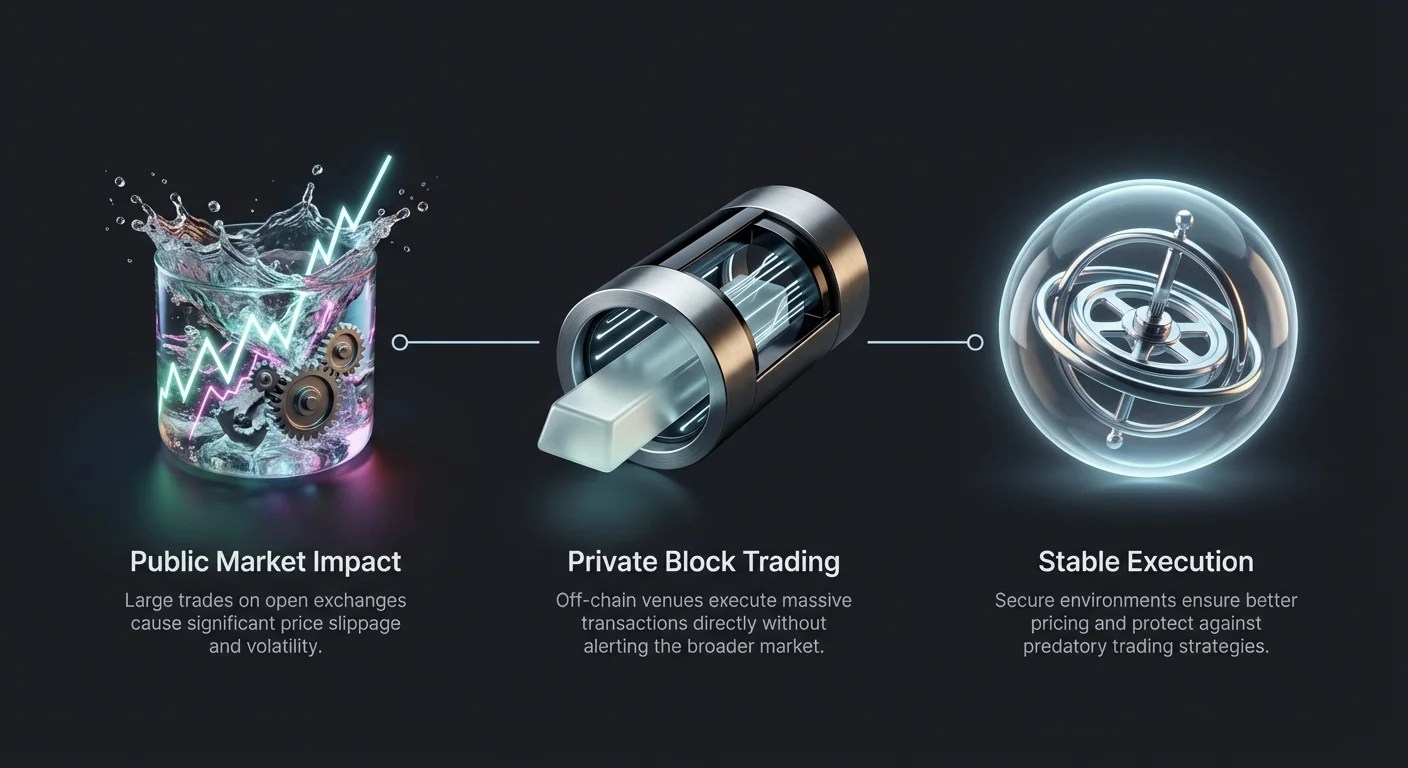
Block trading refers to the exchange of large volumes of assets between parties. These transactions are typically conducted outside of the conventional exchange platforms that retail users access daily. The primary goal is to facilitate significant transfers of value without causing immediate price spikes or crashes.
In the crypto ecosystem, block trades are often synonymous with OTC trading. This method involves a direct exchange between a buyer and a seller. It stands in contrast to exchange-based trading, where an engine matches anonymous orders.
OTC desks act as the intermediaries or principals in these deals. They connect high-net-worth individuals, institutions, and businesses. The platforms facilitate the liquidity needed to fill large orders that would otherwise drain a standard order book. This ensures that the market remains stable even when millions of dollars in crypto change hands.
Addressing Market Impact and Slippage
The most critical reason for using block trading venues is to minimize market impact. Market impact refers to the change in an asset's price caused by a specific trade. On a public exchange, a large buy order eats through the available sell orders at the current price level.
As the buy order consumes the cheapest sell orders, it must move up to more expensive ones to fill the remaining amount. This upward pressure raises the average price per coin for the buyer, a cost known as slippage.
Conversely, a massive sell order clears out the buy support, driving the price down. The seller ends up receiving less value for their assets as they are forced to sell at progressively lower prices. Block trading avoids this by locking in a price for the entire lot or negotiating a weighted average price that does not fluctuate during execution.
Privacy and Confidentiality
Confidentiality is another pillar of block trading. On a public ledger or order book, wallet watchers and algorithmic bots can detect large movements immediately. If the market sees a massive transfer of Bitcoin or Ethereum to an exchange wallet, panic selling or speculative buying often ensues.
Private trading environments ensure that trade details are not broadcast until after settlement, if at all. OTC trading platforms provide a discreet environment. They protect the identity of the parties involved and the specifics of their positions.
This opacity prevents predatory trading strategies. High-frequency traders often look for large pending orders to "front-run" them. By keeping the order in a private pool or direct negotiation channel, the large trader protects their strategy and their entry or exit price.
Mechanisms of OTC Trading Platforms
Crypto OTC trading functions differently from automated order matching. In this model, a client approaches a desk with a request to buy or sell a specific quantity of an asset. The desk then quotes a price. This price is often all-inclusive, meaning it accounts for the asset cost and the service fee.
Once the price is agreed upon, the trade is executed. The desk might source the liquidity from its own reserves, other institutional clients, or a network of exchanges. The key is that this sourcing happens in the background.
Modern OTC platforms have evolved to offer seamless interfaces. While some deals are still done via chat or voice, many platforms now offer automated request-for-quote (RFQ) systems. These systems provide instant pricing for block trades, streamlining the process for institutional clients.
Centralized OTC Desks
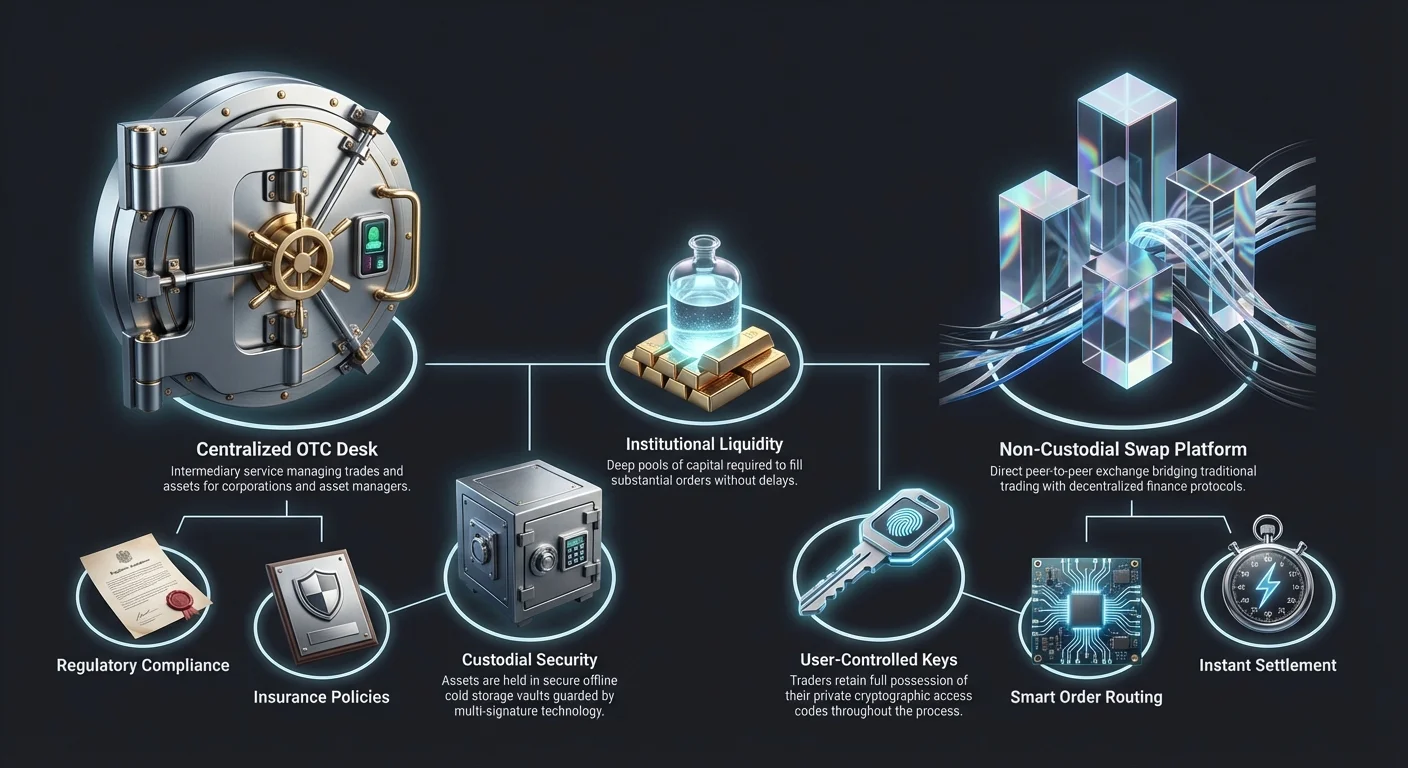
Centralized exchanges often operate dedicated OTC desks. These services cater specifically to asset managers and corporations. For example, platforms like Coinbase Institutional and Kraken offer deep liquidity pools. They facilitate trades across hundreds of assets.
These centralized entities provide a high degree of security and regulatory compliance. They often require stringent Know Your Customer (KYC) verification. This ensures that all participants in the dark pool are verified entities, reducing the risk of interacting with illicit funds.
Services provided by these desks extend beyond simple execution. They offer custodial services, meaning they safeguard the assets involved in the trade. For institutions managing billions in assets, this custody aspect is as vital as the trade execution itself.
Decentralized and Non-Custodial Swaps
A growing sector of the market involves non-custodial swap platforms. These services bridge the gap between traditional OTC desks and decentralized finance. Platforms like ChangeNOW and CCE.Cash allow for the direct exchange of assets without the need for creating an account or depositing funds into a custodial wallet.
These platforms emphasize user control. The user retains possession of their private keys until the moment of the exchange. The swap service acts as a conduit, routing the trade through various liquidity sources to find the best rate.
This model appeals to privacy-focused traders. It minimizes the data collection typically associated with centralized financial services. By removing the need for registration, these platforms offer a faster, more fluid experience similar to interacting with a Decentralized Exchange (DEX).
Comparing Custodial and Non-Custodial Models
The choice between a centralized OTC desk and a non-custodial swap platform often comes down to the specific needs of the trader regarding control and compliance.
| Feature | Centralized OTC Desk | Non-Custodial Swap Platform |
|---|---|---|
| Custody | Exchange holds funds | User holds funds (Self-custody) |
| Registration | Mandatory KYC/AML | No account required / Minimal |
| Target Audience | Institutions, Corporations | Privacy-seekers, DeFi Users |
Centralized desks offer recourse and insurance, which is critical for corporate governance. Non-custodial platforms offer speed and autonomy, aligning closer with the ethos of Web3 and decentralized finance.
Key Features of Block Trading Services
When analyzing platforms that support large-scale transactions, several features stand out as essential. These features ensure that the trade is not only secure but also cost-effective.
One such feature is the smart order router. This technology breaks a large order into smaller pieces and distributes them across multiple liquidity venues. This fragmentation helps in disguising the total size of the trade and achieving a better average price.
Settlement speed is also a major factor. In traditional finance, settlement can take days. In crypto OTC, settlement is often same-day or even instant. Services like CoinFlip emphasize swift settlement on wire transactions, ensuring that capital does not remain idle.
Fixed Versus Floating Rates
Volatility is a constant in the cryptocurrency market. To manage this, swap platforms and OTC desks often offer a choice between fixed and floating rates.
A fixed rate guarantees the amount of crypto the user will receive at the end of the transaction. The platform takes on the risk of price movement during the processing time. If the market shifts unfavorably, the platform absorbs the loss. This provides certainty for the trader, which is crucial for accounting and budget purposes.
A floating rate executes the trade at the market price at the precise moment of the transaction confirmation. If the market moves in the trader's favor, they receive more assets. However, if the market drops, they receive less. This option is often chosen by traders who monitor the market closely and are willing to accept the volatility risk for potentially lower fees.
Support for Diverse Assets
While Bitcoin is the most common asset for block trading, the demand for altcoin liquidity has surged. Modern platforms support hundreds, sometimes thousands, of digital assets.
This diversity allows investors to take large positions in emerging tokens without relying on thin public order books. Platforms supporting multi-chain swaps enable users to move value across different blockchain ecosystems, such as from Ethereum to Solana, in a single large transaction.
This cross-chain capability is vital for portfolio rebalancing. An investor wanting to shift a significant percentage of a portfolio from one chain to another would face massive friction using standard bridges and exchanges. Block trading services streamline this into a unified process.
Security in Private Trading Environments
Security is paramount when dealing with the volumes typical of block trades. The risks differ slightly from standard exchange trading. Counterparty risk is the primary concern in private deals.
In a direct peer-to-peer trade without an intermediary, one party must send funds first. If the other party fails to reciprocate, the funds are lost. OTC desks mitigate this by acting as the trusted middleman or guarantor. They ensure that both sides of the trade are funded before releasing assets.
Regulated platforms add a layer of security through compliance. Entities regulated by financial authorities, such as the New York Department of Financial Services (NYDFS), must adhere to strict operational standards. Certifications like SOC 1 and SOC 2 indicate that a platform has undergone rigorous auditing of its data protection and financial controls.
Custodial Security Measures
For platforms that hold user funds, cold storage is the industry standard. This involves keeping the vast majority of digital assets in offline wallets that are air-gapped from the internet. This protects the funds from remote hacking attempts.
Multi-signature technology is another critical defense. This requires multiple approvals to authorize a transaction. For example, moving funds from a cold wallet might require signatures from three different executives located in different geographic regions.
Insurance policies also play a role. Major institutional desks often carry insurance to cover potential losses from theft or operational errors. This provides a safety net that purely decentralized protocols may not offer.
Non-Custodial Privacy and Safety
Non-custodial platforms approach security by limiting their access to user funds. Since they do not store assets, they are less attractive targets for large-scale wallet hacks. The risk is localized to the brief moment the swap is occurring.
Privacy protection is a form of security for these users. By not storing personal data or transaction history, these platforms protect users from identity theft and targeted phishing attacks. The principle is that data which is not collected cannot be stolen.
However, users on these platforms must be vigilant about phishing sites and verifying the authenticity of the service. Since there is no account recovery process, the responsibility for security lies heavily on the user.
The Economics of Zero-Fee and Low-Fee Trading
Cost efficiency is a major driver for large volume traders. Even a small percentage fee can amount to a substantial sum when trading millions of dollars. Therefore, the fee structure of a block trading venue is a critical selection criterion.
Some platforms offer "zero-fee" trading structures. It is important to understand that "zero-fee" usually refers to the absence of a separate commission charge. However, the cost is often built into the spread.
The spread is the difference between the buy price and the sell price. A desk might quote a price slightly higher than the market rate to cover their costs and generate profit. Transparency regarding these spreads is vital.
Understanding Fee Tiers
Many exchanges employ tiered fee structures. These systems reward high-volume traders with lower costs. As the 30-day trading volume increases, the percentage charged per trade decreases.
For institutional traders, these tiers can drop fees to near zero. Some platforms also offer rebates to market makers who provide liquidity to the book. In the context of block trading, negotiating a flat fee or an all-inclusive price is common practice.
Traders must also watch for hidden costs. These can include withdrawal fees, network fees, and conversion charges for fiat currency. A platform might offer free trading but charge a high percentage for wire transfers or ACH deposits.
The Impact of Network Fees
In decentralized swap environments, network fees (gas fees) are a separate consideration. These are paid to the blockchain validators, not the exchange. During times of network congestion, these fees can spike.
For a large block trade, the network fee is usually negligible relative to the total value. However, for complex cross-chain swaps involving smart contracts, the gas costs can be significant.
Some platforms allow for the separate payment of gas fees or optimize the route to minimize these costs. Advanced order routers can seek out the most efficient path for the swap, considering both the exchange rate and the blockchain transaction costs.
Regulatory Considerations and Compliance
The landscape of crypto block trading is heavily influenced by regulation. Different jurisdictions have varying rules regarding private transactions and large financial transfers.
In the United States, entities facilitating these trades are often required to register as Money Services Businesses (MSB). They must comply with the Bank Secrecy Act, which mandates the reporting of suspicious activities and large cash transactions.
This regulatory framework is why many centralized OTC desks require extensive documentation from their clients. They need to verify the source of funds and the identity of the beneficial owners. This process, while cumbersome, legitimizes the funds and allows institutions to participate without legal risk.
Global Availability and Restrictions
Regulatory compliance also dictates where these services can operate. A platform might be available in Europe but restricted in certain US states due to specific local laws, such as New York's BitLicense.
Traders must ensure that the platform they choose is legally permitted to serve their region. Using an unauthorized platform can lead to frozen funds or legal complications.
Global platforms often have different arms to serve different regions. For instance, an exchange might have a specific entity for Australian users that complies with AUSTRAC regulations, distinct from its global operations.
How to Choose a Platform for Large Trades
Selecting the right venue for block trading requires a careful assessment of specific needs. Liquidity is the first factor. The platform must have the depth to handle the trade size without delays or partial fills.
Reputation is equally important. In the high-stakes world of large volume trading, trust is the currency. Platforms with a long history of operation and a clean security record are generally preferred. User reviews and industry certifications can provide insight into reliability.
Support channels are a practical necessity. When moving large sums, the ability to reach a human support agent 24/7 is invaluable. Institutional desks often provide dedicated account managers who guide the client through every step of the process.
Assessing User Experience
The interface and ease of use matter, even for professional traders. A complicated dashboard can lead to operational errors. The best platforms offer a clean, intuitive experience that reduces the chance of mistakes.
For non-custodial platforms, the simplicity of the swap widget or API is key. The process should be transparent, with clear indications of exchange rates, fees, and estimated arrival times. Real-time tracking of the transaction status helps alleviate the anxiety of waiting for a blockchain confirmation.
Educational resources provided by the platform can also be a sign of quality. A service that invests in educating its users about security, market mechanics, and risk management is often more reliable than one that simply pushes for volume.
Conclusion
Dark pools, OTC desks, and block trading mechanisms are essential infrastructure in the cryptocurrency landscape. They provide the necessary liquidity channels for large-scale capital to enter and exit the market without causing chaos. By moving these transactions off the public order books, these venues protect the stability of the broader market while offering privacy and efficiency to high-volume traders.
The evolution of this sector has led to a diverse array of options. Traders can choose between the regulatory assurance of centralized institutional desks and the speed and autonomy of decentralized swap platforms. Whether prioritizing strict compliance and custody or seeking non-custodial freedom, there is a solution tailored to every strategy. As the crypto market matures, the sophistication of these private trading environments will likely continue to grow, further bridging the gap between traditional finance and the digital asset economy.
Successful high-volume trading relies on utilizing private liquidity channels to secure price stability and protect transaction confidentiality.