
For years, the public conversation around Non-Fungible Tokens (NFTs) focused almost entirely on highly priced digital art, celebrity endorsements, and speculative flips. This narrow view often obscured the revolutionary nature of the underlying technology: the ability to encode unique utility and ownership rights into a digital token.
Today, NFTs are rapidly maturing beyond simple collectibles. They have transformed into sophisticated financial primitives capable of generating measurable, recurring revenue. This shift marks the transition of NFTs from speculative assets to instruments for decentralized yield generation.
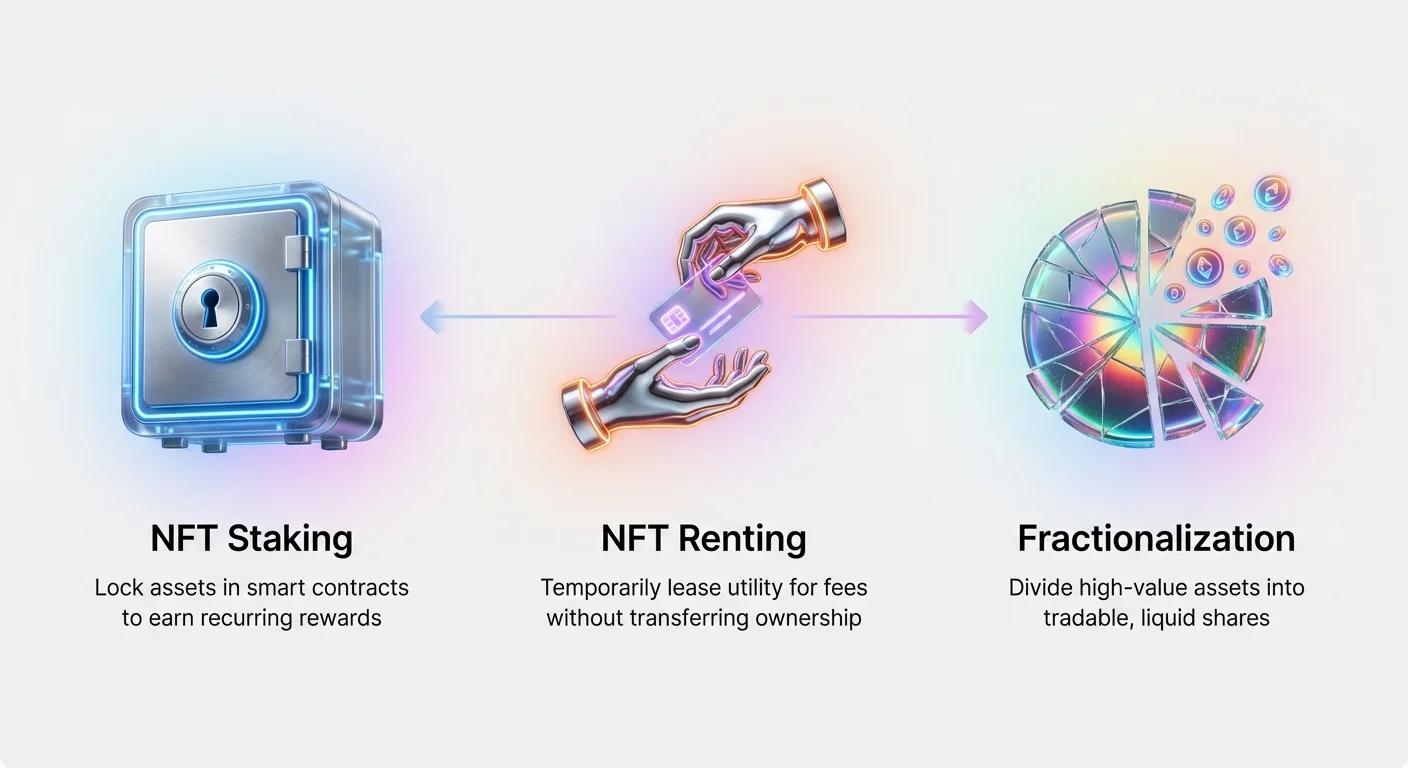
This guide moves past the speculation and dives into the mechanics of how you can use non-fungible assets—be they digital artwork, in-game land, or membership passes—to earn passive income. We will explore key strategies like staking, renting, and fractionalization, offering a beginner-friendly approach to incorporating NFTs into a broader Decentralized Finance (DeFi) yield portfolio.
The Evolution of NFTs: From Collectibles to Financial Assets
To understand how NFTs generate income, we must first recognize their utility. Unlike a fungible cryptocurrency like Bitcoin or Ethereum, which are identical and interchangeable, an NFT is unique and represents specific ownership rights tied to a smart contract. When you generate yield from an NFT, you are monetizing that unique utility.
Understanding Non-Fungibility in Income Generation
In traditional DeFi staking (like staking ETH), you lock up fungible capital to secure a blockchain network. The rewards are based on the quantity of capital locked.
In the world of NFTs, the income model is different. You are locking or renting out a specific right or privilege. This might include:
- Access: Owning a pass that grants entry to a private decentralized autonomous organization (DAO).
- Digital Property: Owning a plot of land in a metaverse game.
- Boosters: Owning an item that enhances a protocol's functionality or mining power.
When you stake or rent an NFT, you temporarily forfeit that utility, and in return, the protocol or the renter pays you yield. The value of your yield is directly tied to the unique utility of your specific non-fungible asset.
The Role of Smart Contracts in NFT Utility
The magic behind NFT income generation lies entirely in the smart contract—the self-executing code that governs the token.
- Defining Rules: The smart contract defines what the NFT is and what it can do. For staking, the contract contains the code that pays rewards to the wallet holding the NFT for a specific duration.
- Enabling Transfers: For renting, the contract can securely facilitate the temporary transfer of utility without transferring permanent ownership, ensuring the asset automatically returns to the owner after the rental period ends.
- Security: These contracts enforce the rules governing the income stream, meaning the process is trustless and automated, eliminating the need for a central intermediary.
Generating Passive Income Through NFT Staking
NFT staking is perhaps the most direct way to generate passive income from your digital collectibles, drawing a clear parallel to traditional crypto staking strategies.
How NFT Staking Works
NFT staking involves locking your non-fungible token within a designated smart contract, often provided by the issuing project (e.g., a specific collection or GameFi ecosystem). By locking the asset, you prove your commitment to the project and, in many cases, reduce the circulating supply of the NFT, which can potentially support its price stability.
Crucially, when you stake an NFT, you temporarily lose the ability to sell, trade, or use the asset's utility (like using it as a profile picture or accessing an exclusive Discord channel). The protocol rewards you for this temporary illiquidity and commitment.
Example: Imagine you own a "Legendary Key" NFT for a blockchain gaming platform. By staking the key, the protocol knows you are committed to the ecosystem. In return, the staking contract automatically drips you the platform's native governance token every hour.
Types of Staking Rewards
The rewards generated from NFT staking vary significantly depending on the project’s mechanics.
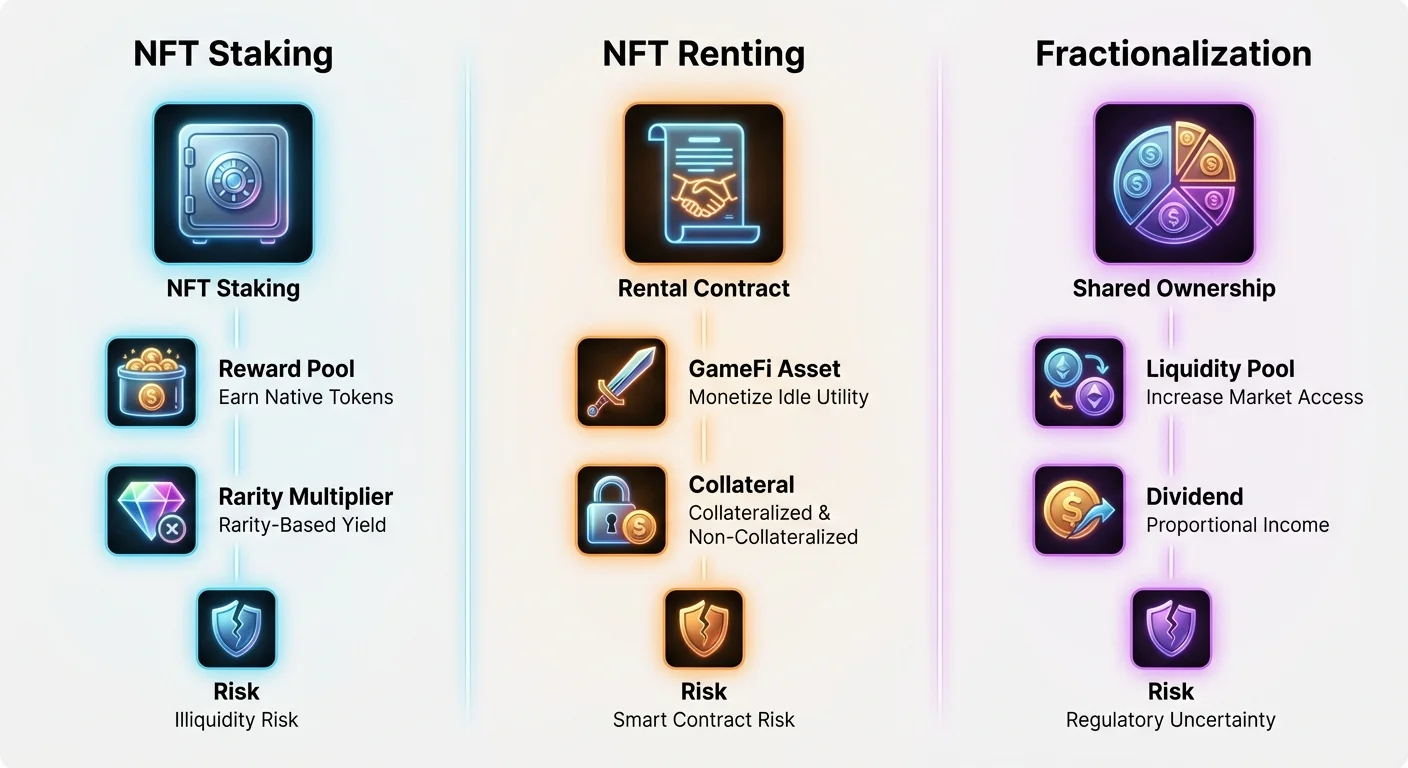
- Native Token Rewards: This is the most common model. The staker earns the project’s proprietary utility or governance token. These tokens can then be sold on the open market for profit, or they can be used within the ecosystem (e.g., voting on project direction or purchasing in-game upgrades).
- Rarity-Based Rewards: Some projects tier their staking rewards based on the rarity traits of the specific NFT being staked. A super-rare NFT might generate 5x the reward of a common one, directly monetizing the asset's unique characteristics.
- Future Airdrops and Whitelists: Staking can be used as a qualification mechanism for exclusive benefits, such as receiving free tokens from future project launches or gaining priority access to new NFT mints.
Risks and Considerations for Staking NFTs
While lucrative, NFT staking carries specific risks that differ from general crypto staking:
- Illiquidity Risk: Since the NFT is locked in a contract, you cannot instantly sell it if the market price drops rapidly. You must first "unstake" it, which may involve a cooldown or waiting period (e.g., 7 days).
- Smart Contract Risk: If the staking contract contains a bug or exploit, the locked NFT could be lost or permanently frozen. Thoroughly vet the security audit history of any protocol before committing your asset.
- Inflationary Yield: If the native reward token is issued excessively, its market value may crash, meaning the high Annual Percentage Yield (APY) displayed is misleading because the token you are earning is rapidly depreciating.
Monetizing Scarcity: Decentralized NFT Rental Protocols
If staking is analogous to a certificate of deposit (CD) where your capital is locked, renting is analogous to earning income from a piece of real estate. You own the underlying asset, but you allow someone else to use it temporarily in exchange for rent.
NFT rental protocols solve a major hurdle in the Play-to-Earn (P2E) space: high barrier to entry. New players often cannot afford the necessary in-game assets (like weapons, characters, or land) to start earning rewards. Renting allows owners to monetize their idle assets while enabling new users to access the utility.
The Mechanics of NFT Lending and Borrowing
NFT rental platforms utilize specialized smart contracts to ensure secure lending without transferring permanent ownership.
- The Owner (Lender): Deposits the NFT into the rental protocol and specifies the terms: rental duration, rental price (often paid daily in a specific cryptocurrency), and any required collateral (though many gaming assets are rented without collateral).
- The Renter (Borrower): Pays the agreed-upon rental fee to the protocol.
- The Protocol: Creates a "wrapped" or derivative NFT that holds the utility of the original asset but remains tied to the protocol. This wrapped NFT is sent to the borrower. The borrower can use the utility (e.g., play the game) but cannot sell or transfer the original asset.
- Automatic Return: Upon expiration of the rental duration, the smart contract automatically burns the wrapped asset and returns the original NFT to the owner’s wallet, ensuring a trustless and guaranteed return.
Use Case: Renting Gaming or Utility Assets
The primary market for NFT rentals is the GameFi sector, where assets often represent productive tools.
- Metaverse Land: An owner of a plot of virtual land in a metaverse game can rent the plot to a business (the renter) that wants to set up a virtual store or advertising billboard for a limited time. The owner receives regular rental income.
- P2E Characters/Tools: A high-level character or rare weapon in a P2E game can dramatically increase a player’s earning potential. Owners who are taking a break from the game can rent these assets to active players. The rental income often comes directly from the in-game tokens earned by the renter, offering a highly liquid income stream for the owner.
- DAO Voting Power: In some governance models, an NFT represents voting rights. An owner could rent out this governance NFT to a party wishing to influence a specific vote, monetizing the political power of the asset.
Managing Risk in Rental Agreements
The risk profile for NFT renting differs based on the protocol’s structure:
- Collateralized Rentals (Lower Risk): The renter must deposit cryptocurrency (often stablecoins) equal to or exceeding the market value of the NFT being rented. If the renter fails to return the asset or violates the terms, the collateral is automatically paid to the owner. This is common for high-value collectibles.
- Non-Collateralized Rentals (Higher Risk, Common in GameFi): This model relies entirely on the wrapped asset mechanism. The risk here is less about losing the asset and more about the protocol or game integrity. If the game’s token collapses, or if the rental smart contract is exploited, the asset may be temporarily unusable or the income stream will dry up. Owners must rely heavily on the security of the rental platform itself.
Enhancing Liquidity with NFT Fractionalization
NFTs, particularly high-value pieces like rare digital art or expensive metaverse property, suffer from significant illiquidity. Since the asset is one-of-a-kind, finding a single buyer willing to pay millions can be difficult. Fractionalization addresses this by converting a single non-fungible asset into hundreds or thousands of fungible tokens, dramatically increasing market accessibility and opening new income streams.
How Fractionalization Works
Fractionalization is the process of locking a single NFT inside a vault smart contract and issuing a new set of fungible tokens (often following the ERC-20 standard) that represent ownership shares of the underlying NFT.
Analogy: If an NFT is a single gold bar, fractionalization is melting that bar down and minting 10,000 tiny gold coins (tokens).
- Shared Ownership: Each fractional token holder now owns a percentage of the underlying NFT.
- Liquidity: These new fractional tokens can be easily traded on decentralized exchanges (DEXs), allowing small retail investors to gain exposure to blue-chip NFTs without needing massive capital. This injection of liquidity is the primary benefit.
Income Streams from Fractional Ownership
Fractionalization creates several opportunities for yield generation that didn't exist when the asset was whole:
- Passive Price Appreciation: Owners of fractional tokens benefit from general price appreciation, and unlike holding the whole NFT, they can sell a small portion of their holding immediately if liquidity is available on a DEX.
- Governance/Decision Dividends: For unique, high-utility NFTs (like rare membership passes), the fractional token may grant voting rights on the asset itself (e.g., whether to accept a high bid to sell the entire piece, or how to use the utility). Any revenue generated by the asset (e.g., renting out the digital land) can be distributed as dividends to fractional token holders.
- Liquidity Incentives: The newly created fractional tokens can be deposited into liquidity pools on DeFi protocols. By pairing the fractional token with a stablecoin (like USDC), holders earn yield from trading fees, effectively generating an ongoing income stream from an asset that was previously completely illiquid.
Fractionalization as a Liquidity Tool
For high-value NFT holders, fractionalization is the most powerful tool for solving the illiquidity problem. It allows the original owner to cash out a portion of the asset’s value (by selling fractional shares) while retaining control or the majority ownership.
The "Liquid Staking" Parallel: Just as Liquid Staking Tokens (LSTs) allow staked Ethereum holders to retain liquidity and use a derivative token in DeFi, fractionalization allows NFT holders to retain exposure and utility through a fungible derivative token while making the underlying asset financially accessible to the broader market.
Case Study: Gaming Asset Monetization (Play-to-Earn/GameFi)
The GameFi sector represents the most mature and dynamic environment for generating passive income from non-fungible assets. In a high-functioning P2E ecosystem, players can combine staking and rental strategies to optimize yield.
Yield Generation through In-Game Assets (Active vs. Passive)
In GameFi, yield generation often involves two primary paths:
- Active Earning: The player uses the NFT assets (weapons, characters, land) to complete tasks, battle other players, or participate in quests, earning immediate in-game tokens.
- Passive Earning: The player uses the NFT as capital to generate income without active gameplay, through staking or renting.
The optimal strategy for an NFT investor is often to maximize the passive income derived from these assets.
Strategy: Combining Staking and Rental in GameFi
A smart portfolio manager in a GameFi ecosystem doesn't just hold assets; they constantly decide how to deploy them to maximize returns based on current demand.
- Analyze Demand: If a specific in-game item (e.g., a "mining drill" NFT) is essential for new players to start generating income, the demand for rental will be high. The investor should prioritize renting this asset for a high daily fee.
- Utilize Idle Assets: If another asset (e.g., a rare cosmetic item or a special character skin) has no immediate utility in gameplay but grants membership privileges or governance rights, it should be staked to earn native token rewards.
- The "Staked Rental" Model: Some advanced protocols allow an owner to stake an NFT (earning basic passive rewards) while simultaneously allowing the staked asset's utility to be temporarily rented out by another party. The owner earns both the basic staking reward and the rental fee, multiplying the passive yield.
This strategic deployment demonstrates the shift from simply owning a digital item to actively managing a small portfolio of productive assets.
Portfolio Strategy and Risk Management for NFT Yield
While NFT yield generation offers exciting returns, the non-fungible nature of the assets introduces unique complexities and higher risk compared to stablecoin lending or basic PoS staking. A robust strategy requires careful due diligence.
Due Diligence: Evaluating NFT Projects for Sustainability
The biggest risk in NFT yield generation is project risk. If the underlying project fails, the utility—and therefore the yield—of your NFT drops to zero, regardless of the smart contract's security.
Actionable Due Diligence Checklist:
| Factor | Description | Why it Matters |
|---|---|---|
| Tokenomics | How are the reward tokens (e.g., tokens earned from staking or renting) generated and distributed? Is the supply capped? | Projects with highly inflationary, uncapped reward tokens often experience rapid price decay, erasing yield gains. |
| Utility Depth | Does the NFT have real, sustainable utility outside of the passive income stream? | High yield generated only to encourage holding (ponzinomics) is unsustainable. Look for assets used in real applications (games, commerce, governance). |
| Team and Community | Is the development team public, experienced, and actively developing? Is the community robust and engaged? | Active development ensures the asset's utility will expand, securing future revenue streams. |
| Audit Status | Have the staking or rental smart contracts been audited by reputable security firms? | This addresses the smart contract risk specific to the deployment mechanism. |
Balancing Illiquidity and High Yield (The NFT Trade-Off)
Investors must recognize the inherent trade-off in the NFT market: generally, the higher the utility and potential yield, the lower the liquidity and the higher the volatility.
- Strategy: Allocate a smaller portion of your DeFi portfolio to non-fungible assets. Use yield generated from low-risk, highly liquid stablecoin strategies to purchase NFTs for long-term passive yield generation.
- Mitigation: If you invest in high-value NFTs, utilize fractionalization protocols to regain some liquidity, allowing you to react to market swings without selling the entire asset.
Security Best Practices
Interacting with complex NFT yield contracts requires heightened security awareness:
- Dedicated Wallets: Never connect your primary, high-value wallet (where the majority of your fungible crypto is held) to new or untested staking/rental protocols. Use a dedicated, hot wallet specifically for interacting with NFT contracts.
- Review Permissions: When approving a staking or rental contract, carefully review the permissions it requests. A legitimate contract should only ask to move the specific NFT being staked/rented, not all assets in your wallet.
- Beware of Impersonation: Always navigate directly to the official project website to access staking portals. Phishing attempts targeting NFT owners who are seeking to maximize yield are common.
Conclusion
NFTs have matured far beyond simple digital collectibles. Through mechanisms like staking, decentralized rental protocols, and fractionalization, non-fungible assets have firmly established themselves as productive tools within the broader Decentralized Finance landscape.
For crypto novices, understanding NFT utility means viewing your digital assets not just as items to be traded, but as mini-businesses capable of generating recurrent cash flow. By strategically deploying assets—renting assets needed for utility, staking assets for long-term rewards, and fractionalizing valuable items for liquidity—investors can integrate this powerful class of assets into a diversified and active yield generation strategy. The future of non-fungible finance is here, and it is built on utility, not just speculation.