
The digital asset revolution promised financial freedom and sovereignty, empowering individuals to transact without intermediaries. Central to this promise is privacy—the ability to control and protect personal financial data. However, as cryptocurrencies have grown from niche technology into a multi-trillion-dollar asset class, they have attracted intense regulatory scrutiny.
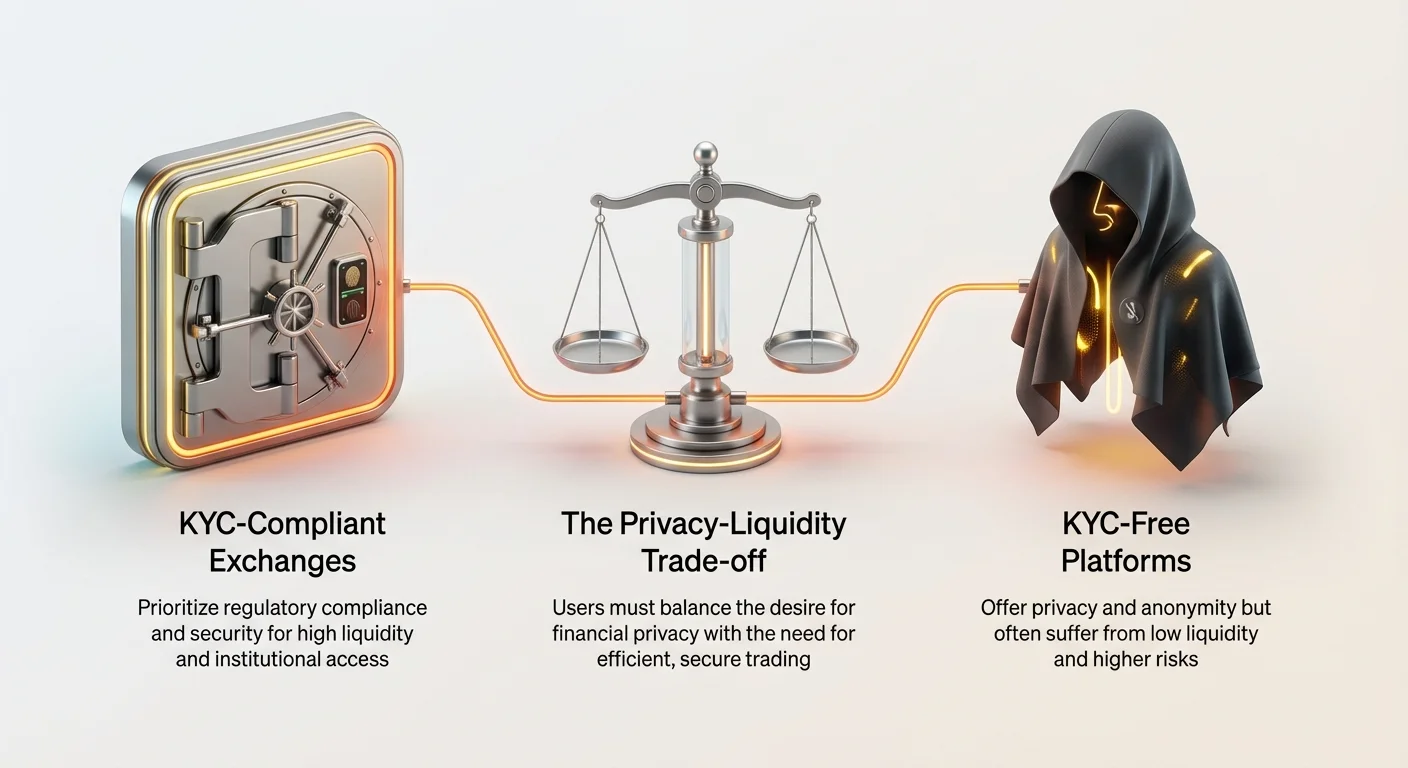
This pressure has created a fundamental dichotomy in the crypto world: the choice between platforms that enforce strict identification rules (KYC) for enhanced security and market access, and platforms that offer anonymity but often sacrifice crucial features like liquidity and regulatory certainty.
For a beginner navigating this landscape, understanding the trade-off between privacy and usability is crucial. This comprehensive guide will analyze the critical risks associated with KYC-free crypto trading, evaluate the actual liquidity available on anonymous platforms, and provide a framework for choosing the option that best aligns with your financial security and privacy needs.
Understanding the Regulatory Framework: Why KYC Exists
Before diving into anonymous trading, it is essential to understand the mandatory identification systems that govern most mainstream finance—and increasingly, major cryptocurrency exchanges. These systems are primarily driven by global governmental efforts to combat illicit financial activity.
What Exactly is KYC? (Know Your Customer)
KYC, or "Know Your Customer," refers to the mandatory process of identifying and verifying the identity of clients before they can open an account or conduct business. When you sign up for a major centralized crypto exchange (CEX) like Coinbase or Kraken, they require documentation—such as a government-issued ID, proof of address, and sometimes a biometric scan (a selfie).
For an exchange, the goals of KYC are twofold:
- Compliance: To adhere to local and international financial regulations.
- Risk Management: To ensure the person using the platform is who they claim to be, thereby preventing fraud and identity theft.
The Role of AML (Anti-Money Laundering)
KYC is the first step in the broader structure of Anti-Money Laundering (AML). AML regulations are a set of procedures, laws, and rules designed to stop criminally derived income (money laundering) and the financing of terrorism (CFT).
When a major exchange implements KYC, it establishes an immutable link between a real identity and the crypto wallet address used on its platform. This link allows regulators to track the flow of funds if suspicious activity occurs. This level of oversight is precisely what high-volume institutional investors require to feel safe entering the crypto market, which, in turn, fuels high liquidity on these platforms.
Global Regulatory Impact on Crypto Exchanges
The global nature of cryptocurrency presents unique challenges for regulation. Different jurisdictions impose different requirements. Exchanges based in highly regulated regions (like the US, UK, or EU) are typically forced to adopt stringent KYC protocols to legally serve residents in those countries.
If a centralized exchange attempts to skirt these rules, they risk massive fines, criminal prosecution, or being shut down entirely. This is why many platforms that boast "no ID verification" are often decentralized, based offshore, or offer significantly limited services (like very low withdrawal limits) to remain outside the most stringent regulatory scope.
The Appeal of KYC-Free Trading
The desire for crypto exchanges with no ID verification is not merely about avoiding regulations; it often stems from genuine concerns about privacy, accessibility, and bureaucratic friction.
Protecting Financial Privacy
For many cryptocurrency advocates, the entire movement is based on the philosophy of financial sovereignty. Providing sensitive personal documents to a centralized corporate entity runs counter to this ethos. Concerns include:
- Data Breach Risk: Any database holding millions of users’ IDs, passports, and addresses is a high-value target for hackers. If a KYC-compliant exchange suffers a breach, users risk identity theft far beyond the simple loss of crypto assets.
- Government Surveillance: Users worry that KYC data could be easily accessed or seized by governments, revealing their entire transaction history and spending habits to state surveillance.
Avoiding Bureaucracy and Expediting Access
Opening an account on a fully KYC-compliant platform can take days or weeks, depending on the jurisdiction and the complexity of verification (especially for institutional or corporate accounts).
KYC-free platforms (often decentralized exchanges or P2P markets) allow users to connect a wallet and begin trading instantly. This ease of entry is highly attractive to newcomers or those needing to execute a trade quickly without waiting for lengthy verification checks.
Accessibility in Restrictive Jurisdictions
In many parts of the world, individuals may lack the necessary documentation (like government IDs or proof of address) required by Western exchanges. Furthermore, some governments impose capital controls or ban crypto trading outright.
For citizens living under restrictive financial regimes, KYC-free crypto trading can be a critical lifeline, offering access to assets and remittances that are otherwise unavailable through regulated banking channels. These users often rely on the best anonymous crypto exchanges as a necessity for financial freedom, not just as a preference for privacy.
Analyzing Core Risks of KYC-Free Platforms
While the lure of anonymity is strong, it comes at a substantial cost, primarily concerning trade execution quality, legal safety, and platform security. When evaluating the kyc free crypto trading risks, these three areas are paramount.
Liquidity and Slippage Concerns
Liquidity refers to how easily an asset can be bought or sold without significantly affecting its price. High liquidity means there are many buyers and sellers, resulting in fast trade execution and tight bid-ask spreads (the difference between the highest buyer offer and the lowest seller demand).
KYC-free platforms, especially true decentralized exchanges (DEXs) or small, unregulated centralized exchanges, almost always suffer from poor liquidity compared to major CEXs:
- Lower Trading Volumes: Institutional traders and major market makers, who provide the deepest liquidity, avoid unregulated platforms due to compliance mandates. This leaves the volume supported only by retail traders.
- Increased Slippage: When trading large amounts on a low-liquidity platform, there aren't enough orders in the order book to absorb the trade at the desired price. The order "slips" to the next best available price, often resulting in executing the trade at a much worse price than expected. For a beginner, this slippage can significantly erode profits, sometimes costing more than the fees saved by avoiding a major exchange.
Enhanced Regulatory and Legal Vulnerability
Operating on an exchange that refuses to comply with international regulations exposes the user to severe legal and financial risk, even if the user is not engaged in illicit activity.
- Sudden Shutdowns and Seizures: Unregulated or anonymous crypto exchanges are prime targets for regulatory action. Unlike compliant exchanges that follow legal processes, unregulated platforms can be shut down, seized, or have their assets frozen instantly by government agencies. Users have little to no recourse to retrieve their funds.
- Tax Liability: Anonymity does not equal immunity from taxation. Even if an exchange does not report transactions, individuals in most jurisdictions are legally required to report their capital gains. Relying on an anonymous platform to dodge taxes carries massive criminal penalties if discovered, far outweighing any privacy benefits.
- Counterparty Risk: If you engage in P2P trading with a malicious or fraudulent counterparty on a non-regulated platform, you have no legal authority to appeal to the platform or law enforcement for recovery.
Custody Risks and Platform Security
The lack of KYC typically correlates with a lack of serious investment in corporate security and infrastructure. Major regulated exchanges must meet high standards for cybersecurity and insurance to protect the verified assets of millions of clients.
1. Centralized Anonymous Platforms (Shady CEXs): If you deposit funds onto a small, centralized, no-ID-verification exchange, you are handing over custody to an unknown, unregulated entity. There is no proof the founders are legitimate, that the funds are secured in cold storage, or that they haven't set up the platform as an exit scam. When these platforms disappear, users have no way to track them down or recover lost crypto.
2. Decentralized Anonymous Platforms (DEXs): While DEXs solve the custody problem (users retain control of their keys), they introduce smart contract risk. The code governing the DEX must be flawless. If there is a bug or vulnerability in the smart contract, attackers can drain the liquidity pools, and because the platform is truly decentralized, there is no CEO, company, or support team to call for a refund.
The Liquidity Dilemma: KYC vs. No-KYC Ecosystems
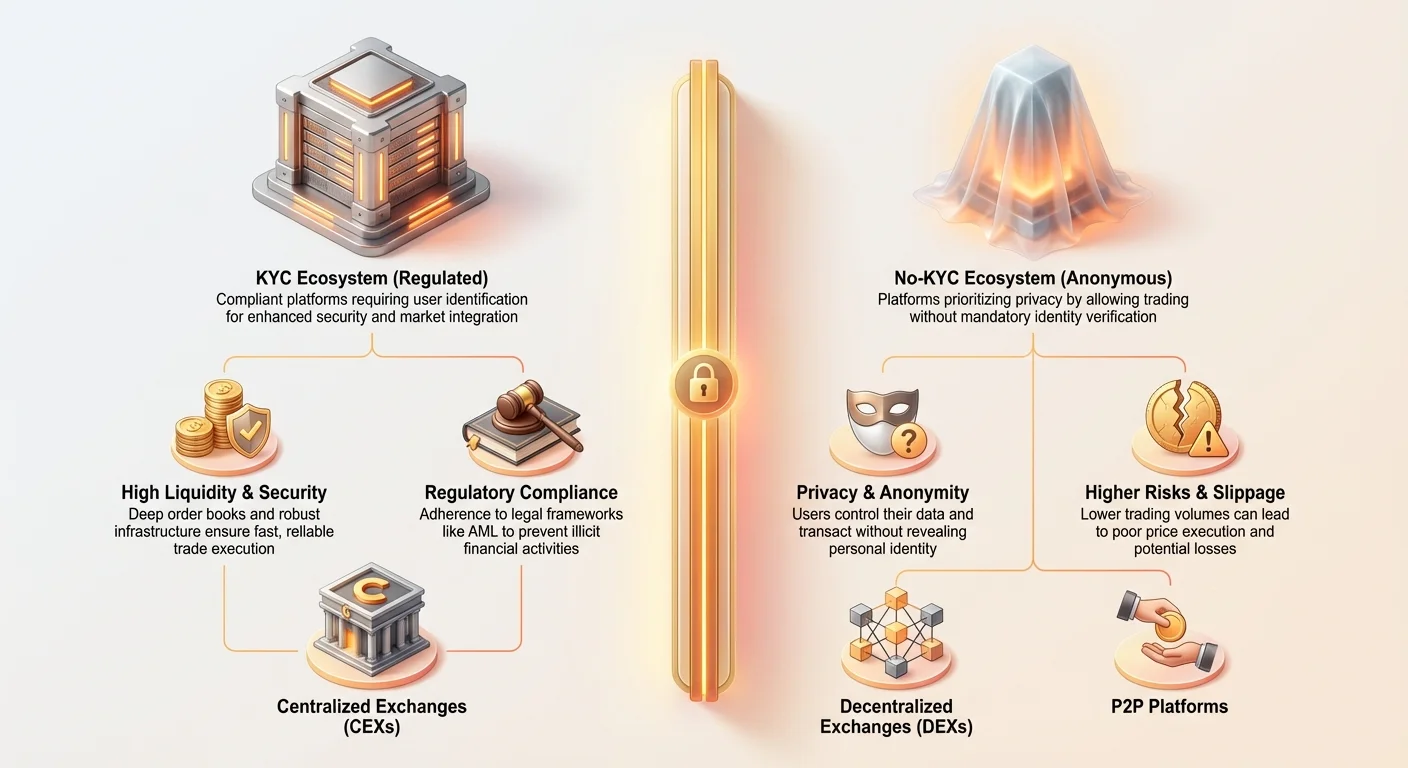
The choice between KYC and anonymity is ultimately a choice about liquidity. Liquidity defines the efficiency and reliability of your trading experience. Understanding the structural differences between these platform types is crucial for making an informed trading decision.
How Liquidity Impacts Trade Execution
Imagine you are trying to sell a rare painting.
- High Liquidity (Major KYC Exchange): This is like selling the painting at Sotheby's. Thousands of major collectors are watching, and when you list it, the sale happens immediately at a price very close to the market estimate. You get your money quickly and reliably.
- Low Liquidity (Anonymous DEX/P2P): This is like selling the painting in a secluded local art shop. Only a few people look at it per day. To sell it quickly, you must drop the price significantly (high slippage), or you must wait days or weeks for the right buyer (slow execution).
Low liquidity impacts all aspects of trading: poor execution, unstable pricing, and higher implicit costs (costs hidden in the price difference, rather than explicit fees).
Centralized Exchanges (CEXs) and Deep Liquidity Pools (KYC Model)
Major centralized exchanges thrive because their regulatory compliance brings trust. This trust attracts two crucial groups:
- Institutional Money: Hedge funds, proprietary trading firms, and large asset managers bring enormous capital and massive trading volumes. They only use platforms where they can meet compliance and reporting obligations.
- Professional Market Makers: These firms specialize in providing liquidity (placing both buy and sell orders constantly) in exchange for small profits on the spread. They only deploy capital on highly secure, regulated exchanges with robust APIs (Application Programming Interfaces) and reliable infrastructure.
This combination of institutional demand and professional liquidity provision creates a virtuous cycle where prices are stable, spreads are tight, and large orders execute instantaneously.
Decentralized Exchanges (DEXs) and AMM Liquidity (No-KYC Model)
Decentralized exchanges offer true KYC-free crypto trading by eliminating the central authority. They rely on Automated Market Makers (AMMs) and liquidity pools instead of traditional order books.
While AMMs provide 24/7 liquidity, it is fundamentally different from CEX liquidity:
- Capital Constraints: AMM liquidity is provided by individuals (liquidity providers, or LPs) who stake their crypto pairs into pools. The total available capital in these pools is usually a fraction of the capital available on major CEXs.
- Impermanent Loss: LPs face risks (like impermanent loss), which discourages the injection of massive amounts of funds, keeping overall pool sizes smaller.
- Scalability Issues: Many DEXs operate on blockchains with higher transaction fees and slower confirmation times compared to the proprietary, high-speed trading engines of CEXs, limiting high-frequency trading opportunities.
Therefore, for serious retail traders or anyone needing to move significant capital, the anonymity gained by using a DEX is offset by the drastically increased risk of slippage.
Types of Anonymous and Low-KYC Trading Platforms
If you prioritize privacy and have accepted the associated risks (lower liquidity, higher slippage, regulatory uncertainty), there are several distinct types of platforms that offer solutions for crypto exchanges no id verification.
Decentralized Exchanges (DEXs) and Self-Custody Requirements
DEXs are the purest form of anonymous trading. They never custody your funds; instead, you interact directly with the blockchain via smart contracts using a non-custodial wallet (like MetaMask).
- How They Work: You swap tokens directly from your wallet. Since the exchange is just code running on a blockchain (e.g., Uniswap on Ethereum or PancakeSwap on BNB Chain), there is no centralized company requiring your ID.
- Key Advantage: You maintain absolute control over your private keys.
- Key Risk: Smart contract vulnerabilities, high gas fees (depending on the chain), and extremely poor liquidity for less popular token pairs.
Tip for Beginners: DEXs are complex. Ensure you understand how to manage a seed phrase and how to revoke token allowances before trading on a DEX. If you lose your seed phrase, your crypto is gone forever.
Hybrid Models and Tiered Verification
Some centralized exchanges, particularly newer or offshore ones, have adopted a tiered system for KYC:
- Tier 0 (No KYC/Email Only): Users can sign up with only an email address. They are restricted to small daily withdrawal limits (e.g., $1,000 or less). This tier is often intended to satisfy smaller retail users who want to test the platform or make small, occasional trades anonymously.
- Tier 1 (Basic ID): Requires a government ID for verification, increasing withdrawal limits significantly.
- Tier 2 (Full Verification): Requires proof of address, sometimes proof of income, and unlocks the highest withdrawal limits and access to advanced tools (like institutional API keys).
These hybrid models attempt to offer a degree of anonymity while managing their own regulatory risk by limiting the exposure of unverified users. If your volume is consistently low, this can be an effective compromise, but remember that even an email-only account may still be linked to an IP address that can eventually be traced.
P2P Exchanges: The Most Direct Route to Anonymity
Peer-to-Peer (P2P) exchanges connect buyers and sellers directly. Unlike CEXs or DEXs, the transaction itself often happens outside the platform's custody, usually through traditional payment methods (like bank transfers or cash).
- How They Work: The exchange acts as an escrow service. When A agrees to buy BTC from B, A sends fiat money directly to B's bank account. Once B confirms receipt, the platform releases the BTC from escrow to A.
- Anonymity Level: The platform itself usually requires minimal KYC (sometimes just an email), but the actual transaction exposes you to the counterparty's banking identity, depending on the payment method used. Trading cash in person (if allowed) is the most private method, but it introduces physical security risks.
- Key Risk: High counterparty risk (fraud, chargebacks) and variable pricing, which often involves a significant premium over the global spot rate.
Best Practices for Maintaining Privacy While Trading
If you determine that KYC-free trading is necessary for your security or location, operational vigilance is essential. True anonymity in crypto requires meticulous planning and consistent execution.
Essential Anonymity Tools (VPNs, Tor, Privacy Wallets)
Simply using an anonymous exchange is insufficient; you must secure your connection and your funds.
- VPN (Virtual Private Network): A quality VPN encrypts your connection and masks your true geographical location (IP address). Choose a reputable, paid VPN service that enforces a strict "no-logs" policy. Never use a free VPN, as they often monetize your data or leak your IP.
- Tor Browser: For maximum anonymity, the Tor browser routes your internet traffic through a decentralized network of relays, making it extremely difficult to trace the origin. While slower, Tor adds another layer of security, especially when accessing offshore or sensitive platforms.
- Privacy Wallets and Coins: While Bitcoin transactions are pseudonymous (addresses are visible but identities are hidden), coins like Monero (XMR) are designed specifically to break the link between sender and receiver. If privacy is paramount, consider using dedicated privacy wallets and mixing services (though mixing services carry their own legal risks in some regions).
Operational Security (OpSec) for Crypto Trading
Operational security (OpSec) refers to the practice of protecting information by observing and analyzing what you reveal about yourself. On anonymous exchanges, poor OpSec is the most common reason users lose their privacy.
- Dedicated Devices: Use a computer or mobile phone dedicated solely to crypto trading that contains no personally identifiable information (PII) linked to your real identity (e.g., do not check personal email or social media on that device).
- Separate Email Addresses: Use an encrypted email service (like ProtonMail) created without linking to your phone number or other PII, specifically for anonymous trading accounts.
- Transaction Hygiene: Never send funds directly from a KYC-verified exchange (like Coinbase) to an anonymous exchange or wallet used for illicit purposes. If you use a CEX to purchase BTC, move it to a clean, non-custodial wallet first before interacting with the anonymous exchange.
Understanding Tax Obligations Regardless of Anonymity
A common misconception is that using an anonymous exchange eliminates tax obligations. This is false. Tax authorities track the movement of assets into and out of regulated financial institutions (banks).
If you purchase cryptocurrency using fiat money transferred from your bank account to a P2P seller or a centralized exchange (even a low-KYC one), you have established a clear paper trail (the initial fiat purchase).
Actionable Tip: Always consult a tax professional familiar with digital assets in your jurisdiction. Designing a strategy that involves paying taxes on gains while still preserving transactional privacy is far safer than attempting to dodge the obligation entirely.
Choosing the Right Balance: A Decision Framework
The final decision between deep privacy and high liquidity should be based on a clear assessment of your needs, risk tolerance, and trading goals. There is no one-size-fits-all answer; the optimal platform is defined by the user.
Assessing Your Risk Tolerance and Trading Volume
Low-Volume, Privacy-Focused User:
- Profile: Trading less than $5,000 per month; primary goal is privacy and avoiding institutional scrutiny; willing to accept higher costs (slippage/fees) and slower execution.
- Recommendation: Focus on established, highly liquid DEXs (Uniswap, etc.) or P2P platforms with strong escrow services. Self-custody is mandatory. Use strong OpSec (VPN, dedicated browser).
High-Volume, Performance-Focused User:
- Profile: Trading $10,000 or more per month; goals include rapid execution, accessing advanced features (APIs, complex order types), and minimizing costs; prioritizes security of funds over maximum anonymity.
- Recommendation: Use major, regulated Centralized Exchanges (CEXs). The reduced slippage and institutional-grade security provide superior financial results that far outweigh the benefit of marginal privacy gains.
When to Prioritize Liquidity (High-Volume Traders)
If your goal is financial optimization—meaning you want the best possible price for your trade—you must prioritize liquidity.
- Arbitrage and Bots: Strategies like automated trading, arbitrage, and copy trading (as seen in source platforms like PrimeXBT or Bitget) are impossible to execute profitably on low-liquidity exchanges. These strategies rely on instant execution and tiny price differences that only deep order books can sustain.
- Large Orders: Attempting to execute a large buy or sell order ($20,000+) on an anonymous platform will guarantee significant slippage, turning a profitable trade into a losing one. CEXs are necessary to minimize market impact.
When to Prioritize Privacy (Small Volumes/Specific Needs)
There are legitimate situations where prioritizing anonymity over liquidity is warranted:
- Location Risk: If you live in a politically unstable or financially restrictive country, using a P2P network or DEX provides resilience against government seizure of assets.
- Sensitive Transactions: If the transaction itself requires a high degree of separation from your public identity (e.g., funding a specific privacy project), the increased operational costs are justified.
- Minimal Exposure: For users who only want to buy small, occasional amounts of crypto to hold, and who primarily use the crypto off-exchange (self-custody), the low-KYC or tiered CEX models might offer a reasonable compromise.
Conclusion
The pursuit of KYC-free crypto trading is a deeply philosophical choice rooted in the desire for financial privacy and sovereignty. However, the market has clearly segregated into two distinct ecosystems: the highly liquid, regulatory-compliant world of centralized exchanges, and the private, but often less efficient, world of decentralized and P2P platforms.
For the overwhelming majority of retail traders, the operational costs (slippage, poor execution) and the inherent security risks associated with small, anonymous exchanges or illiquid DEXs make them unsuitable for serious trading activity. The superior security and liquidity of KYC-compliant exchanges often translate into significantly better financial outcomes.
Ultimately, navigating the world of crypto requires a pragmatic approach. While respecting the ideal of anonymity, a new crypto user must critically analyze whether the value gained in privacy outweighs the immense risks associated with poor execution and legal vulnerability. By understanding the true kyc free crypto trading risks and implementing sound operational security, you can make an informed decision that balances your need for privacy with the necessity of safe, efficient trading.