
Ethereum se uspostavio kao kičma decentralizovanog veba, pokrećući ogroman ekosistem aplikacija decentralizovanih finansija, ne-zamenljivih tokena i pametnih ugovora. Međutim, ova masovna usvojenost otkrila je kritičnu slabost u originalnom dizajnu mreže: njen ograničen kapacitet za obradu transakcija. Kako se sve više korisnika okuplja na platformi, mreža postaje začepljena, što dovodi do sporijih vremena obrade i nestabilnih naknada za transakcije koje mogu isključiti svakodnevne korisnike.
Ovaj fenomen nije samo tehnički kvar, već fundamentalni strukturni izazov poznat kao „trilema blokčejna“. Ovaj koncept sugeriše da decentralizovana mreža obično može optimizovati samo dve od tri ključna atributa u bilo kom trenutku: decentralizaciju, bezbednost i skalabilnost. U svom originalnom obliku Proof-of-Work, Ethereum je davao prioritet decentralizaciji i bezbednosti, neizbežno žrtvujući skalabilnost. Da bi zadržao poziciju vodeće svetske platforme za pametne ugovore, Ethereum je morao da prođe radikalnu evoluciju koja uključuje složene nadogradnje mehanizma konsenzusa i razvoj slojevitih rešenja za skaliranje.
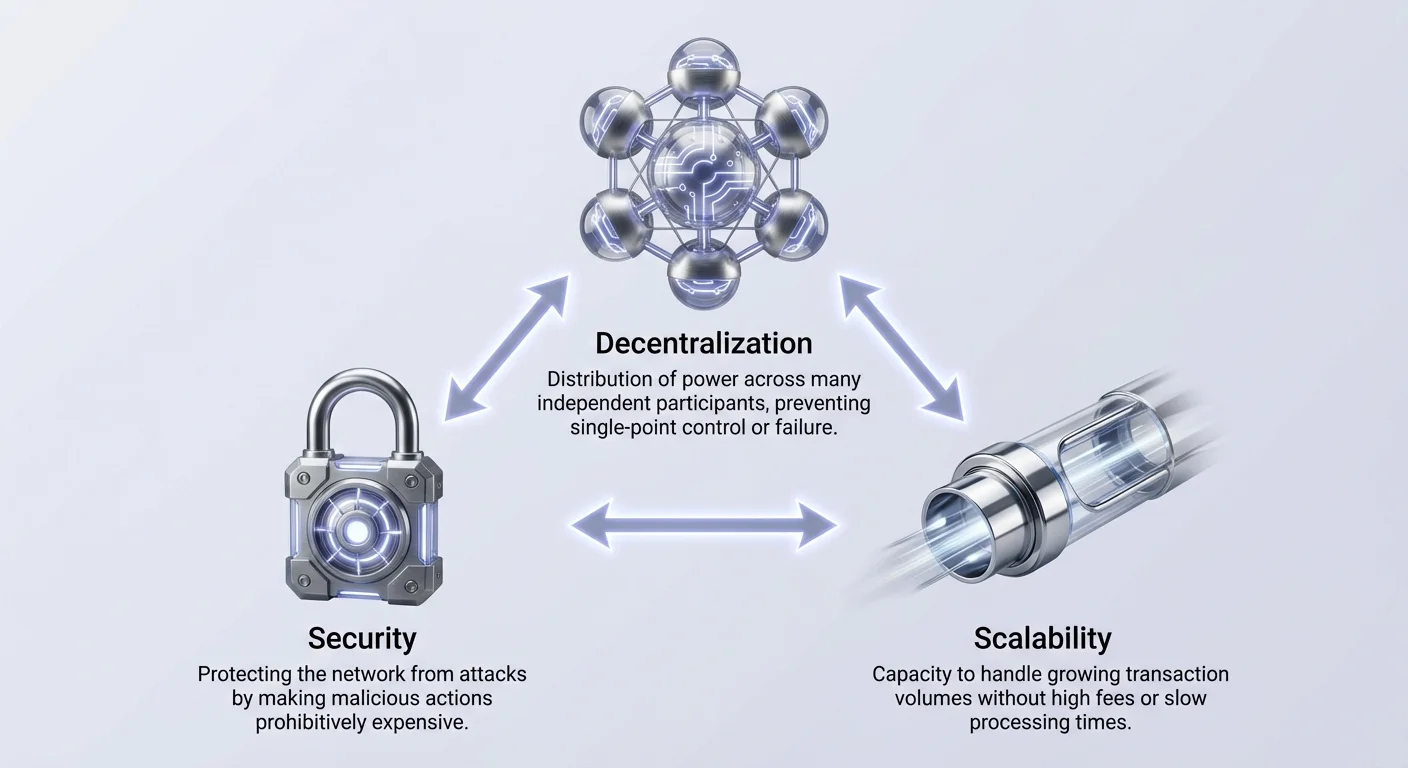
Understanding the Blockchain Trilemma
The blockchain trilemma helps explain why scaling a global, decentralized network is significantly harder than scaling a centralized database. In a centralized system, a single entity controls the servers, allowing them to upgrade hardware and process thousands of transactions per second with ease. However, this comes at the cost of trust and censorship resistance. Ethereum aims to avoid this compromise, but the trade-offs remain difficult to navigate.
The Three Pillars of Network Architecture
Decentralization refers to the distribution of power across a wide network of participants. In Ethereum, this means ensuring that no single entity controls the ledger. A highly decentralized network relies on thousands of independent nodes running the software from different locations. This redundancy makes the network resistant to censorship and government interference. If one node goes down or is compromised, the rest of the network continues to operate without interruption.
Security involves the network's ability to defend against attacks, particularly 51% attacks where a malicious actor gains control of the majority of the network's resources. In a decentralized system, security is achieved by making it prohibitively expensive for any single actor to attack the chain. This requires a massive amount of resources, whether in the form of computational power or financial capital locked in the system.
Scalability is the capacity of the system to handle a growing number of transactions without suffering from congestion or exorbitant fees. This is where the bottleneck occurs. To maintain decentralization, every node in the network must verify every transaction. This requirement inherently limits the speed of the network to the processing power of its individual nodes. If the requirements to run a node become too high in pursuit of speed, fewer people can participate, leading to centralization.
The Necessity of Evolution
Ethereum initially operated on a Proof-of-Work consensus mechanism, similar to Bitcoin. While this provided immense security and a fair distribution model, it was energy-intensive and limited the network to roughly 15 transactions per second. As demand for block space exceeded this limited supply, a bidding war for transaction inclusion ensued. This resulted in high gas fees, effectively making the network unusable for smaller transactions and limiting the potential for global adoption.
To solve this, the community recognized that the protocol could not remain static. Unlike Bitcoin, which often favors a conservative approach to preserve its function as a store of value, Ethereum adopted a progressive philosophy. The goal was to evolve the underlying technology to bypass the trilemma's limitations, aiming to increase throughput without sacrificing the core values of censorship resistance and security.
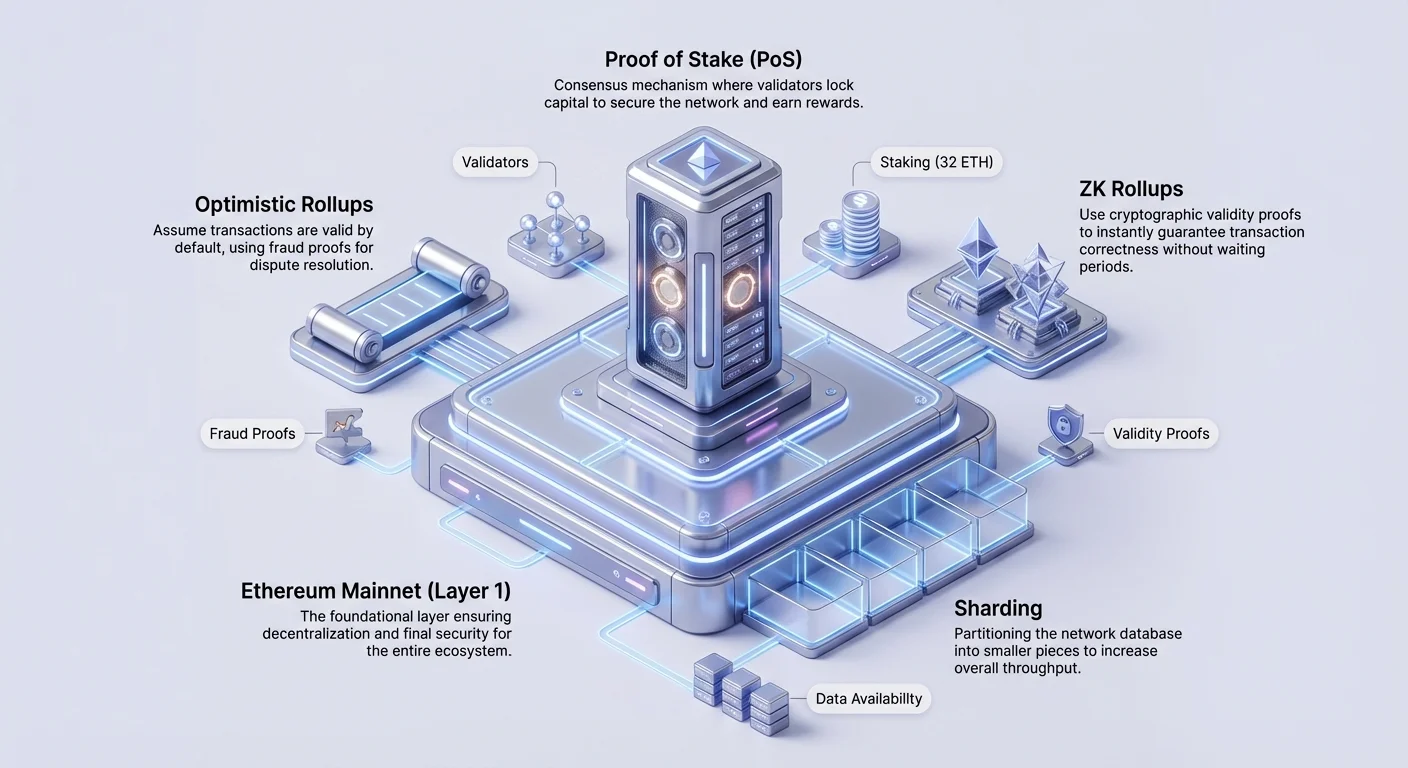
The Transition to Proof of Stake
A central pillar of Ethereum’s strategy to solve the trilemma was the transition from Proof-of-Work (PoW) to Proof-of-Stake (PoS). This massive upgrade, often referred to as "The Merge," fundamentally changed how the network achieves consensus. In the old PoW model, miners used vast amounts of electricity and hardware to solve complex puzzles. This energy expenditure secured the network but drew criticism for its environmental impact.
Mechanics of the New Consensus
In the Proof-of-Stake model, energy-intensive miners are replaced by validators. To become a validator, a participant must "stake" or lock up a specific amount of cryptocurrency—specifically 32 ETH—into a smart contract. This capital acts as a security deposit or a financial guarantee of good behavior. Instead of competing with hardware, validators are selected at random to propose new blocks and verify the work of others.
This system utilizes a "carrot and stick" approach to ensure honesty. Validators who perform their duties correctly, such as ordering transactions and proposing valid blocks, are rewarded with newly minted ETH and transaction fees. Conversely, validators who act maliciously or fail to stay online can face severe penalties known as "slashing." Slashing involves the forfeiture of a portion or even the entirety of their staked assets, making an attack on the network financially devastating for the attacker.
Security and Centralization Debates
The move to PoS offers significant advantages regarding the trilemma. First, it reduced Ethereum's energy consumption by more than 99%, making the network environmentally sustainable. Second, it changed the economics of attacking the network. In PoW, an attacker needs hardware; in PoS, they need to acquire a majority of the staked supply, which drives up the price of the asset they are trying to devalue.
However, this transition has not been without criticism. Opponents argue that PoS can lead to a "rich get richer" scenario. Since rewards are proportional to the amount staked, those with large capital reserves earn more, potentially concentrating influence over time. In contrast, Bitcoin mining is highly competitive with thin margins, forcing miners to sell coins to cover costs, which distributes supply. Despite these concerns, the Ethereum community largely views PoS as a necessary step to enable future scaling technologies like sharding.
Rešenja Layer 2: Kišobran skalabilnosti
Iako su nadogradnje mainnet-a (Layer 1) ključne, trenutno rešenje za začepljenje Ethereum-a došlo je iz „Layer 2“ rešenja. Layer 2 je kišobran termin za tehnologije koje se grade na vrhu Ethereum mainnet-a da povećaju kapacitet transakcija. Ovi protokoli obrađuju transakcije off-chain, rukujući teškim računanjem daleko od glavne mreže, a zatim nastavljaju finalne rezultate nazad na Ethereum. Ovo omogućava korisnicima da uživaju u bezbednosti Ethereum-a uz brže brzine i niže troškove.
Kanal i sajmčevi
Jedan od najranijih oblika skaliranja bio je koncept kanala, sličan Lightning Network-u Bitcoina. Kanali omogućavaju dve strane da transakcioniraju neograničen broj puta između sebe dok samo podnose prvu i poslednju transakciju na blokčejn. Ovo je neverovatno brzo i jeftino, ali zahteva zaključavanje fondova i direktnu vezu sa protustrankom. Ograničeno je u opsegu i ne podržava opšte pametne ugovore.
Nezavisni sajmčevi nude drugi pristup. Ovo su odvojeni blokčejn-i koji rade paralelno sa Ethereum-om i povezani su preko dvosmernog mosta. Primeri uključuju ranu arhitekturu Polygon-a ili Ronin lanac korišćen od strane Axie Infinity. Sajmčevi imaju sopstvene mehanizme konsenzusa i validatore. Ovo ih čini veoma brzim i jeftinim, ali su generalno manje bezbedni od Ethereum-a. Ako ograničen broj validatora sajmčeva koludi, teoretski bi mogli da ukradu fondove, što znači da korisnici veruju u bezbednost sajmčeva umesto Ethereum-ove.
Revolucija rollup-ova
Najperspektivnija Layer 2 tehnologija trenutno je „Rollup“. Rollup-ovi izvršavaju transakcije van glavnog Ethereum lanca, ali objavljuju podatke o transakcijama nazad na Layer 1. „Rollujući“ ili grupišući stotine transakcija u jedan komad podataka, drastično smanjuju prostor potreban na glavnom blokčeinu. Ovo nasleđuje bezbednost Ethereum-a, jer su podaci dostupni za verifikaciju, ali nudi brzinu sajmčeva.
Postoje dva primarna tipa rollup-ova: Optimistički rollup-ovi i Zero-Knowledge (ZK) rollup-ovi. Optimistički rollup-ovi pretpostavljaju da su transakcije validne po default-u da ubrzaju obradu. Oslanjaju se na sistem „dokaza prevare“ gde učesnici mreže mogu da izazovu transakciju ako smatraju da je nevalidna. Ovo zahteva period čekanja, često sedam dana, za povlačenja da se osigura da prevare nije bilo.
ZK rollup-ovi, s druge strane, koriste složenu kriptografiju da generišu dokaz validnosti za svaku grupu transakcija. Ovaj dokaz se podnosi Ethereum-u, matematički garantujući da su transakcije ispravne bez potrebe za periodom čekanja za izazove. Iako su ZK rollup-ovi tehnički složeniji i računski teški za generisanje, nude trenutnu finalnost čim se dokaz prihvati na Layer 1.
| Osobina | Optimistički rollup-ovi | Zero-Knowledge (ZK) rollup-ovi |
|---|---|---|
| Logika validacije | Pretpostavlja validnost osim ako se ne izazove | Kriptografski dokaz validnosti |
| Vreme povlačenja | Sporo (~7 dana za prozor prevare) | Brzo (zavisi od generisanja dokaza) |
| Složenost | Niža, lakše za implementaciju | Visoka, zahteva intenzivno računanje |
Šarding: Podela mreže
Kako Ethereum nastavlja svoj roadmap, „šarding“ predstavlja sledeću veliku fazu skaliranja baznog sloja samog. Šarding je koncept preuzet iz tradicionalne arhitekture baza podataka dizajniran da poveća propusni kapacitet podelom opterećenja. Trenutno, svaki čvor u Ethereum-u čuva celu istoriju mreže. Iako ovo osigurava bezbednost, stvara masivno usko grlo za performanse.
Šarding podrazumeva particionisanje celokupnog stanja mreže u manje, upravljive komade nazvane „shard-ovi“. Svaki shard radi nekako kao sopstveni blokčejn, sposoban da obrađuje transakcije i pametne ugovore nezavisno. Umesto da svaki čvor validira svaku transakciju, validatori se nasumično dodeljuju specifičnim shard-ovima. Oni samo moraju da upravljaju podacima za svoj dodeljeni shard, značajno smanjujući zahteve za hardver za učešće.
Interakcija između shard-ova koordinirana je glavnim lancem, često nazvanim Beacon Chain. Ovo osigurava da podaci ostanu konzistentni preko cele mreže. Inicijalna implementacija šardinga fokusira se na dostupnost podataka – pružajući više kapaciteta za Layer 2 rollup-ove da skladište svoje podatke – umesto direktnog izvršavanja pametnih ugovora na shard-ovima. Ovaj sinergijski pristup znači da će šarding učiniti Layer 2 rollup-ove još jeftinijim i bržim, stvarajući složeni efekat na skalabilnost.
Governance: The Human Element of Evolution
Solving the trilemma is not just a technical challenge; it is a governance challenge. Ethereum is a decentralized protocol, meaning there is no CEO or board of directors to unilaterally dictate changes. Upgrades must be proposed, debated, and voluntarily adopted by the community of stakeholders. This includes core developers, node operators, miners (historically), validators, and application users.
The Improvement Proposal Process
The formal method for introducing changes is the Ethereum Improvement Proposal (EIP). Anyone can draft an EIP, but getting it implemented requires navigating a rigorous process of peer review and community consensus. Proposals are debated on forums and developer calls. Once a "rough consensus" is reached, the code is written, audited, and tested on testnets. Finally, node operators must choose to update their software to include the new rules.
This process is inherently political and relies on "credible neutrality." Credible neutrality is a guiding principle suggested by Vitalik Buterin, emphasizing that the mechanism for governance should not discriminate for or against any specific people. The protocol must treat everyone fairly. This is difficult to maintain as the network grows and different stakeholders develop competing interests. For example, increasing the block size might help users by lowering fees, but it hurts node operators by increasing storage costs, which creates a centralization risk.
Progressivism versus Conservatism
The governance culture of Ethereum differs significantly from Bitcoin. Bitcoin’s community generally adheres to a philosophy of conservatism: the protocol is viewed as sound money that should rarely change to avoid introducing bugs or undermining trust. This stability is a feature, not a bug, for a store of value. Ethereum, aiming to be a global computing platform, adopts a philosophy of progressivism.
Because the demand for smart contract execution is so high and the technology is still maturing, the Ethereum community accepts the risks associated with frequent hard forks and upgrades. This was most evident in the 2016 DAO hack, where the community chose to fork the chain to reverse a theft, leading to the split between Ethereum and Ethereum Classic. While this decision was controversial and criticized for violating the "code is law" ethos, it demonstrated the community's willingness to intervene and evolve the protocol to ensure its long-term survival and utility.
Implikacije za budućnost
Kontinuirana evolucija Ethereum-a ističe da trilema blokčejna nije zid, već prepreka koja se može preskočiti kroz inovacije. Kombinacija Proof-of-Stake-a, Layer 2 rollup-ova i šardinga sugeriše budućnost gde Ethereum može da obrađuje hiljade transakcija u sekundi dok ostaje decentralizovan. Međutim, ova složenost uvodi nove rizike. Rešenja Layer 2 fragmentiraju likvidnost, a oslanjanje na složenu kriptografiju u ZK rollup-ovima dodaje potencijalne vektore za bagove.
Štaviše, oslanjanje na centralizovane pružaoce infrastrukture postavlja tihu pretnju decentralizaciji. Servisi poput Infura pružaju lak pristup podacima blokčejna, što znači da mnogi developeri ne pokreću sopstvene čvorove. Ako ključni pružalac padne, kao što se desilo u prošlosti, značajni delovi ekosistema mogu biti poremećeni. Održavanje niskog praga za ulazak za nezavisne validatore ostaje najkritičnija odbrana protiv ove centralizacije.
Zaključak
Put Ethereum-a je studija slučaja u balansiranju konkurentnih tehnoloških prioriteta. Mreža se pomerila od jednostavnog Proof-of-Work sistema ka modularnom, višeslojnom ekosistemu dizajniranom da rukuje zahtevima globalne finansijske infrastrukture. Prelaskom na Proof-of-Stake i usvajanjem rollup-centričnog roadmapa, Ethereum pokušava da reši trilemu blokčejna optimizujući različite slojeve steka za različite funkcije – bezbednost na mainnet-u i brzinu na Layer 2.
Ova konstantna evolucija je neophodna za Ethereum da ispuni svoju viziju. Kako mreža raste, tako raste i složenost njenog upravljanja i tehnički izazovi sa kojima se suočava. Uspeh ovih nadogradnji će odrediti da li decentralizovani blokčejn zaista može da se skalira da opsluzi milijarde korisnika bez kompromitovanja ključnih vrednosti bezbednosti i otpornosti na cenzuru koje su ga učinile vrednim u prvom mestu.
Skalabilnost nije destinacija, već kontinuirani proces tehničkih inovacija i koordinacije zajednice.