
For many newcomers entering the volatile world of cryptocurrencies, the primary fear is timing the market incorrectly—buying at the peak just before a crash. This anxiety leads many to hesitate or make rash decisions based on investor biases. Fortunately, one of the most powerful and beginner-friendly strategies available is Dollar-Cost Averaging (DCA), which removes emotion entirely and leverages the power of automation.
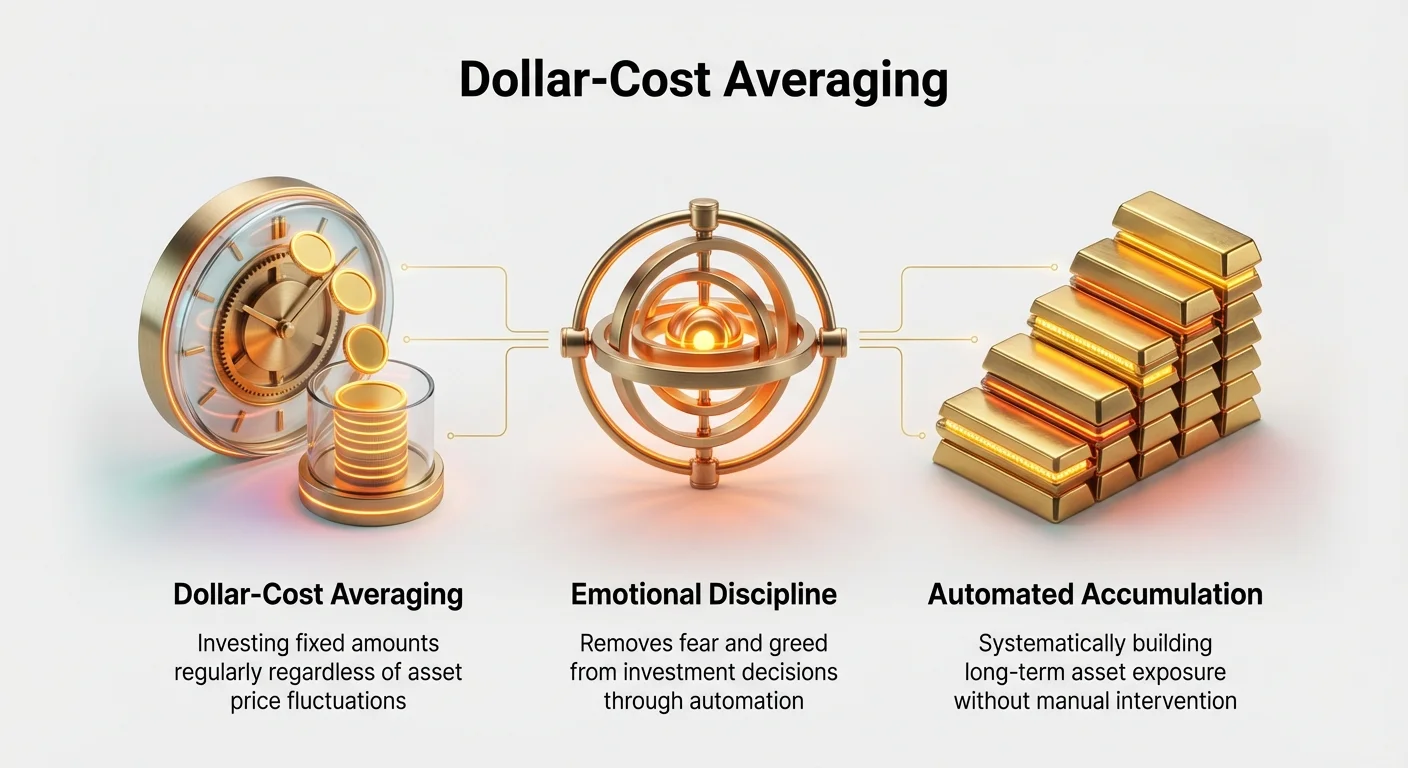
DCA is the foundational strategy for automated investing. It involves investing a fixed dollar amount on a regular schedule, regardless of the asset's price. This simple methodology forms the basis of "recurring buys" offered by nearly every major centralized exchange (CEX) today.
This guide will break down how to effectively implement and optimize an automated DCA strategy. We will compare the simplicity of recurring buys against the potential for optimization offered by advanced, automated limit orders, giving you the tools to create a resilient and profitable trading workflow built on consistency, not guesswork.
Understanding Dollar-Cost Averaging (DCA): The Foundation of Automated Investing
Dollar-Cost Averaging (DCA) is less of a trade strategy and more of an investment philosophy rooted in discipline. It is the perfect entry point for anyone seeking to build long-term exposure to digital assets like Bitcoin or Ethereum without the stress of market timing.
How DCA Works: Reducing Volatility Risk
When you DCA, you commit to buying, for example, $100 worth of Bitcoin every Monday morning. If Bitcoin’s price is $50,000 that week, you get 0.002 BTC. If the next week the price drops to $40,000, your $100 buys 0.0025 BTC.
The core benefit of this approach is that you buy more shares (or fraction of a coin) when the price is low and fewer when the price is high. Over months or years, the strategy averages out your purchase price, protecting you from purchasing all your assets at the market peak.
Why DCA Works for Crypto: Cryptocurrency markets are famous for their dramatic swings—periods of extreme growth followed by deep corrections. DCA provides a systematic method to absorb this volatility, turning market dips from stressful events into beneficial buying opportunities.
DCA vs. Lump Sum Investing: A Beginner’s Perspective
The main alternative to DCA is lump sum investing, where an investor commits their entire available capital to the market all at once.
| Feature | Dollar-Cost Averaging (DCA) | Lump Sum Investing |
|---|---|---|
| Capital Deployment | Staggered over time (e.g., weekly, monthly) | Deployed entirely at one point |
| Risk Exposure | Lowers short-term volatility risk | High short-term volatility risk |
| Execution | Automated/Scheduled Recurring Buys | Manual execution |
| Emotional Impact | Low stress; removes the need to "time the bottom" | High stress; requires confidence in current market timing |
Historically, studies on traditional markets often suggest that lump sum investing may yield marginally higher returns over the very long run, primarily because "time in the market beats timing the market." However, this assumes the investor has perfect conviction and tolerates immediate, severe drops.
For the beginner crypto investor, DCA is overwhelmingly the superior choice. It prioritizes capital preservation and discipline, ensuring you stick to your plan during stressful market conditions, which is essential when dealing with 50% or 70% drawdowns common in crypto.
The Psychological Benefits of Automation
The biggest enemy of a retail investor is typically themselves. Emotions like fear (when the market drops) and greed (when the market soars) drive poor decisions—selling too low or buying too high.
By setting up a recurring buy schedule, you delegate the execution to the platform. This automation offers profound psychological relief:
- Removal of Decision Fatigue: You no longer spend hours staring at charts wondering if "now" is the right moment. The platform decides based on the clock, not the price.
- Discipline Enforcement: It forces consistent saving and investment habits, ensuring you continue accumulating assets even when news headlines are overwhelmingly negative.
- Stress Reduction: Knowing your average entry price is protected reduces panic selling during bear markets.
Implementing DCA: Recurring Buys on Centralized Exchanges (CEXs)
For beginners, the simplest and most accessible path to automated DCA is through the "Recurring Buys" features built directly into major centralized exchanges (CEXs) like major centralized exchanges like Coinbase, Kraken, or Binance.
Setting Up Auto-DCA: Step-by-Step Practical Guide
Setting up an auto-DCA plan typically takes less than five minutes on most modern crypto platforms.
Step 1: Choose Your Exchange and Asset Select a reputable, secure exchange known for low trading fees on recurring orders. Decide which assets to accumulate (often Bitcoin and Ethereum are the safest starting points).
Step 2: Connect Your Funding Source Link a checking account, savings account, or debit card to the exchange. Ensure the connected account has sufficient funds to cover the recurring purchase.
Step 3: Define the Recurring Purchase You will specify three primary variables:
- Amount: The fixed dollar amount you wish to invest (e.g., $50).
- Frequency: How often the purchase should occur (e.g., daily, weekly, bi-weekly, monthly).
- Start Date: When the first purchase will be executed.
Step 4: Confirm and Monitor The exchange will automatically execute market orders (buying at the current market price) based on your schedule. You receive the purchased crypto directly into your account wallet.
Optimizing Frequency and Amount
While the fixed amount should align with your personal budget, the optimal frequency is a topic of debate, especially when considering fees.
The Fee Consideration: Every trade—even automated recurring buys—incurs a transaction fee, usually calculated as a percentage of the trade volume.
- Buying Daily: While theoretically the best at smoothing out price fluctuations, daily buys multiply the fee cost by 365. If your exchange charges 1% per transaction, and you buy $10 daily, you pay $36.50 in fees annually.
- Buying Monthly: Reduces the frequency of fees (12 transactions per year) but exposes you more heavily to the price on that single day of the month.
Best Practice for Beginners: Weekly or Bi-Weekly buys often strike the best balance. They are frequent enough to average out typical weekly volatility but minimize the compounding effect of fees on small transaction sizes.
Key Platform Features for Auto-DCA
When selecting an exchange for recurring buys, assess these critical features:
- Minimum Purchase Limits: Some exchanges require a minimum order size (e.g., $10 or $20). Ensure this aligns with your budget.
- Fee Structure: Look for exchanges that offer a discounted fee structure specifically for recurring, automated buys, as they are considered simple market orders.
- Asset Support: Verify that the platform allows recurring buys for the specific cryptocurrencies you wish to accumulate. While Bitcoin (BTC) and Ethereum (ETH) are standard, some smaller "altcoins" may not be eligible for the recurring buy feature.
- Instant Withdrawal/Deposit Options: Quick access to funds and easy bank linking streamline the DCA process.
Od osnov k naprednemu: Predstavitev naprednih vrst nalogov
Omejitev standardne funkcije "Ponavljajoči se nakup" je, da vedno izvede Tržni nalog—takoj kupi sredstvo po trenutno najboljši ceni. Čeprav je to preprosto, ta pristop žrtvuje optimizacijo cene.
Napredni vlagatelji ali tisti, ki so pripravljeni svojemu trgovanju posvetiti več pozornosti, lahko uporabijo orodja za avtomatizacijo (ali celo funkcije borze, kot so ponavljajoči se limitni nalogi, čeprav so redkejši) za izvajanje naprednih vrst nalogov, ki iščejo boljše cene.
Kaj so limitni nalogi in kako delujejo?
Limitni nalog je stalno navodilo borzi, da kupi ali proda določeno sredstvo le, ko doseže vnaprej določeno ceno.
Limitni nakupni nalog: Nastavite ceno pod trenutno tržno ceno. Nalog ostane neaktiven, dokler cena sredstva ne pade do vaše omejitve.
- Primer: Bitcoin trguje pri 60.000 USD. Verjamete, da bo padel na 58.000 USD. Nastavite limitni nakupni nalog pri 58.000 USD. Če cena pade, se vaš nalog izvede. Če cena nikoli ne pade tako nizko, nalog poteče neizpolnjen.
Tržni nalog (proti limitnemu nalogu): Tržni nalog zagotavlja izvedbo (kripto dobite takoj), vendar ne zagotavlja cene. Limitni nalog zagotavlja ceno (če je izveden), vendar ne zagotavlja izvedbe (cena morda nikoli ne bo dosežena).
Za tiste, ki optimizirajo svoj DCA, strategija ponavljajočih se limitnih nalogov poskuša ohraniti disciplino načrtovanih nakupov, hkrati pa izboljšati povprečno vstopno ceno z nakupom le med tržnimi padci.
Stop-Loss in Take-Profit nalogi za upravljanje tveganja
Medtem ko je DCA predvsem strategija kopičenja, bolj aktivni trgovci pogosto uporabljajo druge napredne naloge, zlasti za prodajo, za obvladovanje tveganja.
Stop-Loss nalogi: Ta nalog ščiti pred znatnimi izgubami. Če cena sredstva pade na vnaprej določeno zaustavitveno ceno, stop-loss nalog sproži tržni prodajni nalog, s čimer omeji nadaljnje izgube. Pomembno opozorilo: Stop-loss nalogi se običajno ne uporabljajo v strategiji kopičenja DCA, so pa temeljni za upravljanje kapitala, pridobljenega z DCA, če ga nameravate trgovati.
Take-Profit nalogi: Ta nalog zagotavlja, da zaklenete dobiček. Če cena sredstva naraste do vnaprej določene tarče, take-profit nalog sproži tržni prodajni nalog, s čimer zajame dobiček pred morebitnim preobratom.
Uporaba teh naprednih nalogov, zlasti limitnega nakupnega, omogoča vlagateljem, da združijo dolgoročno disciplino DCA s kratkoročno cenovno inteligenco, s čimer ustvarijo optimizirano ponavljajočo se strategijo.
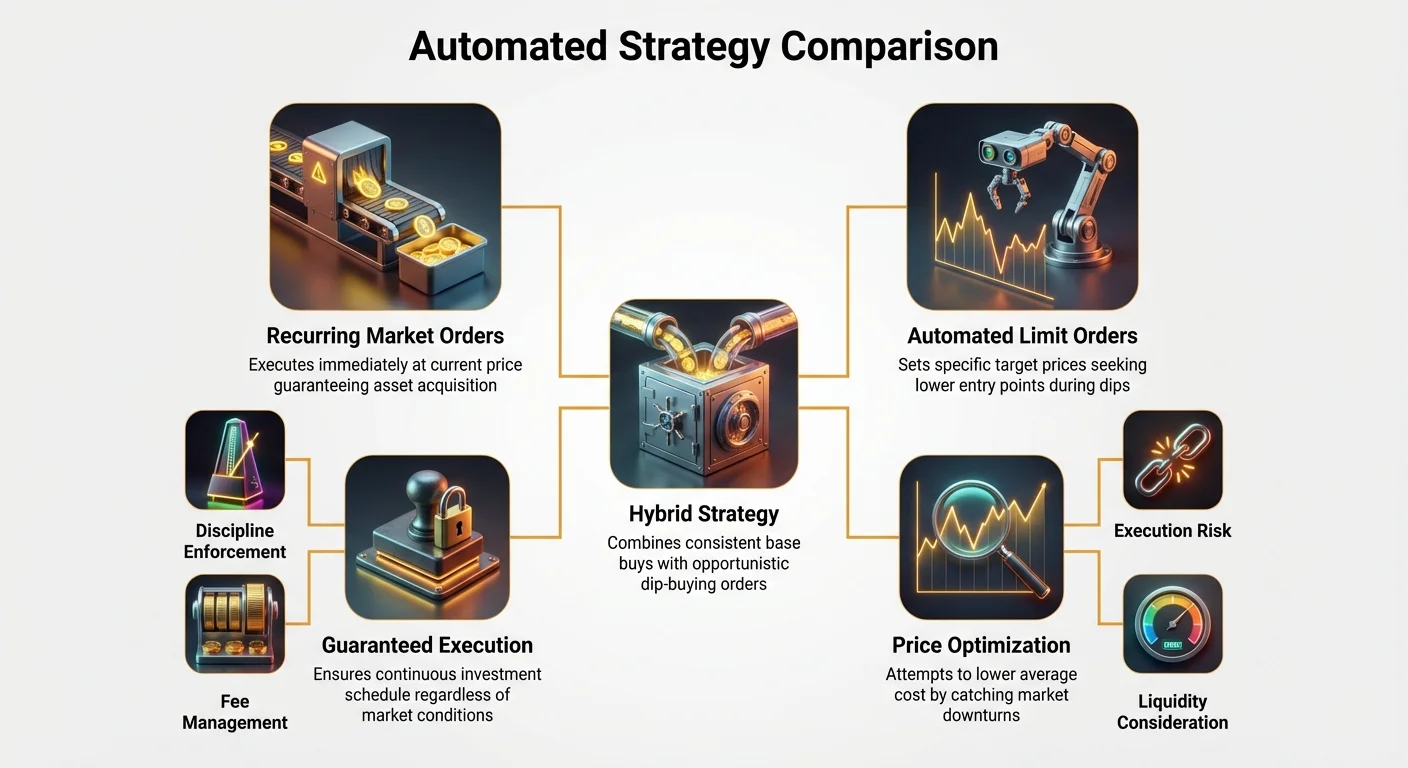
Recurring Buys vs. Automated Limit Order Strategies
The choice between the basic Recurring Buy and a sophisticated Automated Limit Order strategy depends entirely on your goals, time commitment, and tolerance for complexity.
Recurring Buys (DCA): The "Set-It-and-Forget-It" Approach
The standard recurring buy is executed as a market order, meaning you get your cryptocurrency immediately upon the scheduled time (e.g., every Tuesday at 9 AM).
Pros:
- Guaranteed Execution: You are guaranteed to accumulate assets on schedule.
- Highest Simplicity: Requires zero ongoing management or monitoring.
- Maximum Consistency: Ensures absolute adherence to the DCA principle.
Cons:
- No Price Optimization: You always pay the current market price, even if it is momentarily inflated.
- Higher Entry Price: Over time, your average entry price might be slightly higher than if you waited for small dips.
This strategy is ideal for the pure novice investor who wants to contribute capital to the market consistently and walk away, only checking balances occasionally. It is the purest form of DCA.
Automated Limit Orders: Seeking Price Optimization
An automated limit order strategy involves using advanced trading tools (often requiring external crypto trading bots or specific exchange features designed for algorithmic trading) to place recurring limit buy orders at strategic price levels.
For instance, instead of buying $100 every week at the market price, you might instruct a bot to: "Every week, place a $100 limit buy order 5% below the current market price, and if it doesn't fill within 48 hours, cancel it and place a new order at the market price."
Pros:
- Improved Entry Price: If successful, you purchase assets at a lower average cost.
- Tactical Advantage: Allows you to capture sudden dips and flash crashes missed by market-order DCA.
- Lower Fees: Limit orders often benefit from lower trading fees (exchanges sometimes offer "maker" rebates for limit orders that provide liquidity).
Cons:
- Risk of Non-Execution: If the market keeps rising, your limit orders might never be filled, meaning you fall behind on your accumulation schedule.
- Higher Complexity: Requires familiarity with APIs, advanced order types, and sometimes third-party automation software.
- Increased Monitoring: Orders must be managed to ensure capital isn't tied up indefinitely in unfilled orders.
Using DCA and Limit Orders Together (Hybrid Strategy)
For the investor who wants to optimize dca crypto accumulation without fully sacrificing consistency, a hybrid approach is the most effective middle ground.
The goal is to use recurring buys for the base investment and limit orders for opportunistic additions.
Strategy Framework:
- The Base: Set up a core recurring buy (e.g., monthly or bi-weekly) using the exchange’s built-in feature. This ensures 70-80% of your intended investment capital gets deployed regardless of price, maintaining DCA consistency.
- The Optimization Budget: Allocate the remaining 20-30% of your monthly capital budget to manual or automated limit orders.
- Tactical Limit Placement: When the market experiences a minor pullback (e.g., 5-10% from recent highs), use your optimization budget to place specific limit orders slightly below the current dip price. If they fill, great—you bought the dip. If they expire, the capital rolls over to the next month’s optimization budget.
This hybrid approach ensures continuous accumulation (the core DCA benefit) while actively hunting for lower entry points (the optimization benefit of limit orders).
Tips for Optimizing Your Automated Strategy
Whether you stick to simple recurring buys or implement complex automated limit strategies, several critical considerations can maximize the efficiency and security of your investment plan.
Managing Trading Fees for Automated Buys
Fees are a silent killer, especially when executing dozens of small automated trades annually. A fee of 0.5% might seem minor, but it subtracts directly from your capital and compounding returns.
Actionable Fee Reduction Tips:
- Maximize Buy Size: If you plan to invest $400 per month, consider one monthly purchase instead of four weekly $100 purchases. Fewer transactions mean fewer fixed fee percentages applied.
- Utilize Native Tokens: Some exchanges (like Binance with BNB) offer fee discounts if you pay your trading fees using their native token. This can often reduce trading costs by 25% or more.
- Check Maker/Taker Fees: If you transition to automated limit orders, ensure you benefit from Maker Fees (fees charged for adding liquidity, often lower or zero) rather than Taker Fees (fees charged for instantly executing against existing orders). Limit orders that are placed and wait to be filled are usually charged the lower Maker fee.
Liquidity and Slippage Consideration
When using market orders (standard recurring buys), liquidity is crucial. Liquidity refers to how easily an asset can be bought or sold without affecting its price.
- High Liquidity (BTC, ETH): On major exchanges, market orders for BTC or ETH typically execute instantly with minimal Slippage (the difference between the expected price and the execution price).
- Low Liquidity (Small Altcoins): If you set up a recurring buy for a very small, niche altcoin, a large market order could momentarily drive the price up against you, resulting in significant slippage and a higher true cost.
Best Practice: Stick to highly liquid assets (top 10 cryptocurrencies) when utilizing recurring market order strategies to minimize slippage costs.
Security Best Practices for Recurring Strategies
Since automated systems rely on your exchange account being funded and accessible, security must be paramount.
- Enable 2FA (Two-Factor Authentication): This is non-negotiable. Use robust 2FA (like hardware keys or authenticator apps, not SMS) on your exchange account login.
- Review Permissions: If you use third-party tools or trading bots to execute advanced recurring limit orders, carefully review the API keys you grant them. They should only have permission to trade and read balances, never permission to withdraw funds.
- Regular Account Monitoring: Periodically review your transaction history to ensure the recurring buys are executing correctly and that no unauthorized trades have occurred.
Conclusion: Consistency Triumphs Over Timing
For the novice investor, optimizing your investment workflow begins and ends with the consistency provided by automation. Dollar-Cost Averaging, implemented via a simple recurring buy schedule on a reliable centralized exchange, is the single best auto dca strategy for achieving long-term capital accumulation in the crypto space. It is robust, emotionally resilient, and highly accessible.
As you gain experience, you can graduate to the hybrid model, introducing automated limit orders to capture tactical dips and optimize your entry prices. However, always remember that in crypto, capital consistency and discipline far outweigh the ability to perfectly time the market. Start simple, stay disciplined, and let automation do the heavy lifting.