
The cryptocurrency landscape extends far beyond Bitcoin and Ethereum. For investors seeking high-growth potential, the true frontier lies in the altcoin and low-cap market. These assets, often characterized by smaller market capitalizations and newer technologies, present unique challenges and opportunities. Success in this arena depends heavily on selecting the right trading platform.
Unlike major cryptocurrencies that are universally available, low-cap gems and emerging altcoins are not listed everywhere. Accessing them requires navigating a complex ecosystem of exchanges, each with distinct liquidity profiles and listing policies. Understanding the mechanics of these platforms is essential for executing trades efficiently and securing assets.
Liquidity serves as the lifeblood of any financial market. In the context of low-cap tokens, it dictates the ease with which a trader can enter or exit a position without causing drastic price shifts. A deep dive into platform architecture reveals how different exchanges handle this critical factor.
Listing frequency is the second pillar of the altcoin market. It refers to how quickly and aggressively an exchange adds new tokens. High listing frequency offers early access to potential breakouts but often comes with reduced vetting and higher risk. Balancing these factors is the core task of the altcoin trader.
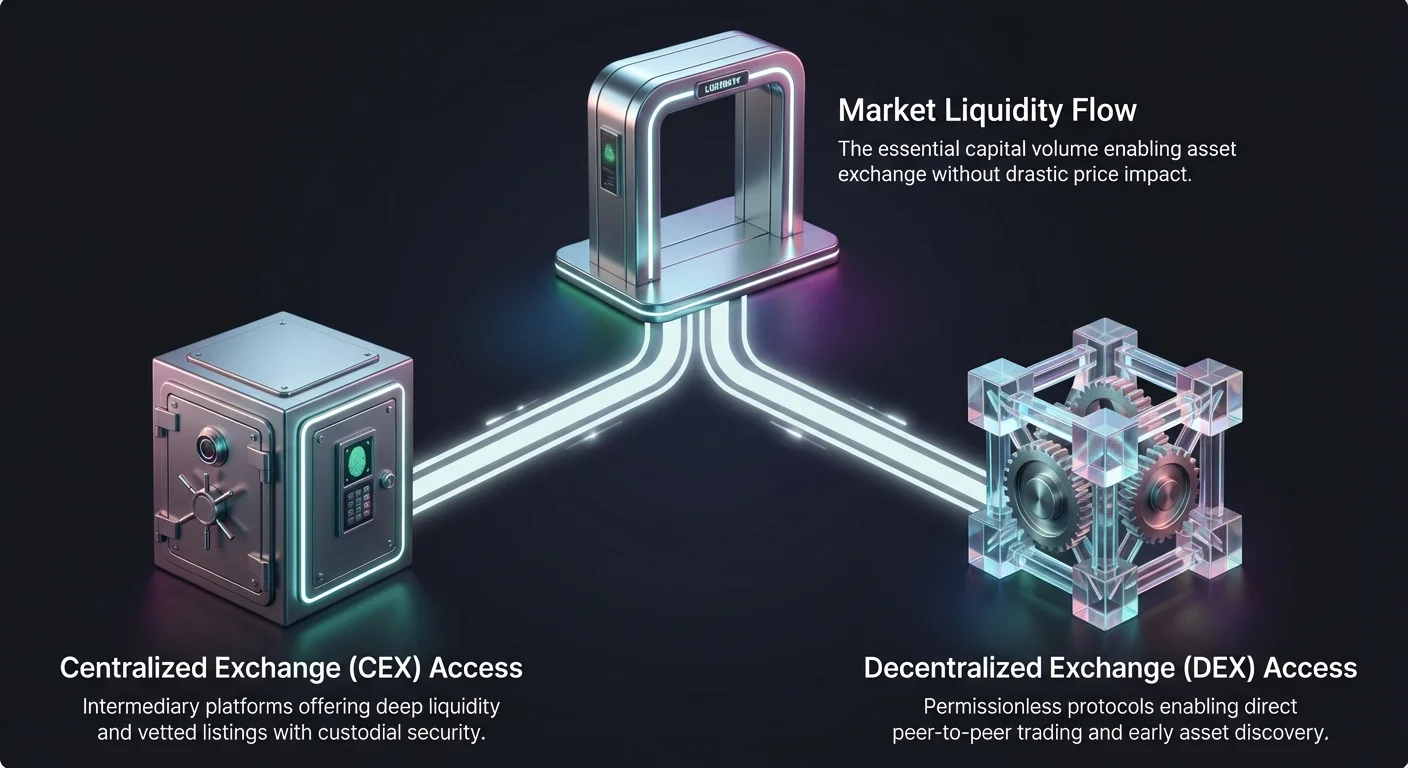
The Spectrum of Exchange Types
The crypto market is serviced by a diverse array of platforms, each catering to different trading needs. Centralized Exchanges (CEXs) act as traditional intermediaries. They are operated by companies that facilitate trades, hold user funds, and manage order books. These platforms are often the first stop for beginners due to their user-friendly interfaces and fiat on-ramps.
Decentralized Exchanges (DEXs) operate on an entirely different paradigm. They function without a central authority, utilizing smart contracts to facilitate peer-to-peer trading. Users retain control of their private keys, trading directly from their personal wallets. DEXs are critical for low-cap investing because they allow permissionless listings, meaning new tokens often appear here first.
Hybrid exchanges attempt to merge the best of both worlds. They aim to provide the high liquidity and speed of centralized systems while offering the non-custodial security of decentralized networks. While less common, they represent an evolving sector of the market designed to mitigate the specific risks associated with pure CEX or DEX models.
Peer-to-Peer (P2P) platforms offer a more direct approach. They connect buyers and sellers directly, often for fiat-to-crypto transactions. While excellent for privacy and bypassing banking restrictions, P2P platforms generally suffer from lower liquidity and a limited selection of altcoins compared to dedicated trading exchanges.
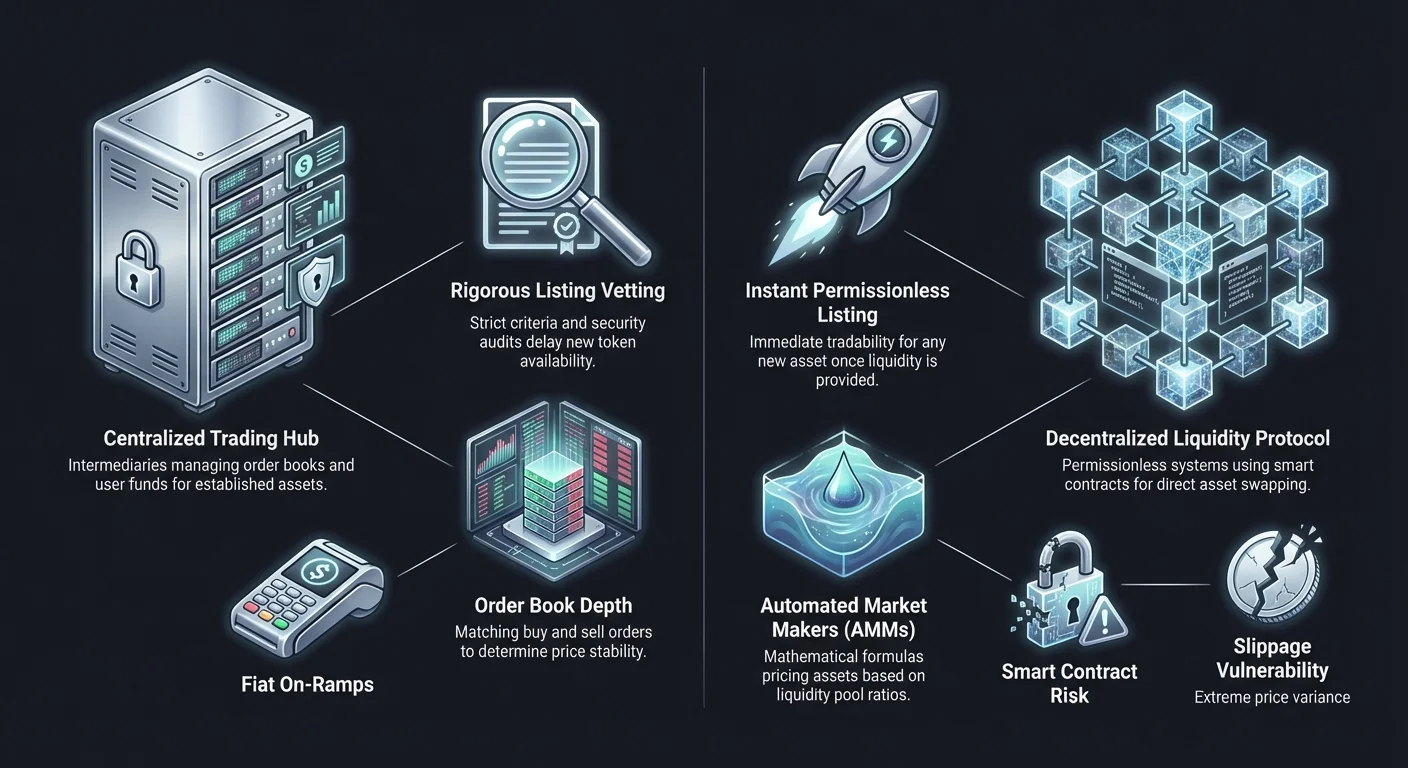
Centralized Exchanges and Liquidity Aggregation
Centralized exchanges typically offer the deepest liquidity for established altcoins. They achieve this by aggregating orders from thousands or millions of users into a central order book. This concentration of activity ensures that buy and sell orders can be matched instantly at stable prices.
For low-cap tokens, however, CEX liquidity can be hit or miss. Top-tier exchanges are selective about what they list. They require projects to meet strict criteria regarding volume, security, and compliance. Consequently, many low-cap tokens are excluded from these massive liquidity pools until they have matured.
When a low-cap token does manage to secure a listing on a major CEX, it often experiences a "listing pump." This phenomenon occurs because the token is suddenly exposed to a massive pool of capital and new traders. The liquidity provided by the exchange stabilizes the asset, making it safer for institutional investors to enter.
However, not all CEXs are equal. Lower-tier centralized exchanges may list hundreds of obscure tokens to attract users. While this provides access, the liquidity on these platforms is often shallow. This can lead to high slippage, where large orders significantly move the price, resulting in unfavorable execution for the trader.
Decentralized Exchanges: The Low-Cap Frontier
Decentralized exchanges are the primary playground for low-cap and micro-cap tokens. Because DEXs typically do not require a central authority to approve a listing, any project can create a liquidity pool and make their token tradable. This permissionless nature ensures that the newest assets are available on DEXs long before they reach centralized platforms.
Liquidity on a DEX works differently than on a CEX. Instead of an order book, most DEXs use Automated Market Makers (AMMs). Users deposit pairs of assets into liquidity pools. Smart contracts then use a mathematical formula to determine the price based on the ratio of assets in the pool.
This model allows for trading even when there is no specific counterparty on the other side of the trade. As long as there is liquidity in the pool, a trade can occur. This is vital for low-cap tokens that might not have active buyers and sellers at every moment.
The downside is that liquidity must be incentivized. If a project fails to attract liquidity providers, the pool remains small. Trading in a small pool results in massive price impacts. A single large buy order can double the price, while a sell order can crash it, creating extreme volatility for holders.
Listing Frequency and Vetting Processes
The speed at which an exchange lists new assets is a defining characteristic for altcoin hunters. Platforms with high listing frequency are often preferred by traders looking for the "next big thing" before it becomes mainstream. However, speed often comes at the cost of due diligence.
Centralized exchanges with rigorous vetting processes list fewer tokens. They conduct security audits, legal reviews, and financial assessments before adding an asset. This slow pace protects users from scams but limits profit potential from early entry. These platforms prioritize reputation and stability over novelty.
Conversely, exchanges known for aggressive listing schedules prioritize variety. They may list trending meme coins or experimental projects within days of their launch. This provides immediate access to market trends but exposes traders to a higher number of failed projects and potential "rug pulls."
On DEXs, the listing frequency is effectively instantaneous. As soon as a smart contract is deployed and liquidity is added, the token is tradable. There is zero vetting. The responsibility falls entirely on the trader to verify the contract address, check for locked liquidity, and assess the project's legitimacy.
Understanding Liquidity Metrics
When evaluating a platform for low-cap trading, understanding liquidity metrics is crucial. Volume is the most cited metric, representing the total value of trades over a specific period. High volume generally indicates a healthy market with active participants.
However, volume can be faked on unregulated exchanges through "wash trading." This involves buying and selling the same asset repeatedly to create the illusion of activity. Therefore, traders must also look at market depth. This measures the volume of open buy and sell orders at different price levels.
| Metric | Definition | Importance for Low-Caps |
|---|---|---|
| Volume | Total value traded in 24h | Indicates interest and activity |
| Market Depth | Quantity of open orders | Prevents price crashes from large sells |
| Spread | Gap between buy and sell price | Determines cost of immediate entry |
Spread is particularly important for low-cap assets. A wide spread means there is a large gap between the highest price a buyer is willing to pay and the lowest price a seller will accept. This acts as a hidden fee, as traders immediately lose value the moment they execute a market order.
The Risks of Low Liquidity Environments
Trading in environments with low liquidity introduces specific risks that do not exist in high-volume markets. The most immediate is slippage. Slippage occurs when the final execution price of a trade differs from the expected price.
In a thin market, a buy order for a large amount of tokens might exhaust the available sell orders at the current price. The engine then moves up the order book to higher prices to fill the remainder of the order. The trader ends up paying significantly more than the market rate.
Volatility is also amplified in low liquidity environments. Without a deep order book to absorb shocks, relatively small trades can cause double-digit percentage price swings. This makes low-cap tokens susceptible to manipulation by "whales" or coordinated groups.
Furthermore, low liquidity can lead to being trapped in a position. If a trader holds a significant amount of a low-cap token and the liquidity dries up, they may find it impossible to sell without driving the price to zero. This lack of exit liquidity is a primary cause of portfolio loss in altcoin trading.
Fee Structures and Profitability
Profitability in altcoin trading is heavily influenced by fee structures. Exchanges generate revenue through various models, most commonly maker and taker fees. Makers are traders who place limit orders that sit on the order book, adding liquidity. Takers place market orders that remove liquidity.
To encourage liquidity depth, many platforms offer lower fees to makers. Some even provide rebates. Takers, who demand immediate execution, typically pay higher rates. For low-cap traders who often need to enter or exit quickly due to volatility, taker fees can accumulate rapidly.
Network fees are another consideration, particularly on DEXs. Trading on the Ethereum network, for example, requires paying gas fees for every transaction. During periods of network congestion, a simple swap can cost upwards of $50 or $100. For smaller trades, this can erode the entire potential profit.
Centralized exchanges often absorb network fees for internal trades, charging only a flat percentage. However, they charge withdrawal fees when users move assets off the platform. These fees can be exorbitant for certain altcoins, sometimes trapping small balances on the exchange because the cost to withdraw exceeds the asset's value.
Security in a High-Risk Market
Security is the bedrock of any exchange, but it becomes paramount when dealing with the high-risk altcoin sector. Centralized exchanges are custodial, meaning they hold the private keys to user funds. This makes them prime targets for hackers.
Top-tier platforms mitigate this risk through cold storage. This involves keeping the vast majority of digital assets in offline wallets that are not connected to the internet. Only a small percentage is kept in "hot wallets" to facilitate immediate withdrawals.
Two-factor authentication (2FA) is a standard requirement for securing user accounts. The most secure platforms support hardware keys or authenticator apps rather than SMS, which is vulnerable to SIM-swapping attacks. Insurance policies are also becoming more common, providing a safety net if the exchange itself is breached.
For DEX users, security is a matter of personal responsibility. The exchange cannot be hacked in the traditional sense, but the user's wallet can be compromised. Furthermore, users must interact with smart contracts. Malicious contracts can drain wallets if users grant them unlimited permissions.
The Role of Privacy and Anonymity
Privacy is a significant factor for many crypto traders. Traditional centralized exchanges are increasingly compliant with global regulations, requiring strict Know Your Customer (KYC) verification. Users must upload government IDs and proof of residence to trade.
Anonymous exchanges cater to those who wish to trade without revealing their identity. These platforms often have higher limits for unverified accounts or operate entirely without KYC. They are popular among privacy advocates and those in regions with restrictive banking laws.
However, anonymous exchanges often lack the regulatory oversight and insurance protections of their compliant counterparts. If an anonymous exchange shuts down or is seized by authorities, users often have little recourse to recover their funds.
DEXs offer the highest level of privacy by design. No account creation is required, and no personal data is collected. Transactions are linked only to a wallet address. While the blockchain ledger is public, linking a specific address to a real-world identity is difficult without external data points.
User Interface and Trading Tools
The complexity of the trading interface can impact a trader's ability to analyze the market. Advanced platforms provide comprehensive charting tools, often integrating software like TradingView. This allows users to apply technical indicators, draw trend lines, and analyze historical data directly on the exchange.
For low-cap trading, real-time data is essential. Price feeds must be accurate and instantaneous. Delays in data rendering can lead to missed opportunities or executing trades based on stale information.
Mobile accessibility is another critical feature. The crypto market operates 24/7, and volatility can strike at any moment. High-quality mobile apps allow traders to manage positions, set alerts, and execute trades from anywhere.
However, some advanced features found on desktop interfaces may be stripped down in mobile versions. Traders must ensure that the mobile app supports the specific order types and analytical tools they rely on for their strategy.
Analyzing Market Depth and Order Types
Sophisticated traders rely on various order types to manage risk and optimize entry points. A standard market order executes immediately at the current price, but it is vulnerable to slippage. Limit orders allow traders to set a specific price at which they are willing to buy or sell.
Limit orders are essential for low-cap assets. By setting a limit, a trader ensures they do not pay more than they intended, even if the market is thin. However, there is a risk that the order will never be filled if the price moves away from the target.
Stop-loss orders are critical risk management tools. They automatically trigger a sell order if the price drops to a certain level. This protects capital during sudden crashes, which are common in the altcoin market.
Advanced platforms offer conditional orders like One-Cancels-the-Other (OCO). This allows a trader to set both a take-profit limit and a stop-loss simultaneously. Whichever price is hit first triggers that order and cancels the other, automating the exit strategy.
The Impact of Regulation on Listing
Global regulations are reshaping the landscape of available assets. Exchanges operating in strict jurisdictions, such as the United States or Europe, face limitations on which tokens they can list. Regulators may classify certain altcoins as securities, making it illegal for compliant exchanges to offer them to retail investors.
This regulatory pressure creates a fragmented market. A token might be available on international platforms but geoblocked for users in specific countries. This disparity affects liquidity, as the global trading volume is split across different venues that cannot interact.
Traders in restrictive regions often have to rely on DEXs or offshore exchanges to access the full range of altcoins. This introduces legal and tax complexities that users must navigate carefully. Understanding local laws regarding crypto trading is as important as understanding the market itself.
Fiat On-Ramps and Off-Ramps
The bridge between traditional finance and the crypto economy is known as the fiat gateway. Exchanges with robust fiat support allow users to deposit and withdraw government currencies like USD, EUR, or GBP directly via bank transfer or credit card.
For altcoin traders, the quality of the fiat gateway is vital. Being able to quickly move cash into the market during a dip can determine the success of a trade. Conversely, the ability to cash out profits reliably is essential for realizing gains.
Some exchanges specialize in crypto-to-crypto trading and offer limited or expensive fiat options. Users might have to buy a stablecoin like USDT or USDC on one platform and transfer it to another to trade specific altcoins. This adds steps and fees to the process.
P2P platforms often fill the gap in regions where direct bank transfers to crypto exchanges are blocked. They facilitate transfers between individuals using local payment methods, acting as a decentralized fiat gateway.
Stablecoins: The Quote Currency of Altcoins
In the altcoin market, assets are rarely priced directly in fiat currency. Instead, they are paired with stablecoins or major cryptocurrencies like Bitcoin. The most common trading pairs involve USDT, USDC, or BTC.
Understanding trading pairs is fundamental. If an altcoin is paired only with Bitcoin, its value in fiat terms will fluctuate not just based on its own performance, but also based on Bitcoin's price movements. Trading against a stablecoin provides a clearer picture of the asset's standalone value.
Liquidity is often fragmented across these pairs. An altcoin might have high volume on its USDT pair but very low volume on its BTC pair. Traders should always seek out the pair with the highest liquidity to ensure efficient execution.
Hybrid Exchanges and the Future
Hybrid exchanges represent an attempt to solve the liquidity issues of DEXs and the security issues of CEXs. These platforms typically use a central order matching engine for speed but settle trades on the blockchain for security.
This model prevents the exchange from holding custody of user funds, reducing the risk of theft or mismanagement. However, technical challenges in scaling these solutions have kept them from dominating the market. As layer-2 blockchain solutions improve speed and reduce costs, hybrid models may become more prevalent.
The evolution of cross-chain bridges is also changing the landscape. These technologies allow tokens from one blockchain to be traded on a DEX built on a different network. This interconnectivity improves liquidity efficiency across the entire crypto ecosystem.
Conclusion
Navigating the world of altcoin and low-cap trading requires a multifaceted approach to platform selection. There is no single "best" exchange; rather, there are platforms optimized for different stages of a token's lifecycle and different trader risk profiles. Centralized exchanges offer stability, speed, and ease of use, making them ideal for established assets and substantial capital. Decentralized exchanges provide the raw access and privacy necessary for discovering early-stage opportunities, albeit with increased responsibility for security and due diligence.
Success depends on understanding the interplay between liquidity, listing frequency, and security. Traders must recognize that high listing speed often correlates with higher risk, and that liquidity is the primary safeguard against volatility and slippage. By leveraging the strengths of both CEXs and DEXs, and utilizing advanced order types and risk management strategies, investors can effectively position themselves in the dynamic altcoin market.
The ideal strategy involves using established platforms for liquidity and security while utilizing decentralized protocols to access emerging opportunities.