
Digital asset security represents a fundamental shift in how individuals perceive and interact with value. In the traditional financial system, security is largely provided by institutions that act as gatekeepers and custodians of funds. When you deposit money into a bank, you are essentially transferring ownership to that institution in exchange for a promise that you can withdraw it later.
This model relies heavily on trust and permission. You must ask the bank to process transactions, and they have the authority to approve or deny these requests based on their internal policies or external regulatory pressures.
In the realm of cryptocurrency, the paradigm shifts entirely toward a model of digital ownership that is peer-to-peer and permissionless. Assets like Bitcoin and Ether function on decentralized networks where no single entity controls the flow of funds. This means you can send value anywhere in the world without asking for authorization from a third party.
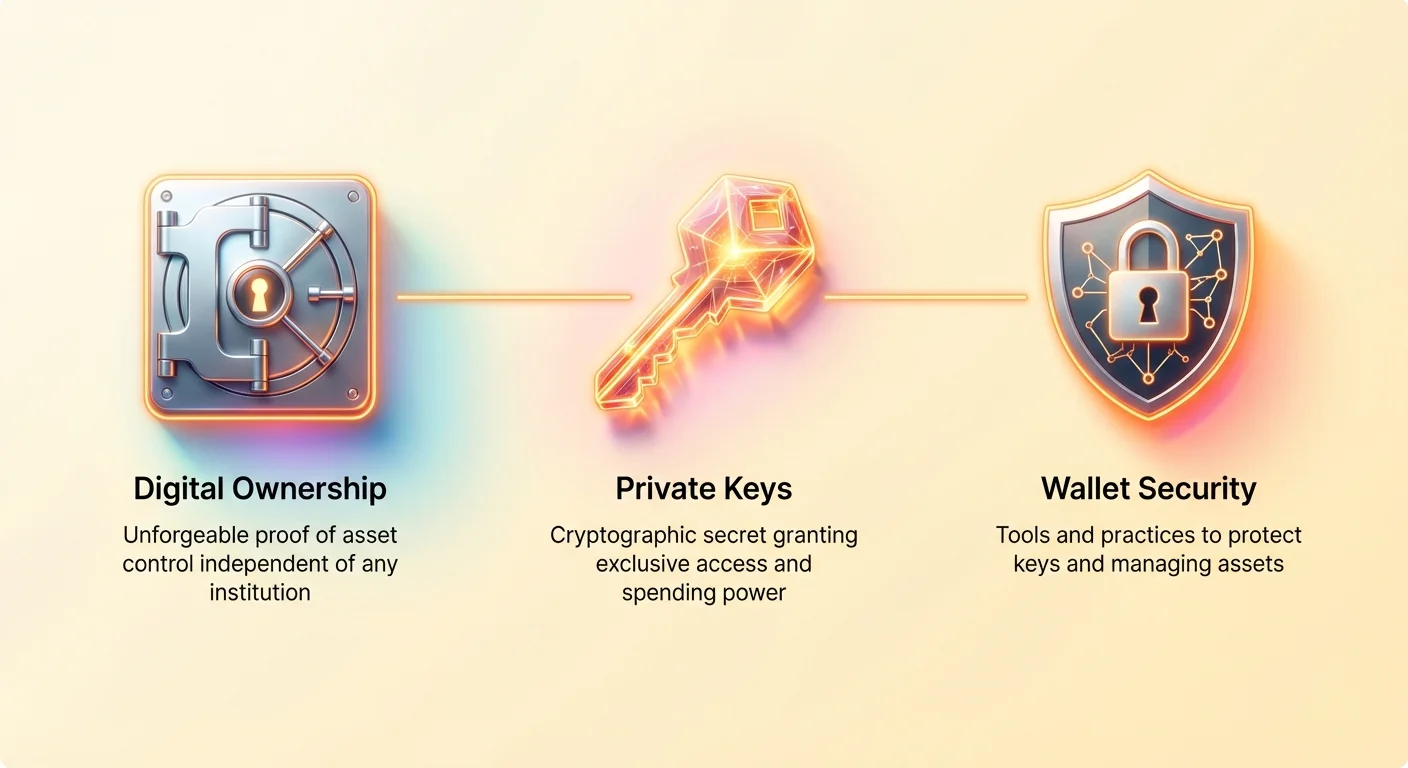
However, this freedom comes with a significant responsibility: you alone are responsible for protecting your assets. There is no customer service department to reverse a fraudulent transaction or recover a lost password. Understanding the anatomy of this ownership—specifically the roles of private keys, seed phrases, and wallet derivation—is essential for anyone navigating this digital landscape.
The Foundation of Digital Security
Peer-to-Peer Responsibility
Cryptocurrencies function on a peer-to-peer basis, meaning transactions occur directly between users without an intermediary. This structure eliminates the need for banks but places the burden of security squarely on the individual. In this environment, your digital assets are only as secure as the measures you take to protect them.
If you fail to safeguard the access credentials to your holdings, the loss is often irreversible. Unlike a credit card charge that can be disputed, a blockchain transaction is final once confirmed. This reality necessitates a deeper understanding of the tools used to manage digital value.
The Vault Analogy
To understand digital security, it is helpful to visualize your crypto holdings as physical assets stored inside a personal vault. In the physical world, a vault protects gold or cash, and access is restricted to whoever holds the combination or key. In the digital world, certain software applications act as this vault, protecting your cryptoassets from unauthorized access.
However, there is a crucial distinction in the self-custodial model. In a typical bank vault, the bank manager also has a key. In a self-custodial crypto wallet, no third party—not the wallet provider, not a government, and not a bank—holds a copy of your key. It is exclusively yours. This ensures total control but also means that if the key is lost, the vault remains locked forever.
Understanding Private Keys
At the core of digital ownership lies the private key. Technically, a private key is a massive, randomly generated number, specifically a 256-bit integer. For a detailed look into the mechanics of seeds, entropy, and derivation paths, consult our guide. This number is the fundamental proof of ownership for any cryptocurrency address. It functions similarly to a password, but with much higher stakes.
Whoever possesses the private key has complete control over the funds associated with it. They can sign transactions, move funds, and effectively claim ownership of the assets. If a hacker gains access to your private key, they can drain your wallet instantly. Conversely, if you lose your private key, you lose access to your funds permanently.
Private keys are typically represented as a long string of alphanumeric characters. For example, a raw private key might look like a confused jumble of letters and numbers that stretches on for dozens of characters. Because this format is unwieldy and prone to human error during transcription, users rarely handle raw private keys directly. Instead, wallet software manages these keys in the background, providing a user-friendly interface while keeping the cryptographic secrets secure.
The Public-Private Key Relationship
The Mailbox Analogy
The relationship between private keys and public keys is best understood through the analogy of a mailbox. In this scenario, your public key (or public address) acts as the mailbox itself. This address is visible to everyone, and anyone can put items (cryptocurrency) into it. You can safely share your public address with the world to receive funds without compromising security.
The private key, however, represents the physical key that unlocks the mailbox. Only the person holding this specific key can open the box to retrieve or spend the contents. While the public address is derived from the private key, the process works in only one direction. It is mathematically impossible to reverse-engineer the private key knowing only the public address, which ensures that receiving funds never exposes your security credentials.
Digital Signatures
When you initiate a transaction, your wallet uses your private key to create a digital signature. This signature is a cryptographic proof that authorizes the movement of funds. It demonstrates to the network that the transaction request originated from the true owner of the address without actually revealing the private key itself.
The blockchain network verifies this signature against the public key associated with the funds. If the signature matches, the transaction is approved and added to the ledger. This process ensures that only the holder of the private key can spend the assets, while maintaining the secrecy of the key itself during the transmission of data.
The Mechanics of Crypto Wallets

The term "wallet" is somewhat of a misnomer in the cryptocurrency space, often leading to confusion for newcomers. In the physical world, a wallet is a container that holds cash and cards. A digital wallet, however, does not store cryptocurrency files within it. The actual coins and tokens exist solely as records on the blockchain network.
Instead of storing money, a crypto wallet stores the private keys required to access that money. A useful comparison is a debit card. The plastic card in your pocket is not money; it is an authentication tool that grants access to funds held in a bank account. Similarly, a Bitcoin wallet is a device or program that stores the credentials needed to move funds on the blockchain.
Wallets serve as the interface between the user and the blockchain network. They manage the complex cryptography, track balances by scanning the public ledger, and facilitate the sending and receiving of assets. Because the wallet is merely a key manager, your funds are safe even if the device running the wallet is destroyed, provided you have a backup of the keys.
The Evolution of Recovery Phrases
Human Readability
Handling raw 256-bit private keys is impractical for humans. A single typo in a string of 64 hexadecimal characters can lead to a total loss of funds. To solve this, the industry adopted the use of recovery phrases, also known as seed phrases or secret passphrases. A recovery phrase is a list of random words, typically between 12 and 24, taken from a standardized dictionary.
This sequence of words acts as a human-readable representation of the wallet's master private key. It is much easier to write down and verify "witch collapse practice feed shame open despair creek road again ice least" than a complex alphanumeric string. This improvement in usability has significantly reduced errors in backing up wallets. Learn more about securing and utilizing your master key.
The Master Key Concept
The recovery phrase serves as a master key for a wallet. Modern wallets are often "deterministic," meaning they can generate a virtually infinite number of key pairs from a single seed phrase. When you set up a multichain wallet, the software creates separate sub-wallets for different networks like Bitcoin, Ethereum, and Bitcoin Cash.
All of these distinct wallets and their respective private keys are mathematically derived from that single recovery phrase. This architecture simplifies the backup process immensely. Instead of managing separate backups for every coin you own, you only need to secure one list of words. If you need to restore your wallet on a new device, entering this phrase will regenerate the entire structure and restore access to all your assets across all supported chains.
Backup Architectures and Strategies
| Backup Method | Description | Risk Profile |
|---|---|---|
| Manual Paper | Writing phrase on paper | Fire, theft, loss, degradation |
| Cloud Backup | Encrypted digital file | Cloud account compromise |
| Metal Plate | Engraving phrase on steel | Theft, physical loss |
Manual Backups
The traditional method of backing up a wallet involves manually writing down the recovery phrase on a piece of paper. This approach keeps the keys offline, protecting them from digital threats like hackers or malware. For maximum security, it is recommended to make multiple copies and store them in separate, secure locations, such as different secure physical structures.
However, paper backups come with physical risks. Paper can degrade, be destroyed by fire or water, or be easily misplaced. Furthermore, if anyone finds the piece of paper, they have immediate and total access to the funds. Consequently, manual backups require strict physical security measures to be effective.
Encrypted Cloud Storage
To mitigate the difficulties of managing physical paper, some modern wallets offer automated cloud backup services. In this system, the wallet creates a backup file of the private keys, encrypts it with a custom password chosen by the user, and stores it in a personal cloud account like Google Drive or Apple iCloud.
This method offers convenience and resilience against physical disasters. If a phone is lost or broken, the user can simply reinstall the app on a new device, log into their cloud account, and enter their decryption password to restore access. The security here relies on the strength of the custom password and the security of the cloud account itself. It acts as a two-step verification: an attacker would need access to the cloud account and the specific decryption password to steal the funds.
Custodial Versus Self-Custodial Models
The Banking Model
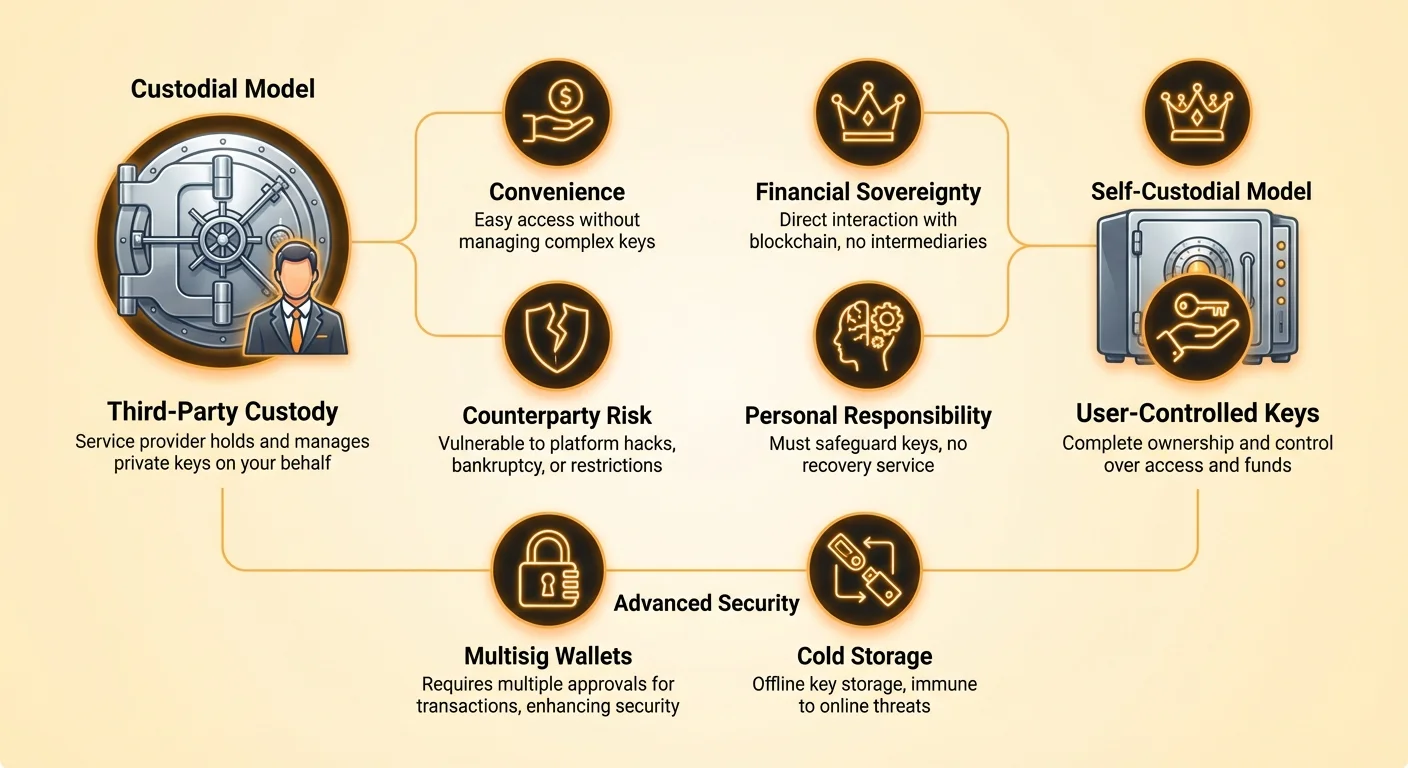
Custodial wallets operate on a model similar to traditional banking. When you use a centralized exchange or a custodial web wallet, the service provider holds the private keys on your behalf. You effectively have an IOU from the company rather than direct ownership of the asset.
This introduces third-party risk. If the platform goes bankrupt, gets hacked, or is shut down by regulators, you may lose access to your funds. The custodian can also restrict your account, delay withdrawals, or charge excessive fees for accessing your own money. You are trading control for the convenience of not managing your own keys. For a deeper analysis of the trade-offs, review the spectrum of custody risks.
The Self-Sovereign Model
Self-custodial wallets place the user in full control. Since only the user possesses the private keys, no one else can confiscate or freeze the funds. This model aligns with the core ethos of cryptocurrency: financial sovereignty.
With a self-custodial wallet, users interact directly with the blockchain. This allows for features like customizing network fees and interacting with smart contracts and decentralized applications (dApps). While it requires more personal responsibility regarding backups and security practices, it eliminates the counterparty risks associated with centralized institutions.
Advanced Security Features
Multisig Wallets
For those requiring enhanced security, multisig (multi-signature) wallets offer a robust solution. Unlike standard wallets that require a single private key to authorize a transaction, multisig wallets require approval from multiple parties. For example, a "2-of-3" multisig wallet would require two out of three designated participants to sign a transaction before it is broadcast to the network.
This structure is ideal for organizations managing treasury funds or families securing shared assets. We offer a guide detailing implementing shared control for organizations and families. It prevents a single person from moving funds unilaterally and protects against the loss of a single key. If one key is lost or stolen, the remaining participants can still manage the assets or move them to a new secure wallet.
Cold Storage
Cold storage refers to keeping private keys completely offline, ensuring they never touch a device connected to the internet. This is often achieved using hardware wallets—dedicated physical devices designed solely to store keys and sign transactions.
When a user wants to send funds, they connect the hardware wallet to a computer. The transaction data is sent to the device, signed internally by the private key, and then the signed data is returned to the computer for broadcasting. Because the private key never leaves the device, it remains immune to computer viruses, keyloggers, and remote hackers. This method is widely considered the gold standard for securing large amounts of cryptocurrency. Our deep dive explores securing seed phrases and interacting with DApps.
Biometric Security
Modern software wallets increasingly integrate biometric security features such as fingerprint scanners and facial recognition. These features serve as a first line of defense for the application running on a mobile device. They ensure that even if a phone is left unlocked or stolen, the wallet app itself remains inaccessible to unauthorized users.
While biometrics add a layer of convenience and local security, they do not replace the need for a backup of the private keys. If the device itself is destroyed, biometric data cannot restore the wallet on a new phone. The underlying recovery phrase or encrypted cloud backup remains the ultimate fail-safe for asset recovery.
Conclusion
The transition to digital ownership requires a fundamental shift in mindset regarding security and responsibility. In the world of cryptocurrency, the private key is the ultimate arbiter of control. It represents the unforgeable proof that assets belong to a specific individual, independent of any bank or government. Understanding the relationship between private keys, public addresses, and the wallet interfaces that manage them is the first step toward true financial sovereignty.
As the ecosystem evolves, tools like seed phrases and automated cloud backups have made managing these cryptographic secrets more accessible to the average user. Whether one chooses the convenience of a software wallet or the fortified security of cold storage, the principle remains the same: whoever holds the keys controls the future of the assets. By adhering to best practices and understanding the anatomy of these digital tools, investors can confidently secure their place in the digital economy.
True ownership of digital assets is defined solely by your ability to secure and control your private keys.