
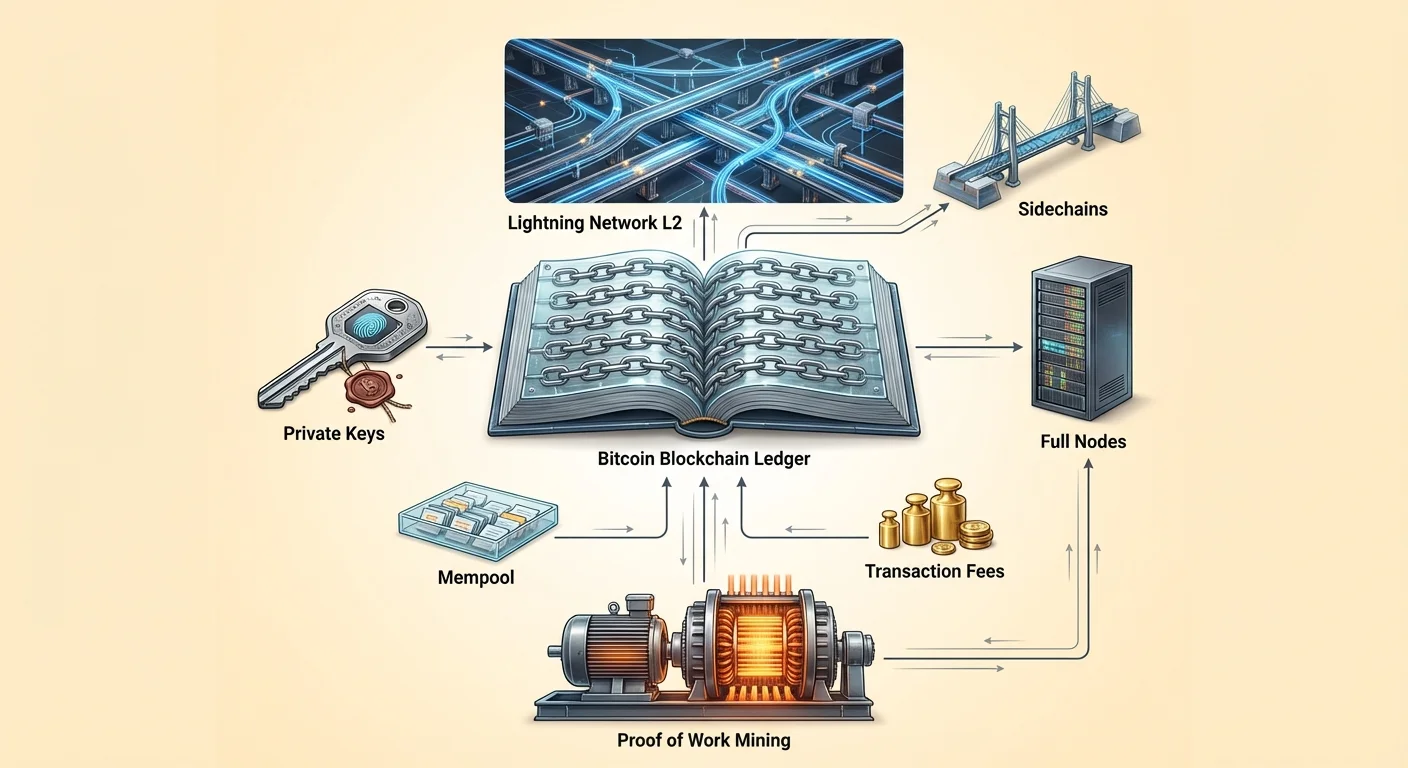
The architecture of decentralized digital currency is built upon a foundation of security, transparency, and immutable consensus. At its heart, the Bitcoin network operates through a complex interplay of cryptographic proofs, economic incentives, and distributed verification. These core mechanics—mining, proof-of-work, and on-chain transactions—ensure that the system remains trustless and resistant to censorship. However, the very features that provide this robust security also introduce inherent limitations regarding speed and throughput. As the adoption of digital assets grows, the conversation inevitably shifts from how the base layer functions to how it can be scaled to accommodate global demand.
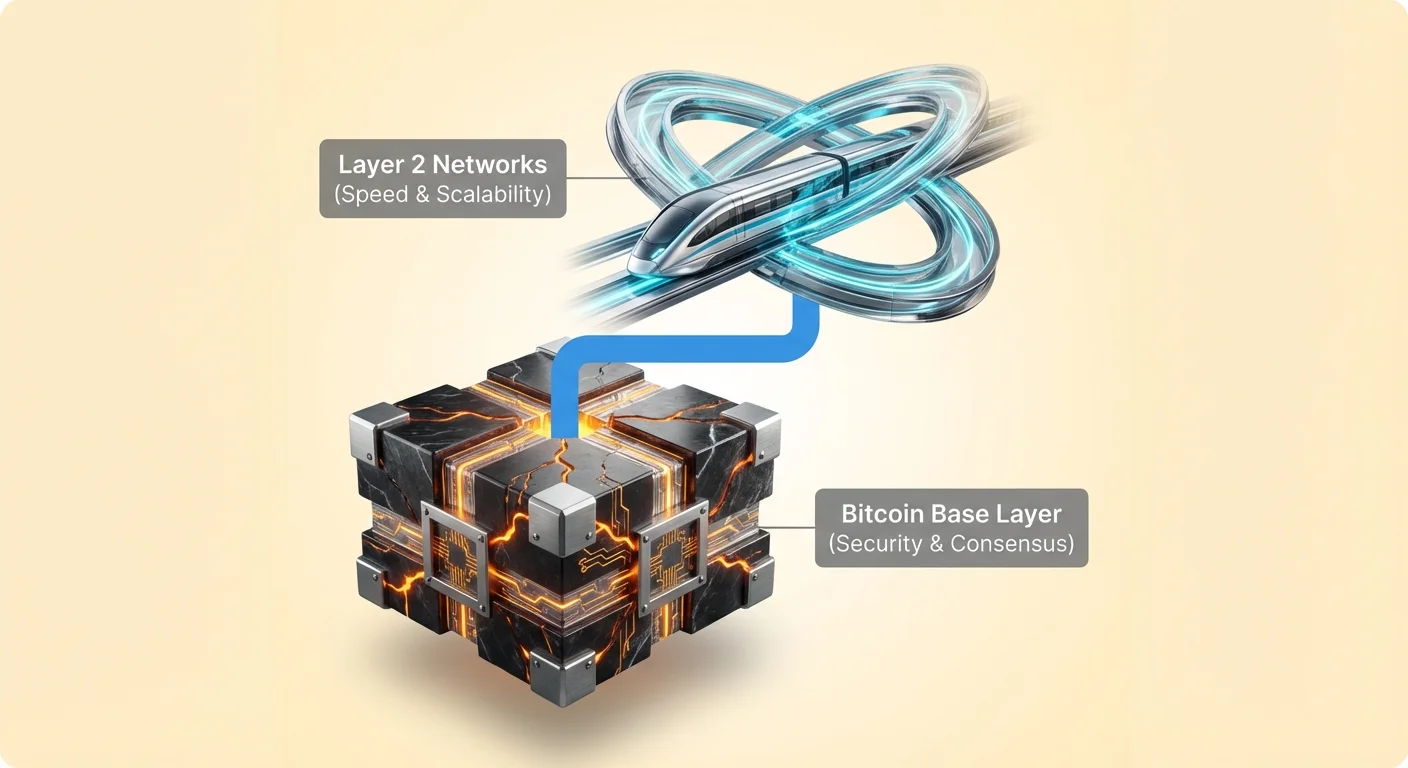
To understand the solutions that exist beyond the core mechanics, such as Layer 2 networks and sidechains, one must first deeply grasp the constraints of the primary network. The design of Bitcoin prioritizes decentralization over efficiency, a deliberate choice that requires every full node to verify every transaction. This redundancy creates an incredibly secure network but results in a bottleneck where transaction space becomes a scarce commodity. The evolution of the ecosystem has thus moved toward building additional layers on top of this secure foundation.
This multi-layered approach allows the main blockchain to serve as the ultimate settlement layer while off-chain solutions handle high-frequency transactions. By moving smaller transfers off the main chain, the network can achieve higher scalability without compromising the security of the base layer. This progression from core protocols to advanced scaling solutions represents the maturation of the technology into a more versatile financial system.
The Foundation of Consensus: Proof of Work
The security of the Bitcoin network relies on a consensus mechanism known as Proof of Work (PoW). This system requires network participants, known as miners, to expend computational energy to solve complex mathematical puzzles. The solution to these puzzles is difficult to find but easy to verify, creating a barrier to entry that prevents malicious actors from spamming or overtaking the network. This process is not merely about processing transactions but is the fundamental way the network agrees on the state of the ledger.
Miners compete to solve these cryptographic puzzles, and the winner earns the right to add the next block of transactions to the blockchain. This competition ensures that the history of transactions is computationally impractical to reverse. To alter a past record, an attacker would need to redo all the work for that block and every subsequent block, a feat that requires controlling more than half of the total network's processing power. This immutability is the cornerstone of digital value preservation.
The specific algorithm used is the Secure Hash Algorithm 2 (SHA2). Miners run this hashing algorithm repeatedly to find a random number, known as a nonce, that meets a specific difficulty target set by the network. The difficulty adjusts approximately every two weeks to ensure that new blocks are produced roughly every ten minutes, regardless of how much total computing power is active on the network. This self-regulating mechanism maintains the steady heartbeat of the blockchain.
Hashrate and Network Security
Hashrate serves as a critical metric for assessing the health and security of the network. It represents the total computational power being contributed by miners at any given moment. A higher hashrate implies that more resources are dedicated to securing the ledger, making it increasingly difficult for any single entity to disrupt operations. It is a direct measure of the energy and hardware invested in maintaining the system's integrity.
As the hashrate increases, the network automatically raises the difficulty of the mining puzzles. This ensures that the rate of new coin issuance remains predictable, adhering to the protocol's monetary policy. The relationship between hashrate and difficulty creates a competitive environment where miners must constantly upgrade their hardware to maintain profitability. This arms race for efficiency ultimately benefits the security of the entire ecosystem.
The Economic Incentive Structure
The mining process is driven by economic incentives designed to align the interests of miners with the health of the network. Miners are rewarded in two ways: newly minted coins and transaction fees. The block reward acts as a subsidy to encourage participation, especially in the early stages of the network's life. This reward is halved approximately every four years in an event known as the Halving, which introduces a deflationary pressure on the supply.
As the block reward decreases over time, transaction fees are expected to become the primary source of revenue for miners. This shift emphasizes the importance of a fee market where users bid for block space. When the network is congested, fees rise, incentivizing miners to prioritize transactions with higher payouts. This economic model ensures that the network remains self-sustaining even after the minting of new coins eventually ceases.
The Mechanics of On-Chain Transactions
A Bitcoin transaction is fundamentally a message that transfers value from one address to another. These messages are digitally signed using cryptography to prove ownership and authorization. Unlike a bank account that holds a balance, the blockchain uses a model based on Unspent Transaction Outputs (UTXO). In this system, your "balance" is simply the sum of all unspent outputs that your private key can unlock.
When a user initiates a transaction, they are essentially gathering these unspent outputs as inputs and creating new outputs for the recipient. Any difference between the input amount and the amount sent (plus fees) is returned to the sender as change in the form of a new unspent output. This process is similar to paying with cash, where you hand over a larger bill and receive coins back.
The security of these transfers relies on public and private key pairs. The public key acts as the address that others can see and send funds to, similar to an email address. The private key is a secret alphanumeric password that signs the transaction, proving that the sender has the authority to move the funds. This digital signature is verifiable by anyone on the network without revealing the private key itself.
The Role of the Mempool
Before a transaction is permanently recorded on the blockchain, it enters a waiting area known as the mempool (memory pool). The mempool is a collection of unconfirmed transactions held by nodes across the network. It acts as a staging ground where transactions wait to be picked up by miners. Since block space is limited to 1MB, not every transaction in the mempool can be included in the next block immediately.
The mempool is dynamic and fluctuates based on network activity. During periods of high demand, the mempool can become congested, leading to a backlog of unconfirmed transactions. In this environment, a fee market emerges. Miners, looking to maximize their profits, will select transactions with the highest fees per byte of data. Users who need fast confirmation must pay a premium to jump the queue.
Transactions with low fees may sit in the mempool for hours or even days if the network remains busy. In extreme cases, they may eventually be dropped from the mempool if they never get picked up, essentially cancelling the transfer. This mechanism highlights the scarcity of block space and the inherent scalability limits of the base layer.
Transaction Confirmation and Finality
Once a miner includes a transaction in a valid block and broadcasts it to the network, the transaction is considered to have one confirmation. Each subsequent block added to the chain increases the confirmation count, adding layers of security. For example, a transaction with six confirmations is generally considered irreversible because an attacker would need to reverse six blocks of proof-of-work to alter it.
This confirmation process is the solution to the double-spend problem. In digital cash systems, there is a risk that a user could send the same digital token to two different recipients simultaneously. The blockchain prevents this by maintaining a timestamped, public history. If a user tries to spend the same UTXO twice, nodes will reject the second transaction because the inputs have already been spent in the first confirmed transaction.
Bitcoin Script Language
The rules for spending bitcoin are defined by a scripting system known as Bitcoin Script. It is a stack-based language that dictates the conditions under which funds can be moved. Each transaction output contains a locking script, which essentially says, "To spend these funds, you must provide a signature that matches this public key." The transaction input provides the unlocking script to satisfy this condition.
Bitcoin Script is intentionally not Turing-complete, meaning it cannot perform complex loops or recursive logic. This design choice prevents infinite loops that could crash nodes and ensures that transaction verification is fast and deterministic. Despite its limitations, Script allows for advanced features like multi-signature wallets, where multiple parties must sign a transaction to release funds. This programmability is the foundation for more complex scaling solutions like payment channels.
Network Nodes: The Guardians of the Ledger
While miners secure the network through energy expenditure, nodes are the auditors that ensure the rules are followed. A node is any computer running the Bitcoin software that participates in the network. They receive new transactions and blocks, validate them against the protocol's rules, and propagate them to other peers. If a miner produces an invalid block, nodes will reject it, ensuring that miners cannot cheat or alter the consensus rules.
There are different types of nodes, each serving a specific function in the ecosystem. Full nodes maintain a complete copy of the blockchain and independently verify every transaction history from the very first block. They are the ultimate authority on the state of the network because they do not rely on third parties for data. This independence is critical for maintaining decentralization.
| Node Type | Functionality | Resource Requirements |
|---|---|---|
| Full Node | Validates all rules, stores full history | High storage and bandwidth |
| Pruned Node | Validates all rules, deletes old data | Moderate storage, high bandwidth |
| Light Node (SPV) | Verifies headers, trusts full nodes | Minimal storage and resources |
Lightweight nodes, or Simplified Payment Verification (SPV) clients, do not store the full blockchain. Instead, they download only the block headers and rely on full nodes to provide transaction data. While they are much easier to run on mobile devices, they offer less security and privacy than full nodes. The diversity of node types ensures that the network remains accessible to users with varying levels of technical resources.
Decentralization and Resilience
The distribution of nodes across the globe is what makes the network resistant to censorship and single points of failure. Because every full node holds a copy of the ledger, there is no central server that can be shut down or manipulated. Even if a large portion of the network were to go offline, the remaining nodes would continue to operate, preserving the integrity of the blockchain.
Running a node contributes to the health of the ecosystem by increasing the number of independent validators. It allows users to interact with the network directly, ensuring their transactions are broadcast and verified without intermediaries. This self-sovereignty is a core tenet of the cryptocurrency philosophy, empowering individuals to be their own bank.
The Scalability Challenge
The core mechanics described above create a system that is secure and decentralized but inherently limited in throughput. The block size limit and the ten-minute block time mean that the network can only process a handful of transactions per second. As global adoption increases, this capacity constraint leads to network congestion and rising fees.
This situation creates a "fee market" where only high-value transactions are economically viable on the main chain. Microtransactions, such as paying for a coffee, become impractical if the transaction fee exceeds the value of the item being purchased. This limitation has driven the development of scaling solutions that operate on top of or alongside the main blockchain.
These solutions aim to increase transaction throughput without compromising the security of the base layer. By moving the bulk of activity off the main chain, they alleviate congestion and enable new use cases that require instant settlement and near-zero fees. This layered approach is analogous to the internet protocol suite, where different layers handle different functions.
Layer 2 Networks and Payment Channels
Layer 2 networks are protocols built on top of the base blockchain (Layer 1) to improve scalability and efficiency. The most prominent example in the Bitcoin ecosystem is the Lightning Network. This solution utilizes the programmability of Bitcoin Script to create bi-directional payment channels between users.
In a payment channel, two parties commit funds to a multi-signature address on the main blockchain. This initial transaction is the only one recorded on-chain. Once the channel is open, the two parties can exchange unlimited transactions back and forth instantly by updating their local balance sheets. These updates are signed and valid but are not broadcast to the main network until the channel is closed.
Because these intermediate transactions do not hit the blockchain, they do not consume block space or incur mining fees. This allows for instant, high-volume micropayments. When the parties are finished transacting, they close the channel, and the final balance is settled on the main blockchain in a single transaction.
Network of Channels
The true power of the Lightning Network lies in its ability to route payments across a web of interconnected channels. You do not need a direct channel with a merchant to pay them. If you have a channel with User A, and User A has a channel with the merchant, the network can route your payment through User A securely. This routing is trustless, ensuring that intermediaries cannot steal the funds.
Lightning Network nodes facilitate these off-chain transactions. Like base layer nodes, they run software to manage channels and route payments. This creates a secondary peer-to-peer network that operates in parallel with the main blockchain. It effectively creates a high-speed rail system on top of the secure foundation of the base layer.
Script and Smart Contracts in Layer 2
The functionality of Layer 2 solutions relies heavily on the capabilities of Bitcoin Script. Specifically, features like time-locks and multi-signature requirements are essential. Time-locks ensure that if one party tries to cheat by broadcasting an old balance state, the other party has a window of time to challenge it and claim the funds. This "justice transaction" mechanism incentivizes honest behavior within the channel.
While Bitcoin Script is not Turing-complete, it is powerful enough to support these types of smart contracts. This demonstrates that complex functionality can be built without complex base-layer logic. By keeping the base layer simple and secure, complex applications can be engineered on higher layers, minimizing the risk of bugs or exploits affecting the main ledger.
Benefits of Off-Chain Scaling
The primary benefit of Layer 2 solutions is the dramatic increase in throughput. While the base layer may process fewer than ten transactions per second, Layer 2 networks can potentially handle millions. This scalability is essential for Bitcoin to function as a medium of exchange for daily commerce rather than just a store of value.
Additionally, Layer 2 networks offer improved privacy. Since intermediate transactions are not recorded on the public blockchain, they are not visible to the entire network. Only the opening and closing of channels leave a permanent public footprint. This adds a layer of confidentiality to financial activities that is often lacking in completely transparent public ledgers.
Sidechains and Federation
Another approach to scaling involves the use of sidechains. A sidechain is a separate blockchain that is attached to the main parent blockchain using a two-way peg. This peg allows assets to be moved between the main chain and the sidechain. Once assets are on the sidechain, they can be transacted according to the rules of that specific chain, which may differ from the main network.
Sidechains can be optimized for speed, lower fees, or advanced features like complex smart contracts that are not possible on the main chain. For example, a sidechain might use a different consensus mechanism that allows for faster block times. Users can move their bitcoin to the sidechain to utilize these features and then move it back to the main chain for security and settlement.
The Role of Federation
Managing the two-way peg between chains often requires a federation. A federation is a group of servers or nodes that act as intermediaries to validate the transfer of assets between chains. Unlike the fully trustless nature of the main network, sidechains often involve some level of trust in the federation to manage the peg securely.
Despite this trade-off, sidechains offer a valuable sandbox for innovation. Developers can experiment with new features and scaling techniques without risking the stability of the main network. If a sidechain fails or is compromised, the damage is contained within that chain, leaving the main blockchain unaffected.
Optimizing the Base Layer
While Layer 2s and sidechains provide significant scaling, improvements are also made directly to the base layer to enhance efficiency. Upgrades to the protocol play a crucial role in maximizing the utility of limited block space. For instance, the Segregated Witness (SegWit) upgrade changed how data is stored in a block, effectively increasing the capacity for transactions.
More recent innovations like Taproot and Schnorr signatures further optimize transaction data. Schnorr signatures allow multiple digital signatures to be aggregated into a single one. This is particularly beneficial for multi-signature transactions and complex smart contracts. By reducing the amount of data needed for these transactions, they take up less space in a block and incur lower fees.
These upgrades not only improve scalability but also enhance privacy. Complex transactions using Taproot look indistinguishable from standard transactions on the blockchain. This fungibility ensures that all coins are treated equally, regardless of their transaction history or the type of wallet used.
Transaction Accelerators
In situations where the network is congested and scaling solutions are not being used, users may face stuck transactions. Bitcoin transaction accelerators have emerged as a service to address this issue. These services work by coordinating with mining pools to prioritize specific transactions.
When a user submits a transaction ID to an accelerator, the service pays a premium to miners to include that transaction in the next block, bypassing the standard fee market queue. This serves as a practical, albeit often paid, solution for urgency within the constraints of the base layer. It highlights the persistent reality of block space scarcity and the economic mechanisms that govern confirmation priority.
Conclusion
The evolution of the Bitcoin ecosystem demonstrates a sophisticated balance between security and scalability. The core mechanics—proof of work, mining, and on-chain consensus—provide an unshakeable foundation of trust and decentralization. These elements ensure that the network remains secure and resistant to censorship, fulfilling its primary role as a digital store of value. However, the inherent constraints of this design necessitate a multi-layered approach to handle global transaction volumes.
Scaling solutions like the Lightning Network and sidechains represent the next phase of this technological journey. By leveraging the security of the main chain while moving activity to more efficient layers, these protocols resolve the tension between decentralization and speed. They transform the network from a simple ledger into a comprehensive financial system capable of supporting everything from large settlements to instant micropayments. As these technologies mature, they continue to reinforce the utility and resilience of the entire cryptocurrency landscape.
Innovation in scaling layers turns the constraints of the base protocol into the foundation for a global financial system.