
The financial landscape shifted permanently in 2009 with the release of open-source software that introduced a new form of value. Before this innovation, digital commerce relied entirely on centralized gatekeepers to verify transactions and maintain account balances. Banks, credit card processors, and governments acted as the necessary arbiters of truth, maintaining the private ledgers that tracked who owned what. Bitcoin emerged as a challenge to this centralized model, offering a peer-to-peer version of electronic cash that allowed online payments to be sent directly from one party to another without going through a financial institution.
At its core, Bitcoin is a decentralized digital asset that functions as both a medium of exchange and a store of value. Unlike traditional fiat currencies, which are issued and regulated by central banks, Bitcoin operates on a global network of computers that follow a specific set of protocol rules. These rules are immutable and transparent, creating a monetary system that is not controlled by any single entity, government, or corporation. This structure introduces a paradigm where trust is placed in code and mathematics rather than in human institutions or political policy.
To truly understand the significance of this technology, one must look beyond price charts and market volatility. The revolutionary nature of Bitcoin lies in its fundamental architecture and the specific problems it solves regarding digital ownership and scarcity. By solving the "double-spend" problem without a central authority, Bitcoin created the first digital object that cannot be copied or counterfeited. This breakthrough has sparked a reevaluation of what constitutes money in the digital age and how value can be stored and transmitted across borders.
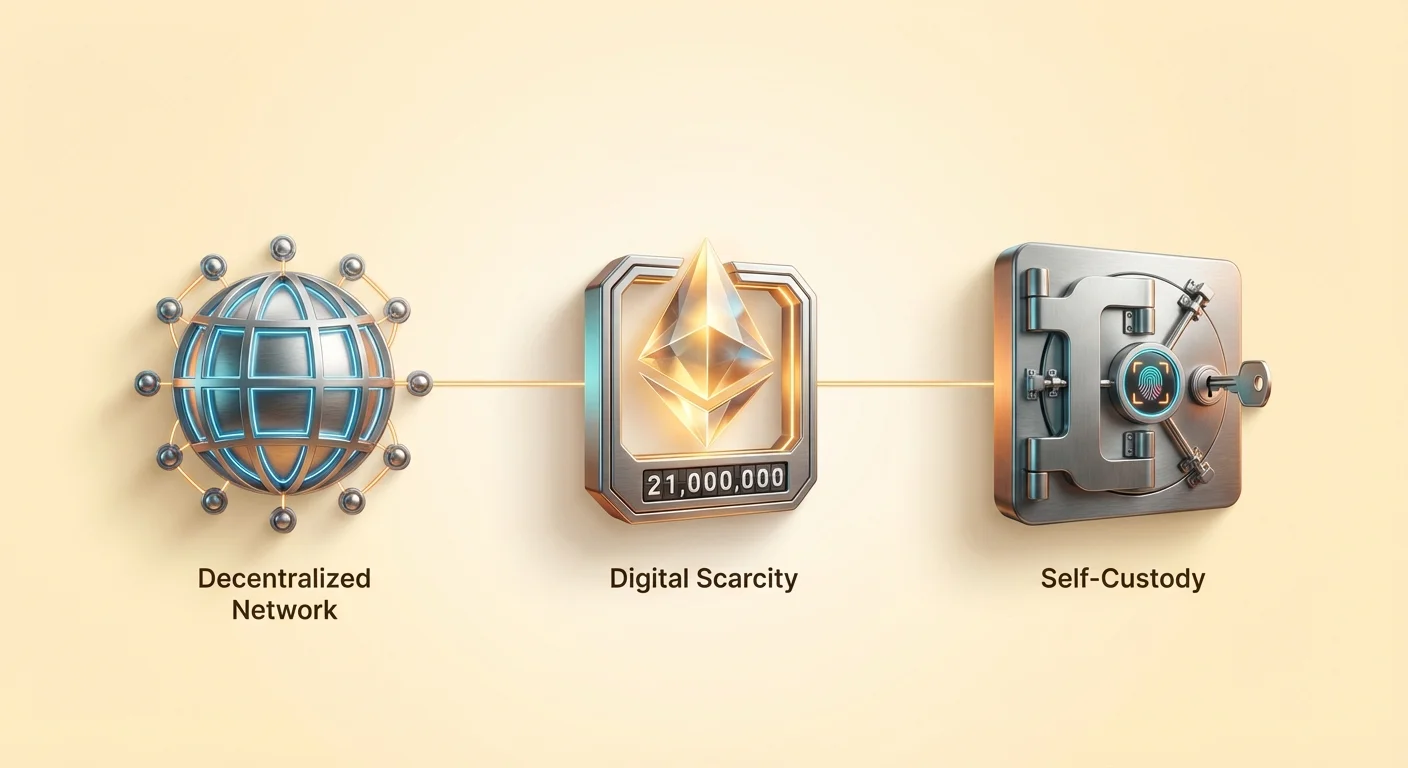
The Architecture of Decentralization
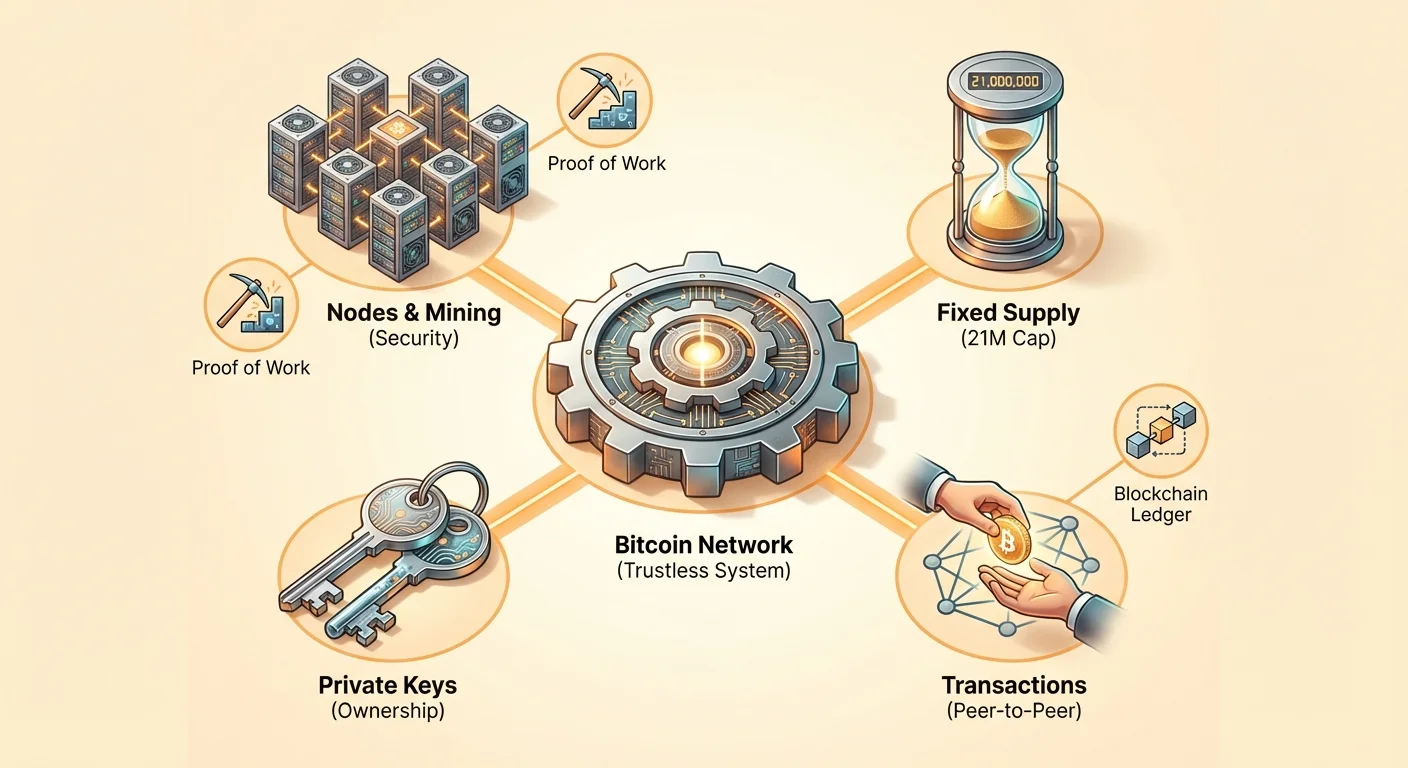
The most defining characteristic of Bitcoin is its decentralized nature. In traditional finance, a central server owned by a bank represents the single source of truth. If that server is hacked, shut down, or manipulated, the integrity of the financial data is compromised. Bitcoin replaces this central server with a distributed network of thousands of independent computers, known as nodes. These nodes are spread across the globe and run the Bitcoin software, each maintaining a complete copy of the blockchain ledger.
removing the Middleman
The primary function of this decentralized structure is to eliminate the need for trusted third parties. In the legacy financial system, intermediaries are required to facilitate trust between strangers. When you swipe a credit card, multiple middlemen—the merchant's bank, the payment processor, the card network, and your issuing bank—stand between you and the vendor. Each of these entities extracts a fee and holds the power to approve or deny the transaction. They act as gatekeepers who determine who can participate in the economy and what purchases are permissible.
Bitcoin operates on a "trustless" model, which does not mean the system is untrustworthy, but rather that participants do not need to know or trust one another to transact safely. The network protocol itself verifies that the sender has sufficient funds and that the transaction adheres to the consensus rules. Once a transaction is broadcast to the network, it is validated by the collective power of the nodes rather than a corporate employee. This creates a system where permission is never required to create an account or move funds.
The Network of Nodes
Nodes are the silent guardians of the Bitcoin network. Anyone with a computer and an internet connection can run a node, and doing so strengthens the network's resilience. These computers constantly communicate with one another to synchronize the ledger. When a new transaction or block of transactions is proposed, every node independently verifies it against the protocol's rules. If a bad actor attempts to spend coins they do not have or create money out of thin air, the nodes simply reject the invalid data.
This distribution of authority makes the network incredibly difficult to shut down or censor. There is no CEO to arrest, no headquarters to raid, and no single server to unplug. To destroy Bitcoin, an attacker would essentially need to shut down the entire global internet or destroy every single computer running the software. This resilience is often described as "antifragile," meaning the network becomes more robust as more participants join and distribute the ledger further.
Digital Scarcity and Value
For a digital asset to function as money, it must address the issue of supply. In the digital world, files like images or documents can be copied infinitely with zero cost. If digital money could be copied just as easily, it would suffer from infinite inflation and become worthless. Bitcoin solves this through strictly enforced digital scarcity, a feature that has led many to compare it to "digital gold." The protocol hard-codes a maximum supply cap that can never be altered, providing certainty to holders regarding future inflation.
The 21 Million Hard Cap
There will only ever be 21 million bitcoins. This fixed supply is central to Bitcoin's value proposition and is a direct contrast to fiat currencies. Central banks manage fiat currencies and have the authority to increase the money supply to manage economic stability. While this flexibility has uses, it often leads to the devaluation of the currency over time, reducing the purchasing power of savings. When more money chases the same amount of goods, prices inevitably rise.
Bitcoin's issuance schedule is programmatic and predictable. New bitcoins are created at a set rate that decreases over time, a process that will continue until the last fraction of a bitcoin is mined around the year 2140. This creates a deflationary pressure similar to precious metals. As adoption grows and demand increases, the supply remains perfectly inelastic. This mathematical certainty allows individuals to store value with the assurance that their holdings will not be diluted by arbitrary policy changes or political printing.
Comparing Utility to Gold
Gold has served as the premier store of value for millennia due to its rarity, durability, and divisibility. Bitcoin mimics these properties but enhances them for the digital age. Like gold, Bitcoin is durable; it does not degrade and exists as long as the network runs. It is also highly divisible. While a gold bar is difficult to shave into small pieces for payment, a single bitcoin can be divided into 100 million smaller units called satoshis. This ensures the currency remains usable regardless of how high the price of a whole unit rises.
Portability is where Bitcoin significantly outperforms physical commodities. Transporting a significant amount of gold requires armored transport, security teams, and physical exertion. It is slow, expensive, and risky. Bitcoin, regardless of the amount, can be transported anywhere in the world instantly. It can be carried on a USB stick or even memorized as a string of words. This combination of strict scarcity and high portability creates a unique asset class that functions as a global, stateless store of value.
Consensus and the Mining Mechanism
The mechanism that secures the network and manages the issuance of new coins is known as Proof of Work (PoW). This system is the solution to the problem of how to get a group of strangers to agree on a single version of history without a leader. Mining is the process by which new transactions are confirmed and added to the blockchain. It involves specialized computers competing to solve complex mathematical problems.
The Proof of Work System
Proof of Work acts as a barrier to entry for fraudulent activity. To add a block of transactions to the ledger, a miner must expend real-world resources in the form of electricity and computing power. This expenditure is the "work" that proves the miner has skin in the game, demonstrating the computational cost of trust. The mathematical puzzle they solve is difficult to find but easy for others to verify. Once a solution is found, it is broadcast to the network, and other nodes can instantly confirm that the work was done.
This requirement makes it economically unfeasible to attack the network. To reverse transactions or alter the ledger, an attacker would need to control more than 50% of the network's computing power. The cost of acquiring the necessary hardware and electricity to achieve this dominance would be astronomical, likely costing billions of dollars. Furthermore, destroying the trust in the network would crash the value of the asset the attacker is trying to steal, rendering the attack self-defeating.
Energy and Environmental Nuance
The energy consumption of Bitcoin mining is frequently cited as a drawback, but this view often lacks context regarding the nature of the energy used. While the network does consume a significant amount of electricity to secure the ledger, miners are geographically agnostic and highly sensitive to electricity costs. This drives them toward the cheapest available power sources, which often takes the form of stranded or wasted energy.
For example, hydroelectric dams often produce more electricity than nearby cities can consume, leading to wasted potential. Bitcoin miners can set up operations in these remote locations to monetize this excess energy. Similarly, miners utilize flared natural gas—a byproduct of oil extraction that is usually burned off into the atmosphere—to power their operations. By converting waste products into economic value, the network creates a unique relationship with energy markets that is more complex than simple consumption metrics suggest.
Sovereignty and Censorship Resistance
One of the most profound aspects of Bitcoin is its ability to provide financial sovereignty. In the traditional system, money in a bank account is legally a liability owed to the depositor by the bank. The bank effectively owns the funds and grants the user permission to access them. If the bank becomes insolvent or if the government orders a freeze on assets, the user loses access to their wealth. Bitcoin restores full ownership to the individual through the use of cryptographic keys.
Unstoppable Transactions
Censorship resistance refers to the inability of any third party to prevent a transaction from occurring. On the Bitcoin network, a valid transaction that includes the necessary fee will be processed by miners regardless of who sends it or where it is going. The protocol is neutral; it does not distinguish between a donation to a charity, a payment for coffee, or a transfer to a political dissident. This neutrality is critical for human rights activists and individuals living under authoritarian regimes.
When governments impose capital controls to prevent citizens from moving their wealth out of a collapsing economy, Bitcoin provides an escape valve. Because the network has no borders and operates continuously, it allows value to move globally without passing through choke points controlled by state actors. This makes it a powerful tool for preserving economic freedom in jurisdictions where financial repression is common. The system operates on a "push" mechanic, where the user pushes funds to a recipient, eliminating the risk of unauthorized pull transactions or chargebacks. This fundamental resilience is central to understanding the architecture of digital freedom.
Freedom from Seizure
True ownership in Bitcoin is defined by the possession of private keys. These keys act as a digital signature that authorizes the spending of funds. As long as a user maintains exclusive control over their private keys, their bitcoin cannot be confiscated by force. Unlike physical gold, which can be found and seized, or bank accounts that can be digitally frozen, Bitcoin exists only on the ledger. Access requires the specific cryptographic secret held by the owner.
This property changes the power dynamic between individuals and the state. For the first time, wealth can be secured in a way that makes it practically impossible to seize without the owner's cooperation. This level of security places a heavy responsibility on the user to protect their keys, but it offers unparalleled protection against asset forfeiture and theft by institutional actors.
Privacy and Transparency
There is a common misconception that Bitcoin is anonymous. In reality, it is pseudonymous, allowing users to master privacy. Every transaction that has ever occurred on the network is permanently recorded on the public blockchain. This ledger is available for anyone to download and audit. Transparency is a feature, not a bug, as it allows anyone to verify the total supply and ensure that no manipulation is occurring. However, this transparency comes with specific implications for user privacy.
The Nature of Pseudonymity
On the blockchain, identities are represented by strings of alphanumeric characters known as addresses. There are no names, email addresses, or physical locations attached to these addresses at the protocol level. A user can send and receive funds without ever revealing their real-world identity to the network. This offers a baseline level of privacy that protects users from casual observation.
However, if a user's real-world identity is ever linked to their Bitcoin address, their entire financial history associated with that address becomes visible. This linking often happens at the "on-ramps" and "off-ramps" of the ecosystem, such as centralized exchanges that require Know Your Customer (KYC) verification. Once an exchange knows that a specific address belongs to a specific person, they can trace the flow of funds across the blockchain. Blockchain analysis firms specialize in tracking these movements to identify illicit activity.
Enhancing Transaction Privacy
To maintain privacy, users must employ specific best practices. The most fundamental rule is to never reuse addresses. Modern wallet software automatically generates a new address for every transaction, which helps fragment a user's footprint and makes it more difficult to cluster their activity. This creates a moving target for anyone attempting to build a profile of the user's wealth or spending habits.
More advanced tools exist for those requiring higher levels of anonymity. Coin mixers and privacy-focused wallets can obscure the link between the sender and receiver by combining multiple transactions into one. Additionally, operating within the peer-to-peer economy rather than using centralized exchanges helps sever the link between a user's physical identity and their digital assets. While the ledger is public, the ownership of the data remains private if proper precautions are taken.
Wallets and Custody
The concept of a "wallet" in crypto is often misunderstood. A Bitcoin wallet does not store coins in the way a physical wallet stores cash. Instead, a wallet stores the private keys that allow the user to move coins on the blockchain. The coins themselves never leave the ledger; the wallet simply contains the proof of ownership required to authorize a transaction. Understanding this distinction is vital for asset security.
Private Keys and Self-Custody
The mantra "not your keys, not your coins" is a foundational principle of the crypto ecosystem. If a user leaves their bitcoin on a centralized exchange, they are essentially trusting that company to hold the keys on their behalf. This reintroduces the counterparty risk that Bitcoin was designed to eliminate. History is littered with examples of exchanges that have been hacked, mismanaged, or shut down, resulting in the total loss of customer funds.
Self-custody involves taking personal responsibility for these keys. By generating a wallet on their own device, the user becomes their own bank. This grants them complete control over their assets but also means there is no customer support line to call if mistakes are made. If a user loses their private keys or their recovery phrase, the funds are lost forever. This responsibility drives the need for secure backup strategies and careful management of security credentials.
Hardware vs. Software Wallets
Wallets generally fall into two categories: hot and cold. Hot wallets are software applications connected to the internet, such as mobile apps or desktop extensions. They are convenient for frequent spending but are more vulnerable to malware and online attacks. They are best suited for carrying small amounts of value, similar to the cash one might carry in a physical pocket.
Cold wallets, or hardware wallets, are physical devices that keep private keys offline at all times. Even when connected to a computer to make a transaction, the signing process happens inside the device, ensuring the keys are never exposed to the internet. This provides the highest level of security and is the recommended method for storing significant amounts of wealth. By isolating the keys from online threats, hardware wallets protect users from remote hackers and compromised computers.
Bitcoin vs. The Broader Crypto Ecosystem
As the first cryptocurrency, Bitcoin set the standard for the industry, but it is distinct from the thousands of other digital assets that have followed. The most common comparison is drawn between Bitcoin and Ethereum, the second-largest cryptocurrency. While both utilize blockchain technology, their goals and fundamental architectures serve different purposes. Understanding this divergence is key to navigating the digital asset space.
Money vs. Platform
Bitcoin was designed specifically to be a form of sound money—a tool for storing and transferring value without intermediaries. Its code is intentionally simple and rigid to prioritize security and stability. Changes to the Bitcoin protocol are slow and conservative, reflecting its role as a foundational monetary layer. The community prioritizes reliability and censorship resistance over speed or complex features.
Ethereum, in contrast, was built as a decentralized platform for computing. While it has its own currency (Ether), its primary purpose is to execute "smart contracts"—programmable code that automatically executes when certain conditions are met. This allows developers to build decentralized applications (DApps) on top of the Ethereum network, ranging from financial services to digital art marketplaces. If Bitcoin is digital gold, Ethereum is often described as digital oil—a utility resource used to power a broader engine of applications.
Comparing Features
To clarify the distinctions between these two systems and traditional fiat, consider the following comparison of their core attributes:
| Feature | Bitcoin | Fiat Currency (USD) | Ethereum |
|---|---|---|---|
| Primary Purpose | Store of Value / Money | Medium of Exchange | Decentralized App Platform |
| Supply Policy | Fixed (21 Million) | Unlimited / Inflationary | Uncapped / Variable |
| Issuance Control | Decentralized Code | Central Bank Committee | Decentralized Code |
This table highlights why Bitcoin stands alone as a monetary asset. While Ethereum offers expansive utility for building software, its monetary policy has changed over time to accommodate technical upgrades. Bitcoin’s rigidity is its greatest asset in the context of storing wealth, offering a level of predictability that neither fiat currencies nor other crypto assets can match.
The Evolution of Money
The emergence of Bitcoin represents a return to free-market money. throughout history, humanity has utilized various mediums of exchange, from sea shells to gold coins to paper notes backed by nothing but government decree. Each transition was driven by the need for a more efficient way to trade and store value. The digital age requires a form of money that is native to the internet—instant, borderless, and open to all.
Bitcoin satisfies these requirements while reintroducing the discipline of scarcity that was lost when the world moved away from the gold standard. It offers a solution to the erosion of purchasing power caused by inflation and provides a shield against financial overreach. By decoupling money from the state, it creates a neutral financial layer that connects the global economy without bias.
As the world becomes increasingly digital, the reliance on physical banking infrastructure becomes a bottleneck. Bitcoin removes this friction, allowing value to flow as freely as information. It is not merely a speculative asset but a technological breakthrough that democratizes access to the financial system. Whether used as a hedge against inflation, a tool for remittance, or a mechanism for financial privacy, it empowers individuals to take control of their economic destiny.
Conclusion
Bitcoin is far more than a ticker symbol on a trading screen; it is a comprehensive system for decentralized value transfer that challenges centuries of financial tradition. By combining the scarcity of gold with the speed of the internet, it provides a unique alternative to state-sponsored currencies. Its decentralized architecture ensures that it remains resilient against censorship and corruption, while its fixed supply offers protection against the silent theft of inflation.
Understanding the core concepts of decentralization, scarcity, mining, and self-custody allows one to see the broader picture. This technology places the responsibility of financial security back into the hands of the individual. While the learning curve can be steep, the result is a level of financial sovereignty that was previously impossible to achieve. As the network matures, its role as a neutral, global reserve asset continues to solidify.
Bitcoin is the first engineered money that allows you to own and control your wealth completely without asking for permission.