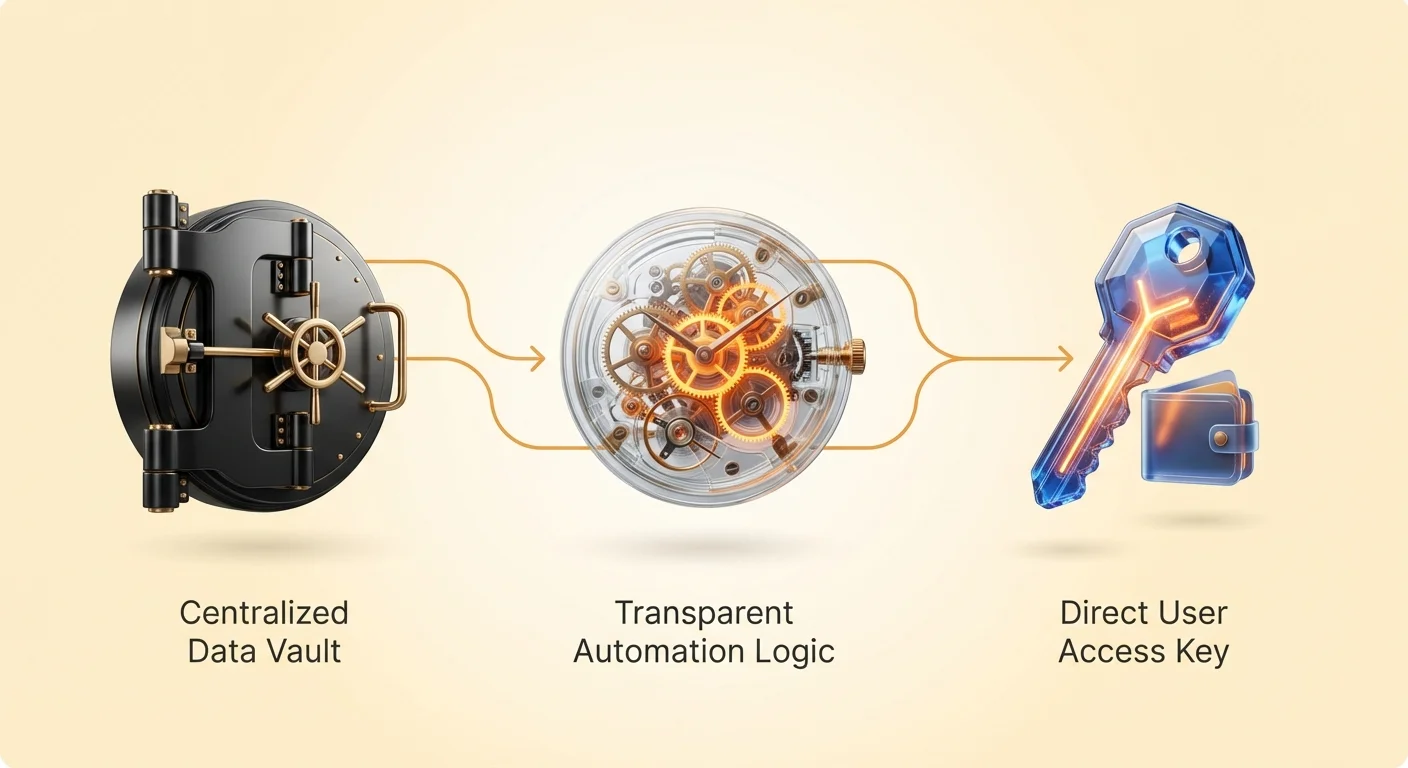
The digital world relies heavily on invisible architecture. When a user interacts with a traditional banking application or a social media platform, they are essentially sending requests to a centralized server. This server is a private computer owned, maintained, and controlled by a specific company. The user must trust that the company will handle their data correctly, execute transactions fairly, and protect their funds from internal mismanagement. This model is the standard for Web2, but it creates a singular point of failure and requires absolute faith in a third party.
Smart contracts introduce a fundamental shift in this architecture. Instead of relying on a private server managed by a corporation, smart contracts operate on decentralized networks like Ethereum. These are not merely databases but are effectively shared global computers. A smart contract is a program stored on this network that runs exactly as written. Once deployed, the code cannot be altered by a central administrator to benefit themselves. This creates a "trustless" environment, meaning users do not need to trust a human or a brand. They only need to trust the code and the public network it runs on.
The Definition of Digital Logic
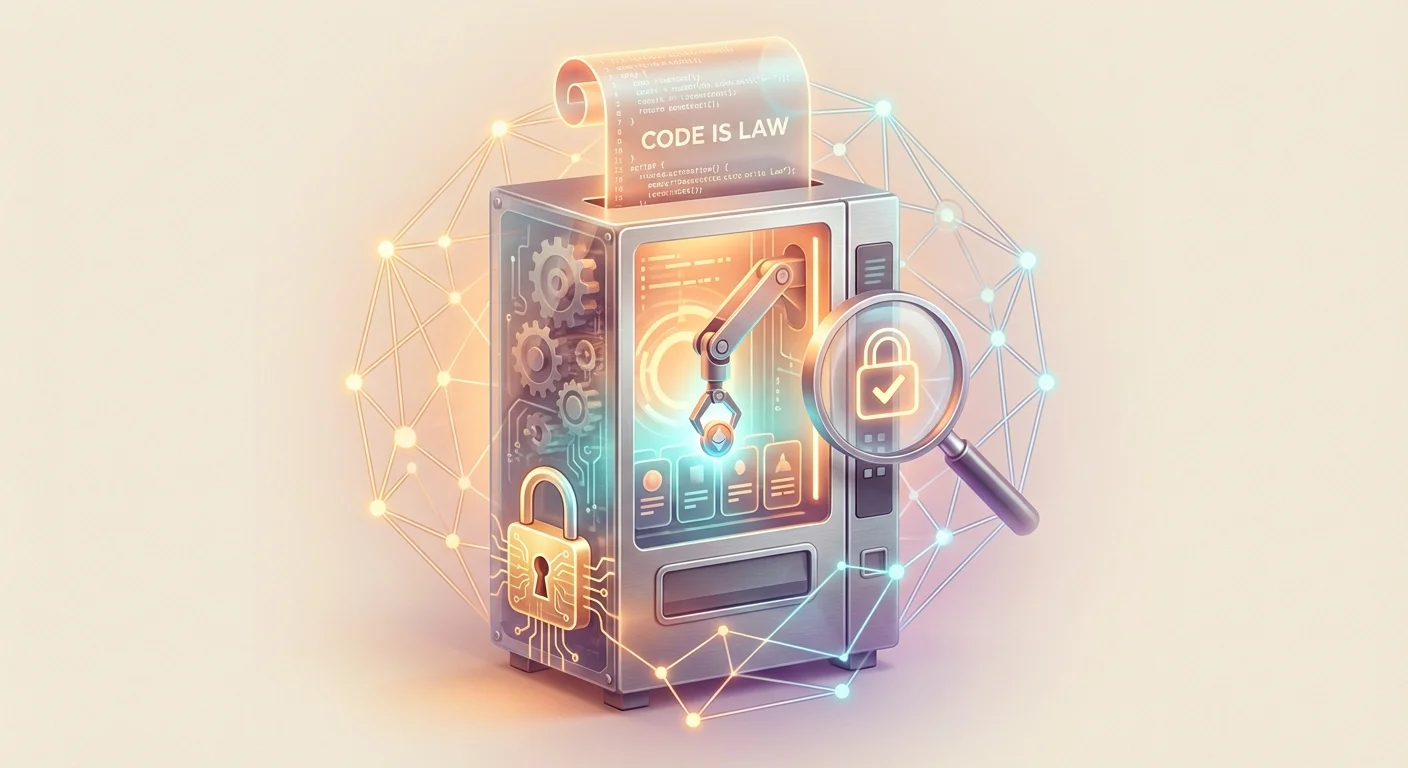
At its core, a smart contract is a self-executing agreement. The terms of the arrangement are written directly into lines of code. While the concept sounds futuristic, the logic is often compared to a vending machine. In a vending machine, the rules are hard-coded into the machinery. If you insert a specific amount of money and press a specific button, the machine is programmed to release a specific item. No store clerk is required to verify the transaction or hand over the goods. The machine acts as the intermediary, executing the logic automatically based on the input.
Smart contracts apply this logic to complex digital assets and data. They exist on a blockchain, which serves as a decentralized ledger recording every transaction and state change. Because the network is maintained by thousands of independent computers rather than a single corporate server, the smart contract is highly resistant to censorship. No single entity can turn it off or block a valid transaction. This differs significantly from traditional backends, where a service provider can suspend accounts or freeze assets at will.
The technology has evolved significantly since its theoretical inception. While Bitcoin utilizes a limited form of smart contracts to process transactions, networks like Ethereum were designed specifically to be "Turing complete." This means the network can theoretically perform any computation that a regular computer can. This capability transforms the blockchain from a simple ledger of transactions into a robust platform for decentralized applications. Developers can build sophisticated programs, from financial protocols to gaming systems, that run entirely on this shared infrastructure.
Infrastructure Trade-offs
It is important to understand why traditional backends are still dominant for most internet services. Centralized cloud computing services, such as Amazon Web Services (AWS), offer immense speed and low costs. A centralized database can process thousands of transactions per second with negligible expense. In contrast, decentralized networks face significant limitations regarding throughput and cost. Every transaction on a smart contract platform must be processed and verified by multiple participants across the network.
This redundancy is what provides security, but it comes at the price of efficiency. Executing code on a blockchain requires "gas," a fee paid in the network's native token to compensate the computers processing the data. Complex operations cost more gas. Therefore, smart contracts are not currently suitable for every type of application. High-frequency trading or hosting large video files remains more practical on traditional servers. The use case for smart contracts focuses on scenarios where security, transparency, and trust are more valuable than raw speed.
| Feature | Traditional Backend | Smart Contract Backend |
|---|---|---|
| Control | Centralized (Company owned) | Decentralized (Public network) |
| Transparency | Opaque (Black box) | Transparent (Open source) |
| Cost | Low (Economies of scale) | High (Gas fees) |
The decision to use a smart contract architecture is effectively a decision to prioritize verifiable truth over performance. In a traditional system, a user cannot prove that a bank's database is correct; they simply accept the balance displayed on the screen. In a smart contract system, the user can independently verify the code and the transaction history. This transparency eliminates the need for auditors or regulators to ensure the system is working as promised, as the system's operation is visible to anyone with an internet connection.
Automated Financial Services
The most prominent application of this technology is Decentralized Finance, or DeFi. This sector attempts to replicate traditional financial services—such as lending, borrowing, and trading—without intermediaries. In the traditional world, getting a loan is a human-centric process. It involves credit checks, paperwork, and approval from a loan officer. The bank acts as the trusted middleman, holding the depositor's funds and lending them to the borrower. The bank creates the trust gap between the two parties.
Smart contracts automate this entire workflow. In a DeFi lending protocol, there is no loan officer. Instead, a user interacts directly with a smart contract. They deposit cryptocurrency into a "pool" managed by the code. This capital is then available for others to borrow. The smart contract automatically calculates interest rates based on supply and demand. If many people want to borrow, the interest rate rises to attract more depositors. If demand is low, the rate falls.
The system manages risk through over-collateralization. Because there is no credit check or identity verification in a permissionless system, the protocol cannot sue a borrower who fails to repay. To solve this, smart contracts require borrowers to deposit asset value exceeding the loan value. For example, a user might deposit 1 ETH to borrow a smaller amount of US dollar-pegged tokens. The smart contract holds the ETH as insurance.
Managing Risk Without Humans
The deterministic nature of smart contracts allows for automated risk management that is stricter than any human bank. If the value of the borrower's collateral drops below a specific threshold, the smart contract triggers a liquidation event. It automatically sells the collateral to repay the loan and ensure the depositors do not lose money. This happens without a phone call, a grace period, or a negotiation. The code executes the logic it was programmed to follow.
This automation creates capital efficiency and fairness. In traditional finance, large institutions often get better rates or special treatment. In DeFi, the smart contract treats every wallet address exactly the same. The rules for liquidation or interest accumulation are universal. Furthermore, the profit distribution is automated. In a traditional bank, the institution keeps the vast majority of the interest earned from loans, paying the depositor a fraction. In DeFi, the smart contract routes the majority of the interest paid by borrowers directly back to the depositors.
The Mechanics of Decentralized Exchange
Exchange and trading represent another area where smart contracts replace traditional backends. A centralized exchange operates on a private server with an order book, matching buy and sell orders internally. Users must deposit their funds into the exchange's wallet, giving up custody of their assets. This creates counterparty risk; if the exchange is hacked or acts maliciously, the user loses their funds.
Decentralized Exchanges (DEXs) solve this by using smart contracts to allow peer-to-peer trading. Users trade directly from their own wallets. The smart contracts that define the protocol move assets between users based on the logic of the code. This is often achieved through "liquidity pools."
Users can trade against this pool at any time. The smart contract uses a mathematical formula to determine the price based on the ratio of assets in the pool. To ensure there is enough money in the pool for trading, the protocol incentivizes users to deposit their assets. These "liquidity providers" earn a portion of the trading fees. This effectively crowdsources the role of a market maker, allowing anyone to become a part of the exchange infrastructure.
Decentralized Applications (dApps)
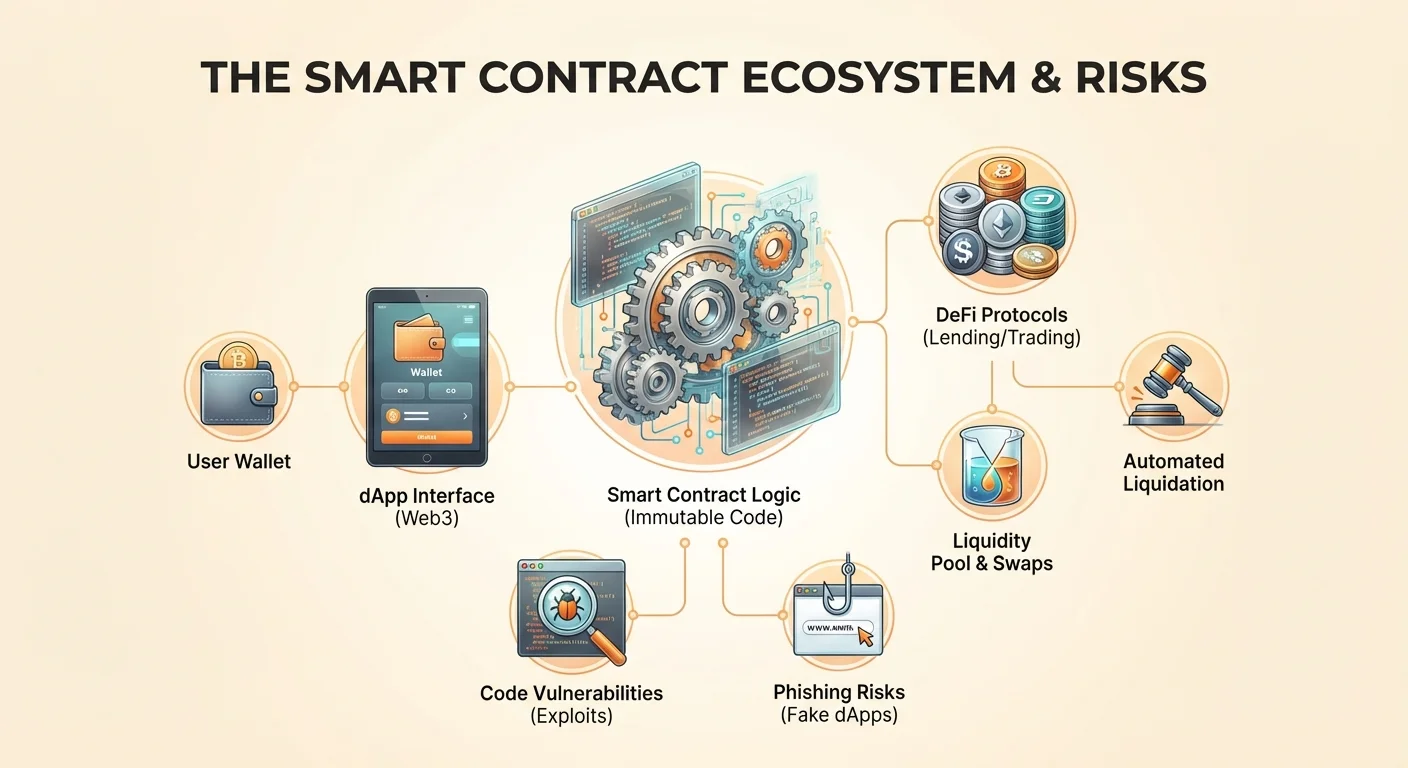
Smart contracts are the backend logic for Decentralized Applications, or dApps. A dApp looks and feels like a regular website or mobile app to the end user. It has a frontend interface built with standard web technologies. However, instead of connecting to a database on a private server, the frontend connects to smart contracts on a blockchain. This hybrid structure allows for user-friendly interfaces while maintaining the benefits of decentralized security and data ownership.
One of the key advantages of dApps is censorship resistance. Because the backend logic lives on a decentralized network, no government or corporation can shut down the application by simply turning off a server. As long as the blockchain network is running, the dApp remains accessible. Additionally, dApps are generally permissionless. Anyone with a crypto wallet can interact with them, regardless of their geographic location or credit score.
This architecture also changes data ownership. In traditional apps, the company owns the user's data and can monetize it. In dApps, the user retains control of their assets and identity. Interacting with a dApp typically involves connecting a wallet rather than creating a profile with a username and password. This allows users to move seamlessly between different applications without creating new accounts for every service.
Provable Fairness in Gaming
The transparency of smart contracts has profound implications for the gaming and gambling industries. In a traditional online casino, the player must trust the "house" that the software is fair. The code that generates random numbers or determines a win is hidden on a private server. The operator could theoretically manipulate the odds without the player knowing.
In a blockchain-based game, the logic is open source. A developer can create a dice game where the smart contract determines the outcome. Anyone can inspect the code to verify that the "house edge" is exactly what is advertised, for example, 1%. They can also verify that the random number generation is tamper-proof. This concept is known as "provably fair" gaming. It eliminates the need for blind trust between the player and the operator.
Furthermore, smart contracts enable true ownership of in-game assets. In traditional gaming, if a player earns a rare item, that item exists only on the game developer's server. If the game shuts down or the player is banned, the item is lost. Through the use of Non-Fungible Tokens (NFTs) managed by smart contracts, gaming assets can exist independently of the game itself. Players can sell, trade, or lend these items on open marketplaces.
Programmed Incentives and Airdrops
Smart contracts allow projects to program economic incentives directly into the protocol. This is often seen in the distribution of tokens. A traditional company might spend millions on marketing to acquire users. A crypto project can instead use a smart contract to conduct an "airdrop." This involves sending free tokens to the wallets of early users who meet specific criteria defined in the code.
For example, a decentralized exchange might program a smart contract to distribute governance tokens to anyone who provided liquidity or made a trade before a certain date. This rewards the community for their early support and aligns their interests with the success of the protocol. The distribution is transparent and verifiable. Users can see the exact rules of eligibility in the code, ensuring that insiders cannot secretly allocate tokens to themselves unfairly.
These mechanisms also enable decentralized governance. Smart contracts can be written to accept votes from token holders. This allows the community to propose and vote on changes to the protocol, such as adjusting fees or adding new features. The smart contract can even be programmed to automatically implement the result of the vote, removing the need for a central team to enact the community's will manually. This creates a structure known as a Decentralized Autonomous Organization (DAO).
Vulnerabilities in the Code
While the "trustless" nature of smart contracts removes human error from transaction execution, it introduces a different type of risk: code vulnerability. In a traditional system, if a bank makes a mistake or a bug is found, a central administrator can reverse the transaction or patch the server immediately. In a blockchain environment, transactions are immutable. If a smart contract has a bug, hackers can exploit it to drain funds, and there is often no way to reverse the theft.
The deterministic nature of the technology means that "code is law." If the smart contract permits an action, the network will execute it, even if that action was an unintended loophole. This has led to significant losses in the DeFi space. Reputable projects mitigate this risk by undergoing rigorous audits. Security firms review the code line-by-line to identify weaknesses before the contract is deployed. However, even audited contracts can contain unforeseen vulnerabilities.
Users must also be wary of malicious smart contracts. Because anyone can deploy code to the network, scammers can create dApps designed to steal funds. These might look like legitimate investment platforms but contain hidden functions that allow the creator to withdraw all deposited assets. This is often referred to as a "rug pull." Unlike traditional finance, where regulations and legal enforcement provide a safety net, the DeFi user is responsible for verifying the safety of the contracts they interact with.
Navigating the Interface Layer
The risks extend beyond the smart contracts themselves to the interface layer. A common attack vector is the "phishing dApp." A user might intend to visit a popular decentralized exchange but accidentally click a link to a fake website that looks identical. When the user connects their wallet, they are interacting with a malicious smart contract instead of the genuine one. This malicious contract may request permission to spend the user's tokens, leading to a total loss of funds.
Verifying the URL and checking for security indicators is crucial. Additionally, the open-source nature of the ecosystem means that the community plays a vital role in security. As protocols exist longer in the "wild," they become more battle-tested. Vulnerabilities are found and fixed, and the surviving protocols generally become more robust over time. This evolutionary process mirrors open-source software development but with higher financial stakes.
The responsibility placed on the user is significantly higher than in traditional systems. There is no customer support hotline to call if a transaction goes wrong. The irreversibility of the blockchain means that errors, whether caused by the user or the code, are often permanent. This stark reality is the trade-off for the freedom and control that the technology offers.
Conclusion
The shift from traditional backends to smart contracts represents a fundamental change in how digital trust is established. We are moving from a model based on institutional reputation to one based on cryptographic verification. In the traditional model, efficiency and user protection are managed by centralized intermediaries who hold custody of assets and data. This system is fast and forgiving of user error but is opaque and prone to censorship or mismanagement.
Smart contracts offer an alternative architecture where transparency and autonomy are paramount. By automating financial logic and removing the need for human intermediaries, these programs create a more open and equitable system. However, this new architecture demands a higher level of vigilance. The code executes without bias, but it also executes without mercy. As the technology matures, the distinction between the "law of the code" and the protection of the user remains the central challenge to widespread adoption.
In a world of smart contracts, trust is no longer given to a company, but verified in the code.