
Cryptocurrency represents a fundamental shift in how value is stored and transferred. Unlike national currencies issued by central banks, digital assets like Bitcoin operate on decentralized infrastructure. This system is opt-in and controlled by the consensus of its users rather than a government decree. The architecture allows people to store value independently of any financial institution or company. This independence is a core feature that distinguishes cryptoassets from fiat money, stocks, or other traditional assets that rely heavily on intermediaries.
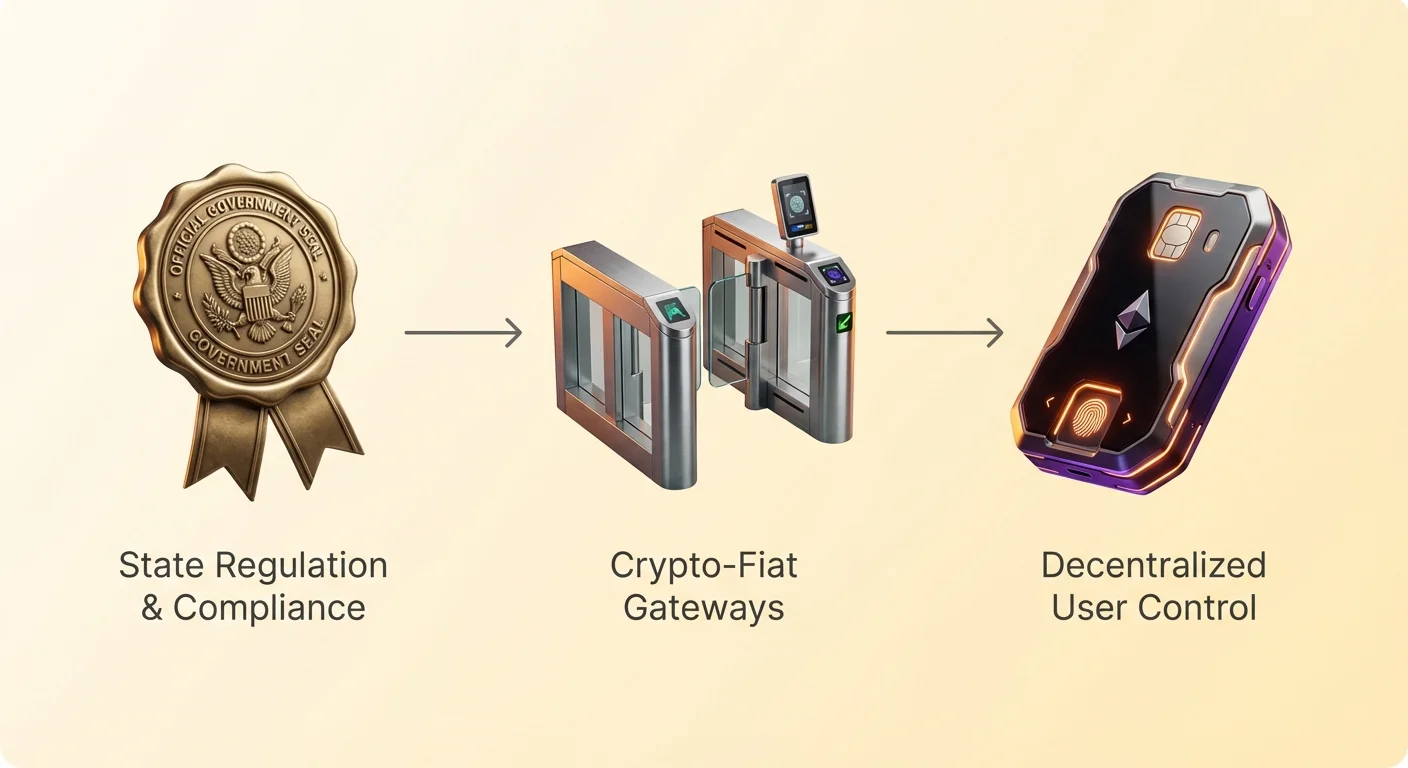
However, this decentralized nature creates significant friction with established global financial systems. Traditional finance relies on centralized gatekeepers to monitor transactions and prevent illicit activity. Banks and payment processors are legally deputized to track the flow of money. When a technology removes these gatekeepers, it challenges the regulatory frameworks designed to maintain order and security in the economy.
The result is an ongoing tension between the ethos of privacy that birthed the crypto industry and the strict compliance requirements of the modern world. As digital assets gain mainstream adoption, the industry finds itself navigating a complex landscape of regulations. This environment forces users and service providers to balance the benefits of censorship resistance against the legal necessity of identity verification and financial surveillance.
The Regulatory Toolkit
Financial regulations are designed to prevent money laundering, terrorist financing, and other financial crimes. To achieve this, regulators enforce a suite of protocols that financial institutions must follow. These protocols strip away anonymity to ensure that every transaction can be traced back to a specific individual or entity.
Know Your Customer (KYC)
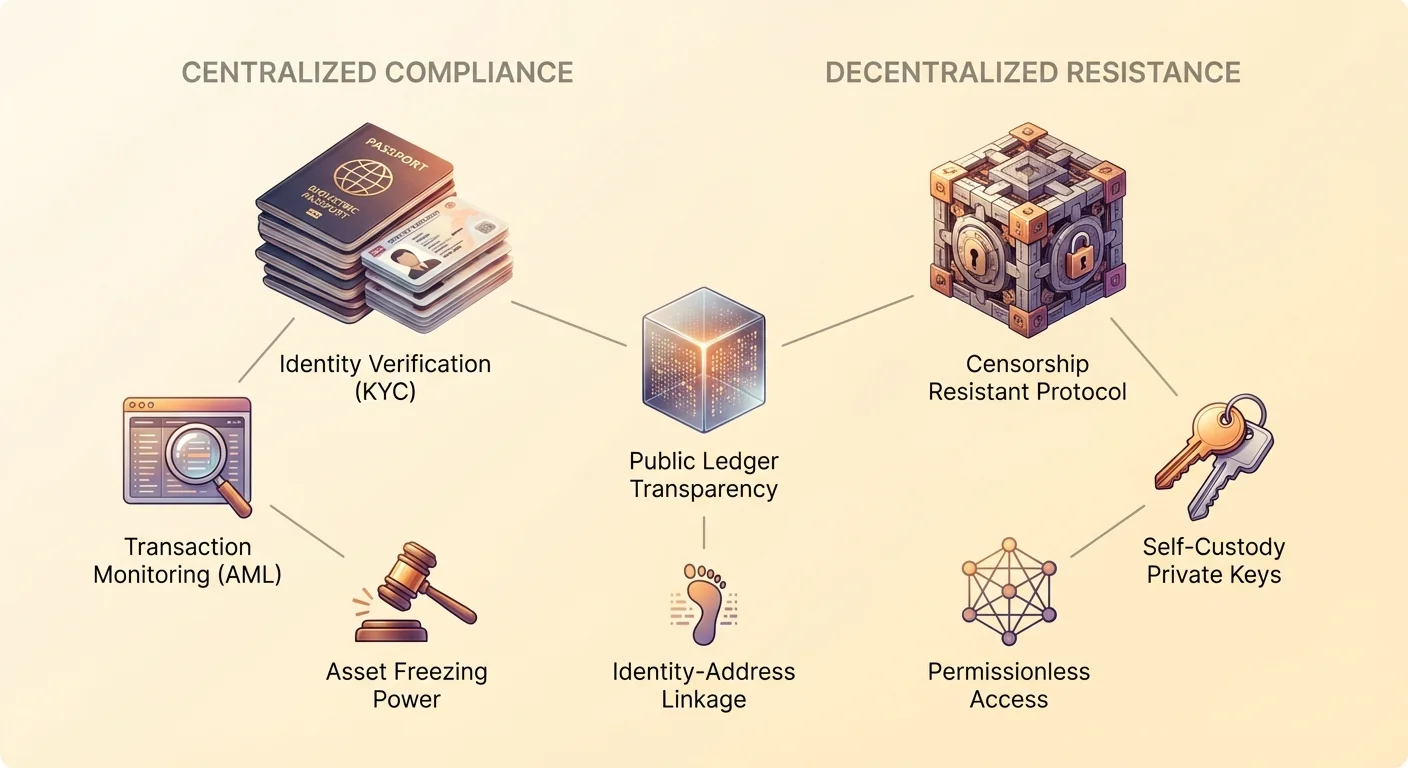
Know Your Customer, or KYC, is the foundational layer of financial compliance. These regulations mandate that financial institutions verify the identity of their customers before providing services. The goal is to establish a clear link between a human being and a financial account. The process typically begins with a Customer Identification Program (CIP).
During the CIP phase, a user must provide verifiable information. This includes identity documents like a passport or driver's license, proof of address, and potentially biometric data. This creates a permanent record that ties real-world identity to digital activity. Institutions are legally obligated to collect and store this data to remain compliant with local laws.
Following identification, institutions perform Customer Due Diligence (CDD). This involves assessing the risk profile of the customer. For standard users, this might just mean verifying their ID. For high-net-worth individuals or those involved in complex transactions, Enhanced Due Diligence (EDD) is required. This deeper investigation may probe the source of funds and the nature of the customer's business relationships.
Anti-Money Laundering (AML) and Transaction Monitoring
While KYC focuses on identity, Anti-Money Laundering (AML) focuses on activity. AML regulations require institutions to monitor the flow of funds to detect suspicious patterns. This is often where the concept of "Know Your Transaction" (KYT) comes into play. KYT involves scrutinizing individual transfers to ensure they are not interacting with known criminal entities or sanctioned addresses.
In the context of cryptocurrency, KYT leverages the public nature of blockchains. Analytics firms can trace the history of specific coins to see if they were previously used in hacks, darknet markets, or theft. If a user deposits funds into a compliant exchange, the exchange uses KYT software to check the provenance of those assets. If the funds are "tainted," the exchange may freeze the account to comply with AML statutes.
The Philosophy of Censorship Resistance
At the other end of the spectrum lies censorship resistance. This is a defining characteristic of decentralized networks like Bitcoin. Censorship resistance refers to the ability to carry out financial actions despite the wishes of any third party. It is built on three primary pillars: the freedom to transact, the freedom from confiscation, and the immutability of transactions.
In traditional finance, censorship is a common tool. Governments and banks can suppress financial activities by freezing assets or blocking transactions. This power is often used for law enforcement, but it can also be used for political suppression. Financial intermediaries like credit card companies or payment platforms may block legal transactions based on internal policies or government pressure.
Operation Choke Point is a historical example of this dynamic. Running from 2013 to 2017, this US government initiative pressured banks to deny service to industries deemed "high risk" or morally objectionable, even if they were legal. Similarly, in 2022, payment processors froze the accounts of protestors in Canada without court orders. These events highlight the vulnerability of funds held in centralized institutions.
Cryptocurrencies offer an alternative by removing the intermediary. When a user holds digital assets in a self-custodial wallet, they possess the private keys to those funds. This means no bank or government can unilaterally confiscate the assets or prevent a transaction from being broadcast to the network. As long as the user protects their keys, the network validates the transaction based on mathematical rules, not political permission.
Blockchain Transparency vs. Personal Privacy
A common misconception is that cryptocurrency is anonymous. In reality, most public blockchains are pseudonymous. A blockchain acts as a digital record of transactions that is copied and shared across a global network of computers. Every transaction is permanently recorded and viewable by anyone.
The Open Ledger
On a public blockchain, user identities are represented by alphanumeric addresses. While these addresses do not explicitly display a name, the ledger records every interaction associated with them. If a user's real-world identity is ever linked to their wallet address, their entire financial history becomes visible. This transparency promotes accountability and trust within the network, but it also acts as a powerful tool for surveillance.
The Linkage Problem
The privacy of a public blockchain relies on keeping the link between an identity and an address broken. However, complying with KYC regulations at centralized entry points effectively repairs this link. When a user buys Bitcoin on a centralized exchange, they provide their ID. The exchange then sends the Bitcoin to the user's personal wallet. The exchange now knows that specific wallet belongs to that specific person.
Once this connection is made, blockchain analytics can track how those funds are spent, where they are sent, and how much wealth the user holds. This creates a level of financial transparency that often exceeds traditional banking, where your transaction history is private between you and the bank. In crypto, once the pseudonym is cracked, the history is public.
Gateways and Friction Points
The interaction between the decentralized crypto economy and the traditional fiat economy is where regulatory friction is most intense. This interface is managed primarily by exchanges, which act as the on-ramps and off-ramps for capital.
Centralized Exchanges (CEXs)
Centralized exchanges resemble traditional stock trading accounts. They are custodial, meaning the provider holds the assets on behalf of the user. Because they facilitate the exchange of crypto for government-issued fiat currency, they fall under strict financial regulations.
To operate legally, CEXs must implement rigorous KYC and AML procedures. Users cannot trade or withdraw significant amounts without verifying their identity. While this offers a layer of safety and recourse for users, it reintroduces the risks of centralization. Users do not control their private keys, and their funds can be frozen if the exchange collapses or is ordered to do so by regulators.
Decentralized Exchanges (DEXs)
Decentralized exchanges offer a different model. These platforms facilitate peer-to-peer trading directly on the blockchain using smart contracts. A DEX does not take custody of user funds. Instead, users trade directly from their own self-custodial wallets.
Because there is no central intermediary holding funds, DEXs typically do not require KYC. This aligns with the ethos of privacy and permissionless access. However, this lack of oversight makes DEXs a target for regulatory scrutiny. As trading volume on decentralized platforms grows, regulators are exploring ways to enforce compliance on software that has no central administrator.
| Feature | Centralized Exchange (CEX) | Decentralized Exchange (DEX) |
|---|---|---|
| Custody | Exchange holds funds | User holds funds |
| Identity | Mandatory KYC | No ID required |
| Control | Vulnerable to freezing | Censorship resistant |
The Role of Stablecoins in Compliance
Stablecoins have become a critical component of the crypto ecosystem. These are digital assets pegged to stable assets like the US dollar to minimize volatility. They serve as a bridge between the reliability of fiat currency and the speed of blockchain technology. However, the structure of stablecoins often dictates their level of compliance and censorship resistance.
Centralized Stablecoins
The most widely used stablecoins, such as USDT and USDC, are centralized. They are issued by private companies that maintain reserves of cash and equivalents to back the tokens. To maintain compliance with US regulators and international laws, these issuers retain the ability to freeze assets at the smart contract level.
If law enforcement requests a freeze on a specific address holding USDC or USDT, the issuing company can blacklist that address. This renders the tokens in that wallet immovable. This capability has been used to block funds associated with hacks, theft, and sanctioned entities. While this provides a tool for law enforcement, it introduces counter-party risk for holders who rely on the issuer's permission to use their money.
Decentralized Stablecoins
Decentralized stablecoins, like DAI, attempt to solve this by removing the central issuer. Instead of a company holding dollars in a bank, users generate stablecoins by locking up crypto collateral in smart contracts. This process is managed by code and decentralized governance rather than a corporate entity.
While this model offers greater censorship resistance, it faces scalability and stability challenges. Furthermore, many decentralized stablecoins have begun to accept centralized assets like USDC as collateral to maintain their peg. This reintroduces regulatory risk, as the underlying collateral could theoretically be frozen by the centralized issuer, destabilizing the decentralized token.
Financial Censorship and Global Implications
The ability to control financial flows is a primary lever of power for modern states. This control is exercised through capital controls and sanctions. Cryptocurrencies disrupt this power dynamic by providing alternative rails for value transfer that are difficult to block.
Capital controls are restrictions governments place on how citizens can use their money, often to prevent wealth from leaving the country during economic crises. In high-inflation environments, citizens may seek to convert depreciating local currency into foreign assets. Cryptoassets provide a way to bypass these controls, preserving individual purchasing power but undermining government monetary policy.
Sanctions operate on a similar principle at an international level. They aim to isolate a regime or entity from the global financial system. While crypto offers a theoretical bypass for sanctions, the liquidity of the market limits its utility for large-scale evasion. FinCEN has noted that the lack of depth in crypto markets makes it difficult for governments or large corporations to use them to avoid sanctions effectively. However, for individuals in sanctioned nations, crypto remains a vital tool for receiving remittances and accessing the global economy.
The Future of Privacy and Money
The conflict between privacy and compliance is driving the evolution of money itself. Two distinct paths are emerging: Centralized Bank Digital Currencies (CBDCs) and decentralized privacy-preserving technologies.
The Rise of CBDCs
Central banks around the world are actively exploring CBDCs. These are digital versions of national currencies issued directly by the state. Unlike cryptocurrencies, CBDCs are centralized and permissioned. They aim to provide the efficiency of digital assets while maintaining—and potentially increasing—state control over monetary policy.
CBDCs could theoretically allow for programmable money, where governments can track every transaction in real-time or restrict how funds are spent. This represents the ultimate form of compliance and surveillance, eliminating the privacy inherent in physical cash.
Privacy Innovations
In response to increasing surveillance, the crypto industry continues to innovate. Privacy coins are cryptocurrencies designed specifically to obscure transaction data. They use advanced cryptographic techniques to hide the sender, receiver, and amount involved in a transfer.
Beyond specific coins, technologies like coin mixers allow users to obscure the trail of their funds. Mixers pool funds from many users together and then redistribute them, breaking the on-chain link between the source and destination. However, these tools are often viewed with suspicion by regulators, leading to strict crackdowns and the blacklisting of mixer addresses.
The Self-Custody Imperative
Ultimately, the degree of privacy and censorship resistance a user enjoys depends on how they store their assets. The distinction lies between custodial and self-custodial wallets.
In a custodial arrangement, such as keeping funds on a centralized exchange, the user effectively holds an IOU. The institution controls the private keys and, by extension, the assets. This subjects the user to the institution's compliance policies, risk of insolvency, and potential censorship.
Self-custodial wallets place the user in full control. The user manages their own private keys, meaning the wallet provider cannot access the funds. This model aligns with the concept of "be your own bank." It creates a direct relationship between the user and the blockchain protocol. While self-custody requires the user to take responsibility for security—such as backing up recovery phrases—it is the only way to ensure true censorship resistance and immunity from bank runs.
Conclusion
The intersection of cryptocurrency and regulation is defined by a fundamental trade-off between control and freedom. Regulatory frameworks like KYC and AML are essential tools for preventing financial crime and ensuring the integrity of the traditional banking system. They rely on identity verification and the ability to intervene in transactions. Conversely, the blockchain ethos prioritizes permissionless access, censorship resistance, and the privacy of the individual.
As the industry matures, the line between these two worlds is becoming more distinct. Users must navigate a landscape where compliant, centralized gateways offer convenience and legal security, while decentralized protocols offer autonomy and privacy. The choice of which tools to use—whether transparent public ledgers or privacy-focused assets, custodial accounts or self-hosted wallets—defines the level of freedom and friction a user experiences.
True financial ownership requires accepting the responsibility of self-custody to ensure your assets remain under your control.