
The integration of traditional financial value with blockchain technology has created one of the most significant sectors in the digital economy. This phenomenon is best represented by stablecoins, which serve as the primary vehicle for tokenizing real-world assets (RWA). By digitizing government-issued currencies like the US dollar, these assets bridge the gap between the stability of fiat money and the efficiency of decentralized networks.
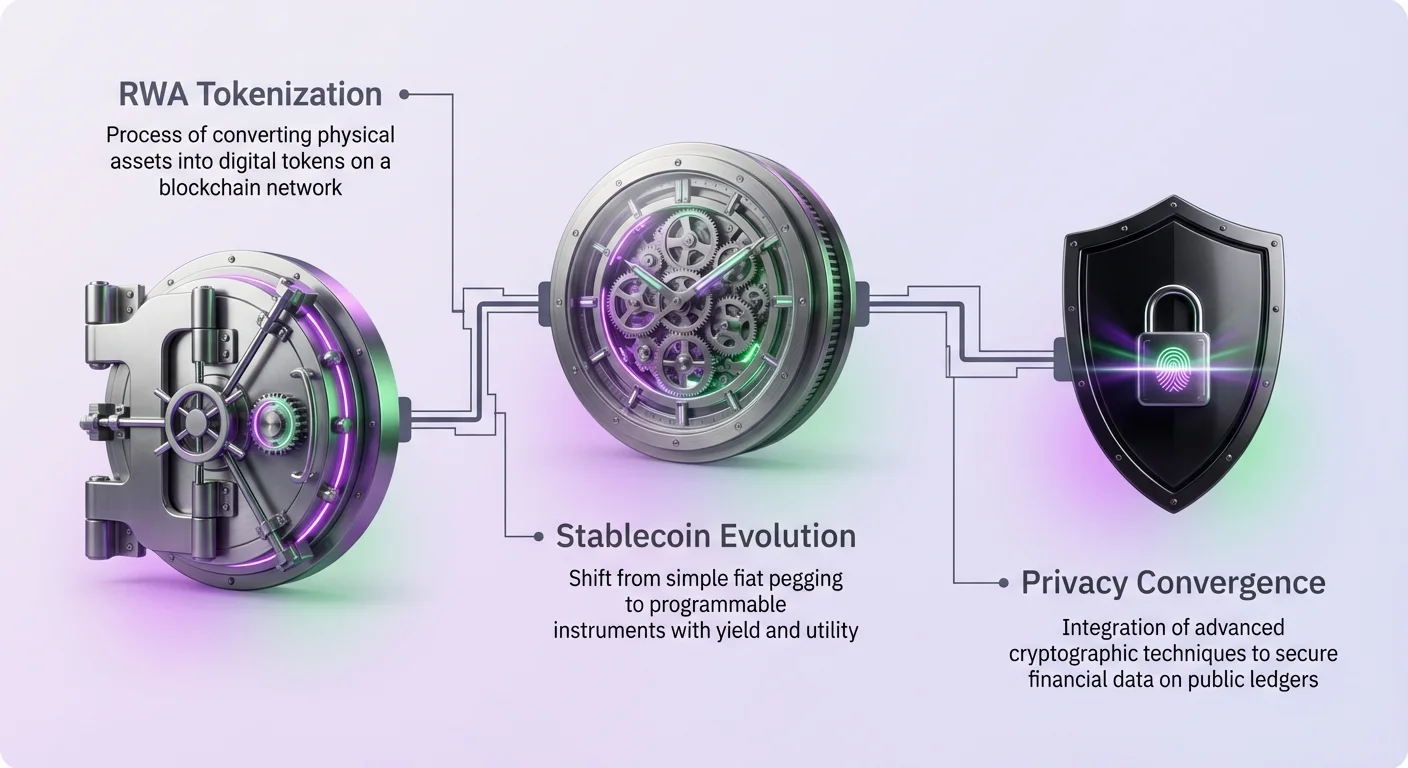
The market has evolved from simple digital receipts to complex, programmable financial instruments. Early iterations focused solely on maintaining a one-to-one peg with the dollar to facilitate trading. However, the landscape is shifting toward a convergence of stability, privacy, and yield generation. This evolution transforms how value is stored and transferred globally.
As the sector matures, it faces a critical challenge regarding transparency versus privacy. While public ledgers offer verification, they also expose financial histories. New protocols are emerging to address this by merging the stability of fiat-pegged assets with advanced cryptographic privacy measures. This convergence represents the next frontier in the tokenization of value.
The Mechanism of Fiat Tokenization
The most prevalent form of real-world asset tokenization in the cryptocurrency market is the fiat-backed stablecoin. These digital assets are designed to maintain a stable value by pegging their price directly to a national currency, most commonly the US dollar. The mechanism relies on a centralized issuer that holds reserves of cash or cash equivalents.
For every token minted on the blockchain, there is theoretically a corresponding dollar held in a bank account or invested in short-term government securities. This one-to-one backing provides the assurance that the digital token can be redeemed for the underlying physical asset. It essentially creates a digital twin of the fiat currency that can move across blockchain rails.
This model has proven to be the most scalable method for bringing real-world value on-chain. It allows traders to move in and out of volatile cryptocurrency positions without leaving the digital ecosystem. Furthermore, it enables cross-border payments that settle in minutes rather than days, bypassing the inefficiencies of the traditional SWIFT banking system.
The Dominance of Centralized Issuers
The market for tokenized fiat is currently dominated by centralized entities that act as the bridge between traditional banking and the crypto economy. Tether (USDT) was the first to rise to prominence, launching in 2014. It operates across numerous blockchain networks, including Ethereum, Tron, and Solana, providing deep liquidity for global markets.
Tether has maintained its position as the largest stablecoin by market capitalization despite historical controversies regarding the transparency of its reserves. Its utility as a tool for settlements and remittances is undeniable, particularly in regions where access to traditional banking is limited. It functions as a dollar-denominated instrument that exists outside the direct purview of the US banking system.
USD Coin (USDC), issued by Circle, represents a more regulated approach to the same concept. It prioritizes compliance and regular audits to ensure that its reserves are fully backed by cash and US Treasury bonds. This focus on transparency has made it a preferred choice for institutional investors and decentralized finance protocols that require a lower risk profile.
New entrants continue to validate this model. PayPal recently introduced PayPal USD (PYUSD), bringing a major fintech player into the space. Similarly, Ripple has launched RLUSD, a stablecoin operating on the XRP Ledger and Ethereum. These developments signal that major financial institutions view tokenized fiat as a permanent fixture of the future monetary landscape.
Decentralized Approaches to Asset Pegging
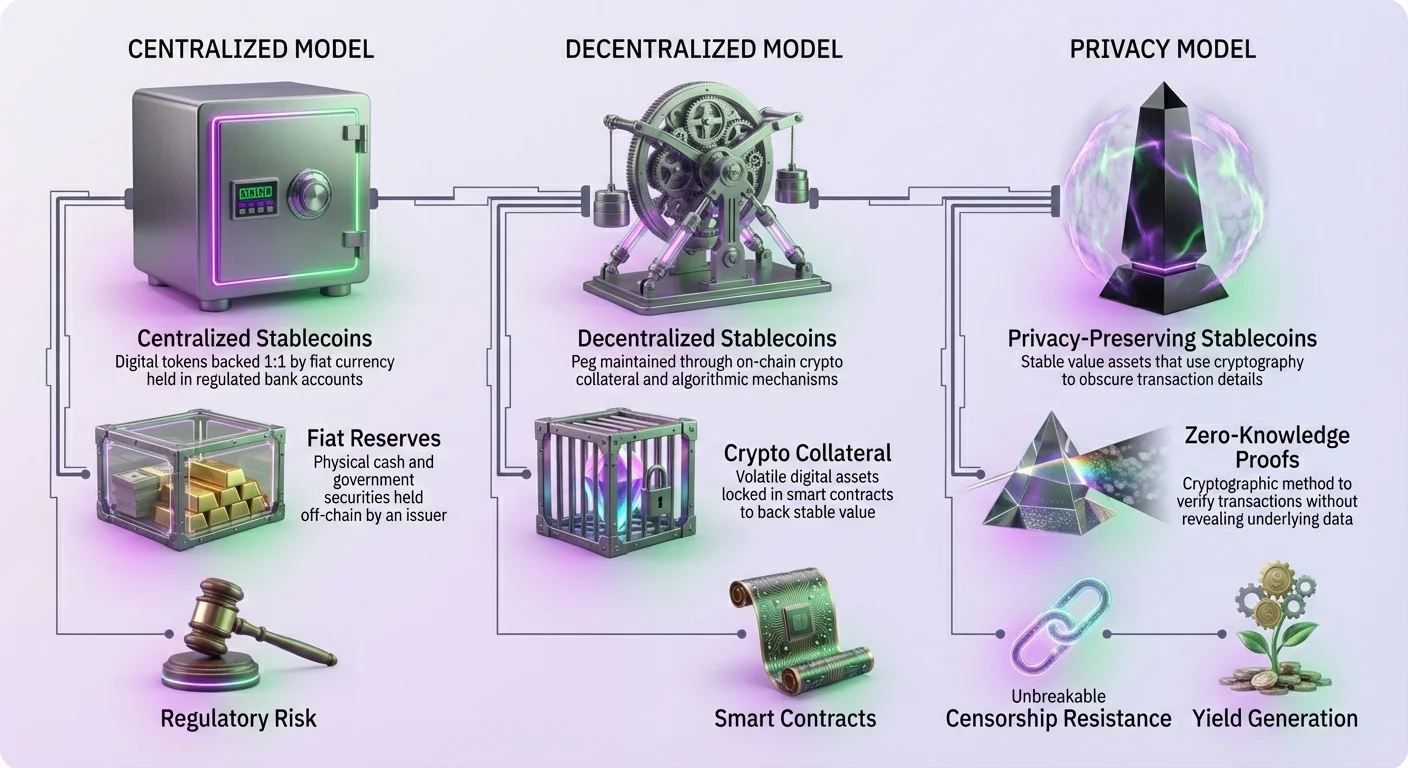
While centralized stablecoins offer efficiency, they reintroduce the counterparty risk that cryptocurrencies were originally designed to eliminate. Users must trust that the issuer actually holds the reserves and that the government will not freeze those assets. Decentralized stablecoins attempt to solve this by replacing the central bank account with smart contracts and crypto-native collateral.
Crypto-Collateralized Models
The most established method for creating decentralized stable value is through over-collateralization. In this model, users lock up cryptocurrency assets, such as Ethereum or Wrapped Bitcoin, into a smart contract to mint new stablecoins. Because the collateral is volatile, the system requires the user to deposit more value than they mint.
DAI, managed by MakerDAO (now rebranding to Sky), pioneered this approach. Users open Collateralized Debt Positions (CDPs) to generate DAI. If the value of the collateral drops below a certain threshold, the system automatically liquidates the assets to repay the debt and maintain the peg. This ensures stability without relying on a trusted third party to hold cash in a vault.
The ecosystem is evolving with the introduction of Sky Dollar (USDS), which replaces DAI in the new Sky ecosystem. This upgrade aims to enhance the utility of the token while maintaining the core principles of decentralized backing. Users can upgrade their existing DAI to USDS, gaining access to new governance features and native token rewards.
Algorithmic and Hybrid Experiments
A riskier approach to stability involves algorithmic mechanisms that control supply and demand without traditional collateral. These systems often use a two-token model where one token absorbs volatility to keep the stablecoin pegged. The most infamous example was TerraUSD (UST), which relied on an arbitrage relationship with the LUNA token.
When UST traded above one dollar, users burned LUNA to mint UST, increasing supply and lowering the price. Conversely, when UST dropped below a dollar, users burned UST to mint LUNA. While this model was capital efficient, it ultimately failed in May 2022, leading to a "death spiral" that wiped out billions in value. This event served as a stark lesson in the dangers of under-collateralized financial engineering.
Modern iterations like Frax (FRAX) and Ethena USDe employ hybrid models to mitigate these risks. Frax combines partial collateralization with algorithmic adjustments, while USDe uses a "delta-neutral" strategy involving short positions to hedge the value of its collateral. These next-generation assets attempt to balance the need for scalability with the imperative of stability.
The Convergence of Privacy and Stable Value
A significant limitation of standard stablecoins, whether centralized or decentralized, is the lack of privacy. Most stablecoins run on public blockchains like Ethereum, where every transaction is recorded on a transparent ledger. Anyone can trace the sender, recipient, and amount of every transfer. This transparency, while useful for auditing, is detrimental for personal financial privacy and commercial confidentiality.
The convergence of real-world asset tokenization with advanced privacy technology is creating a new class of digital assets. These are designed to offer the stability of the US dollar while providing the anonymity associated with physical cash. This development is crucial for users who wish to protect their financial sovereignty in an increasingly surveilled digital economy.
Zano and the Confidential Asset Standard
Zano is a privacy-focused blockchain that addresses the transparency issue through its unique infrastructure. Unlike Bitcoin or Ethereum, Zano uses a hybrid Proof-of-Work and Proof-of-Stake consensus mechanism designed specifically for privacy. It introduces the concept of "Confidential Assets," which are tokens that inherit the privacy features of the native chain.
On the Zano network, privacy is the default setting rather than an optional feature. It employs technologies such as Ring Signatures, which mix a user's transaction with others to obscure the true sender. It also utilizes Stealth Addresses, which generate one-time destinations for every transaction, preventing outside observers from linking multiple payments to a single user.
The most critical innovation for tokenized assets is the ability to hide the transaction amount and the asset type itself. Through a cryptographic method involving blinded asset tags, Zano ensures that an observer cannot determine whether a user is transferring the native ZANO coin or a tokenized asset. This creates a unified shield around all value moving through the network.
The Freedom Dollar (fUSD)
The first major implementation of a private stablecoin on this infrastructure is the Freedom Dollar (fUSD). Launched in early 2025, fUSD is designed to maintain a one-to-one peg with the US dollar while operating as a Confidential Asset on the Zano blockchain. It represents a direct convergence of RWA stability and privacy-preserving technology.
Unlike transparent stablecoins where wallet balances are visible to the world, fUSD balances are encrypted. When a user sends fUSD, the transaction details are verified by the network using cryptographic proofs without revealing the sensitive data. This restores the fungibility of money, ensuring that units of currency cannot be blacklisted or discriminated against based on their transaction history.
The Freedom Dollar creates a censorship-resistant alternative to centralized stablecoins. Since it does not rely on a central authority that can freeze specific addresses at the protocol level, it functions more like digital cash. This is particularly relevant for use cases involving donations, political support, or commerce in regions with restrictive financial controls.
Technical Architecture of Private Tokens
The underlying technology that enables assets like fUSD is known as Zarcanum. This is a custom Proof-of-Stake scheme that allows for hidden amounts in staking and transactions. It integrates Bulletproofs+, a form of zero-knowledge proof that drastically reduces the size of confidential transactions while verifying that no false value has been created.
The architecture allows users to issue their own Confidential Assets easily. This capability extends beyond stablecoins to potentially include other tokenized real-world assets in the future. Any asset issued on the Zano chain automatically benefits from the ring signatures and stealth addresses, removing the need for developers to build their own privacy layers from scratch.
This system also supports "Ionic Swaps," which are privacy-preserving atomic swaps. This allows users to trade different assets on the Zano chain without a centralized exchange and without revealing the amounts being traded. This facilitates a decentralized financial ecosystem where trade privacy is mathematically guaranteed.
Utility and Yield in the Tokenized Economy
The convergence of tokenized assets and decentralized finance (DeFi) has unlocked new utility for the digital dollar. In the traditional banking system, cash deposits often earn negligible interest while losing purchasing power to inflation. In the crypto economy, stablecoins can be put to work to generate significant yield.
Lending and Liquidity Provision
One of the primary methods for earning yield on tokenized assets is through decentralized lending protocols. Users can deposit their stablecoins into smart contracts, which then lend those funds to borrowers. The interest rates are determined dynamically by supply and demand. Because there is often high demand for leverage in crypto markets, lending rates for stablecoins can significantly exceed traditional bank rates.
Another avenue is automated market making (AMM). On decentralized exchanges like Uniswap or Curve, traders need liquidity to swap between assets. Users can deposit their stablecoins into liquidity pools to facilitate these trades. In return, they earn a portion of the trading fees generated by the platform. This transforms a passive holding into a productive asset.
Yield generation carries its own set of risks, particularly "impermanent loss" in liquidity pools or smart contract vulnerabilities in lending platforms. However, the ability to earn a return on a stable asset is a powerful driver of adoption. It shifts the narrative of crypto from pure speculation to a new form of fixed-income investing.
Yield-Bearing Stablecoins
A recent innovation in this space is the "yield-bearing" stablecoin. Instead of requiring the user to actively deposit funds into a lending protocol, the stablecoin itself has yield generation built into its design. Ethena's USDe is a prime example of this model. It is a synthetic dollar that generates returns through a "cash and carry" trade.
The protocol holds staked Ethereum as collateral and simultaneously opens a short position in the derivatives market. This strategy aims to capture the funding rates paid by traders who are betting on price increases. The yield generated from these derivatives positions is passed on to the holders of the stablecoin.
This model represents a further convergence of complex financial engineering and simple tokenized value. It allows users to hold a dollar-pegged asset that automatically grows in quantity over time. However, these mechanisms introduce additional layers of complexity and risk compared to simple fiat-backed tokens.
Risks and Challenges in Convergence
Despite the rapid innovation, the convergence of RWAs and stablecoins is fraught with risks. The most immediate concern for fiat-backed tokens is regulatory uncertainty. Governments worldwide are scrutinizing stablecoin issuers, concerned about their impact on monetary policy and financial stability.
The Centralization Paradox
Centralized stablecoins like USDT and USDC introduce a single point of failure. The issuing companies have the power to freeze assets at the request of law enforcement. While this compliance is necessary for their operation within the legal banking system, it contradicts the core ethos of cryptocurrency. Users holding these tokens do not truly possess "unstoppable money."
This centralization risk was highlighted in past incidents where law enforcement requested the freezing of funds in specific addresses. For users seeking genuine financial sovereignty, this capability is a significant drawback. It drives demand for decentralized alternatives like DAI and private options like fUSD, which prioritize censorship resistance over regulatory compliance.
De-pegging and Solvency
The primary risk for any stablecoin is the loss of its peg. If the market loses confidence in the reserves backing the token, a "bank run" can occur. This was vividly illustrated by the collapse of UST, but even centralized giants like USDC have experienced temporary de-pegging events during periods of banking instability.
For algorithmic and crypto-backed stablecoins, market volatility poses a constant threat. If the value of the collateral crashes too quickly, the system may become under-collateralized before it can liquidate assets. Protocols must maintain high over-collateralization ratios to buffer against these shocks, which makes them capital inefficient compared to fiat-backed rivals.
| Risk Type | Primary Cause | Affected Models |
|---|---|---|
| Censorship | Issuer intervention/Freezing | USDT, USDC, PYUSD |
| De-pegging | Collateral value drop/Bank run | Algo (UST), Crypto-backed (DAI) |
| Smart Contract | Code bugs/Hacks | All Decentralized/DeFi models |
Regulatory Scrutiny on Privacy
The integration of privacy features into stablecoins creates a specific conflict with regulators. Authorities often view privacy-enhancing technologies as tools for illicit finance. Privacy coins like Monero have faced delistings from centralized exchanges due to pressure from regulators who demand full traceability of funds.
Stablecoins like fUSD that utilize confidential asset technology may face similar hurdles. While they offer legitimate protection for user data, their obfuscation of transaction trails makes them difficult to integrate into the regulated banking sector. This creates a bifurcation in the market between compliant, transparent stablecoins and private, censorship-resistant ones.
Conclusion
The tokenization of real-world assets via stablecoins has fundamentally altered the cryptocurrency landscape. By bringing the stability of the US dollar on-chain, these assets have enabled a thriving ecosystem of trading, lending, and global payments. The market is now moving beyond simple digital replicas of fiat currency toward more sophisticated models that incorporate yield and privacy.
The rise of confidential assets represents a crucial evolution in this convergence. Projects like Zano and the Freedom Dollar demonstrate that it is possible to combine the stability of traditional finance with the privacy guarantees of cryptographic networks. This offers a necessary counter-balance to the surveillance capabilities inherent in public blockchains and centralized financial systems.
As the technology matures, the distinction between "crypto" and "real-world" assets will continue to blur. The future likely holds a diverse ecosystem where compliant institutional stablecoins coexist with private, decentralized alternatives. This variety ensures that users can choose the form of digital value that best suits their need for stability, yield, or sovereignty.
Stablecoins are evolving from simple digital dollars into complex, privacy-preserving tools that restore financial autonomy.