
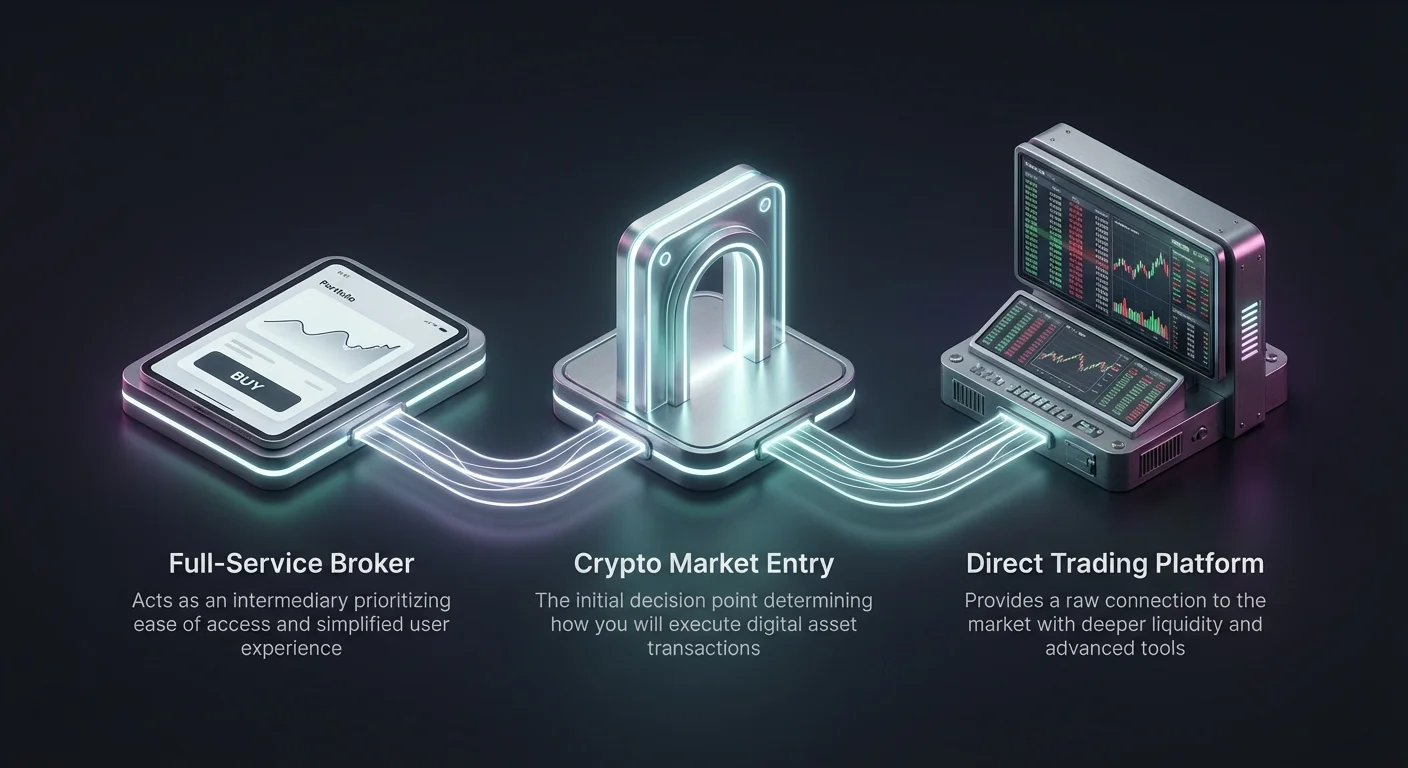
Deciding how to enter the cryptocurrency market involves more than just selecting a digital asset to purchase. You must primarily determine the vehicle through which you will execute your transactions. This choice generally falls into two distinct categories: full-service crypto brokers and direct trading platforms. Each avenue offers a radically different experience, tailored to specific types of market participants ranging from passive investors to high-frequency traders.
The distinction between these two models shapes everything from the fee structure you encounter to the level of control you maintain over your digital assets. Full-service brokers typically prioritize ease of access and simplicity, acting as intermediaries that smooth out the complexities of the blockchain. In contrast, direct trading platforms, often referred to as exchanges, provide a raw connection to the market, offering deeper liquidity and advanced tools but requiring a steeper learning curve.
Understanding the nuances between investment-focused brokerage services and direct market access is critical for long-term success. The right choice depends heavily on your technical proficiency, your financial goals, and how actively you intend to manage your portfolio. This guide explores the operational mechanics, cost implications, and security architectures of both models to help you navigate the digital asset landscape effectively.
Defining the Cryptocurrency Broker Model
The Role of the Intermediary
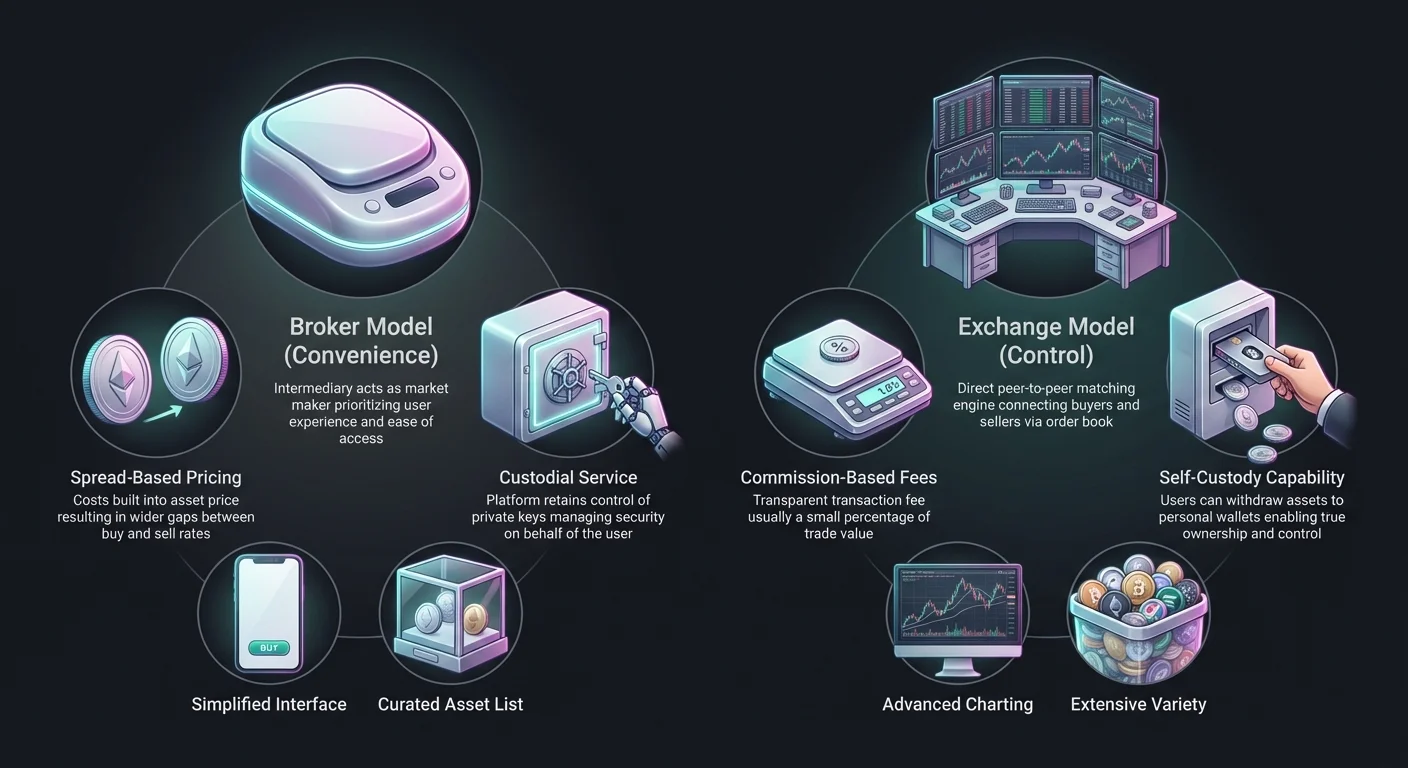
A cryptocurrency broker functions similarly to a traditional stockbroker or a currency exchange at an airport. When you engage with a broker, you are not trading directly with other market participants. Instead, you are dealing with the brokerage firm itself. The broker sets a price for the asset, and you have the option to buy or sell at that specific rate.
This model places the broker in the position of a market maker or a dealer. They hold a diverse inventory of assets and facilitate trades by selling from their own reserves or by sourcing liquidity from larger exchanges behind the scenes. The primary value proposition here is convenience. You do not need to worry about order books, market depth, or finding a counterparty to match your trade size.
The broker handles the complexities of the transaction execution. This ensures that your order fills immediately at the quoted price, eliminating the uncertainty that can sometimes accompany direct market orders. For beginners, this removes a significant barrier to entry, as the process feels identical to purchasing goods from an online retailer.
Simplified User Interfaces
Brokerage platforms are engineered with a focus on user experience (UX) design that caters to non-technical users. The interface is often stripped of complex charts, scrolling numbers, and flashing indicators that characterize professional trading terminals. Instead, you are presented with a clean dashboard showing your portfolio value and simple "Buy" and "Sell" buttons.
This design philosophy extends to the onboarding process. Identity verification and funding methods are streamlined to resemble standard banking applications. The goal is to reduce friction, allowing a user to convert fiat currency into cryptocurrency with as few clicks as possible. This accessibility makes brokers the preferred entry point for individuals who view crypto as a long-term investment rather than a daily trading activity.
Custodial Services and Asset Management
One of the defining features of a full-service broker is the custodial nature of the relationship. When you purchase Bitcoin or Ethereum through a broker, the platform typically retains custody of the private keys. You do not hold the assets in a personal wallet; rather, you hold a claim against the broker for those assets.
This arrangement is beneficial for users who are terrified of the responsibility of self-custody. Managing private keys, securing seed phrases, and protecting against phishing attacks can be daunting. A broker acts as a custodian, employing enterprise-grade security measures to protect the funds on behalf of their clients. If you lose your password, you can simply contact customer support to restore access, a safety net that does not exist in self-custody scenarios.
However, this convenience comes with a trade-off regarding control. Since you do not possess the keys, you are subject to the broker's terms of service. Withdrawal limits, maintenance downtimes, or regulatory freezes can restrict your access to your funds. This dynamic aligns more with traditional banking than with the decentralized ethos of cryptocurrency.
Mechanics of Direct Trading Platforms
The Order Book System
Direct trading platforms, or centralized exchanges (CEXs), operate on a fundamentally different mechanism known as the order book. In this environment, the platform does not set the price. Instead, it acts as a matching engine that connects buyers and sellers. The price is determined dynamically by the supply and demand of the market participants.
The order book displays a list of all open buy orders (bids) and sell orders (asks). When you place a market order, the engine matches you with the best available price from the opposing side of the book. This peer-to-peer matching process ensures that the price reflects the true market sentiment at any given millisecond.
For active traders, this transparency is invaluable. You can see the depth of the market, meaning you know how much liquidity is available at various price points. This visibility allows for more strategic decision-making, such as identifying support and resistance levels based on the concentration of pending orders.
Advanced Order Types
Direct trading platforms empower users with a suite of sophisticated order types that go far beyond simple buying and selling. Limit orders allow you to specify the exact price at which you are willing to execute a trade. If the market does not reach your price, the trade does not happen. This gives you precise control over your entry and exit points.
Stop-loss orders are another critical tool available on exchanges. These allow you to set a trigger price that, if hit, automatically sells your assets to prevent further losses. This automation is essential for risk management in the volatile crypto market, allowing traders to protect their capital even when they are not actively monitoring the screen.
More complex strategies involve "One Cancels the Other" (OCO) orders, where placing a profit-taking order automatically sets a stop-loss order, and vice versa. These tools are designed for individuals who treat cryptocurrency as a trading profession or a serious hobby, requiring granular control over every aspect of trade execution.
Direct Market Access vs. Aggregation
Direct trading connects you to the raw feed of market data. You are seeing the interactions of automated trading bots, institutional investors, and retail traders in real-time. This contrasts with the sanitized view provided by brokers. On an exchange, you can witness price slippage and volatility as it happens.
Some platforms operate as hybrids, offering both a simple conversion interface (broker-like) and an advanced trading view (exchange-like). However, the core functionality of direct trading remains rooted in the ability to interact with the order flow. This access is necessary for strategies like arbitrage or scalping, where small price discrepancies are exploited for profit.
Analyzing Fee Structures and Costs
The Spread vs. Commission Model
The most significant financial difference between brokers and direct trading platforms lies in how they generate revenue. Brokers typically utilize a "spread" model. They do not always charge a transparent transaction fee. Instead, they build their profit into the price of the asset.
For example, if the market price of Bitcoin is $50,000, a broker might offer to sell it to you for $50,200 and buy it from you for $49,800. The difference is the spread. While this simplifies the fee structure into a single price, it often results in higher overall costs compared to direct trading, especially for large transactions.
Direct trading platforms generally charge a commission fee based on a "maker-taker" model. "Makers" are traders who place limit orders that add liquidity to the order book, while "takers" place market orders that remove liquidity. Makers often pay lower fees (or sometimes receive rebates) to incentivize them to provide liquidity. Takers pay a slightly higher fee, usually a small percentage of the trade value (e.g., 0.1% to 0.5%).
Hidden Costs in Payment Methods
Funding your account can incur different costs depending on the platform type. Brokers often integrate seamlessly with traditional banking rails and consumer payment apps like PayPal or credit cards. While convenient, these methods often carry high processing fees. A credit card purchase might incur a 3% to 5% surcharge on top of the broker's spread.
Direct trading platforms heavily incentivize bank transfers or wire deposits, which are typically slower but cheaper. Some exchanges have started accepting card payments, but usually through third-party processors that charge significant premiums. For a cost-conscious investor, understanding the deposit fee structure is just as important as the trading fees.
Impact on Long-Term Profitability
For a "buy and hold" investor who makes one purchase a month, the higher fees of a broker might be negligible compared to the convenience offered. Paying an extra 1% on a $100 purchase is a small price for simplicity and security. The ease of use justifies the cost for passive accumulation.
However, for an active trader executing multiple trades per day, the spread model is financially unsustainable. The compounded cost of entering and exiting positions with a wide spread would erode any potential profits. Direct trading platforms with low commission fees are the only viable option for high-frequency strategies, where minimizing transaction costs is vital to maintaining a positive edge.
Security Architectures and Safety
Cold Storage and Asset Protection
Security is the paramount concern in the digital asset space. Both high-end brokers and reputable exchanges utilize cold storage to protect user funds. Cold storage involves keeping the vast majority of digital assets offline, disconnected from the internet. This air-gapped approach makes it nearly impossible for hackers to access the private keys remotely.
Top-tier platforms typically keep only a small percentage of funds in "hot wallets" (online) to facilitate immediate withdrawals and trading liquidity. The rest is secured in geographically distributed vaults, often requiring multiple signatories to access. When evaluating any platform, investigating their ratio of cold to hot storage is a crucial due diligence step.
Regulatory Compliance and Insurance
Full-service brokers often operate under stricter regulatory frameworks compared to some global exchanges. Because they interface directly with the traditional banking system and offer simplified investment products, they are frequently scrutinized by financial authorities. This compliance often mandates that they hold specific licenses and adhere to strict auditing standards.
Some brokers and US-based exchanges carry insurance policies to protect digital assets held in hot storage. If the platform is breached and online funds are stolen, the insurance policy may reimburse users. It is vital to note that this insurance rarely covers unauthorized access to your individual account resulting from a weak password or a phishing scam; it generally covers platform-wide breaches.
Two-Factor Authentication and User Security
Regardless of the platform type, user-side security features are essential. The safest exchanges and brokers enforce Two-Factor Authentication (2FA) as a mandatory standard. This requires a second form of verification, such as a code from an authenticator app or a hardware key, in addition to your password.
Advanced platforms offer deeper security settings, such as address whitelisting. This feature prevents funds from being withdrawn to any wallet address that you have not previously approved and verified. This waiting period for new addresses adds a critical layer of defense, giving you time to react if your account is compromised.
Asset Selection and Market Diversity
The Curated Approach of Brokers
Brokers generally offer a curated selection of cryptocurrencies. They tend to list assets that have high trading volume, established reputations, and sufficient regulatory clarity. You will consistently find Bitcoin, Ethereum, and major large-cap altcoins on these platforms.
This curation acts as a quality filter for beginners. By excluding highly volatile, low-liquidity micro-cap coins, brokers protect inexperienced investors from the riskiest segments of the market. The assets available are usually deemed "investment grade" by the platform's listing committee.
However, this limitation can be frustrating for investors seeking high-risk, high-reward opportunities. If you are looking to invest in a brand-new token that just launched, you are unlikely to find it on a full-service brokerage platform until it has established a significant track record.
The Extensive Variety of Exchanges
Direct trading platforms, particularly those with a global footprint, prioritize variety. They often list hundreds, sometimes thousands, of different digital assets. This includes stablecoins, governance tokens, utility tokens, and even meme coins.
For traders, this diversity is essential. Market trends shift rapidly, and capital rotates between different sectors of the crypto economy. Having access to a wide array of assets allows traders to chase volatility and capitalize on emerging narratives. Exchanges are often the first places to list new projects, giving users early access before an asset hits mainstream brokerage apps.
Implications for Portfolio Diversification
The choice between a curated list and an extensive catalog influences your portfolio strategy. A broker supports a concentrated portfolio strategy, focusing on blue-chip assets held for long durations. This aligns with a conservative investment approach similar to index fund investing.
An exchange supports a highly diversified, venture-capital style approach. You can spread small bets across dozens of speculative assets in hopes that one will outperform. This requires more research and active management but offers exposure to the broader innovation occurring within the blockchain space.
Comparison of Key Features
Trading Tools vs. Investment Features
| Feature | Crypto Broker | Direct Trading Exchange |
|---|---|---|
| Primary Goal | Simple Acquisition | Precision Execution |
| Pricing | Spread-based (Fixed) | Commission-based (Dynamic) |
| Interface | Minimalist | Data-Rich / Technical |
Brokers focus on "investment features." This includes recurring buy options (Dollar Cost Averaging), portfolio tracking tools that visualize performance over time, and educational content integrated directly into the dashboard. The goal is to help you build wealth over time without requiring constant attention.
Exchanges focus on "trading tools." This includes real-time depth charts, technical analysis indicators (RSI, MACD, Bollinger Bands), and API access for connecting algorithmic trading bots. These features are designed to help you analyze price action and execute trades with millisecond precision.
Leverage and Derivatives
While some brokers offer Contracts for Difference (CFDs) that allow you to speculate on price movements without owning the asset, this is fundamentally different from the derivatives markets found on exchanges. CFDs are synthetic instruments often used for short-term speculation within the broker's ecosystem.
Direct trading platforms offer deep markets for futures and options. These are complex financial instruments that allow traders to hedge their positions or apply significant leverage (borrowed capital) to their trades. Leverage can amplify gains but also introduces the risk of liquidation, where you lose your entire collateral. These tools are strictly for experienced professionals.
Copy Trading and Social Features
A growing trend among certain brokers and hybrid exchanges is social trading. This allows users to browse the profiles of successful traders, view their historical performance, and automatically copy their trades. This "hands-off" approach appeals to investors who want active management without doing the work themselves.
Direct trading platforms rarely offer social layers in the same integrated way. While you can view public order books, you cannot easily identify individual traders or copy their strategies automatically without third-party software. The culture on exchanges is more individualistic and competitive.
Payment Methods and Regional Accessibility
Fiat On-Ramps
The bridge between traditional money (fiat) and cryptocurrency is known as an "on-ramp." Brokers excel in this area. They typically support a wide range of local payment methods, from instant bank transfers to Apple Pay and Google Pay. The integration is seamless because brokers function similarly to fintech apps.
Exchanges often have more friction at the on-ramp stage. Depending on their banking partners and regulatory status in your specific region, they may only accept wire transfers, which can take days to clear. P2P (Peer-to-Peer) marketplaces are often integrated into global exchanges to solve this, allowing users to transfer local currency to another user in exchange for crypto, but this adds complexity.
Geographic Restrictions
Regulations governing cryptocurrency vary wildly by country and state. Brokers often have specific licenses that limit their operation to certain jurisdictions. A broker might be available in the UK but not in the US due to different laws regarding financial derivatives.
Global exchanges often try to serve as many countries as possible, sometimes operating in regulatory gray areas. However, this can lead to sudden service interruptions if a local regulator cracks down. It is essential to verify that the platform you choose is fully licensed to operate in your country to ensure you have legal recourse if something goes wrong.
PayPal and Alternative Payments
PayPal has become a major player in the crypto space, offering its own brokerage services and integrating with other platforms. Many full-service brokers accept PayPal for deposits and withdrawals, leveraging its speed and user protection policies.
Direct trading exchanges are less likely to accept PayPal directly due to the risk of chargebacks. Cryptocurrency transactions are irreversible, while PayPal transactions can be disputed. This mismatch creates risk for the exchange. Therefore, users relying on PayPal usually have to stick to brokers or P2P markets.
Privacy and Anonymity Considerations
Know Your Customer (KYC)
Both legitimate brokers and centralized exchanges enforce strict Know Your Customer (KYC) protocols. You cannot trade without uploading government-issued ID and proof of address. This is a legal requirement to prevent money laundering and terrorism financing.
If privacy is your primary concern, neither a standard broker nor a major centralized exchange will satisfy your needs. You would likely need to explore decentralized exchanges (DEXs) or specific non-custodial platforms that facilitate crypto-to-crypto swaps without accounts. However, these platforms rarely handle fiat currency, meaning you still need an on-ramp.
Data Security
Brokers and exchanges collect vast amounts of personal data. The safety of this data is as important as the safety of your funds. High-quality platforms employ encryption for data at rest and in transit. They also comply with data protection regulations like GDPR in Europe.
Anonymous exchanges reduce this data risk by simply not collecting the data in the first place. However, they lack the ability to help you recover your account if you lose your credentials. The trade-off is between privacy and support.
The "Not Your Keys" Debate
Implications of Broker Custody
When you use a broker, you often cannot withdraw the actual cryptocurrency to an external wallet. You can only sell it back for cash. This is known as a "walled garden." While this is changing, with some brokers now allowing withdrawals, it remains a common restriction.
This means you cannot use your crypto to pay for goods, participate in DeFi (Decentralized Finance) protocols, or stake directly on the blockchain. You are purely speculating on the price. If the broker goes bankrupt, you are an unsecured creditor.
Exchange Wallets and Withdrawals
Direct trading platforms almost always allow you to withdraw your crypto to a personal wallet. This capability is essential for the philosophy of self-sovereignty. You can buy on the exchange and then move the assets to a hardware wallet for long-term safekeeping.
This ability gives you true ownership. Once the assets are in your private wallet, no exchange downtime or freeze can stop you from transacting. However, you become solely responsible for the security of that wallet.
Decentralized Exchanges (DEX)
For those who refuse to trust any third party, Decentralized Exchanges (DEX) offer a solution. DEXs operate via smart contracts on the blockchain. Users trade directly from their personal wallets. There is no middleman holding the funds.
DEXs represent the ultimate direct trading experience. However, they suffer from high network fees (gas fees), slower transaction speeds, and a complete lack of customer support. They are tools for advanced users who prioritize autonomy above all else.
Investment Strategies: Which Platform Fits You?
The Passive Investor (HODLer)
If your goal is to invest a fixed amount of money every month into Bitcoin and hold it for five to ten years, a full-service broker is likely the superior choice. The slightly higher fees are negligible over a long timeframe.
The simplicity of the interface reduces the likelihood of making a mistake. The custodial nature means you don't have to worry about losing a hardware wallet. The automated recurring buy features allow you to "set it and forget it," removing emotional decision-making from the process.
The Active Trader
If you intend to trade daily or weekly, aiming to profit from short-term volatility, you must use a direct trading exchange. The fee savings alone will determine your profitability. The advanced charting tools are necessary for technical analysis.
Furthermore, the ability to use limit orders and stop-losses is non-negotiable for active risk management. Access to a wider variety of altcoins provides more opportunities to find mispriced assets. The steep learning curve is an investment in your trading education.
The Hybrid Approach
Many experienced crypto users utilize both. They keep a long-term "hodl" stack on a hardware wallet (purchased via an exchange to minimize fees) and maintain a separate, smaller account on a mobile-friendly broker for quick, opportunistic buys or to hold a small amount of spending money.
This diversification of platform risk ensures that if one service goes down, you are not completely locked out of the market. It allows you to leverage the convenience of brokers for small interactions while retaining the power of exchanges for serious capital deployment.
Conclusion
The choice between a full-service crypto broker and a direct trading platform is fundamentally a choice between convenience and control. Brokers offer a streamlined, user-friendly gateway into the digital asset economy, handling the technical complexities of custody and security on your behalf. This service comes at a premium, often manifesting in wider spreads and limited asset selection, but provides a safe harbor for those new to the volatile world of cryptocurrency.
Direct trading platforms, conversely, place the power in your hands. They offer cost-effective execution, deep analytical tools, and the freedom to move assets across the blockchain ecosystem. This autonomy requires a higher degree of responsibility regarding security and market mechanics. For those willing to climb the learning curve, exchanges unlock the full utility of digital assets beyond mere price speculation.
Ultimately, your decision should align with your engagement level. Investors seeking a frictionless, long-term allocation will find value in the polished experience of a broker. Traders and crypto-natives seeking liquidity, variety, and self-custody will inevitably gravitate toward the robust infrastructure of direct exchanges.
Choose a broker for simplicity and long-term investing; choose an exchange for active trading, lower fees, and asset control.