
Bitcoin emerged in 2009 as a response to the vulnerabilities inherent in traditional financial systems. Unlike fiat currencies managed by central banks, Bitcoin operates on a decentralized network without a single point of authority. Its creation marked the first successful implementation of a peer-to-peer electronic cash system that solved the double-spend problem. This innovation allowed digital scarcity to exist for the first time, transforming how the world perceives value in the digital age.
The asset functions through a distributed ledger known as the blockchain. This public record tracks ownership and transactions transparently and immutably. Because the network is maintained by thousands of independent computers, no government or corporation can control it. This structural independence is a primary reason why Bitcoin is increasingly viewed as a macro asset. It behaves differently than stocks, bonds, or national currencies, often moving independently of traditional markets.
Investors and economists now analyze Bitcoin through the lens of monetary policy and utility. Its code dictates its economic rules, providing a level of predictability that fiat currencies cannot match. While central banks can adjust money supply based on economic goals, Bitcoin's supply curve is fixed and unchangeable. This rigidity turns Bitcoin into a unique benchmark for value in the global economy. It represents a shift from trust-based money to verification-based money.
The Monetary Policy of Bitcoin
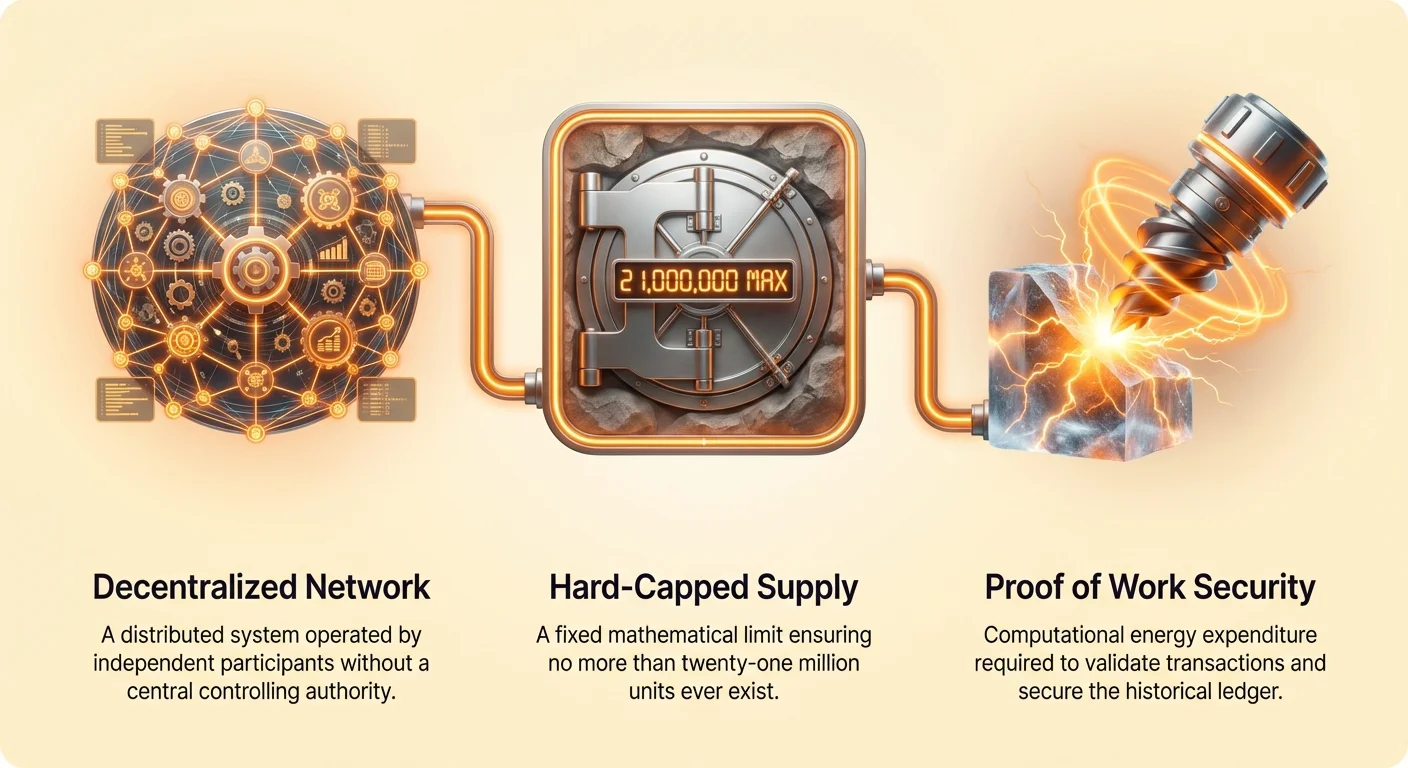
Bitcoin’s economic model is built on strict, algorithmic rules that enforce scarcity and predictability. Unlike modern fiat currencies, which can be printed in unlimited quantities, Bitcoin has a hard-capped supply. This predetermined monetary policy is designed to counter inflation and preserve purchasing power over long periods. The issuance of new coins is not decided by a committee but by mathematical consensus.
The 21 Million Hard Cap
The most defining feature of Bitcoin's monetary policy is its absolute supply limit. There will never be more than 21 million bitcoins in existence. This scarcity is hard-coded into the protocol and enforced by every node on the network. If anyone attempted to alter this cap, the network would reject the change, preserving the original rules.
This finite supply creates a deflationary pressure relative to fiat currencies. As central banks expand their money supplies to manage economic cycles, the ratio of fiat to Bitcoin grows. This dynamic suggests that, over time, the value of Bitcoin should rise against depreciating inflationary currencies. It positions the asset as a digital alternative to gold, which also relies on physical scarcity to maintain value.
The cap also eliminates the risk of arbitrary devaluation. Holders of Bitcoin know exactly what percentage of the total supply they own. In traditional finance, printing more money dilutes the wealth of existing savers. Bitcoin’s code guarantees that no unexpected supply shocks can occur due to political or economic pressure.
The Halving Mechanism
To reach the 21 million cap gradually, Bitcoin uses a distribution schedule known as the "halving." Approximately every four years, or every 210,000 blocks, the reward that miners receive for securing the network is cut in half. When the network launched, miners received 50 BTC per block. This dropped to 25, then 12.5, and continues to decrease.
The halving serves two primary functions. First, it mimics the extraction curve of precious metals like gold. In the early days, gold was easy to find, but over time, it became harder and more resource-intensive to mine. Bitcoin replicates this by reducing the flow of new coins entering the market, making them increasingly scarce as time passes.
Second, the halving acts as a periodic supply shock. If demand for Bitcoin remains constant or increases while the production rate is cut by 50%, market equilibrium shifts. Historically, these events have been associated with periods of price volatility and appreciation. The process ensures that the issuance of Bitcoin is disinflationary, eventually reaching zero inflation once all coins are mined.
Predictability vs. Discretion
The core advantage of Bitcoin’s policy is predictability. Participants in the network can calculate the exact inflation rate of Bitcoin for any day in the future. There is no ambiguity regarding supply schedules. This stands in stark contrast to central banking, where monetary policy is discretionary and reactive.
Central banks adjust interest rates and money supply to manage employment and inflation. While this flexibility allows them to respond to crises, it also introduces uncertainty and human error. A policy change can rapidly alter the value of a currency or the cost of borrowing. Bitcoin removes this variable entirely.
By removing human discretion, Bitcoin operates as "neutral" money. It does not care about geopolitical events, employment rates, or trade deficits. It simply produces blocks and issues coins according to schedule. This reliability appeals to investors looking for a hedge against the unpredictable nature of traditional monetary policy intervention.
Consensus and Network Security
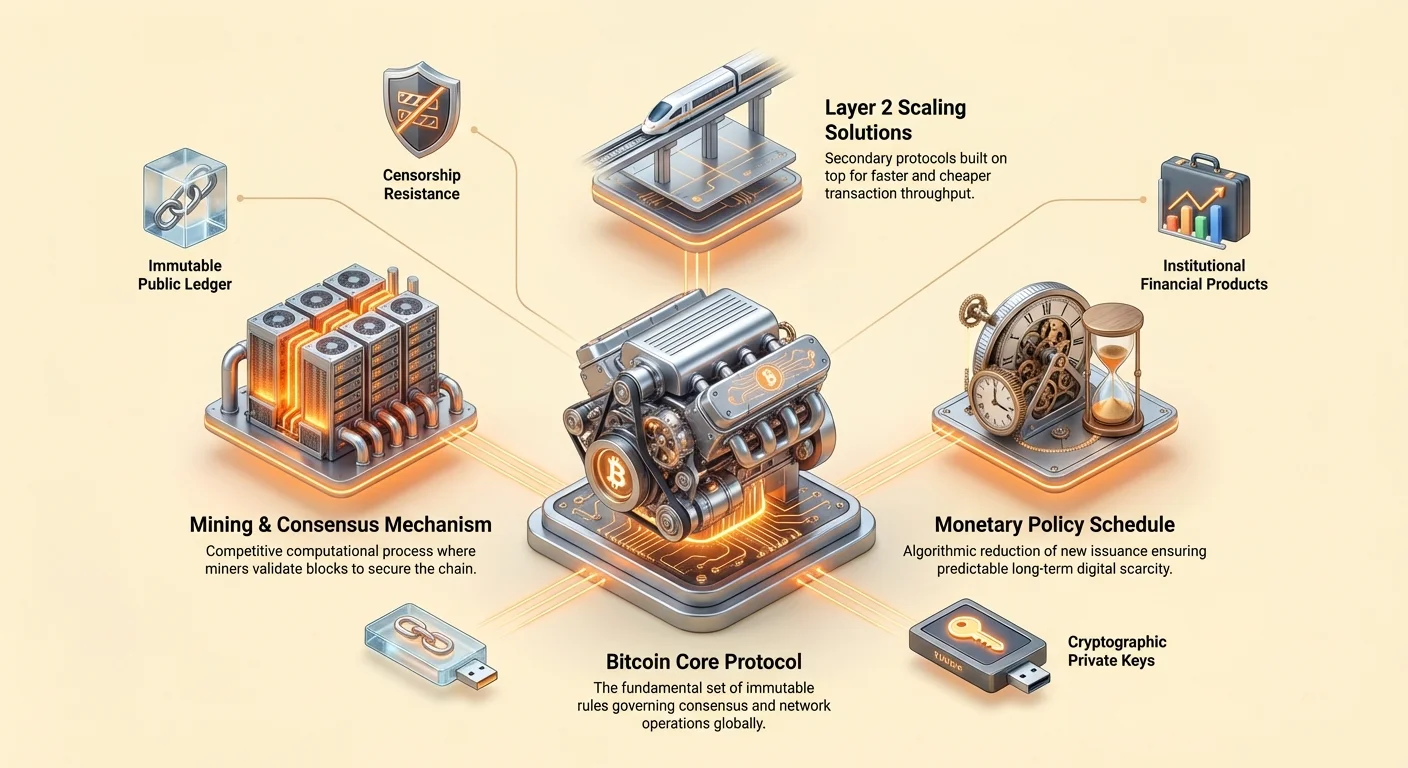
The value of a macro asset depends heavily on its security and the reliability of its network. Bitcoin uses a consensus mechanism called Proof of Work (PoW). This system requires participants, known as miners, to expend computational energy to validate transactions and add them to the blockchain.
Proof of Work Explained
Proof of Work is the foundation of Bitcoin’s decentralized trust. Miners compete to solve complex mathematical puzzles using specialized hardware. The first miner to solve the puzzle gets the right to build the next block of transactions. This process connects digital value to physical energy, creating a cost of production for every bitcoin.
This mechanism ensures that adding a block is difficult and costly, but verifying it is easy. Any user running a node can instantly confirm that a miner followed the rules. If a miner tries to cheat or create invalid transactions, the network rejects their work, and they lose the energy and money spent on the computation.
PoW is often criticized for energy consumption, but this energy expenditure is what secures the ledger. It creates a "wall of energy" that protects the network from attacks. To rewrite the blockchain's history, an attacker would need to control more than half of the global computing power dedicated to Bitcoin. This makes the network practically immutable.
Hashrate and Immutable Security
The total computing power of the Bitcoin network is referred to as the "hashrate." A higher hashrate means the network is more secure. As the value of Bitcoin grows, more miners join the network to capture rewards, increasing the difficulty of the puzzles. This creates a positive feedback loop that constantly strengthens network security.
This security model is essential for a macro asset. For institutions or nations to hold billions of dollars in Bitcoin, they must be certain the ledger cannot be altered. The dispersed nature of mining prevents any single entity from censoring transactions or seizing funds at the protocol level.
Unlike centralized databases used by banks, Bitcoin has no single point of failure. The ledger is replicated across thousands of nodes worldwide. If one node goes offline, the network continues without interruption. This resilience is a critical utility for a global store of value that must operate 24/7 without downtime.
Comparative Analysis: Bitcoin vs. Traditional Assets
To understand Bitcoin's role in a portfolio, it is helpful to compare its properties directly with fiat currencies and gold. While gold has served as a store of value for millennia, Bitcoin introduces digital improvements regarding portability and verifiability.
| Property | Bitcoin | Gold | Fiat Currency |
|---|---|---|---|
| Scarcity | Absolute (21M max) | Physical (Hard to mine) | Unlimited (Printable) |
| Portability | High (Digital) | Low (Heavy/Physical) | High (Digital/Cash) |
| Verifiability | Instant (Mathematical) | Difficult (Requires assay) | Easy (Counterfeit risks) |
Bitcoin combines the scarcity of gold with the portability of fiat. You can send a billion dollars worth of Bitcoin anywhere in the world in minutes. Moving the same amount of gold requires armored transport, insurance, and time. Furthermore, verifying the authenticity of gold requires physical testing, whereas Bitcoin is verified by software instantly.
Fiat currency excels in stability and acceptance for daily commerce but fails as a long-term store of value due to inflation. Bitcoin sacrifices short-term price stability for long-term purchasing power preservation. This trade-off defines its utility as a distinct asset class rather than a direct replacement for the dollar in buying coffee.
Utility Beyond Store of Value
While "digital gold" is a popular narrative, Bitcoin offers utility that physical assets cannot match. It acts as a permissionless payment network that operates globally. This utility is derived from its decentralized architecture, allowing users to transact without intermediaries.
Censorship Resistance
Censorship resistance is one of Bitcoin's most significant value propositions. In the traditional financial system, banks and payment processors can block transactions. They may do this due to regulatory pressure, political reasons, or risk management policies. This leaves certain individuals or industries without access to financial services.
Bitcoin allows anyone to send or receive value regardless of their location, identity, or political stance. The network does not discriminate. As long as a user has a private key and internet access, they can transact. This feature is particularly vital for people living in regimes with strict capital controls or unstable banking systems.
This property transforms Bitcoin into a tool for economic freedom. It provides an exit valve for citizens watching their local currency collapse due to hyperinflation. By converting wealth into Bitcoin, individuals can protect their savings from confiscation or extreme devaluation by their governments.
Pseudonymity and Privacy
Bitcoin is not anonymous, but it is pseudonymous. Real-world identities are not attached to Bitcoin addresses on the blockchain. The public ledger shows that an address sent funds to another address, but it does not inherently reveal who owns those addresses. This offers a layer of privacy not available in digital bank transfers.
However, privacy on the base layer is not absolute. Blockchain analysis can trace fund movements. To enhance privacy, the ecosystem has developed best practices and tools. Users are encouraged to avoid reusing addresses and to manage their "UTXOs" (Unspent Transaction Outputs) carefully to minimize data leakage.
Upgrades like Taproot have further improved the potential for privacy. Taproot makes complex transactions, such as those involving multiple signatures, look identical to standard transactions on the blockchain. This makes it harder for observers to distinguish between different types of network activity, increasing the fungibility of the asset.
Scaling and Technical Evolution
For Bitcoin to function as a global macro asset, it must handle transaction volume efficiently. The base layer of Bitcoin prioritizes security and decentralization over raw speed. To address this, the network has evolved through layered solutions and protocol upgrades.
Layer 2 Solutions
The most prominent scaling solution is the Lightning Network. This is a Layer 2 protocol built on top of Bitcoin. It allows users to create payment channels between each other. Transactions in these channels happen instantly and with near-zero fees because they are not recorded immediately on the main blockchain.
Only the final result of these transactions is settled on the main chain. This enables Bitcoin to handle thousands of transactions per second without clogging the base layer. It makes micropayments feasible, allowing Bitcoin to be used for small daily purchases while the main chain remains a settlement layer for large value transfers.
This layered approach mirrors the traditional financial system. Gold or central bank reserves sit at the bottom as the settlement layer, while credit card networks and payment apps operate on top for speed. Bitcoin's architecture preserves the security of the base layer while enabling high-velocity commerce on upper layers.
Protocol Upgrades
Bitcoin undergoes cautious upgrades to improve efficiency without risking stability. Segregated Witness (SegWit) was a major update that separated signature data from transaction data. This change effectively increased the block size limit, allowing more transactions to fit in each block and lowering fees.
More recently, the Taproot upgrade enhanced Bitcoin's scripting capabilities. It introduced Schnorr signatures, which are more efficient and secure than the previous signature scheme. Taproot opens the door for more complex smart contracts on Bitcoin, expanding its utility beyond simple value transfers.
These upgrades demonstrate that Bitcoin is not a static technology. It evolves to meet the needs of the market. However, the development process is deliberately slow and rigorous. In a network worth nearly a trillion dollars, avoiding bugs and maintaining uptime is more important than moving fast and breaking things.
Institutional Adoption and Financialization
The perception of Bitcoin has shifted dramatically from a niche internet experiment to a recognized macro asset. This transition is driven by the entry of institutional investors and the creation of regulated financial products. The launch of spot Bitcoin ETFs (Exchange Traded Funds) was a watershed moment.
ETFs allow traditional investors to gain exposure to Bitcoin through standard brokerage accounts. They do not need to worry about managing private keys or using crypto exchanges. This accessibility brings massive pools of capital, such as pension funds and retirement accounts, into the Bitcoin market.
Corporate adoption has also accelerated. Publicly traded companies have begun holding Bitcoin on their balance sheets as a treasury reserve asset. This strategy is used to diversify holdings and hedge against the inflation of fiat cash reserves. It signals a growing acceptance of Bitcoin as a legitimate corporate financial instrument.
Comparative Analysis: Bitcoin vs. Other Crypto Assets
To fully grasp Bitcoin's macro status, one must distinguish it from the broader cryptocurrency market. Not all digital assets serve the same purpose. The primary distinction lies between "Coins" like Bitcoin and "Tokens" or alternative Layer 1 blockchains.
Bitcoin vs. Ethereum
Bitcoin and Ethereum are often grouped together, but they have different goals. Bitcoin is designed as sound money—a store of value and medium of exchange. Its development focuses on stability and security. Ethereum, conversely, is a platform for decentralized applications (dApps) and smart contracts.
Ethereum recently transitioned to a Proof of Stake (PoS) consensus mechanism. In PoS, validators secure the network by locking up capital (staking) rather than expending energy. While this reduces energy usage, some argue it changes the security model and governance dynamics compared to Bitcoin's Proof of Work.
Additionally, Ethereum's monetary policy is more fluid. While generally deflationary or low-inflation due to fee burning mechanisms (EIP-1559), it does not have a hard cap like Bitcoin's 21 million. This makes Bitcoin the preferred choice for investors specifically seeking absolute scarcity and an immutable supply schedule.
Coins vs. Tokens
It is also vital to understand the difference between a coin and a token. A coin, like Bitcoin or Litecoin, runs on its own independent blockchain. It is native to the network and essential for paying fees and securing the ledger.
Tokens, such as those created on Ethereum (ERC-20 standard), rely on another blockchain's infrastructure. They do not have their own consensus mechanism or miners. Tokens are often used for utility within specific applications, governance rights in DAOs, or representing stablecoins pegged to fiat.
As a macro asset, Bitcoin stands apart because it does not rely on any other platform. It is the base layer. Tokens introduce platform risk; if the underlying blockchain fails or is congested, the token is affected. Bitcoin’s independence strengthens its case as a pristine collateral asset.
Market Dynamics and Liquidity
Bitcoin is traded 24/7 across a global network of exchanges. This continuous operation provides deep liquidity, allowing large investors to enter and exit positions at any time. Unlike stock markets, which close for nights and weekends, the Bitcoin market never sleeps.
This global availability reduces the "gap risk" seen in traditional markets, where news breaks over the weekend and prices open drastically different on Monday. However, it also contributes to short-term volatility. Without market closures to cool off panic or euphoria, price action can be rapid and intense.
Over-the-Counter (OTC) trading desks play a crucial role for high-net-worth individuals and institutions. These desks allow "whales" to trade large blocks of Bitcoin without immediately impacting the public spot price. This infrastructure supports the asset's function as a vehicle for large-scale capital allocation.
Conclusion
Bitcoin has evolved from an obscure cryptographic experiment into a sophisticated macro asset with a unique value proposition. Its monetary policy, defined by an immutable 21 million coin cap and the predictable halving schedule, offers a stark alternative to the discretionary inflation of fiat currencies. By leveraging Proof of Work, Bitcoin converts real-world energy into digital security, creating a decentralized ledger that is resistant to censorship and tampering.
The utility of Bitcoin extends beyond simple speculation. It serves as a global payment network, a store of value, and a hedge against monetary debasement. While technical challenges regarding scaling exist, solutions like the Lightning Network and protocol upgrades like Taproot demonstrate the network's ability to adapt without compromising its core principles. As institutional adoption deepens through ETFs and corporate treasuries, Bitcoin's integration into the global financial system continues to solidify.
Bitcoin provides a verifiable, scarce, and decentralized alternative to traditional money, independent of any government or central bank control.