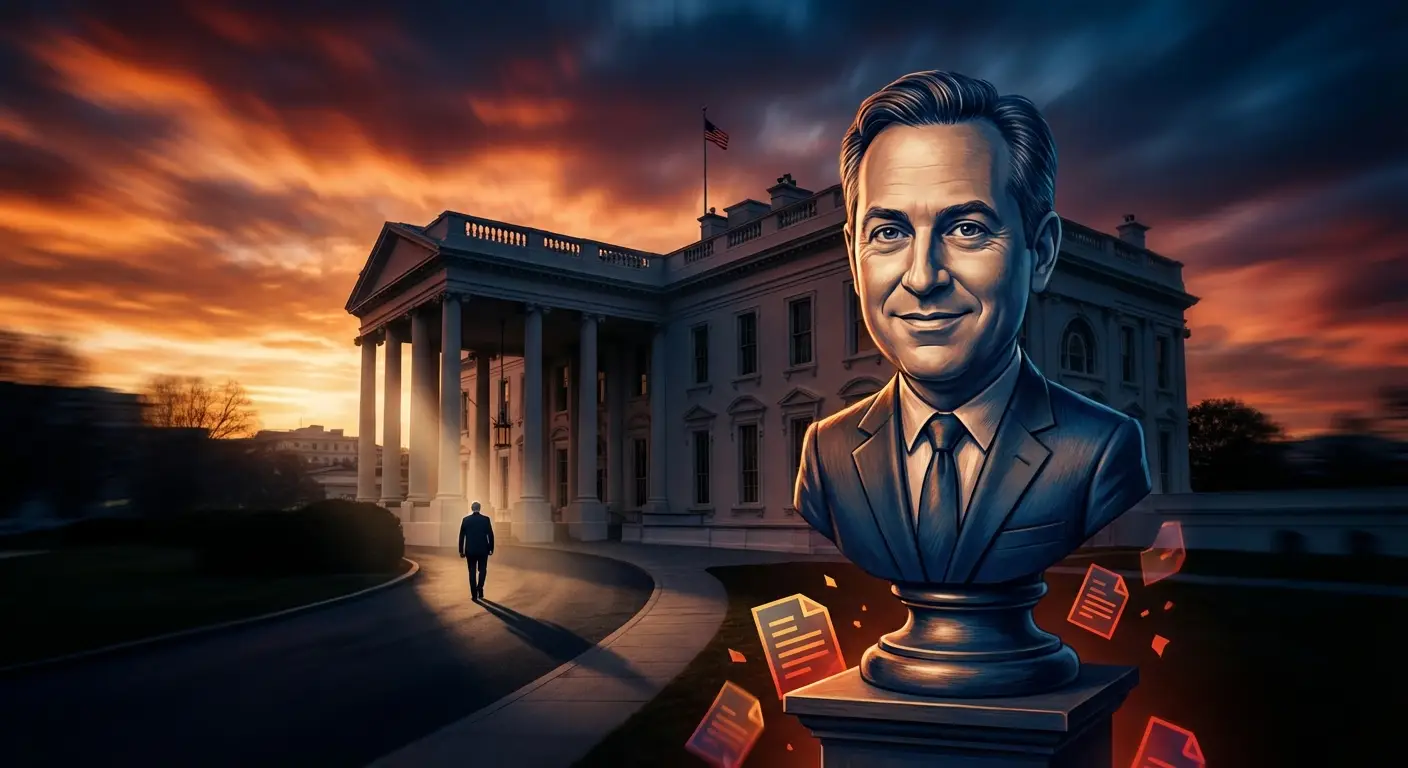
David Sacks, the venture capitalist who became the face of the Trump administration’s pro-digital asset agenda, is officially stepping down from his role as the White House AI and Crypto Czar. His departure comes at a volatile moment for the market, with Bitcoin (BTC) slipping 1.8% to trade around $68,700 as policy uncertainty mounts. While Sacks is not leaving the administration entirely, his exit from the designated "Czar" position leaves several high-profile legislative goals in a state of limbo.
The transition was a legal necessity rather than a political shift. Sacks’s designation as a "special government employee" (SGE) carries a strict statutory limit of 130 working days. Having reached that cap, he is transitioning to a new role as co-chair of the President’s Council of Advisors on Science and Technology (PCAST). Unlike the Czar role, the PCAST position does not carry the same time restrictions, allowing Sacks to remain a key advisor on a broader range of technological issues.
Legislative Gridlock and Unfinished Business
Despite a productive start, Sacks leaves the Czar desk with some of the industry’s most anticipated reforms still on the drawing board. He was a vocal proponent of passing major market structure and stablecoin legislation within the administration’s first 100 days. However, those efforts have met significant resistance in Congress, where the CLARITY Act continues to face debate and delays.
While Sacks successfully oversaw the passage of the GENIUS Act, which focused on stablecoin frameworks, broader market clarity remains elusive. A proposed permanent "White House Crypto Council" of industry leaders also failed to materialize during his 130-day tenure. Reports suggest that industry infighting and the complexities of navigating diverse stakeholder interests led the administration to opt for periodic summits and internal working groups instead.
The Strategic Bitcoin Reserve in Limbo
One of the most significant pillars of the administration’s crypto platform was the establishment of a U.S. Strategic Bitcoin Reserve. Sacks played a central role in shaping the early discussions around this stockpile, which was envisioned as a way to position the U.S. as a global crypto hub. The plan involved seeding the reserve with Bitcoin already seized by the U.S. government.
However, the framework for this reserve remains largely theoretical. Questions persist regarding how the government would fund additional BTC purchases and the exact legal mechanisms required to manage such an asset class. With Sacks moving to a broader advisory role at PCAST, the momentum for a dedicated Bitcoin reserve may face a leadership vacuum in the immediate term.
Market Reaction: Extreme Fear Grips Traders
The timing of Sacks’s departure has coincided with a period of technical weakness for Bitcoin. The Crypto Fear & Greed Index has collapsed to a reading of 13, signaling a state of "Extreme Fear" among market participants. Historically, such low readings represent either a capitulation bottom or the start of an accelerated selloff.
Traders are currently monitoring several key support levels:
- $68,000: Initial support that bulls are fighting to defend.
- $67,700: A secondary level that, if broken, could lead to a deeper correction.
- $66,500: The final major support zone before a potential drop to $60,000.
Resistance is currently capped at $70,400 and $71,700. Without a clear legislative win or a new figurehead to champion the crypto cause in the White House, analysts suggest that Bitcoin may continue to consolidate within its current descending channel.
Transitioning to PCAST
In his new capacity at PCAST, Sacks will join an elite roster of technology leaders. The council includes Nvidia CEO Jensen Huang, Meta’s Mark Zuckerberg, and venture capitalist Marc Andreessen. This star-studded group is expected to provide high-level guidance on AI, science, and national security, but the focus on crypto-specific legislation may become diluted.
Sacks has maintained that he will continue to shape digital asset policy from his new seat. To avoid conflicts of interest, he reportedly sold his personal cryptocurrency holdings before taking his initial government role. While his advocacy remains, the "czar" title provided a centralized authority that the crypto industry has now lost.
The crypto market now faces a period of "wait and see" as the administration determines who will take the lead on day-to-day digital asset policy. For now, the aggressive 100-day timeline for comprehensive crypto reform has passed, leaving the industry to navigate a landscape of half-finished laws and regulatory uncertainty.