Entering the world of cryptocurrency requires a fundamental shift in how individuals perceive financial ownership. Unlike traditional banking systems where a third party manages funds and security, digital assets place the burden of responsibility directly on the user. This shift introduces a spectrum of storage options that range from highly convenient mobile applications to ultra-secure offline methods. Every user must navigate this landscape to find the right balance for their specific needs.
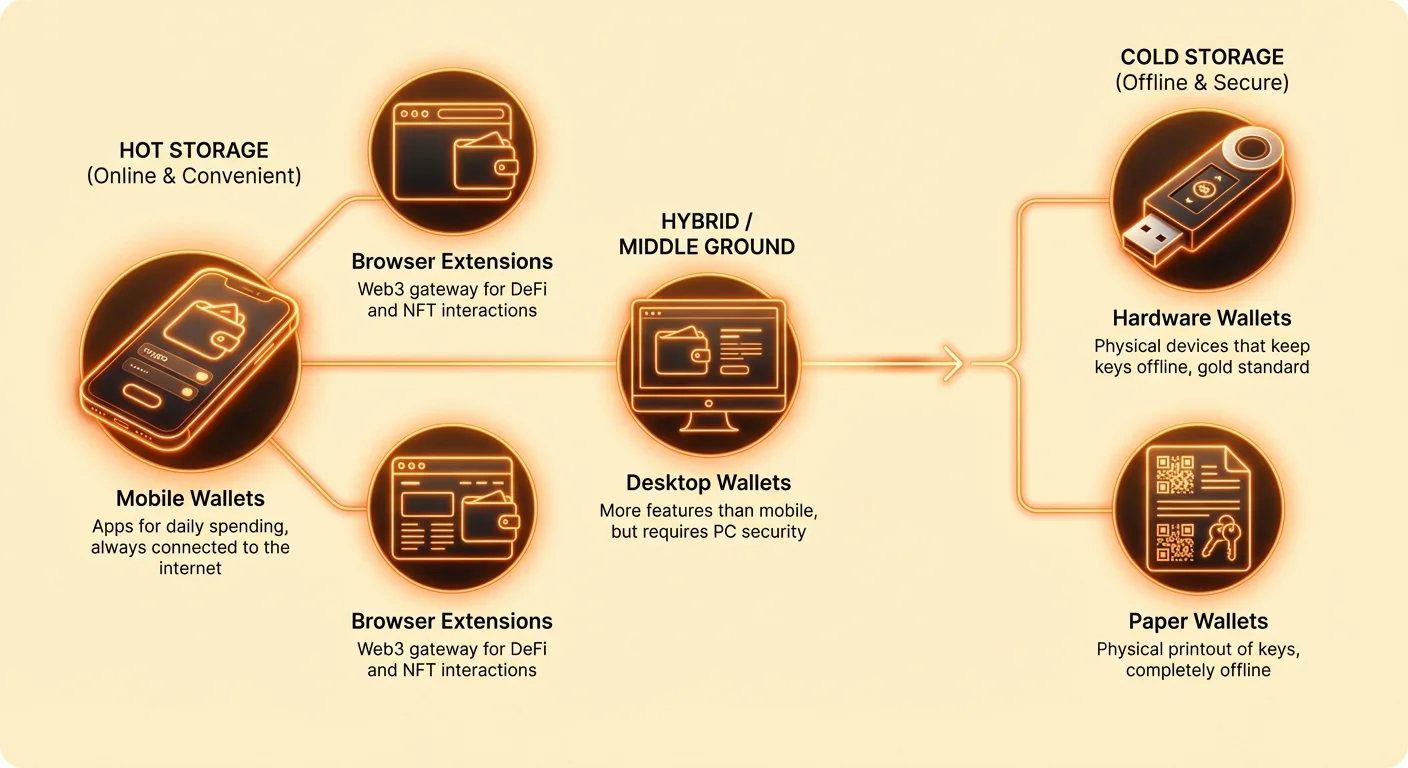
The storage ecosystem is generally divided into "hot" and "cold" categories. Hot storage refers to any method where the funds are accessible via a device connected to the internet. This connectivity offers speed and ease of use. It allows for quick trading, spending, and interaction with decentralized applications. However, this constant connection also exposes the assets to potential online threats such as phishing, malware, and hacking attempts.
On the opposite end of the spectrum lies cold storage. This method involves keeping the critical access credentials completely offline. By removing the internet connection from the equation, the attack surface is drastically reduced. Cold storage is the preferred method for long-term holding, often referred to as "HODL-ing," where the primary goal is preservation rather than frequent activity.
Choosing the right wallet is not merely about selecting a piece of software or hardware. It is about understanding the trade-offs between immediate access and long-term security. A day trader requires different tools than a long-term investor. Most experienced users eventually adopt a hybrid approach. They might keep a small amount of "spending money" in a hot wallet while securing the majority of their wealth in a cold storage solution.
The Mechanics of Ownership: Keys and Custody
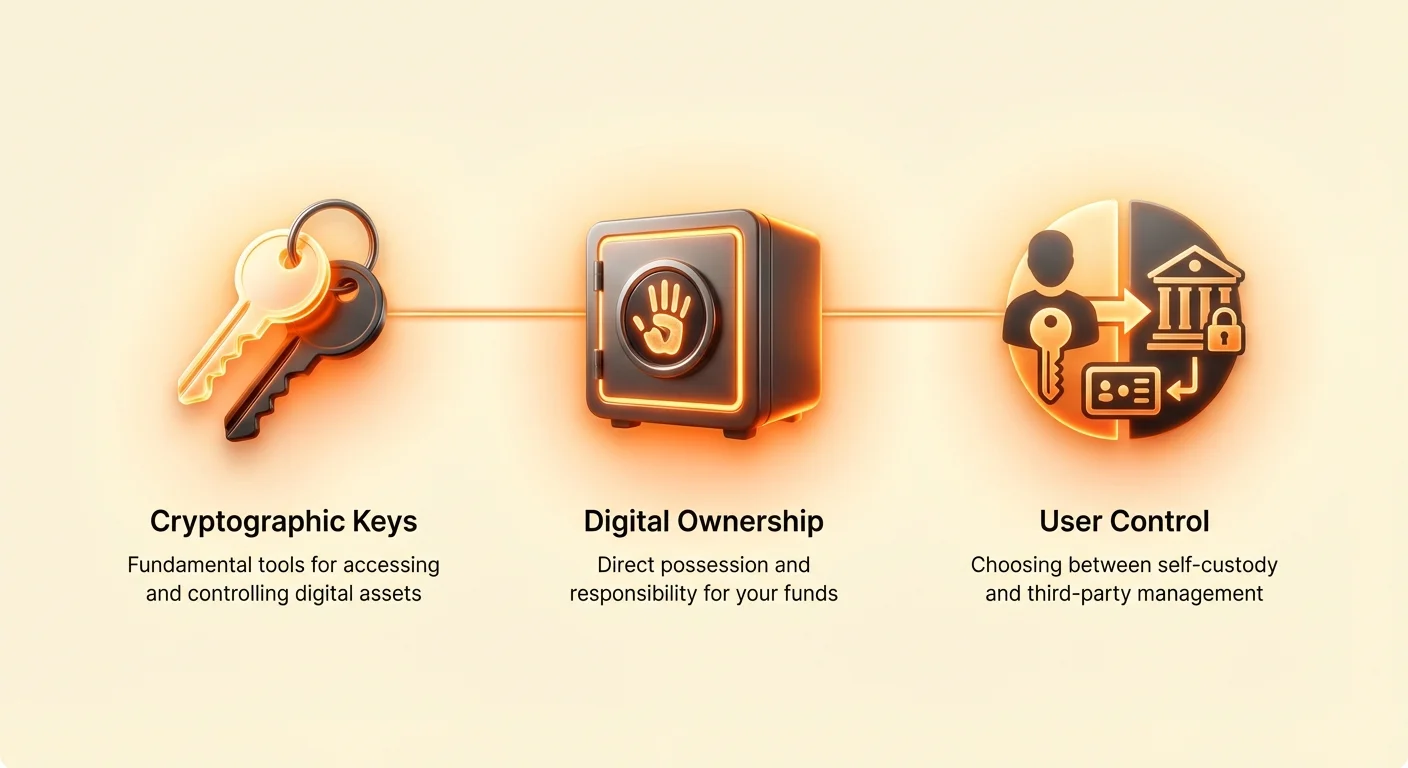
To understand the differences between wallet types, one must first grasp the underlying technology of cryptocurrency transactions. A wallet does not technically store coins. Instead, it stores cryptographic keys. These keys are the tools used to interact with the blockchain network. The public key serves as the address where funds can be deposited, similar to a bank account number or an email address. It is safe to share this information with others.
Private Key Responsibility
The private key is the critical component of ownership. It functions like a digital signature or a password that authorizes outgoing transactions. Whoever possesses the private key has total control over the funds associated with that address. If a private key is lost, the funds are inaccessible forever. If it is stolen, the funds can be transferred away instantly.
This mechanic leads to the most important distinction in the custody spectrum: custodial versus non-custodial wallets. In a custodial arrangement, a third party such as a centralized exchange holds the private keys. The user logs in with a standard username and password, and the service manages the security. This offers a familiar experience similar to online banking, including the ability to restore access if a password is forgotten.
The Philosophy of Self-Custody
Non-custodial (or self-custodial) wallets give the user exclusive control over the private keys. This aligns with the core ethos of cryptocurrency, often summarized by the phrase "not your keys, not your coins." In this model, there is no middleman to freeze accounts or block transactions. However, it also means there is no customer support to reset a forgotten password or recover lost funds.
The transition to self-custody requires the user to secure a recovery phrase. This is typically a sequence of 12 to 24 random words generated when the wallet is first created. This "seed phrase" can regenerate the private keys and restore the wallet on a new device if the original is lost or damaged. Protecting this phrase is the single most important security task for a crypto owner.
Mobile Wallets: The Apex of Convenience
For the majority of users, mobile wallets serve as the primary entry point into the cryptocurrency ecosystem. These are applications installed directly on a smartphone that allow for the sending, receiving, and storing of digital assets. The defining characteristic of mobile wallets is their portability. They enable users to carry their portfolio in their pocket, making them ideal for face-to-face transactions or daily spending.
Features and Functionality
Modern mobile wallets have evolved into comprehensive platforms. Beyond simple storage, they often include built-in exchanges that allow users to swap between different cryptocurrencies without leaving the app. Many also integrate browsers for decentralized applications, or dApps. This connectivity allows users to interact with decentralized finance (DeFi) protocols directly from their phone interface.
Security on mobile wallets leverages the hardware features of modern smartphones. Most reputable apps integrate biometric authentication, such as fingerprint scanning or facial recognition, to authorize access and sign transactions. This adds a layer of physical security that is difficult for remote attackers to bypass. Additionally, the operating systems of mobile devices often sandbox applications, preventing them from reading each other's data.
Connectivity Risks
Despite their advanced features, mobile wallets are considered "hot" wallets because mobile devices are almost constantly connected to the internet. This connectivity creates a vector for potential attacks. While the wallet software itself may be secure, the environment it runs on can be compromised.
Users must be vigilant against phishing attacks or malicious apps that mimic legitimate wallets. If a phone is infected with malware, it could theoretically capture screen inputs or clipboard data when a user copies an address. Therefore, mobile wallets are generally recommended for smaller amounts of cryptocurrency intended for daily use, rather than for storing significant life savings.
Desktop and Browser Extensions: The Web3 Gateway
Desktop wallets are software programs installed on a personal computer. They offer a middle ground between the mobility of phone apps and the robust feature sets required by power users. Because desktop computers generally possess more processing power and storage than mobile devices, these wallets can offer deeper functionality. Some desktop wallets allow users to run a full node, which downloads the entire blockchain history to independently verify transactions.
Browser Extension Wallets
A specific subset of software wallets that has gained immense popularity is the browser extension wallet. These lightweight programs live within web browsers like Chrome or Firefox. They are designed specifically to facilitate interactions with Web3 applications. When a user visits a decentralized exchange or an NFT marketplace, the browser extension acts as the bridge, allowing the website to request transaction signatures from the user.
This integration makes browser extensions the standard tool for users heavily involved in DeFi and NFT collecting. They allow for seamless connectivity across different blockchain networks, such as Ethereum, Solana, and Binance Smart Chain. Users can switch between networks with a few clicks to manage assets across different ecosystems.
Security Considerations for PC Users
Computers are often more vulnerable to malware and viruses than mobile devices due to the open nature of desktop operating systems. A keylogger installed on a computer could record a password or a recovery phrase as it is typed. Consequently, using a desktop or browser wallet requires a high degree of digital hygiene.
Users should ensure their operating system and antivirus software are up to date. It is also crucial to download wallet software only from official sources. Scammers frequently buy ads on search engines to promote fake versions of popular wallet software. These fake sites look identical to the real ones but are designed to steal the recovery phrase the moment a user enters it.
Hardware Wallets: The Standard for Security
For those seeking to secure significant value, hardware wallets are widely considered the gold standard. These are dedicated physical devices, often resembling USB drives, that are designed with a single purpose: to generate and store private keys offline. The architecture of a hardware wallet ensures that the private keys never leave the device, even when it is connected to a compromised computer.
How Hardware Isolation Works
When a user initiates a transaction on their computer, the transaction details are sent to the hardware wallet. The device then uses the private key internally to digitally sign the transaction. Only the signed transaction data is sent back to the computer to be broadcast to the network. Because the private key remains isolated within the hardware's secure element, it is immune to computer viruses and remote hackers.
This "cold" nature means that even if a computer is infected with malware, the attacker cannot extract the keys. Furthermore, hardware wallets typically feature a small display screen and physical buttons. This requires the user to physically verify and confirm the destination address and amount on the device itself before the transaction is finalized. This protects against attacks where malware swaps the recipient address on the computer screen.
Backup and Recovery
While the device itself is robust, it is not indestructible. It can be lost, stolen, or damaged. Therefore, the security of the funds ultimately relies on the physical backup of the recovery phrase. When setting up a hardware wallet, the user must write down the seed phrase on paper or stamp it into a metal plate.
This backup must be stored in a secure location, separate from the device. If the hardware wallet is destroyed, the funds can be recovered onto a new device using this phrase. However, if the phrase is stolen, the thief can access the funds without the physical device. Thus, physical security of the backup is just as important as digital security of the device.
| Feature | Mobile Wallet | Hardware Wallet | Paper Wallet |
|---|---|---|---|
| Connection Type | Hot (Online) | Cold (Offline) | Cold (Offline) |
| Primary Use | Daily Spending | Long-term Storage | Deep Storage |
| Cost | Free | $50 - $200+ | Free |
| Security Level | Moderate | High | Maximum |
Paper Wallets: The Ultimate Cold Storage
Before hardware wallets became popular, paper wallets were the primary method for cold storage. A paper wallet is essentially a physical document that contains a public address for receiving funds and a private key for spending them, usually printed in the form of QR codes. Because paper is a physical medium, it is completely immune to digital hacking. A hacker cannot exploit a piece of paper sitting in a safe.
Creating a Secure Paper Wallet
The process of creating a paper wallet requires strict adherence to security protocols to ensure true cold storage. It involves using a client-side address generator. To do this securely, a user should download the generator software to a computer. Then, the computer must be disconnected from the internet before the program is run.
Once offline, the software generates the random key pair. The user then prints the document using a printer that is also not connected to a network. This creates a "air-gapped" environment where the keys are generated and printed without ever being exposed to the internet. Once printed, the digital files should be deleted, and the computer rebooted before reconnecting to the web.
Risks of Physical Decay
While paper wallets offer immunity from digital theft, they introduce physical risks. Paper is fragile. It can degrade over time, be eaten by pests, or be destroyed by fire or water. Additionally, ink can fade, rendering the QR codes unreadable. To mitigate these risks, users often laminate the paper or store it in sealed, weather-proof bags within a fireproof safe.
Redeeming funds from a paper wallet is also a delicate process. To spend the bitcoin, the private key must be imported into a hot wallet. This action moves the funds from cold storage to hot storage. It is generally recommended to sweep the entire balance at once. Once a paper wallet's private key has been entered into a computer, the paper wallet should be considered compromised and never used for storage again.
Lightning Wallets: Speed and Scalability
As the Bitcoin network grew, scalability became a concern for everyday transactions. The Lightning Network emerged as a Layer 2 solution built on top of the main Bitcoin blockchain. Lightning wallets are specialized tools designed to leverage this network, enabling near-instant transactions with negligible fees. This makes Bitcoin practical for microtransactions, such as buying a coffee or tipping a content creator.
Off-Chain Transactions
Lightning wallets work by opening payment channels between users. Transactions occur off-chain, meaning they are not immediately recorded on the main blockchain ledger. Instead, the wallet updates the balance within the channel. This allows for high-volume throughput without network congestion. Only when the channel is closed is the final balance settled on the main blockchain.
This technology shifts the custody dynamic slightly. While users still control their funds, managing Lightning channels can be technical. Some Lightning wallets are custodial, handling the channel management in the background for a smoother user experience. Others are non-custodial, giving the user full control over their nodes and channels.
Privacy and Utility
Beyond speed, Lightning wallets offer enhanced privacy. Because individual transactions within a channel are not broadcast to the public blockchain, they are harder to trace than standard on-chain transfers. This makes Lightning wallets an excellent choice for users who value privacy in their daily spending habits.
These wallets often come with features distinct from standard storage wallets. They may support "streaming" money, where funds are sent second-by-second for services like video consumption. However, due to the technical complexity and the "hot" nature of the network, users typically keep only small amounts in Lightning channels, reserving their main holdings for on-chain hardware or paper wallets.
Conclusion
The spectrum of cryptocurrency custody offers a solution for every type of user. From the rapid-fire convenience of mobile and Lightning wallets to the fortress-like security of hardware and paper solutions, the tools exist to manage digital wealth effectively. The key lies in understanding that these are not mutually exclusive choices. A robust security strategy often involves utilizing different types of wallets for different purposes.
For the new investor, starting with a reputable mobile wallet or a regulated exchange provides a gentle learning curve. As knowledge grows and portfolio value increases, the transition to self-custody becomes a logical step. Hardware wallets provide the best balance of security and usability for significant holdings, protecting assets from the digital threats that permeate the internet. Paper wallets remain a viable, cost-effective option for those willing to manage physical risks carefully.
Ultimately, the freedom of cryptocurrency comes with the duty of protection. There is no bank manager to reverse a transaction or recover a lost account. By educating oneself on the mechanics of keys, the risks of connectivity, and the procedures for backup, anyone can confidently navigate the crypto custody spectrum. The goal is to find the sweet spot where assets are secure enough to let you sleep at night, yet accessible enough to be useful when needed.
The best security strategy is usually a mix: keep spending money accessible on your phone and lock your savings away offline.